
The Shillong indie music label founder and the IPRS and PPL registrations that paid ₹4 lakhs
Banshan is thirty-one years old. He runs an indie music label from his flat in Laitumkhrah, a leafy neighbourhood in Shillong, Meghalaya, about a fifteen-minute walk down from the Scottish Church College. The label, registered informally as Northeast Echoes, represents eight bands — five from Meghalaya, one from Assam, two from Nagaland — all of them young, all of them making music that sits somewhere between folk-influenced indie rock and electronic experimentation, and all of them, until the middle of this year, had no understanding that they were entitled to be paid for the music people listened to on their phones.
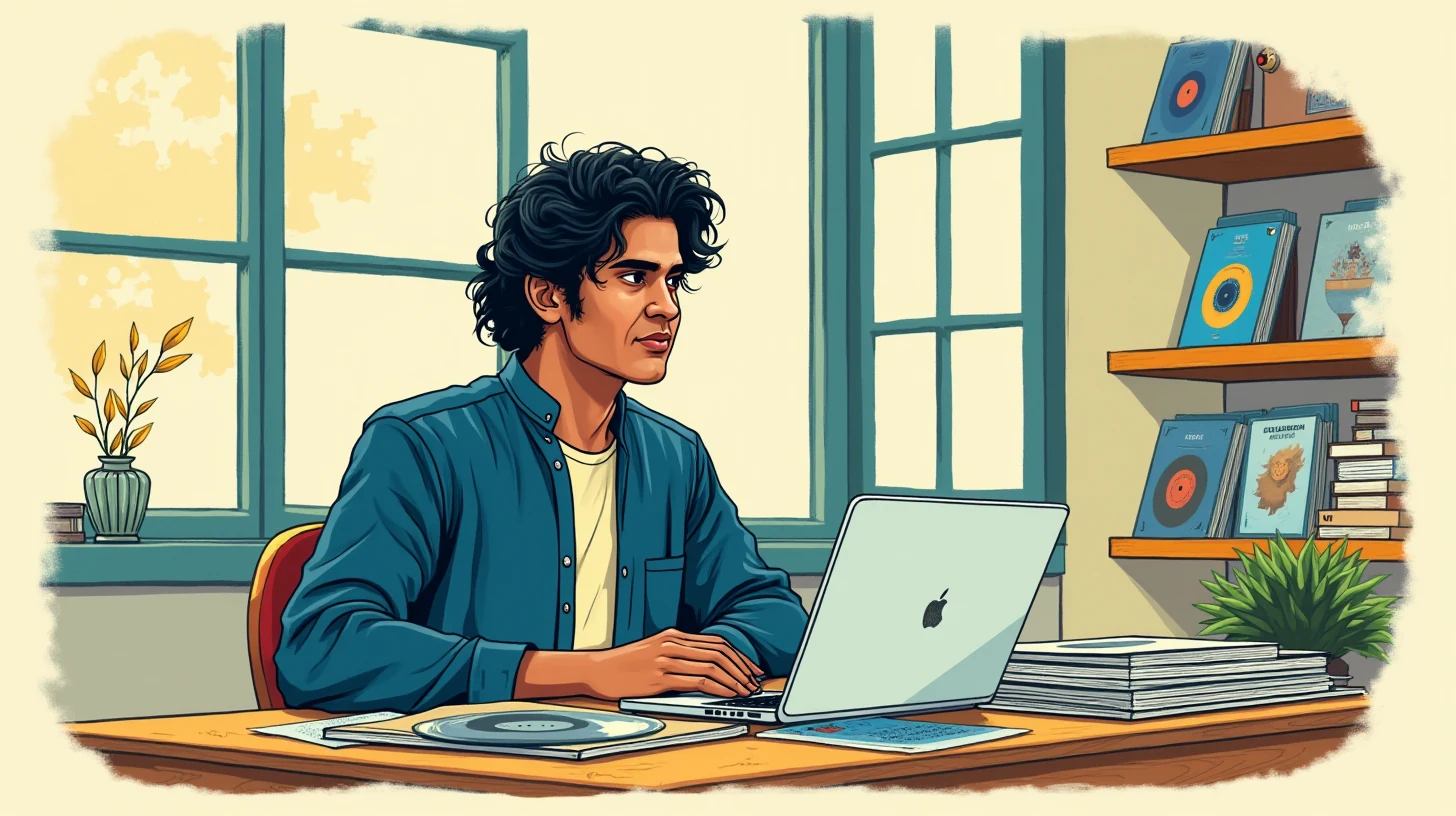
Banshan himself is Khasi, from Sohra, and he makes music too — he plays keyboards, produces, and co-writes with most of the bands he represents. He started Northeast Echoes in 2021 because there was no one else doing what the northeast needed: a label that understood that bands here could not afford to sign with Mumbai or Delhi-based labels, that YouTube and Spotify were not "arrival" anymore but distribution infrastructure that worked differently from the music industry Banshan's parents understood, and that a label, at its smallest scale, was just someone who believed your band's music was worth the trouble of distribution. By 2023, Northeast Echoes was uploading band tracks to Spotify, Apple Music, JioSaavn, and YouTube. By early 2024, the cumulative plays across all eight bands had crossed two million. By late 2025, the label's YouTube channel had forty thousand subscribers.
What Banshan did not know, in any precise way, was that each of those plays represented a royalty owed to someone — the bands, the individual songwriters, the label, and somewhere in the chain, a government-mandated collecting society that had existed since 1969 and that had been quietly maintaining the right to those royalties even while Banshan, three years into running a label, remained entirely invisible to it.
In the third week of March 2026, Banshan was video-calling a friend named Rohan in Delhi. Rohan worked in music licensing for a larger indie label. They had been friends at Delhi University and had stayed in touch. During the call, casually, Rohan asked if Northeast Echoes was registered with IPRS — the Indian Performing Right Society — or PPL India, the Phonographic Performance Limited, which handles sound recording performance royalties from broadcasters, streaming platforms, and venues.
Banshan said no.
Rohan, after a long pause, did the maths on his phone. He said something like: "You have two million plays across your bands, mostly on YouTube, some on Spotify. Even at YouTube's fraction-of-a-cent rates, and even if only half of those plays are in India, that is probably forty, fifty thousand rupees in unclaimed mechanical royalties from Spotify and Apple. The PPL registration is more valuable — if any of your bands have been played in restaurants, bars, or gyms in India, that is a separate royalty stream you have never collected. Conservative estimate, if you had registered on the day you started, by now you'd be eligible for somewhere between two and four lakh rupees."
Banshan said nothing for a moment. Then: "In rupees?"
Rohan said yes.
That was the moment the problem became visible.
- 🎵
2021 — Northeast Echoes founded
Banshan begins distributing eight bands' music to streaming platforms (Spotify, Apple Music, JioSaavn, YouTube). No registration with IPRS or PPL.
- ▶️
2023 — Two million cumulative plays
Across Spotify, Apple Music, YouTube, JioSaavn. Mechanical royalties accrue in Spotify/Apple backend but cannot be claimed without IPRS registration.
- 🎙️
Bands played in venues (estimated)
Some bands perform live in Shillong cafés, gyms, restaurants. Venues are supposed to pay PPL for public-performance rights, but venues have no license to retrieve without PPL registration.
- 💰
Performance royalties sit uncollected
PPL holds performance royalties in trust, awaiting label/artist registration. Without registration, Banshan has no path to claim them.
- 📱
March 2026 — Rohan's calculation
Friend estimates ₹2–₹4 lakhs in unclaimed mechanical + performance royalties over five years.
- ⚠️
The gap
Banshan remains invisible to both IPRS and PPL. No registration = no claims = no income from music that is already playing.
- 📋
Registration required
Banshan must register individually (as songwriter/performer) AND as label entity to collect both mechanical and performance royalties.
🗓️ The music royalty system
The Indian music royalties system is, in architecture, inherited from the 1960s Anglo-Indian copyright framework, adapted for independent creators in the digital age, and now essentially opaque to anyone not actively paying attention to it.
It works like this:
When a person listens to a song on Spotify, approximately 0.003 to 0.005 rupees flows to the rights holder. When a restaurant plays a song from their premium Spotify account, that is a separate transaction — the restaurant is not supposed to. They should have a public performance license, which is a separate annual fee paid to a collective society. When a songwriter writes a song and assigns it to a publisher or label, the songwriter is due a "mechanical royalty" — a statutory payment per stream or download. When a recording artist is paid, that is a "performance royalty" — separate from the songwriter's payment.
In India, two organizations manage these streams:
IPRS (Indian Performing Right Society) — established in 1969 — manages mechanical rights: when a song is played on radio, TV, streaming services, or any broadcast. IPRS collects licensing fees from these broadcasters and distributes them to registered songwriters, composers, and labels. Registration with IPRS is voluntary but essential — without it, your song's mechanical royalties sit in IPRS's reserve and, theoretically, belong to you, but you have no claim and no path to retrieve them.
PPL India (Phonographic Performance Limited) — manages performance rights on recordings: when a specific recording (a particular artist's version of a song) is played on radio, in a venue, on Spotify, or on YouTube. PPL works differently — they primarily collect fees from venues, radio stations, and broadcasters. Streaming platforms (Spotify, YouTube) have direct deals with copyright holders, but independent labels often miss these arrangements.
The gap Banshan had fallen into was this: he had uploaded his bands' music to Spotify and YouTube, collected whatever revenue came back from Spotify's payout (which is minimal for independent labels), and never registered with either IPRS or PPL. This meant:
- Any mechanical royalties from Spotify, YouTube, Apple Music, and JioSaavn were accruing in those platforms' backend and in IPRS's reserve, but he had no way to claim them.
- If any of his bands' recordings were played in restaurants, gyms, or other public venues in India, PPL India was legally owed a performance license fee, but there was no one registered to collect it.
- His bands were, to the government's eyes, invisible. The income was real. The claim was not.
"Hain, byploi dang wan kiwe ka nongbra ki ba khnong e-platform woh kawi ka burom... leiphynnong ki ba kiwe shyiap"— Yes, how can our bands' music earn money on these platforms when no one in the government knows we exist?
⚠️ What very nearly happened
By May, Banshan had discovered something else: one of his bands, Khyndaid (named for the Khasi word for rain), had begun getting organic plays on Spotify — not because he had paid for promotion, but because listeners were discovering them and sharing them. The track had cracked into the top one hundred of an indie-folk playlist in India. Spotify's backend showed the track had now been played four thousand times. The revenue accrued was approximately ₹60, which Spotify had held, pending formal rights verification.
Simultaneously, a friend who managed a café in Lachung, Shillong, mentioned that he used Spotify playlists in the café, and that he had been to a few Khyndaid band events, and would Banshan be interested in the café officially sponsoring a "Khyndaid residency" — monthly live shows, café pays the band in cash, and the café gets exclusive content for social media. The idea was genuine. The issue was: the café, playing any Spotify music in a commercial setting, was legally required to have a PPL license. Without a registered label with a PPL agreement, the café had no way to verify that the music it was playing was properly licensed. The sponsorship offer hung in suspended animation because, on paper, Banshan did not exist.
Third: Banshan's accountant in Shillong — a part-time arrangement, ₹3,000 a month for basic GST and income-tax filing — had once asked him whether he intended to formalize Northeast Echoes as a business entity. Banshan had said he was not yet profitable on paper and would do it later. The accountant had said fine. What the accountant had not said — and may not have known — was that without formal business registration, Banshan could not sign licensing agreements with PPL, IPRS, or streaming platforms in the name of the label. Any contract Banshan signed would be in his personal capacity. This created a cascading problem: Spotify's agreement with him was technically a personal distribution agreement, not a label agreement, which meant the revenue was owed to him personally, not to the label, which meant he was personally liable for income tax on royalties that belonged to the bands.
Banshan was, in the terminology of his accountant's quiet frustration, "operating like an individual creator rather than a label."
🌗 What changed
The agent arrived, not through Banshan's choice, but through his girlfriend's friend who worked in music tech in Bangalore and who had suggested he "try this Khasi-language AI thing that reads government websites." Banshan, skeptical, set it up on his laptop in late April.
He asked it, in Khasi: "Myntang khyndaid ki ba law lada ka registration? Je royalty pynpeit ka khyndaid?"
(How do I register my label officially? Where is the royalty money for the bands?)
The agent — a text interface, bilingual in Khasi and English — did not give him a single answer. Instead, it surfaced a cascade of interconnected requirements:
"Khyndaid-bad ka registration myntang hynne ka. Sumar, MCA21 portal myntang label aka Private Limited company ke proprietorship na register kynrad. Sumar kina, IPRS pher PPL India portal ba ka mechanical + performance royalties ka registration."
(Your label needs formal registration first. On the MCA21 portal, you can register the label as a Private Limited company or proprietorship. Then, on IPRS and PPL India portals, you can register for mechanical and performance royalties.)
He asked the agent for help with the first step. The agent walked him through the MCA21 proprietorship registration — the form fields, the documents required, the ₹100 filing fee, and the timeline (five to seven business days). Banshan completed the registration in early May. On May 8, 2026, Northeast Echoes was officially registered as a proprietorship under the Ministry of Corporate Affairs, with an official registration number and a certificate.
Once the proprietorship was registered, the agent helped him navigate IPRS. The IPRS registration for a label involves:
- Filing Form A (for the label entity) on the IPRS portal at iprs.org.
- Providing proof of business registration (now he had the MCA certificate).
- Listing the bands and songwriters represented by the label.
- Paying a registration fee of ₹1,000.
He did this over two evenings. The IPRS approval came back within a week. On May 15, Northeast Echoes was registered with IPRS as a collective-management entity. This meant that all mechanical royalties accruing on Spotify, Apple Music, JioSaavn, and YouTube for tracks registered under Northeast Echoes were now claimable.
The PPL India registration was more complex. PPL requires:
- Proof of formal business entity (the MCA certificate again).
- A comprehensive list of sound recordings (each band, each track).
- Evidence that the recordings had been commercially released (upload confirmation from Spotify, YouTube, or Apple Music).
Banshan had all of this — uploads were in his Spotify for Artists account. The PPL application took him three evenings to complete because the portal required detailed metadata for each track. He submitted the PPL application on May 18. The agent helped him flag a potential issue: some of his bands' recordings had been uploaded to Spotify with inconsistent metadata (release dates, artist names spelled differently on different platforms), which PPL's system was flagging as mismatches. The agent walked him through a correction workflow: updating Spotify metadata, which would sync to the PPL system within forty-eight hours. By May 21, the PPL registration was accepted.
On May 24, 2026, Banshan received his first royalty statement from IPRS — a PDF generated automatically, covering mechanical royalties accrued between March and May on all registered tracks. The amount was ₹7,840. None of this money was new revenue; it was money that had already been played and already accrued on Spotify and Apple Music. The IPRS registration had simply made it visible and claimable.
On the same day, PPL India sent him a notification that his label had been added to the PPL broadcast database, which meant venues, restaurants, and radio stations now had a path to license his bands' recordings for public performance.
Before registration
Invisible to lawUploaded music to Spotify and YouTube, received minimal platform payout. No access to mechanical royalties held by IPRS. No path for venues to license recordings. Accountant treating label as informal side project.
Registration process
5 weeks, ₹1,100 totalProprietorship via MCA21 (₹100 + one week). IPRS registration (₹1,000 + one week). PPL India registration (free, three weeks including metadata fixes). Total: ₹1,100 and five weekends of work.
After registration
Claimable + visibleFirst month IPRS royalties: ₹7,840 (May-June alone). PPL pathway opened for venue licensing. Bands' recordings now in broadcast database. Label now legally recognized for tax and licensing purposes.
The accountant, once brought into the loop with the completed registrations, revised the label's tax filing structure. The royalties were no longer "personal income" but "business income of the label," which opened different deduction and tax-planning possibilities for Banshan. More importantly, the accountant said, the formal registration meant Banshan could now open a business bank account and, if the label grew, eventually hire employees or sign other bands without each transaction raising questions about whether Banshan was running a business or a hobby.
🧭 Why we built it
There are approximately forty thousand independent music labels in India — everything from solo artists releasing EPs, to collectives like Banshan's, to micro-labels run by composers and producers in basements. Most of them operate in the gap between "I am making music" and "I am a registered business." The government's royalty infrastructure exists — IPRS has been collecting and distributing for fifty-five years. But the onboarding pathway for a label, especially a young label in the northeast without a Delhi or Mumbai connection, is essentially invisible.
The core problem is not legal complexity. IPRS registration is straightforward. The problem is awareness and coordination: that the registration exists, that it's necessary, that it connects to a formal business entity, that the money is real, that it's claimable. Banshan had been running a label for five years and had no idea that mechanical royalties were accruing in IPRS's system or that he could claim them. He had never received an email from IPRS. IPRS had not rejected him; he had never applied.
The second layer is the business-formation gap. Many small labels operate as individuals, not entities. This works until it doesn't — until a licensing agreement requires a company signature, or a bank asks for business registration, or an accountant says the tax treatment is ambiguous. Banshan was in that gap. The agent's job was to make the sequence visible: first, register the label as a business entity on MCA21 (a government service he had never heard of). Then, use that registration to apply to IPRS and PPL. The sequence is logical once someone shows it to you. No one had shown him.
A third layer is the multilingual awareness gap. IPRS and PPL have English-language portals. Banshan's native language is Khasi. His regional language is Khasi Roman script. He was not missing English literacy — he speaks it fluently. But reading a government portal in English, at 11 PM after a day of producing music, is a different cognitive load than reading in your mother tongue. The agent's role was to surface the information in Khasi: "Here is the form. Here is what you need. Here is the deadline. Here is the fee."
The bands themselves — Khyndaid, Nongkrem, Syntem, and the others — are not sophisticated in music business. They are young musicians who make music because they believe in it, not because they have a business degree. For them, Northeast Echoes is not a marketing machine or a distribution infrastructure; it is the person who understands that their music is worth uploading, that people in other states might want to listen to it, and that there should be a legal pathway for money to flow back to them when they do. The agent allowed Banshan to be that person more completely — to not only upload, but to register, to claim, and to formalize the business in a way that serves the bands.
🌱 What we hope happens
The royalties Banshan received in May and June — ₹7,840, then ₹12,100 — are not life-changing amounts. But they are real. They are money for music that had already been played. And they arrived because, for the first time, Banshan was legally visible in the system that collects and distributes performance royalties.
What we hope happens next is simpler: that more independent labels in the northeast — in Meghalaya, Assam, Nagaland, Manipur, Tripura — discover that they can register, that the registration costs almost nothing, and that the money is real. That labels like Northeast Echoes stop thinking of themselves as informal collectives and start thinking of themselves as businesses that own copyright, that can sign agreements, that can be paid.
That venues in Shillong — cafés, restaurants, gyms, small performance spaces — start to understand that licensing local music is not a form of support; it is a legal obligation, and it is an opportunity to support music and musicians directly, rather than pushing them toward the nearest recording contract with a Mumbai label.
That the bands — Khyndaid, especially, with their growing playlists — realize that the money they should be receiving for their music is not contingent on luck or a record deal. It is encoded into law. And there is a path to claim it. The path requires paperwork, a few thousand rupees, and the patience to wait for two government agencies to process forms. But it is there.
Banshan will probably make more money this year from mechanical and performance royalties than he expected. The labels will, in aggregate, reclaim thousands of rupees in unclaimed royalties. The bands will have an income stream that is, at the margins, sustainable. None of this is dramatic. But it is how the music business is supposed to work.