
The Surat wedding planner and the GST officer's pre-show-cause notice
Mehul Trivedi is thirty-eight years old. He runs Trivedi Weddings from a two-room office above a sweet shop in Athwa Gate, Surat — the kind of address where the stairwell smells of ghee and saffron on weekdays and of jasmine on the nights a big order goes out. His wife, Nainaben, handles all bookings from the same WhatsApp number that has, over ten years, become more famous in Athwa Gate than Mehul himself. His father, Ramubhai — retired manager from a textile mill in Ring Road, a man who wore a full-sleeve shirt even in May and who kept a double-entry ledger until 2019 — comes in three mornings a week to sit with the accounts. Five people total; forty weddings a year, mostly Gujarati families from Surat and Navsari, some Marwari families, mid-range budgets of ₹15 to ₹40 lakh. It has, for ten years, been a perfectly manageable operation.
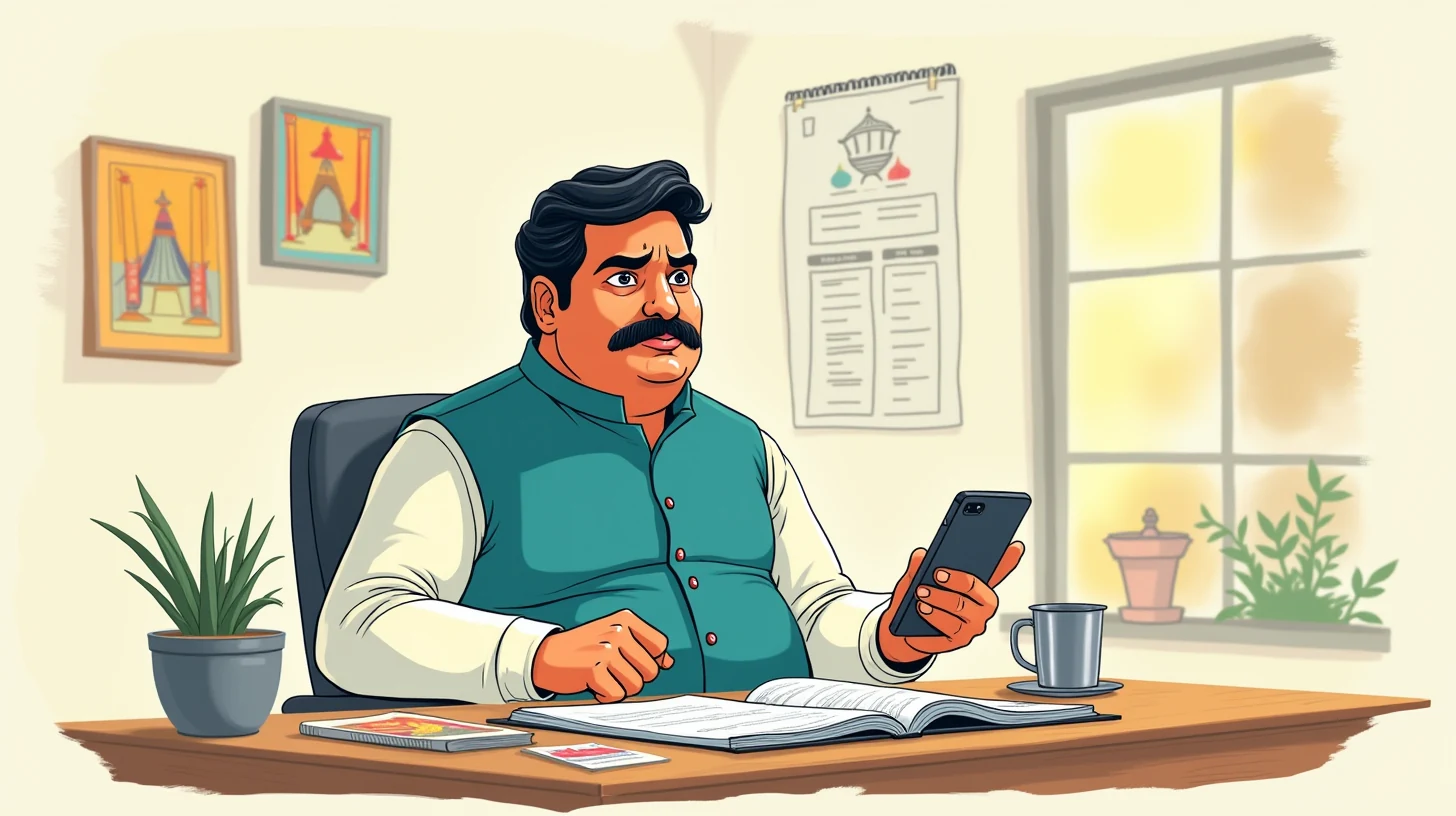
Until the Tuesday morning in March when Mehul opened the GSTN portal to download a few invoices and found, sitting in his notification queue like an uninvited cousin at a baraat, a document titled: Intimation of Discrepancies — Form DRC-01A — FY 2024-25. Amount of additional tax liability identified: ₹3,72,480. Period of deficiency: April 2024 to January 2025. Time to respond: thirty days, after which a full Show-Cause Notice would be issued.
He read it three times. He understood, at the end of three readings, the number. He did not understand why.
- 📨
March — DRC-01A arrives
GST portal flags ₹3,72,480 in additional liability across April 2024 – January 2025: RCM under-payment on unregistered-vendor purchases, plus a GSTR-1 vs ITR-3 income mismatch. 30-day response window.
- 🔍
Evening 2 — Agent reads the PDF
Translates the notice into Mehul's Gujarati-Hindi. Identifies the two distinct issues: invalid ITC on unregistered vendors + RCM gap. Asks for the purchase register.
- 🗂️
Day 4 — Vendor-by-vendor reconciliation
Ramubhai reads out 30+ purchase entries. The agent cross-matches against GSTR-2A. Discovers two GSTIN typos worth ₹1.38L — the vendors are real and filed; only the purchase register had wrong digits.
- 📋
Day 9 — Annexure-A submitted
Thakkar drafts response at revised ₹6,000 (down from ₹15,000) since the reconciliation is already done. ₹2.34L RCM liability + ₹17.2K interest paid voluntarily under Section 50.
- ₹
Three weeks later — revised order
GST officer accepts the GSTIN-typo reconciliation. ₹1.38L portion dropped. Final liability: ₹2.51L against original ₹3.72L. Diwali advance untouched.
🗓️ The morning the dashboard changed
The DRC-01A is, by design, a second chance: the department has spotted a discrepancy, and rather than issuing a full show-cause notice immediately, it gives the taxpayer thirty days to either pay or file a reconciliation. It is, in theory, a generous provision. It is, in practice, a document that reads like it was drafted for an audience of lawyers, and that assumes the recipient understands — as background knowledge — what RCM is, what Rule 42 and Rule 43 say, and how GSTR-1 output declarations relate to the income filed in an ITR-3.
Mehul understood none of these things. He knew GST existed. He knew his CA in Nanpura filed GSTR-1 and GSTR-3B every month and that he signed off on a summary. He knew he charged 18% on event-management services and that some ITC came back from vendors. That was the extent of his knowledge, and in ten years of running the agency it had been sufficient. The DRC-01A was the first time the system had stopped working and looked him directly in the eye.
He called Thakkar, his CA. Thakkar — forty clients, March filing season — said it was manageable but would need a careful reconciliation and an Annexure-A submission. He quoted ₹15,000 for the drafting work and said he could start in two weeks. Mehul said that sounded reasonable and then sat in his car in the parking area behind the office for twenty minutes doing nothing in particular.
The ₹3.7 lakh was not sitting in any account. March meant Diwali-season advances were already out to vendors for a large November booking — a three-day Marwari wedding in Surat that the family had contracted in December and which was, by some distance, the agency's biggest job of the year. The agency's liquid balance was thin. If the full demand was upheld, it would have to come from somewhere painful.
⚠️ What the notice actually said
It was Nainaben who, two evenings after the CA call, suggested he try the AI on his phone. Their twelve-year-old had installed it after a school tech fair and shown them both the basic interface. Mehul had used it once to ask about a hotel booking that had gone wrong. He had not, until now, thought of it as a tool for something like this.
He typed, in Gujarati, roughly: "Mane GSTN portal par DRC-01A aavyo chhe. Aa shu chhe?"
The agent asked him to share the PDF. He photographed the DRC-01A page by page and shared it.
What came back, over the next fifteen minutes of back-and-forth, was the following explanation — in the mix of Gujarati and Hindi that the agent had matched to his own typing:
"મેહુલ-ભાઈ, આ DRC-01A એક intimation છે — SCN નહીં, હજુ સુધી. Notice માં બે અલગ કારણ છે તમે જાણો."
(Mehul-bhai, this DRC-01A is an intimation — not a Show-Cause Notice, not yet. The notice contains two separate reasons you should know.)
The first issue, the agent explained, was something called the Reverse Charge Mechanism — RCM — which applies when a registered business pays a supplier who is not registered under GST. In that case, the tax the supplier cannot charge goes instead to the registered buyer to pay directly to the government. Mehul's agency had, across FY 2024-25, made payments to several banquet halls, mandap suppliers, and catering vendors who were either unregistered or working under the composition scheme. The agency had been claiming ITC on those purchases as if the vendors were fully registered and had charged GST. They had not. The department's GSTR-2A auto-population — which pulls supplier filings against the buyer's GSTIN — showed no corresponding returns from those suppliers for the periods in question. The agency had claimed ITC it was not entitled to, and had not paid the RCM liability that should have offset it.
"Aaano matlab: tame jo ITC lidho hato jyare vendor registered na hto, te ITC valid hoti nahin. Ane RCM-ni liability government ne direct bharvo joiye hto — tame bharyo nahin. Aa mismatch department e detect karyo."
The second issue was simpler but also irritating in its own way: Mehul's GSTR-1 — where he declared his outgoing invoices for event-management services at 18% GST — showed totals that did not perfectly align with the income disclosed in his ITR-3 for the same year. The gap was partly a timing difference (GST is invoice-based; IT is partly cash-basis for small agencies), but the department's automated cross-matching system had flagged the gap as unexplained, and it had added to the demand figure.
Mehul read all of this. He read it twice, on the phone, while Nainaben sat across from him at the dinner table with the pressure cooker going in the background. The agent, unprompted, then said:
"Mehul-bhai, aage vadhiye? Tame tamaro purchase register mane share karo, toh hum joch sakiye ke ₹3.7 lakh maa ketlu sachi liability chhe ane ketlu reconcile thashe."
He did not have the purchase register on his phone. He called Ramubhai.
🌗 What changed — Ramubhai and the ledger
Ramubhai arrived the next morning with a thick physical ledger and the resigned expression of a man who has been summoned from retirement to deal with a problem he had, in fact, warned about two years earlier — he had once told Mehul, at a Diwali dinner, that the agency should be verifying vendor GSTIN registration before issuing purchase entries, and Mehul had said "Bapu, CA sambhali lese" and that had been the end of the conversation.
They spent the morning photographing pages of the purchase register and sharing them with the agent, vendor by vendor. Ramubhai read out entries. Mehul typed. The agent cross-referenced each vendor name and invoice amount against what was reflected in the GSTR-2A auto-population data — which Mehul pulled up on the GSTN portal simultaneously, sharing screenshots.
After roughly two and a half hours of this, the agent produced a reconciliation. And the reconciliation showed something that neither Mehul nor Ramubhai had expected.
Of the ₹3,72,480 total demand, approximately ₹1,38,000 was attributable to two vendors — a banquet hall in Katargam and a tent-and-decor supplier near Udhna — where the underlying suppliers were in fact GST-registered and had filed their returns, but Mehul's purchase register had logged their GSTINs with typographical errors. One digit transposed in one GSTIN, a zero typed as a capital O in the second. Because the GSTINs in the agency's purchase entries didn't match the actual GSTINs in the portal, the auto-population hadn't linked them. To the system, they looked like unregistered vendors. They were not.
"Aa bey vendors valid registered chhe — GSTR-2A maa tenu return chhe. Sirf taro purchase register maa GSTIN galat type thayu chhe. Aa ₹1.38 lakh portion contestable chhe — aa tari genuine clerical mistake chhe, tax liability nahin."
The remaining roughly ₹2,34,000 — covering eight other vendors who were genuinely unregistered or on the composition scheme — was a legitimate RCM under-payment. Interest had accrued. The honest assessment, the agent said quietly, was that contesting this portion would be difficult and probably not worth the CA time. The liability was real. The agency had genuinely not paid RCM on those transactions, had genuinely claimed ITC it was not entitled to, and a GST officer reviewing a well-drafted reconciliation would see through any attempt to argue otherwise.
"Aa ₹2.34 lakh ane interest — roughly ₹16-18 thousand interest — bharvo padshhe. Par ₹1.38 lakh no bhag tame reconciliation sathe contest karo, to likely accept thashhe."
Ramubhai put the ledger down and looked at the ceiling.
The reply that cost ₹15,000 less
Mehul called Thakkar the CA the same evening and told him what the reconciliation had found. Thakkar was quiet for a moment. He said the analysis sounded correct. He said the GSTIN typo issue was a clean defence for the ₹1.38 lakh portion and that with the right documentation — the original vendor GST certificates, the corrected GSTIN mapping, and a clear Annexure-A reconciliation — there was a reasonable chance the GST officer would accept it. He revised his drafting fee to ₹6,000 since the reconciliation was already done; he only needed to put it into the formal response template and attach the supporting documents.
The agent helped Mehul compile the Annexure-A: the full vendor-wise reconciliation table, columns for invoice date, invoice amount, vendor GSTIN as filed in purchase register, correct vendor GSTIN from GST portal, and the GSTR-2A reference. For the two contested vendors, it attached screenshots from the GSTN portal showing the supplier's return filings and the correct GSTIN. For the remaining eight, it flagged the RCM nature of the transaction and the amount being voluntarily paid.
Before Mehul handed the compiled document to Thakkar, he sat with the agent for an hour going through the reply's legalese paragraphs — the references to Section 50 interest calculations, Rule 42 and Rule 43 ITC reversal provisions, the procedural rights under Section 73(5) of the CGST Act. Not because Mehul needed to become a GST lawyer. But because, as the agent had put it:
"Mehul-bhai, tame aa document par sign karva jao chho. Tame jaanvo joiye su likheyu chhe ane su admit thay chhe. Baaki Thakkar-bhai sambhali leshhe — pan pehla ek vaer vandho."
He read it. He understood it. He signed.
After the filing
Mehul paid ₹2,34,000 in RCM liability and approximately ₹17,200 in interest under Section 50 of the CGST Act — a total of just over ₹2.51 lakh — before filing the response. Paying the legitimate demand upfront, rather than contesting it, was a deliberate choice; it put the agency in a demonstrably cooperative posture before the officer, and it closed the interest meter.
Thakkar submitted the response with the Annexure-A reconciliation in the GSTN portal's online response module. The GST officer — they never learned which ward it came from — issued an acknowledgment within a week. Three weeks later, a revised order came through the portal: the demand on the two contested vendors had been dropped. The clerical mismatch, with the corrected GSTINs and the supplier return evidence attached, had been accepted.
Total final liability paid: ₹2.51 lakh against an original demand of ₹3.72 lakh. Thakkar's revised fee: ₹6,000 instead of ₹15,000. The Diwali booking's advance was not touched.
Ramubhai now cross-checks every vendor's GSTIN against the GST portal before logging an invoice. He asked Mehul to show him the AI on the phone. He has since used it twice himself — once for a query about his mill pension commutation, and once for something to do with his own ITR-4 that he declined to elaborate on, except to say it had come out right.
"Noti vaancho sathe. Pachhi decide karo."— Read the notice together. Then decide. (What the agent said. What Mehul needed.)
What it does
- 🔍Reads the DRC-01A PDF in Gujarati and Hindi, identifies the two distinct reasons (invalid ITC + RCM gap), and explains each in the language Mehul types in.
- 🗂️Cross-matches every purchase-register entry against GSTR-2A row by row; flags GSTIN typos that the system is treating as unregistered-vendor purchases.
- 📞Drafts the Annexure-A reconciliation tables — vendor-wise, with correct GSTINs and GSTR-2A references — that Thakkar then puts into the formal response template.
What it does not do
- 🔒Never logs into the GSTN portal or files the DRC-01A response — Thakkar files, Mehul signs.
- 💳Never decides what to pay voluntarily — it surfaces the legitimate-vs-contestable split; Mehul and Thakkar decide the posture before the GST officer.
- ✅Never replaces the CA — it does the reading work before the ₹6,000 conversation; Thakkar still files, signs, and represents.
🧭 Why we built it
We built the agent because there are a few hundred thousand small-agency owners in India — wedding planners, event managers, travel agents, small interior designers — who sit exactly between a GST system complex enough to generate a ₹3.7 lakh DRC-01A and a CA ecosystem that charges ₹15,000 to interpret it. The gap between those two numbers is not a gap in the law. It is a gap in legibility.
A quiet Hindi-and-Gujarati-speaking AI that reads the DRC-01A PDF, maps vendor invoices against GSTR-2A row by row, and says — without preamble — "aa bey invoices mein GSTIN galat chhe, baki aath mein RCM genuine chhe" is not doing legal work. It is doing reading work. The attentive cousin who happens to understand GST, and who will sit with you on a Tuesday evening until the picture is clear. Most small-agency owners do not have that cousin.
We are not tax advisors. Thakkar-bhai is the tax advisor. We are the reading layer that comes before the advisor — the thing that means you walk into the ₹6,000 conversation already knowing which ₹1.38 lakh is contestable and why.
🌱 What we hope happens
There will be another DRC-01A. The GSTN's automated audit trail cross-matches GSTR-1, GSTR-3B, GSTR-2A, and ITR data at scale, and for any business with a mix of registered and unregistered vendors, mismatches will surface. The question is not whether small-agency owners across India will receive these notices. They will. The question is whether they will have, on the morning the dashboard changes, something that reads the notice in their language and tells them honestly: aano ketlo bhag real chhe ane ketlo bhag reconcile thashhe.
Mehul's agency is fine. The Diwali wedding went well — three days, four hundred guests, a marigold mandap that Hiral built so precisely that Nainaben photographed it and it went on the website. Ramubhai is now something of an internal compliance resource, which was not the retirement he had imagined but which suits him.
If you run a small agency anywhere in India and a DRC-01A or an RCM query has appeared on your dashboard in a form you could not read, the product is free at gabforge.in. It speaks Hindi and Gujarati and whichever language you type in. It will read the PDF with you, and it will be honest about which part is yours to pay and which part is worth contesting. It does not file anything. It does not replace your CA.
Noti vaancho sathe. Pachhi decide karo. Read the notice together. Then decide.