
The Aizawl Puan textile designer and the GI application she filed alone
Lalrinhlui Sailo's studio occupied the ground floor of a converted colonial house on Sathlum Road in Chanmari, Aizawl, just behind the old Mizoram State Museum. The building had cream-coloured plaster that was peeling in long strips, and the air inside always smelled faintly of indigo and chalk. She was 32 years old, born and raised in the city, but her real education had come from the four weavers she employed—Sialei, Zarmawii, Remsiami, and Zu—who had moved from Lunglei two years earlier to work with her on what had started as an Instagram project and had quietly become a small business.
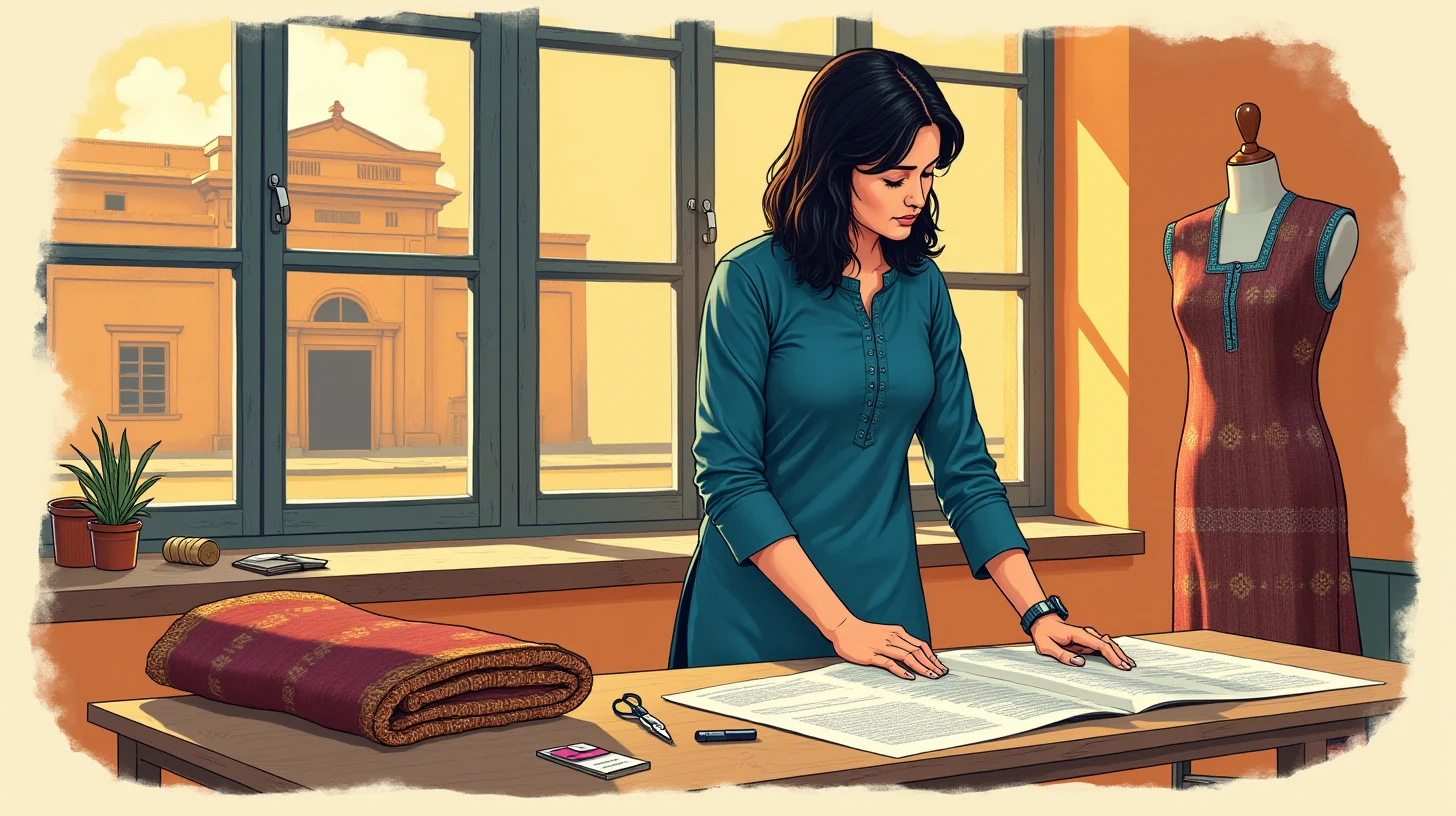
She designed contemporary garments built entirely around Mizo Puan textiles: the formal Puanchei with its precisely spaced horizontal stripes in deep reds and earth tones; the ceremonial Hmaram, woven with elaborate geometric patterns in burgundy and cream that took a master weaver six weeks to complete; the Tawlhlohpuan, the richest of the three, its silk and cotton blend reserved for weddings and church processions. Her innovation was simple: she had started pairing these traditional weaves with modern cuts—tailored jackets, high-waisted trousers, oversized wraps that made the Puan patterns legible to contemporary eyes. Her pieces sold slowly but steadily on Instagram and through a small collective of heritage boutiques in Delhi and Bangalore. The margins were thin. She paid her weavers a monthly salary, not piece rates, because she believed the work deserved it. Her own income, after materials and rent, was perhaps ₹28,000 to ₹35,000 some months, less in others.
In March 2025, she had read a newspaper article about a stalled Geographical Indication application. The Mizoram Handloom and Handicrafts Development Corporation had filed an application in 2021 to register "Mizo Puan" as a GI—a protection that would prevent anyone outside Mizoram from manufacturing or selling textiles under that name. The application had gone into administrative limbo. No one seemed to know why. No one seemed to be responsible. When Lalrinhlui called the Office of the DC Handlooms in Aizawl, the officer who picked up said the file was "under review" but could not say for how long, or whether the corporation would ever revive it.
She decided, in the way that makers decide difficult things, that she would file her own application. The Puan deserved protection. Her weavers deserved protection. And if the corporation's application died, someone had to act.
Three months later, in June 2025, she sat at her studio desk with printed copies of the GI Registry rules and a growing folder of rejection and confusion. The first page of the Handbook of Geographical Indication Rules said it clearly: "An application shall be filed by any association of producers of the goods." Not by a single person. An association. She had no association. She had four weavers and a studio and an Instagram following of 11,000 people. That was not an association in the eyes of intellectual property law.
🗓️ The annual rhythm of weaving and waiting
The Mizo Puan—the term describes both the textile and the garment made from it—sits at the intersection of domestic craft and national bureaucracy. Mizoram's weaving tradition reaches back to the pre-colonial era, recorded in oral history and in missionary accounts from the 19th century. The Puan is worn at weddings, at church, at important ceremonies. It is a garment of identity, of kinship, of ritual. For generations, it was made at home, by women for women, with the understanding that a hand-loomed Puan could not be made anywhere else because the skill and the yarn sources existed only in the state.
That understanding faced its first formal challenge around 2007, when Chinese synthetic copies of Puan patterns began appearing in Indian markets. The copies were cheap, cheerful, and legal—no law protected the name "Mizo Puan" as a geographical indication. Any manufacturer could buy the cotton, hire local weavers, and label their product as authentic. By 2015, the market was fractured. Genuine hand-loomed Puan cost ₹4,500 to ₹18,000 per piece depending on the complexity of the weave. Machine-made copies from Tamil Nadu cost ₹800 to ₹2,500. The weavers, paid per piece, saw their income collapse. Many left Mizoram for work in Bangalore or Guwahati or simply stopped weaving.
In 2020, the state government recognized the crisis and commissioned the Mizoram Handloom and Handicrafts Development Corporation to pursue a Geographical Indication registration. A GI would function like a collective trademark—all registered producers in Mizoram could use the protected name, but no one else could. The corporation hired a consultant in Delhi. The consultant gathered documentation: photographs of the weaving process, affidavits from weavers, historical texts, maps showing the geographic boundaries of Mizoram. The application was filed on March 15, 2021. The initial examination report came back six months later. There were technical objections about the geographic boundaries, the definition of "hand-loomed," the distinction between the Puan and other northeastern textiles. The corporation made amendments and resubmitted. The examination dragged into 2022, then 2023. By 2024, the file was in the system but no one at the corporation seemed to have clear authority to pursue it. The consultant had moved on. The original civil servant who championed the application had been transferred. The Puan remained unregistered.
Every year, in the months before Christmas, Lalrinhlui's four weavers took orders and began work on pieces for the holiday market. They worked through January and February. By March, their hands ached and their eyes strained. They earned perhaps ₹22,000 to ₹28,000 for eight weeks of labour—not poor money, but not enough to build a life on. They could not invest in tools or study new weave patterns. They could not afford to weave experimentally. The annual rhythm of their work was shaped entirely by Lalrinhlui's sales, which were shaped by Instagram algorithms and the discretionary spending of heritage-conscious consumers in Delhi and Bangalore.
- 📑
March 2021 — GI Application Filed
The Mizoram Handloom and Handicrafts Development Corporation files an application to register 'Mizo Puan' as a geographical indication with IP India. Documentation includes photographs of the weaving process, weaver affidavits, historical texts, and geographic boundaries.
- ⚖️
September 2021 — Initial Examination Report
IP India sends technical objections regarding geographic boundaries, the definition of 'hand-loomed,' and the distinction between the Puan and other northeastern textiles. The corporation is asked to amend and resubmit.
- 📨
2022–2023 — Amendments and Delays
The corporation makes amendments and resubmits. Examination drags across multiple cycles. The consultant hired for the application moves on to other work. The original civil servant leaves the post.
- 🛑
2024–2025 — Stalled Status
The file remains in the system but no one has clear authority to pursue it. No updates, no timeline, no explanation. The Puan remains unregistered and vulnerable to market copies.
⚠️ The deadline no one announced
In May 2025, Lalrinhlui attended a handloom conference in Guwahati organized by the Handicrafts Council of India. She sat on a panel about market access for Mizoram weavers. During the break, she spoke to a woman from the Odisha Textile Association who had recently completed a GI registration for Sambalpuri cotton weaves. The woman said: "If you do not have a registered GI, you have no defense in court. When a company in Tamil Nadu starts selling 'Mizo Puan'—and they will—your only option is to sue them for trademark infringement. That costs ₹5 lakh to ₹15 lakh. Most small weavers cannot afford it. A GI registration costs perhaps ₹50,000 in legal fees and is a standing protection."
Back in Aizawl, Lalrinhlui made a decision. She would file her own GI application. The corporation's application might resurface someday; it might not. Her four weavers needed protection now. Her studio needed protection now. She began researching the GI Registry rules online.
What she discovered was a labyrinth with no marked exit. The Geographical Indications of Goods (Registration & Protection) Rules, 1999 clearly stated that an application must be filed by an "association of producers." The rules defined this narrowly: an organization with multiple members, each a producer of the good in question, bound by a constitution or bylaws. A single designer, however dedicated, did not qualify. A studio with four weavers did not qualify. Even a collective of ten weavers, unless they had formally registered as an association, would not qualify.
She would need to register an association under the Mizoram Societies Registration Act, 1991. The act required registration of bylaws, a list of founding members (all of them weavers), and official approval by the state government. Then, and only then, could the association file a GI application.
She found the form online. It was in English. The form was sixteen pages long. It asked for:
- The name, age, address, and Aadhaar number of every founding member
- The constitution of the society (a detailed document defining rights, duties, meetings, amendments)
- A statement of objects (why the society exists)
- Proof of address for each member
- A bank account (the society must have a bank account in the society's name)
- A copy of the GI application you intend to file
The deadline was understood but not written: she had to move fast, because once a GI was registered—whether by the corporation, by another organization, or by anyone—her own application would be inadmissible.
What it does
- 📑Registers a geographical indication for a specific good (e.g., 'Mizo Puan textile') produced only in a specific geographic area (e.g., Mizoram state).
- 🔍Allows registered producers to use the protected name on their goods and to prosecute counterfeiters in court.
- 💼Applies across all of India and internationally under the Lisbon Agreement—a significant economic asset for a weaving community.
- ⏰Lasts indefinitely, as long as the association maintains the registry and meets the GI Registry's renewal requirements.
What it does not do
- 💳Does not guarantee sales or market access. The producer association must still find buyers and market the product.
- 🔒Does not prevent non-members from weaving in the same region—any hand-loom weaver in Mizoram can become a member if they meet the registry's criteria.
- ✅Does not provide financial support or weaver subsidies. The state government may offer support separately, but GI registration itself is a legal protection only.
🌗 The agent surfaces the form in plain language
In early June 2025, Lalrinhlui typed a question into a tablet her cousin had given her—a tablet on which someone had installed the agent software. She had never used an AI before. She was not certain if the question would make sense to a machine. She typed, slowly, in English:
"I want to form a Mizoram Societies Registration for weavers. I have a form but it is very long and in English. Can you tell me what each section means?"
The agent returned a structured plain-language guide. Each section of the form was broken down into what it required and why. The agent flagged the sections that would be most difficult: the constitution of the society, which required Lalrinhlui to define the rights and responsibilities of members, the process for amending the constitution, and the procedures for membership. These were legal definitions, not merely administrative blanks.
More crucially, the agent surfaced something Lalrinhlui had missed. The form required that every founding member be a "producer" of the good—not a designer, not a facilitator, but a weaver. Lalrinhlui was not a weaver. She designed garments. She sourced materials. She managed the business. But she did not sit at the loom. This meant she could not be a founding member of the society. The society would have to be formed by Sialei, Zarmawii, Remsiami, and Zu.
"Aizawl, itupui leh membrina, ke zi-at-a han lo zau em? Thawhpui hring an nih a, mihring-in an hmachua em. Uluk ang, mikhat bik pawl an ni. Keini an nih pawl em, Handloom Corporation in an file hna."
(Lalrinhlui, one afternoon in the studio, speaking to the agent: Will these four agree to lead this, do you think? They are craftspeople, not administrators. They didn't train for this. In some ways, they are just four people. Can they actually do this, when the corporation with all its resources couldn't?)
"The Mizoram Societies Registration Act does not require formal training or administrative credentials. It requires that the founding members be the producers—the weavers themselves—and that they have a constitution that defines how decisions are made. The four of you already make collective decisions about technique, materials, and timeline. A constitution formalizes what you already practice. Each of the four weavers will be a legal equal on the society board. That is the requirement and the protection. The agent can help draft the constitution in plain English, and you can translate it into Mizo so each member understands their role fully."
Over the course of six weeks, Lalrinhlui worked with the agent to draft the constitution. It was written in simple English: Membership is open to any hand-loom weaver of the Mizo Puan residing in Mizoram. A general meeting of all members will be held annually. Major decisions—like defining what counts as a "hand-loomed" Puan, or adding new members—require a vote by two-thirds of the membership. A board of five will manage day-to-day matters. Any member can vote. Any member can serve on the board. Disputes are resolved through mediation by a neutral member, or through the courts.
Lalrinhlui translated the constitution into Mizo and read it aloud to Sialei, Zarmawii, Remsiami, and Zu during a studio lunch. She asked each of them, in Mizo, whether they understood what the constitution meant. Whether they were willing to be founding members. Sialei asked if membership would affect how much she was paid. Remsiami asked whether she could leave at any time. Zu asked whether other weavers from her village could join. The questions were the right ones—they showed they understood that the society was a legal entity that they would have to manage.
All four said yes.
"Ka lama hming an nei lo a, chu chu ka phur tawh lo. Mahni lama hming a nei theih nân chu ka beisei a ni."— I had stopped waiting for someone else to put their name on this. That is what I am here for.
🧭 Why ordinary advice fails small designers fighting to protect craft goods
When Lalrinhlui had first called the DC Handlooms office, the officer had suggested she hire a trademark lawyer in Guwahati or Delhi. A trademark lawyer, he said, would cost ₹25,000 to ₹50,000 and would handle the application "professionally."
Trademark lawyers are trained to handle individual trademark applications—registering a brand name like "Nila Studio" or "Puan & Co." with the Trademark Registry. A GI application is a different beast. A GI is not an individual property right; it is a collective right held by an association. The constitution of the association becomes part of the legal record. The geographic boundaries of the production area must be mapped with precision. The historical and technical distinctiveness of the good must be documented with archival sources, not just with product samples.
A typical trademark lawyer would charge ₹25,000 and submit a template GI application. The application would likely be rejected in the first examination report for lack of specificity about geographic boundaries, or for failure to define the technical characteristics of the hand-loomed Puan in a way that distinguishes it from other textiles. Lalrinhlui would then be back where she started, minus ₹25,000, without understanding what went wrong.
The agent's approach was different. The agent could not file the application—that still required Lalrinhlui to submit the forms and the constitution and the documents to the GI Registry. But the agent could surface the requirements in plain language, flag the sections most likely to face objections, and help Lalrinhlui understand what the registry was asking for. This meant that when Lalrinhlui eventually filed, she would file with clarity about why each piece of documentation mattered.
Over the next three months, Lalrinhlui collected the documents. She worked with the four weavers to create a photographic record of each stage of hand-looming a Puan: the sizing of the loom, the preparation of yarn, the threading, the weaving itself, the finishing. They photographed the differences between a hand-loomed Puan and a machine-made copy. They gathered affidavits from the four weavers—translated into Mizo and English—describing their training, their experience, the time it took to weave each type of Puan. Lalrinhlui drew maps showing the boundaries of Mizoram and the specific localities where Puan weaving occurred. She wrote a short history of the Puan, drawing on sources from the Mizoram State Archives and on interviews with older weavers in Lunglei.
She also contacted the DC Handlooms office and asked for copies of the original documentation from the 2021 application. The officer, sympathetic, provided the photographic records and some of the affidavits. These could be reused—the registry would not require duplication of effort.
On September 10, 2025, Lalrinhlui filed the GI application on behalf of the newly registered Mizo Puan Weavers' Association. The society had been formally registered with the Mizoram government on August 28, 2025—a process that had taken seven weeks from the time Lalrinhlui first began drafting the constitution. The four weavers were now the founding members and the board of the association. The application was submitted to the IP India GI Registry with:
- The constitution of the association, in English and Mizo
- Affidavits from the four weavers, in English and Mizo
- Photographic documentation of the weaving process
- Maps and geographic documentation of Mizoram
- A historical narrative describing the Puan
- Technical specifications distinguishing hand-loomed from machine-made Puan
- Evidence of the goods' reputation and distinctiveness in the market
The application fee was ₹4,500. The filing was complete.
Will the application succeed? The IP India GI Registry typically takes twelve to eighteen months for examination and publication. Objections are likely—some technical, some perhaps political, should the 2021 application suddenly revive. But the application is now in the system in the name of the producers themselves, backed by clear documentation and by a constitution that defines how future producers in Mizoram can join the association and benefit from the protection.
The difference between Lalrinhlui's application and the stalled 2021 application is not the documents—the 2021 documents were sound. The difference is that a government corporation can lose momentum, lose sponsorship, lose continuity when officials change posts. But an association of producers cannot easily disappear. The four weavers are Sialei, Zarmawii, Remsiami, and Zu. They remain in Mizoram. They remain at their looms. If the GI Registry issues an examination objection in 2026, the association will respond. The association is not a bureaucracy. It is made of people whose livelihoods depend on the outcome.
🌱 Quiet continuity
Five months after filing, in February 2026, Lalrinhlui had not heard from the registry. This was expected—the IP India GI Registry sends an initial examination report only after a period of advertisement and public objection. The silence was not reassuring, but it was normal.
What had changed was smaller and quieter. In January 2026, Remsiami approached Lalrinhlui and asked whether she could bring her 16-year-old daughter to the studio to learn weaving. The daughter had recently dropped out of school—a common path for girls in Lunglei—but Remsiami believed she had the attention and the patience for the loom. Under the old arrangement, when the four weavers were employees of Lalrinhlui's studio, there was no mechanism for bringing new people into the craft. They were workers, not a collective. Now, as members of a registered association, they could propose her daughter's membership. If the association voted to approve, she would become a member of the Mizo Puan Weavers' Association. She would learn under the association's definition of what hand-loomed Puan meant. When she was ready to establish her own loom, she could produce under the GI protection.
Lalrinhlui said yes. Remsiami's daughter arrived at the studio in February. She is still learning.
The Puan itself has not changed. The weaving is the same as it was in 1950, in 1920, in the generations before that. What has changed is the legal shape around it—the form in which the Puan exists in relation to the state, to the market, to the next generation of makers. The Puan is no longer only a garment or a tradition. It is now also a registered association, a constitution, a geographic boundary, a set of specifications that the IP India registry has formally acknowledged. It is harder to copy. It is easier to defend. And it is owned, now, by the people who make it.