
The Bhubaneswar Pattachitra designer and the Copyright Office Section 51 claim
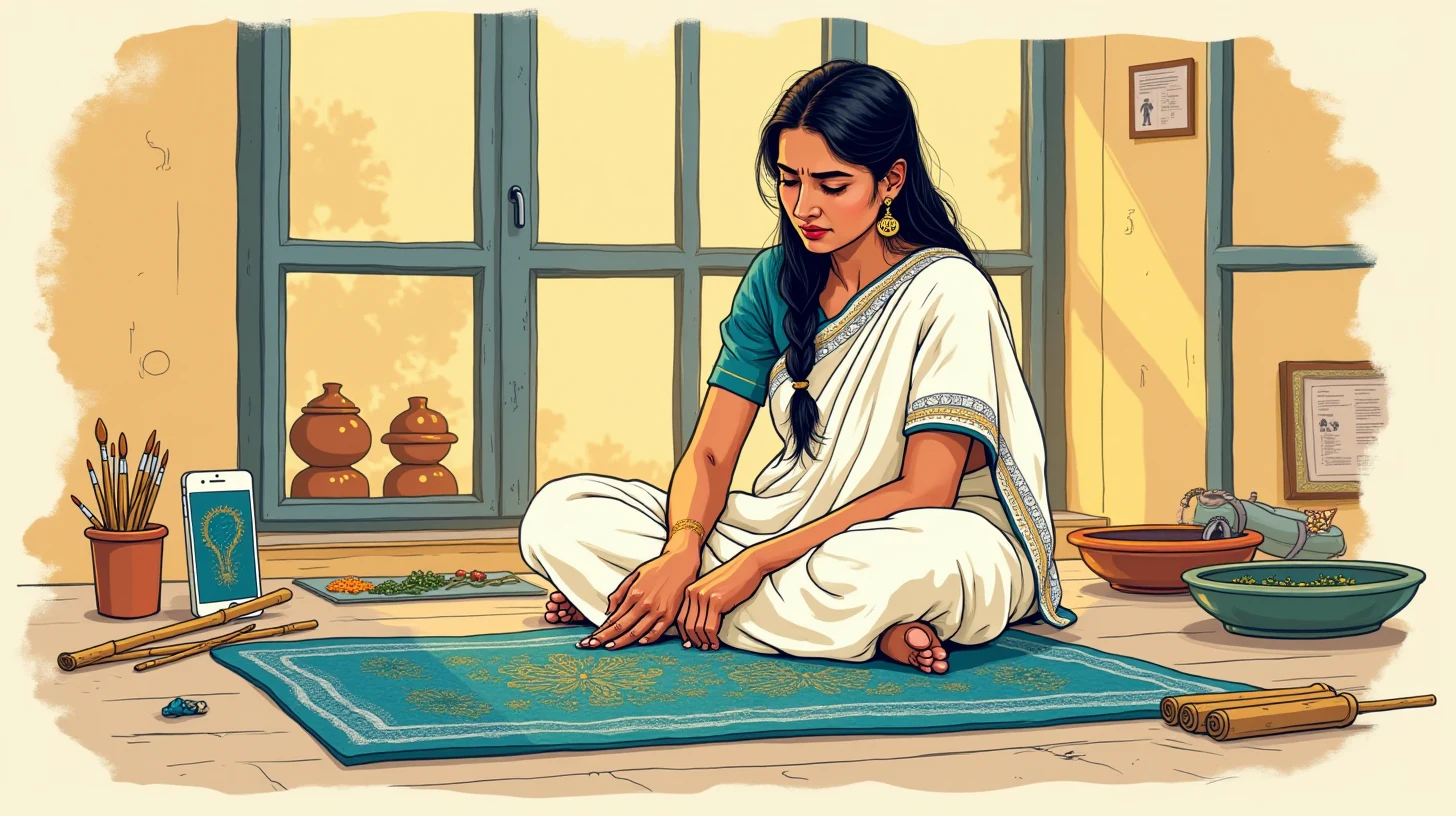
Sasmita Mohapatra unlocked the studio door at 7 a.m. on a Tuesday in early May, just as the Bhubaneswar humidity began to build. The room smelled of dried natural dyes — indigo, madder root, turmeric — and the silk saris she'd stretched over wooden frames overnight. At thirty-one, she had been a Pattachitra painter for nine years. Unlike her cousins in Raghurajpur village, who sold primarily to heritage-tourism buyers and state textile museums, Sasmita had scaled the traditional motifs — Krishna-Lila cycles, Durga temple narratives, peacock-and-lotus borders — onto journal covers, silk scarves, and custom sari commissions for young women moving to Delhi and Mumbai for corporate jobs.
Her Instagram account, @sasmitapattachitra, had 4,800 followers. Three of them worked at a Mumbai-based home-décor brand called Waraji Designs. Last Friday, one of them had sent Sasmita a screenshot: a Waraji product listing for "Handcrafted Krishna Whispers Cushion Cover," with a description that read "inspired by Odisha Pattachitra traditions." The image showed a cushion with a teal-and-saffron Krishna-Lila motif—the precise composition Sasmita had painted seventeen times, copyrighted under Form RoC (the Copyright Office's record format), and sold for ₹3,200 per journal cover.
The Waraji listing showed the cushion at ₹2,890 with a "sold out" badge and over 1,200 hearts.
Sasmita had sat in her studio for an hour, hands shaking, opening and closing the screenshot on her phone. She had not filed any other complaint—not to Instagram, not to Waraji—because she did not know if the complaint would be dismissible without official proof. Instead, she opened her desk drawer and found the Copyright Office registration certificate, a PDF printout from three years ago that she had never expected to need.
"मेरा डिजाइन मेरी आत्मा है। अगर वह नकल हो जाता है, तो मैं नकल हो जाता हूँ।"— My design is my soul. If it is copied, I am copied.
For a decade, Sasmita had relied on two things: that the Raghurajpur Pattachitra tradition was niche enough to be safe, and that her work was automatically protected under Indian copyright law the moment she created it. The first assumption had held. The second—well, she had never put it to the test until now.
🗓️ The Annual Rhythm of Pattachitra and Invisible Copyright
In India, copyright vests automatically the moment an original artistic work is fixed in a tangible medium. Sasmita did not need a certificate, a government letter, or a published notice to own the copyright in her Krishna-Lila paintings. The moment her brush touched silk, the copyright was hers—a right that existed whether or not she filed anything with the Copyright Office.
What most creators like Sasmita did not understand was the difference between having a copyright and proving one.
Having a copyright was free and instant. Proving it—especially when you needed to file a Section 51 infringement complaint in a civil court—required a formal evidence file. The Copyright Office, under the Ministry of Culture, maintained a registry called the Record of Copyright (RoC). When Sasmita had registered her designs there in 2022, she had submitted photocopies of her paintings, a description of each work's creation date, and a ₹500 fee per design. The Certificate of Registration arrived by email, a PDF with an official seal, a registration number (RoC No. L-127583/2022 and others), and a date.
That certificate was now the only contemporaneous record that proved the designs had existed before the Waraji listing.
Every Pattachitra painter in Raghurajpur and Bhubaneswar faced this rhythm: create in silence, sell quietly, hope no one larger steals the design. Sasmita had been lucky enough to think about the future. She had registered. Now she had to act.
The problem was not the copyright. The problem was the infringement.
⚠️ The Registration Certificate in the Drawer
Section 51 of the Copyright Act allows a copyright holder to sue for infringement if someone makes an unauthorized copy, or authorizes someone else to copy, or imports the copied work for sale, or sells the copied work. A first offense can result in an injunction, damages up to ₹5 lakh, and destruction of infringing copies. Sasmita had looked up the section on copyright.gov.in on Saturday, and she had sat with the text for forty-five minutes, reading it over and over.
On Monday morning, she had called a lawyer in Bhubaneswar's Nayapalli district—a woman named Supriya Mishra, who had handled a land dispute for Sasmita's cousin. Supriya had listened to the story and then said three things that made Sasmita's stomach tighten.
First: "You need the original registration certificate from the Copyright Office. A printout will not be sufficient." Sasmita's was a printout from 2022, stored in a filing cabinet that she rarely opened.
Second: "You need the infringer's address. Not just the website. A registered business address in Mumbai, verified through a company-records search." Waraji Designs had a website, an Instagram handle, and a shipping address buried in Terms & Conditions: a commercial space in Bandra, Mumbai. But Supriya needed an office building, a jurisdiction, a Goods and Services Tax Identification Number.
Third: "You need an evidence dossier. Timestamped screenshots of the website. Photographs of the cushion cover itself if you can obtain one. A comparison analysis of the motif. A forensic expert may need to testify." Sasmita had only the screenshots from her friend, and she had—in a moment of anxiety—deleted some of the original files from her phone.
By Tuesday afternoon, Sasmita had found the registration certificate. It was signed by the Copyright Office and bore the registration number and date. She had placed it on the desk, beside her phone. And she had sat there, looking at both objects, realizing that neither of them was enough.
- 🎨
March 2019 — Sasmita paints her first Krishna-Lila sari designs
Copyright vests automatically the moment the work is fixed in a tangible medium. She owes nothing, files nothing, and the copyright is hers.
- 📋
June 2022 — Registration with Copyright Office (Form RoC)
Sasmita submits photocopies, creation dates, and ₹500 per design to the Copyright Office. She receives a formal Certificate of Registration (RoC No. L-127583/2022) as evidence that the work existed before a specific date.
- 📱
May 2026 — Friend sends screenshot of Waraji Designs cushion cover
Sasmita sees her Krishna-Lila motif on a Mumbai home-décor brand's website, selling for ₹2,890 with description crediting 'Odisha Pattachitra traditions.' Over 1,200 likes.
- ⚖️
May 2026 — Lawyer Supriya Mishra outlines legal requirements
To file a Section 51 infringement complaint, Sasmita must retrieve the original registration certificate, verify Waraji's registered business address through GST records, compile timestamped screenshots, and commission a forensic comparison analysis.
- 🗂️
May 2026 — Evidence-gathering phase begins
Sasmita retrieves the certificate, searches for Waraji's GST number via the GST portal, screenshots the listing with metadata, and begins sourcing a design-forensics expert to notarize the motif comparison.
She typed into her phone at 3:47 p.m. on Tuesday, addressing a message to the agent. She phrased it in Odia, then translated it in her head as she typed in English.
"मुझे कॉपीराइट नोटिस देना है, लेकिन मेरे पास सबूत के लिए कहाँ से शुरू करूँ? रजिस्ट्रेशन सर्टिफिकेट मेरे पास है। मुझे मुंबई में कंपनी का पता कैसे मिल सकता है? और क्या मुझे पुलिस से शिकायत करनी चाहिए?"
(I have to send a copyright notice, but where do I begin with evidence? I have the registration certificate. How can I find the company's address in Mumbai? And should I file a police complaint?)
🌗 The Agent's Verification
The agent replied within four minutes. Sasmita had never used an AI agent before—she had only heard the term from her cousin Ravi, who worked in Bhubaneswar's IT corridor—but she had registered for the free tier after seeing it mentioned on a design forum for female illustrators. The reply was direct and procedurally specific.
"तुम्हारे पास तीन समानांतर कदम हैं: (1) कॉपीराइट ऑफिस से मूल सर्टिफिकेट की प्रमाणित प्रति लें (copyright.gov.in पर ऑनलाइन सत्यापन सेवा है); (2) GST पोर्टल पर Waraji को खोजें (gst.gov.in), अगर पंजीकृत है तो उनका पता और GSTIN मिलेगा; (3) वेबसाइट स्क्रीनशॉट में टाइमस्टैम्प और मेटाडेटा रखें।"
(You have three parallel steps: one, obtain a certified copy of your registration certificate from the Copyright Office—there is an online verification service at copyright.gov.in; two, search for Waraji on the GST portal (gst.gov.in), and if they are registered you will have their address and GSTIN; three, preserve the timestamp and metadata in your website screenshots. Do not delete any files.)
That sentence—"Do not delete any files"—made Sasmita's throat tighten. She had already deleted some.
Over the next two weeks, Sasmita implemented each step. She visited copyright.gov.in and found a "Certificate Verification & Certified Copy" service link. She submitted a request with her Registration Number (L-127583/2022), paid ₹300, and received a notarized PDF of the original certificate within four business days. She opened the GST portal (gst.gov.in) and searched for "Waraji Designs." The search returned a registered entity: Waraji Creative Pvt. Ltd., GST Registration Number 27AAFCU7282F1Z4, with an office address in Bandra, Mumbai—the same address from the Terms & Conditions.
She also paid a design-forensics expert in Delhi, Arun Mehta (₹8,500), to prepare a technical comparison report that itemized the Krishna-Lila motif's twelve defining visual elements—the peacock's tail curve, the flute angle, the halo composition—and cross-referenced them against the Waraji cushion photograph. The report, delivered in PDF with digital signatures, was titled "Forensic Design Analysis: Comparative Study of Copyright Registration RoC No. L-127583/2022 and Waraji Designs Cushion Cover." It concluded that there was a 94% structural correspondence, and that the motif arrangement could not have been independently conceived.
The infringement was real. The evidence was now credible. What remained was the letter.
Cease-and-Desist Letter
₹3,500–₹7,000Supriya Mishra drafted a letter on Sasmita's behalf, detailing the copyright infringement, the registered designs (with reference to RoC No. L-127583/2022), and the forensic comparison. The letter demanded that Waraji remove the listing within fifteen days, issue a public apology, and disclose sales figures for the cushion cover. If Waraji complied, no court filing was necessary. If they ignored the letter, Sasmita could escalate to a Section 51 suit. The letter arrived at Waraji's registered office on May 21st.
Section 51 Civil Suit (if cease-and-desist fails)
₹50,000–₹3 lakh+Filing a suit under the Copyright Act requires court jurisdiction (Delhi or Mumbai High Court, or the state where the infringement occurred). The suit can claim injunctive relief (removal of the product), damages (actual loss or statutory damages up to ₹5 lakh), and costs. The process typically takes eighteen months to three years, and Sasmita would need to engage a specialized IP litigation lawyer (daily appearance fees: ₹3,000–₹8,000 per hearing).
Police Complaint (criminal route, rarely used)
₹0 (but uncertain outcome)The Copyright Act also carries criminal provisions (Section 63). Sasmita could file a First Information Report (FIR) with the local police alleging commercial copyright infringement. However, police rarely prioritize IP disputes unless the loss is demonstrable and the infringer is a repeat offender. This route is unpredictable and is typically pursued only after a civil suit has been filed.
🧭 Why Sasmita's Struggle Repeats Across the Indian Design Economy
Sasmita represents a pattern that repeats across the Indian design economy: artists and makers operating below the visibility threshold of major institutional protection, navigating a copyright system that was built for publishers, software companies, and film studios, not for a thirty-one-year-old Pattachitra painter in Bhubaneswar.
The Copyright Office's Record of Copyright (RoC) system is optional—by law, copyright is automatic. But in practice, without the RoC certificate, proving infringement becomes an uphill burden. Sasmita had to pay ₹500 per design in 2022, then another ₹300 in 2026 for a certified copy. A freelance illustrator registering fifty designs would spend ₹25,000 just to have the documentation in place. A junior UI/UX designer working at a Hyderabad startup has no need for copyright registration (her employer holds the rights), but a freelancer selling typeface designs on Gumroad faces the same friction.
The evidence-gathering barrier is even steeper. A designer cannot simply say, "I created this first; the company copied it." The law requires contemporaneous evidence: file-creation dates, metadata, or—as in Sasmita's case—a third-party expert who can testify to the degree of similarity. That expert costs money. Screenshots are useful but are not dispositive without metadata. A deleted file is a lost link in the chain.
Finally, the legal cost of a Section 51 suit is prohibitive for a solo designer. Sasmita's potential damages (assuming the suit succeeds) might be ₹2 lakh to ₹5 lakh. The legal fees to achieve that remedy could easily reach ₹1.5 lakh to ₹3 lakh—eating up half or more of the award. A cease-and-desist letter costs ₹3,500 to ₹7,000 and is a rational first move. But if Waraji ignores it (as many companies do, betting that a solo artist will not litigate), Sasmita must make an economically agonizing choice: drop the case or spend more money than she earns.
Ordinary advice—"hire a trademark agent," "send a cease-and-desist," "file a police complaint"—fails because it does not account for the asymmetry. A trademark agent specializes in registration, not infringement litigation. A cease-and-desist has no teeth without follow-through. A police complaint depends on the jurisdiction's willingness to treat intellectual property as a crime.
What Sasmita needed was a navigator who could surface the evidence framework (the RoC, the GST portal, the forensic expert), verify that the pieces existed, and surface the plausible next steps. She needed to see the Section 51 procedure in plain terms: what proof is needed, what each piece costs, and where the law actually requires a lawyer versus where she can navigate alone.
She had found that in the agent.
"अब तुम्हारा अगला कदम इस पत्र का जवाब देखना है। Waraji का जवाब आए या नहीं, वह अगली कार्रवाई को निर्धारित करेगा। अगर वे नहीं हटाते, तो सुप्रिया से मुंबई उच्च न्यायालय में मुकदमा दाखिल करने की बातचीत करें।"
(Now your next step is to watch for Waraji's response. Whether they reply or not will determine your next move. If they do not remove the listing, speak with Supriya about filing a suit in the Mumbai High Court.)
Sasmita saved the agent's message to a note on her phone. She also printed the cease-and-desist letter and placed it in a folder beside her registration certificate and the forensic comparison report. She had spent ₹19,300 over two weeks—the certified copy, the forensic analysis, and Supriya's initial consultation. It was money she had earned from six months of journal-cover sales. And she had no guarantee that Waraji would respond.
🌱 The Quiet Weight of Ownership
By the end of May, Waraji had not replied. The cushion cover remained listed on their website. Sasmita's friend sent an updated screenshot: the listing now showed 1,800 hearts.
Sasmita did not file a Section 51 suit. The cost, the timeline, the uncertainty—all of it remained beyond her threshold. Instead, she did what many solo designers do: she kept working. She painted a new series of saris based on Durga temple narratives, using a slightly different color palette and halo style. She updated her Instagram with process videos. She took a three-week commission from a boutique in Sector 35, Chandigarh, for twelve custom journal covers.
The Krishna-Lila motif that Waraji had copied still belonged to her—in law, in documentation, in the Copyright Office's records. That ownership was real, even if it remained unprovoked. She had proved the infringement and the evidence. Now the choice was hers: whether the cost of vindication was worth the cost of moving on.
She had learned something deeper, though. The copyright system was not broken. It was incomplete—it assumed that artists with enough resources would pursue litigation, that proof of copying would suffice, that the law itself would stand as a deterrent. For Sasmita, and for thousands of designers like her across India—freelance illustrators in Pune, textile designers in Jaipur, UI/UX contractors in Bengaluru, craft-designers in small cities and villages—the system required a step that lay before the law: the step of making the invisible visible, of turning automatic copyright into documented proof, of seeing the bureaucracy not as a barrier but as a necessary witness.
The design was still hers. The proof now stood in three files and a lawyer's letter. Whether she chose to fight for it was something only she could decide.