
The Chandigarh kurti designer and the trademark opposition
Simran Kaur Anand is thirty-one years old. She works out of a small studio in Sector 35B, Chandigarh — if you know the right lane, you find a row of unremarkable ground-floor spaces housing a surprisingly serious economy of boutique designers and embroidery contractors. Simran's studio occupies one of these. It has a front room with four dress forms draped in unstitched phulkari panels — the dense, geometric, fire-red-and-saffron embroidery of Punjab that Simran's grandmother's generation learned as a girl and that Simran learned from photographs, YouTube, and three trips to the villages around Patiala — and a back room with two cutting tables, a long shelf of chikankari fabric from a supplier in Lucknow, and a garment rail that, in the second week of November, has seventeen pieces waiting for delivery.
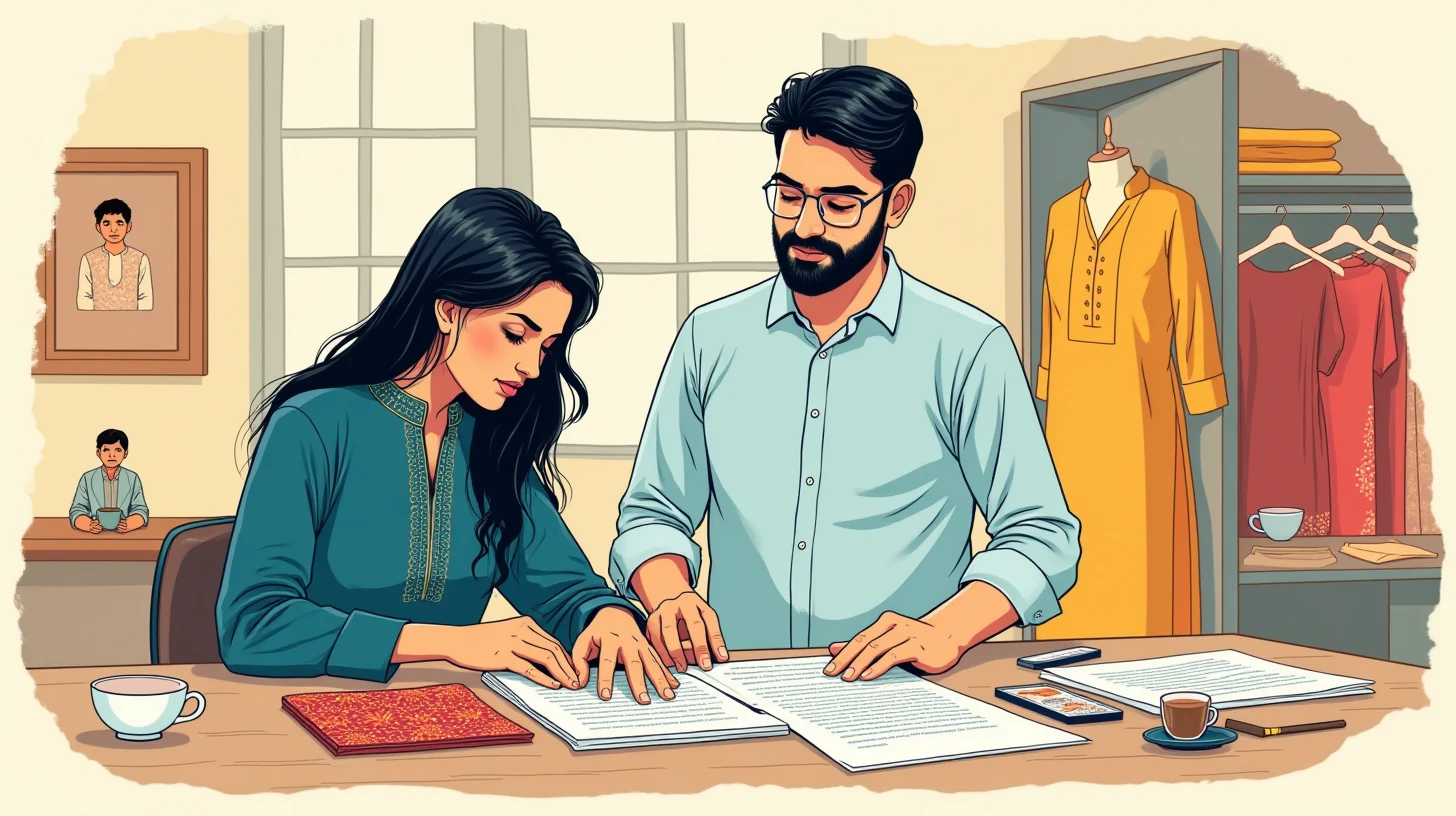
Her brand is called Anand Buti. The name is hers: Anand is her married surname, and buti — the small repeating floral motif that runs through both phulkari and chikankari — is the specific design vocabulary she has made her signature. The combination, she has said in every interview she has given, is intentional. "Buti is the connector," she told a design journal in 2023. "Phulkari is the colour, chikankari is the delicacy. The buti is what they share." The brand mark — a tilted-script "Anand Buti" with a small buti motif threaded into the A — she designed herself on a paid Canva account at 2 AM during her son's first week of continuous sleeping. He is four now. His name is Veer, and he is, by all accounts, a person of strong opinions about his snacks.
She started the brand in 2020, in the first lockdown, on Instagram: an account, a ring light, a white wall with a potted fern, and the word-of-mouth that happens when a good product meets an idle audience. She sold ₹11 lakh worth in the first year, which she describes as "clearly insane in retrospect", and ₹38 lakh in FY 2025-26, which she describes as "still mildly insane but now at least it's a business." Her husband, a DSP in the Punjab Police posted in Patiala, drives back to Chandigarh on weekends. They have worked out a domestic arrangement on the premise that neither person's career subordinates the other's — which requires, among other things, that Simran manages the business herself, completely, including the parts that are not embroidery and Instagram.
In March 2024, she filed a trademark application for the Anand Buti brand mark at the Trade Marks Registry, New Delhi, under Class 25 (clothing, footwear, headgear) through the IP India portal at ipindia.gov.in — Form TM-A, ₹4,500 government fee, paid by UPI at midnight because that is when she had uninterrupted time. She hired a solo trademark agent in Sector 17 to handle the filing.
The examination report under Section 18 arrived in October 2024 with no objections raised — neither under Section 9 (absolute grounds) nor Section 11 (relative grounds, similarity to existing marks). The application was advertised in the IP India Trade Marks Journal in January 2026: the public notice stage, during which any third party who believes they have grounds can file a Form TM-O Notice of Opposition. This is the mechanism Section 21 of the Trade Marks Act, 1999 provides.
The four months passed without incident.
- 📋
March 2024 — application filed
Form TM-A submitted on IP India portal under Class 25, ₹4,500 government fee paid by UPI. Trademark agent in Sector 17 handles the filing.
- ⚖️
October 2024 — examination report
Report under Section 18 arrives with no objections — neither absolute grounds under Section 9 nor relative grounds under Section 11. Clean passage.
- 📨
January 2026 — advertised in journal
Application published in the IP India Trade Marks Journal, opening the four-month public opposition window under Section 21.
- 🛑
April 2026 — Form TM-O arrives
Anand Boutique Private Limited, Lajpat Nagar, files a nineteen-page opposition citing Section 11 similarity grounds. Lawyer quotes ₹1.8 lakh.
- ✅
April 14, 2026 — counter-statement filed
Simran files the counter-statement herself via IP India portal. Government fee: ₹2,700. Legal fee: ₹0.
The notice
"Oye, eh tan vekh — Trademark notice aaya hai," said her studio assistant Priya, on a Wednesday morning in mid-April, looking at Simran's laptop, which was open to the email registered with the Trade Marks Registry. Simran, who was in the middle of pinning a phulkari dupatta to a dress form, came over, looked at the screen, and stopped pinning.
The notice was a Form TM-O. Filed by Anand Boutique Private Limited, a company registered in Delhi with a principal place of business in Lajpat Nagar. The grounds of opposition — nineteen pages of lawyer-drafted text — ran through the usual Section 11 claims: the mark was, they asserted, deceptively similar to their existing marks; consumers in the clothing market would be confused; the Anand prefix was strongly associated with the Anand Boutique brand.
Simran read the first three pages. Then she called her trademark agent.
The agent — the solo practitioner in Sector 17 — said: "Simran-ji, yeh serious matter hai. Opposition hai. You will need a formal counter-statement, appearances before the Registrar, possibly a hearing. My fee for this would be ₹1.8 lakh — counter-statement drafting plus two to three hearing appearances."
Simran said she would think about it.
She drove back to the studio, collected Veer from the crèche around the corner, put him in front of a cartoon he likes about a small blue truck, and sat at the cutting table with the notice and a cup of tea going cold beside her. She was not, in the general sense, a person who panicked — six years of solo business management had seen to that: GST, MSME registration, a supplier who vanished with an advance, an Instagram account impersonation. But ₹1.8 lakh is not nothing. It is half a month's revenue. And the broader fear — that Anand Boutique, with its fourteen registered marks and its lawyers, was simply hoping she would look at the number and walk away — was the fear that made her angrier than the money.
She had, some months earlier, been given access by a friend to a Hindi-and-Punjabi-speaking AI assistant, a small thing that lived on her phone and had helped her, at various points, with a GST return she didn't understand and with parsing the MSME self-certification form. She opened it now.
"Yeh TM-O notice kya hai," she typed. "Anand Boutique ne mera trademark oppose kiya hai. Mujhe samajhna hai."
What the AI read
The assistant — speaking in quiet, colloquial Hindi, the way one of Simran's more practically-minded cousins might — said: "Bilkul, ek ek baat dekh lete hain."
It asked her to photograph the notice pages and upload them. She did. It read them.
The opposition was grounded in Section 11 of the Trade Marks Act, 1999, which allows opposition on relative grounds: specifically, that the applied-for mark is similar to an earlier mark such that there is a likelihood of confusion or association in the relevant public. The AI flagged, within the notice, the specific claim: Anand Boutique argued that the shared "Anand" prefix in both marks created confusion likelihood.
"Simran-ji, ek cheez clear karte hain," the AI said. "'Anand' ek bahut common Punjabi-Hindi surname aur naam hai. Trade Marks Registry is tarah ke generic prefix ko akele trademark nahi deti — especially jo kisi ki own personal name ya surname ho. Anand Boutique ka 'Anand' unke marks mein ek element hai, lekin unka trademark sirf us word par nahi, unke poore mark par hai — unka specific script, their logo, their combination. Aapka mark 'Anand Buti' hai — tilted script, plus the buti motif. Yeh distinctly alag hai."
It then pulled up, from the publicly searchable IP India portal, Anand Boutique's trademark portfolio: fourteen marks registered, all for bridal lehengas and premium occasion-wear retailing at ₹15,000 to ₹80,000 per piece, sold through mall boutiques and destination bridal stores. Anand Buti's phulkari-chikankari kurtis sold at ₹1,800 to ₹8,500, via Instagram and a studio in Sector 35B. Different segment, different price, different channel.
"Opposition mein typically iska burden hota hai — matlab Anand Boutique ko PROVE karna hoga confusion. Aapko prove nahi karna ki koi confusion nahi. Yeh ek important distinction hai," the AI said. "Section 21 ke under jo counter-statement aap denge, usme aapko sirf clearly state karna hai: (a) aapka mark visually alag hai, (b) aapke consumers alag segment mein hain, (c) 'Buti' suffix aapka unique hai — unke kisi bhi 14 marks mein 'Buti' nahi hai, aur (d) 'Anand' prefix itself trademarked nahi ho sakta."
It made one more point, quietly: the counter-statement — the Form TM-O reply — is a document Simran could file herself, through the IP India portal, with a government fee of ₹2,700. Filing a counter-statement does not require a lawyer. What would likely need legal representation is the eventual hearing before the Registrar — but that hearing, based on typical Registry timelines, was twelve to eighteen months away. There was no hearing scheduled. There was no hearing notice issued. The ₹1.8 lakh her attorney was quoting covered work that, in full probability, would not be required for at least a year.
"Simran-ji, TM-O reply ke liye government fee ₹2,700 hai — yeh aap khud IP India portal par UPI se pay kar sakti hain. Counter-statement filing ke liye koi lawyer mandatory nahi hai — Section 21 mein yeh clearly permissible hai. Anand Boutique ke paas June 2026 tak apna evidence file karna hoga. Abhi sirf ek kaam hai: aapka counter-statement, clearly aur time pe."
(Simran-ji, the government fee for the TM-O reply is ₹2,700 — you can pay this yourself on the IP India portal via UPI. A lawyer is not mandatory for counter-statement filing — Section 21 permits it clearly. Anand Boutique must file their evidence by June 2026. There is only one task right now: your counter-statement, clearly written and on time.)
"Abhi jo karna hai," the AI said, "counter-statement likhna aur submit karna hai. Hearing ke liye, jab aayega tab dekhenge. Lawyer chahiye tab. Abhi nahi."
The counter-statement
Simran spent three evenings on it, with the AI walking her through each ground. The counter-statement she filed on April 14, 2026 — on the IP India portal, Form TM-O reply, ₹2,700 official fee paid by UPI — ran to six pages.
It argued that Anand Boutique's opposition lacked merit on each ground advanced. The visual marks were not similar: Anand Buti used a tilted Latin script with an integrated buti motif; Anand Boutique's marks used stylised Devanagari with a different graphic vocabulary entirely. The consumer markets were not overlapping: phulkari-chikankari kurtis and dupattas sold at ₹1,800 to ₹8,500 via Instagram is not the same market as occasion-wear bridal retail at ₹15,000 to ₹80,000 in mall boutiques. The "Anand" element — a common personal name and surname in widespread use — is not capable of being exclusively appropriated as a distinguishing element. The "Buti" suffix had no analogue in any of Anand Boutique's fourteen registered marks. And Simran had prior use evidence going back five years: invoices, Instagram posts, fabric supplier receipts, three press features, and the 2023 design journal interview, all under the Anand Buti name.
The AI also flagged the core principle: similarity of marks must be assessed on overall impression on an average consumer of ordinary intelligence — not on isolated elements like a shared prefix word. "Papa-ji ka naam Anand hota toh bhi koi trademark confusion nahi hota," the AI said at one point. "'Anand' is nobody's monopoly. Yeh simply kisi bhi Indo-Pakistani surname ki tarah hai."
She filed the counter-statement at 11:20 PM, after Veer was asleep. Her husband called from Patiala to say she had done "ekdum sahi karri" and to ask if she had eaten. She had not. She made herself a paratha.
"ਉਹਨਾਂ ਨੇ ਸੋਚਿਆ ਹੋਵੇਗਾ ਕਿ ₹1.8 ਲੱਖ ਦਾ ਅੰਕੜਾ ਦੇਖ ਕੇ ਮੈਂ ਛੱਡ ਦਿਆਂਗੀ — ਪਰ ਅਨੰਦ ਬੂਟੀ ਮੇਰਾ ਨਾਮ ਹੈ, ਮੇਰੀ ਦਾਦੀ ਦੀ ਕਢਾਈ ਹੈ। ਇਹ ਕਿਸੇ ਦੀ ਵੀ ਨਹੀਂ ਜਾਵੇਗੀ।"— They must have thought I would walk away when I saw the ₹1.8 lakh figure — but Anand Buti is my name, my grandmother's embroidery. It is not going to anyone.
What happened next
Six weeks after the counter-statement was filed, Anand Boutique's lawyers filed a procedural amendment — a minor citation correction — but submitted no fresh evidence, no affidavits, no consumer surveys. The amendment had the look of a law firm keeping its billing clock ticking with nothing new to stand on.
In October 2026, the Trade Marks Registry sent an evidence-stage notice requiring Anand Boutique to file Form TM-43 supporting evidence within two months. They did not file. The window lapsed in December. Simran's trademark agent — who had watched the whole counter-statement episode with the expression of someone unsure whether to be offended or impressed — confirmed that the non-filing materially strengthened her position. The Registry would proceed to schedule a hearing.
She was told to expect the hearing in early 2027 — at which point she will need a lawyer, and she has already spoken to an IP litigator in Chandigarh who quoted a more contained fee for a single-hearing appearance. A manageable expense for a business that has grown to ₹52 lakh in FY 2026-27.
She has paid, in legal fees, exactly zero rupees. She has paid, in government fees, ₹2,700.
When she mentioned this to her original trademark agent — the one who had quoted ₹1.8 lakh — he said: "Simran-ji, you got lucky. If they had filed the evidence properly, this would have been a full-blown hearing from the start."
She thanked him. She did not agree with his characterisation. Luck is when an opponent fails to do something you had no information about. What happened here was that something read the Trade Marks Act, 1999 with her and told her the difference between a formal window and an evidence burden, between the work needed today and the work that could wait for a notice that had not yet arrived. That is not luck. That is the right information at the right moment, in the language you actually think in, on the phone you keep beside you while your four-year-old is asleep.
What the AI does not do
What it does
- 🔍Reads the TM-O notice and identifies the specific legal grounds cited — Section 11 similarity, opponent's mark portfolio, burden of proof allocation.
- 🗂️Searches the publicly accessible IP India portal to pull Anand Boutique's fourteen registered marks, their classes, and price segment for comparison.
- ⚖️Explains in plain Hindi-Punjabi which parts of the reply Simran can file herself today, and which parts require a lawyer only when a hearing notice arrives.
What it does not do
- 🔒Never logs into the IP India portal using Simran's credentials or submits any form on her behalf.
- 💳Never pays any government fee, transfers money, or interacts with payment systems.
- ✅Never drafts the final counter-statement independently — Simran wrote every line; the agent verified the legal grounds and confirmed the deadline.
The AI did not file the counter-statement for her. It is not a lawyer and does not have standing before the Trade Marks Registry. What it did was read the Act with her, find the public records she did not know were public, explain the procedure in plain Punjabi-Hindi, and make one specific point that ₹1.8 lakh worth of legal advice might or might not have opened with: the burden of proof in a Section 21 opposition sits with the opponent. It is Anand Boutique that must demonstrate confusion. It is not Simran who must disprove it. This is the foundational logic of the opposition mechanism — the kind of thing that sounds obvious when stated and that most brand founders simply do not know because they have never had occasion to read Section 21.
She knows it now.
A note on the product
The AI she used is called gabforge.in. It speaks Hindi, Punjabi, and twelve other Indian languages natively — not translated from English, but composed in those languages as a first register. It is free. It has no law degree and will tell you this promptly if you ask. What it has is access to the publicly searchable records on ipindia.gov.in, familiarity with the broad structure of the Trade Marks Act, 1999, and the specific patience — which practitioners billing by the hour cannot always afford — to sit with you at 11 PM while a paratha is getting cold and explain the difference between a formal opposition window and an evidence-filing obligation.
Not all designers have ₹1.8 lakh to hand to a lawyer on the day a TM-O notice arrives. Some will abandon their marks — not because their marks are weak, but because the machinery of opposition looks, from the outside, like something requiring expensive professional mediation at every stage. The product does not solve this problem entirely. What it does is make it marginally less true that only the brands with the largest legal budgets can outlast an opportunistic opposition.
If you are a designer, artisan, or small-brand founder with a trademark question — or a Form TM-O notice sitting in your inbox that you haven't quite understood — the product is free at gabforge.in. We read Hindi, Punjabi, and the IP India portal. We will not replace your lawyer for the hearing. But we will read the Act with you before you decide you need one.