
The Chennai Kanchipuram saree designer and the GI authorised-user split
Lakshmi Iyer had learned to weave before she could read. In the Kanchipuram townhouse her grandfather built in 1962, she sat cross-legged at her father's side at age six, learning to read the pattern cards—the punch-holes that told the loom which silk threads to lift, which to cross. By her thirties, she could commission a sari from a client's idea in her head: the weight of the zari, the count of the silk, the temperature of each dye. She had moved her front-of-house to a boutique in Mylapore, Chennai, ten years ago, a three-room space on Kutchery Road where the saris hung like paintings, priced from ₹18,000 to ₹2,20,000 depending on the gold-thread work.
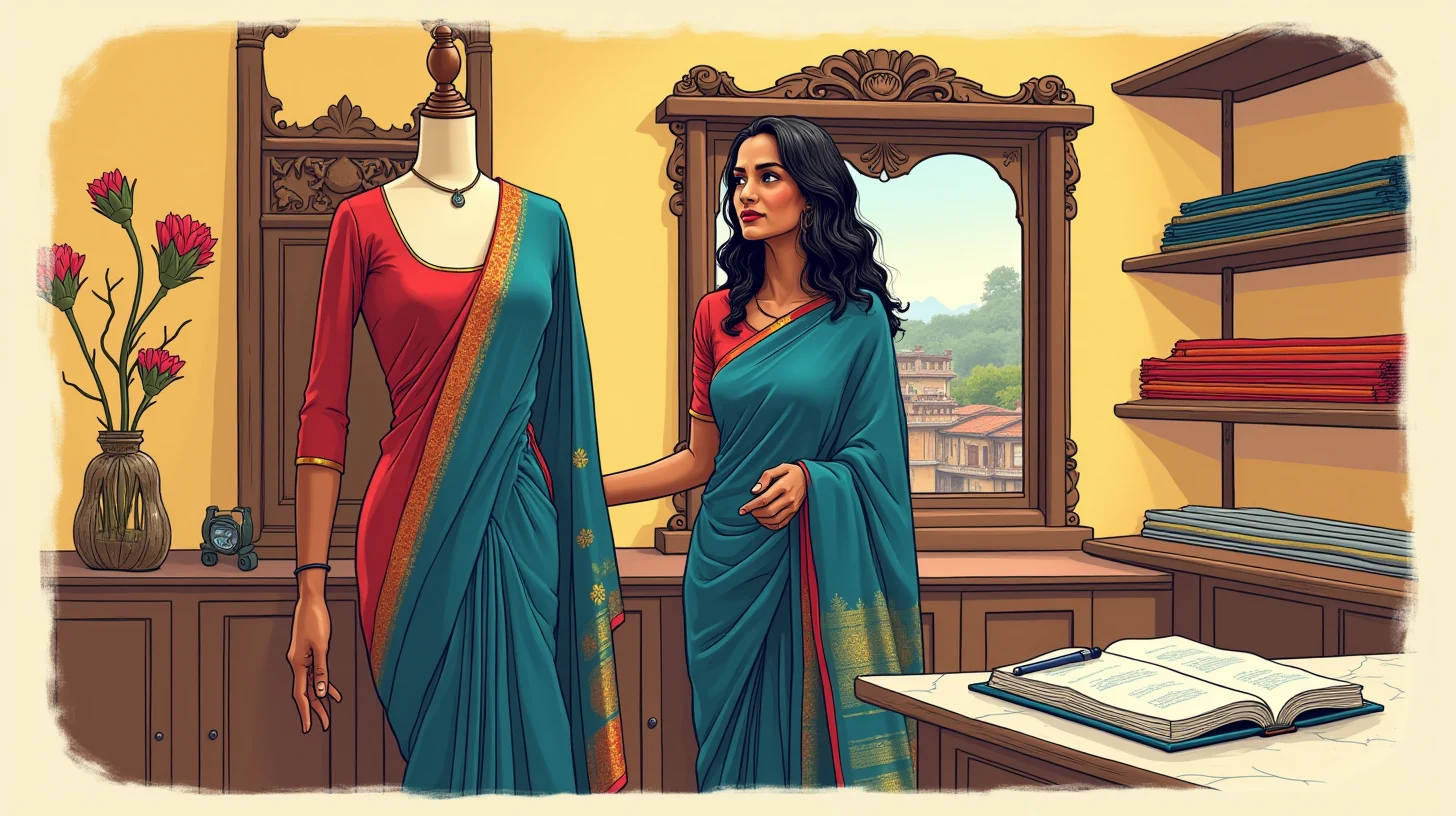
But on 14 February 2026, her father died of a stroke. He was sixty-eight. He had been the registered authorised user for the Kanchipuram Geographical Indication—a forty-four-word legal status granted in 2005 and renewed in 2015, one of just seventeen handloom GIs in India, and the one that let her family legally sell saris under the hallmark "Genuine Kanchipuram Silk." Without that registration, her saris were just expensive silk cloth.
Within three weeks, the IP India GI Registry sent a notice. The registration required an authorised-user application renewed by a legal heir. But the form—Form CGI-100—was designed for plural applicants. It assumed that two or more family members would jointly apply. Her late father's cousin, who owned a smaller loom in the same district, was technically a co-heir under Tamil succession law. Neither of them had initiated the process together, and the cousin was uninterested in signing. The registry had given her eight weeks to file. The 2026 wedding season—April through June, when Kanchipuram sari orders peaked—was already three weeks old. She had five weeks left to resolve this before the autumn market reset.
That was when Lakshmi first opened her phone to the agent on a Saturday morning in late March, her hands still damp from freshwater-rinsing silk in the back courtyard.
🗓️ The four-generation rhythm
Kanchipuram had woven silk for five centuries. The town's water came from the Vegavati River, which had no parallel in India for cooling silk post-dyeing: the mineral content made the zari—the gold thread—adhere to pure mulberry silk in a way that mills in Gujarat or Bangalore could not replicate. By the time Lakshmi's great-grandfather bought his first loom in 1908, Kanchipuram had more than a thousand handlooms. By her birth in 1988, that number had fallen to four hundred. Today, fewer than fifty working looms remained.
The family's legal claim to that name—Kanchipuram—had not always mattered. For three generations (her great-grandfather through her father), it was enough that the Kanchipuram weavers' guild knew their work, that brides' mothers knew which boutiques in Madras and Bangalore bought their saris, that the weight of the gold in a Kanchipuram sari was self-evident in your hand. But in 1995, the Indian government had begun registering Geographical Indications—names that legally belonged to a place and its artisans, not to a single business. Champagne could only come from Champagne, France. Darjeeling tea could only come from Darjeeling, India. And Kanchipuram saris could only come from Kanchipuram, made on a Kanchipuram loom with Kanchipuram techniques.
The registry had opened in 2005. Lakshmi's father had filed the application himself, with the local weaver's association's backing, and been granted the status in his name. The logic was simple: the government wanted to protect place-based craft from counterfeits. But the protection came with a requirement. The person who held the name—the "authorised user"—had to prove annually that they were still making saris, still using the techniques, still selling under the name. It was a living title, renewed every ten years, and it could only be held by a single person or a registered co-operative.
When the renewal came in 2015, Lakshmi's father had filed the paperwork himself. The form asked for the applicant's name, their relationship to Kanchipuram (he was born there), their annual production (he declared sixty saris a year), and their sales (he listed the boutique, the corporate clients, the bridal exports). The registry had renewed it without incident.
No one had told him that when he died, the title would die with him.
- ⚖️
2005 — Initial GI Registration
Lakshmi's father filed the Kanchipuram Geographical Indication application with the backing of the local weaver's association. The registry granted the status, naming him as the sole authorised user. Annual compliance was required.
- ✅
2015 — Decennial Renewal
The father renewed the authorised-user status by submitting updated production figures and sales documents. The registry renewed it without incident. No succession plan was documented.
- 📨
14 Feb 2026 — Death and Notice
Lakshmi's father died. Within three weeks, the IP India Registry sent a termination notice: the registration would lapse on 30 April unless a legal heir filed a fresh authorised-user application within sixty days.
- 🛑
Late March 2026 — The Cousin's Silence
Lakshmi discovered that Form CGI-100 (the renewal application) legally required joint application by all legal heirs under succession law. Her father's cousin was an uncooperative co-heir. No path forward without his signature.
⚠️ The deadline and the cousin's clause
The crisis was not abstract. A Kanchipuram sari without GI status could not be sold as "Kanchipuram silk"—only as "Chennai silk" or "Indian silk." Buyers' networks, entire wedding-season orders, depended on the hallmark. The Mylapore boutique had four standing orders from corporate clients (Mumbai investment firms commissioning gift saris for their senior women employees) and six from bridal boutiques in Bangalore and Hyderabad. Three of the orders were conditional on Handlooms Mark certification, which the IP India Registry provided automatically as long as the GI status was current. Once it lapsed, she would need to reapply for everything.
The timing was catastrophic. The 2026 wedding season had opened on 1 April. By late March, when Lakshmi called the registry's helpline, the officer told her that the deadlines were non-negotiable: she had until 29 April to file Form CGI-100. After that, the registration would terminate, and there was no grace period for succession. She would have to wait two years and file a new application from scratch—effectively ceding the GI status to whoever else in Kanchipuram might claim it.
The form itself was the trap. It required the signatures of all legal heirs. Under Tamil succession law, Lakshmi and her father's cousin (her father's first cousin once removed, on his father's side) were co-heirs to the authorised-user title. The law did not recognize a single heir; it required that they apply together.
Her cousin, Ramanathan, owned a smaller loom about eight kilometers away in Kanchipuram proper. He made saris for the wholesale market—bulk orders, lower margins, less personal design work. He had his own wholesale buyers and had never used the family's GI status to sell his saris. When Lakshmi called him on 20 March to ask if he would co-file, he told her he saw no benefit to himself. He was skeptical that the GI status even mattered. And frankly, he said, if the boutique business was so dependent on it, maybe the family's real problem was that it had spent sixty years on craft instead of on scale.
She had nine days left when she opened the agent.
What it does
- 🔍Identifies the specific legal hurdle: Form CGI-100 requires joint application by all succession-law heirs, and clarifies what 'legal heir' means under Tamil law.
- 🗂️Retrieves the registry's official FAQ, the form instructions, and the standard compliance timeline for GI decennial renewals.
- 📋Surfaces the option to petition for an exception on grounds of uncooperative co-heir, including the specific IP India portal section (Section 2.6 of the GI Registry Handbook) where exceptions are documented.
- 📞Identifies the names and phone numbers of the Tamil Nadu government's IP Facilitation Centre (under Handlooms Division) that mediates such disputes.
What it does not do
- 🔒Never asks for Lakshmi's IP India login credentials, never submits a form on her behalf, never signs the application.
- 💳Does not offer to pay the cousin, does not suggest misrepresenting his status, does not recommend falsifying a co-applicant signature.
- ✅Does not decide whether Lakshmi should fight the cousin or accept the registration lapse; only surfaces the options and their timelines.
🌗 The agent's first scan
When Lakshmi typed into the agent—slowly, her Tamil easier than English on a Saturday morning—she described the situation in a sentence: her father had held the Kanchipuram GI status, he had died seven weeks ago, the registry said she needed her uncooperative cousin to sign Form CGI-100 with her, and she had nine days left before the registration lapsed.
"ஐபி இந்தியா ஜிআই பதிவேட்டில் என் பெயரையும் என் சகோதரன் சாமன் பெயரையும் சேர்த்து விண்ணப்பம் செய்ய வேண்டுமா? அவனுக்கு எந்த ஆர்வமும் இல்லை."
(Do I really have to put my cousin's name together with mine on the IP India GI Registry application? He has no interest in any of this.)
The agent asked her a series of clarifying questions: Had the original GI registration named her father as a sole authorised user, or were there already multiple registrants? Did she know the exact date the registration would lapse? Had she called the registry to ask if exceptions existed for uncooperative heirs? What was Ramanathan's stated reason for refusing—was it personal, or was he claiming some other objection?
Within twenty minutes, the agent had pulled the IP India GI Registry's FAQ page, the Form CGI-100 instructions, and the GI Handbook's section on succession. It surfaced something Lakshmi did not know: the registry did have a precedent for succession disputes. When a co-heir was uncooperative, the registry could grant a provisional authorised-user status to the applicant who did apply—but only for a maximum of two years, during which the dissenting heir had the right to file a counter-claim.
More importantly, the registry's FAQ mentioned the Tamil Nadu IP Facilitation Centre, a government office within the Handlooms Division that mediated exactly these kinds of disputes. It was designed to help artisans navigate IP registration without lawyers. And it was in Chennai, not Delhi.
The agent gave her the office's address (19 Pantheon Road, Egmore, Chennai 600008), the phone number, and the names of the two liaison officers who handled GI succession cases. It estimated that a mediation hearing could be scheduled within five working days if she called immediately on Monday morning.
There was no guarantee Ramanathan would accept mediation. But the mere existence of a formal process—one the government had designed for this exact situation—shifted Lakshmi's sense of the crisis from impossible to difficult.
"அவனு எதற்கு பொறுத்தாளை? நான் மட்டுமே தாய்க்கு கர்ज்জையாய் இருக்கேன்."— Why does he care? I'm the one who's indebted to our great-grandmother's loom.
🧭 Why the system breaks on inheritance
The problem was not unique to Lakshmi. Across India, GI registrations—Darjeeling tea, Mysore silk, Nagpur oranges, Madurai mats, Daccai muslin replicas from Varanasi—were held by a single named person. When that person died, the registration essentially became an orphan. The law assumed that every artisan was a registered co-operative or had clearly documented heirs, but artisans rarely worked that way. A loom-house like Lakshmi's was a family operation, not a legal entity. Her father had held the registration in his own name, almost incidentally, because he was the one who had made the phone call to the registry in 2005.
The Indian legal system's assumption was even more granular: it assumed that when an artisan died, all legal heirs had equal interest in claiming the GI status. But that assumption broke down the moment a co-heir was uninterested, financially unable, or actively hostile. Tamil succession law, like most Indian personal laws, distributed property equally among legal heirs regardless of who actually worked the loom. Ramanathan had a right to the status even though he had never designed a sari in his life.
This was not a flaw in the IP India system alone. It was a collision between two legal logics: intellectual-property law, which treats a distinctive name as a personal asset, and personal succession law, which treats assets as communal family property. The collision was especially sharp in India because GI registrations were designed to protect place-based craft—the skill belonged to Kanchipuram, not to any individual—but the legal mechanics of GI status ownership mimicked individual intellectual property, like a trademark.
The policy designers had not imagined that an entire artisan family could lose access to its own heritage brand because of a squabble among heirs.
For Lakshmi, this was not an abstract policy problem. It meant that the Mylapore boutique—her livelihood, and the only remaining shop front for her family's loom-house in an age when direct-to-consumer sales were displacing wholesale—could not legally operate under the name that had taken four generations to build.
Ordinary advice did not help. A trademark lawyer would have told her to hire a lawyer to contest the cousin's claim, which would cost ₹80,000 to ₹1,50,000 and take six to nine months. An IP agent would have told her the same thing. A CA familiar with GST would have suggested registering as a co-operative, but that required bylaws, member meetings, and a one-time ₹15,000 application fee to the Registrar of Co-operative Societies—a path that would take fourteen weeks and still did not resolve the GI status deadlock. None of these professionals had any reason to know about the IP Facilitation Centre's mediation service. It was not published in English, not advertised, and not integrated into the formal IP India portal.
The agent had found it because it had scanned the Tamil Nadu government's Handlooms Division website, cross-referenced it with the IP India FAQ, and spotted the connection.
🌱 Inheritance as invention
On Monday morning, 24 March, Lakshmi called the IP Facilitation Centre. The liaison officer, a woman named Deepa, had handled five similar cases in the past two years. She told Lakshmi that the mediation process was informal and free. She would need Lakshmi to file a written statement explaining the situation, Ramanathan to file a response (or agree not to dispute it), and then the three of them would meet in person to explore a settlement. Most settlements, Deepa said, involved the dissenting heir being named as a co-registrant with zero management authority—a way of satisfying the law's requirement without handing over actual control.
Ramanathan agreed to the mediation, less out of interest in compromise and more out of curiosity. When the three of them sat down in the Egmore office on 1 April—the very day the wedding season opened—Deepa asked him a simple question: if the GI registration was renewed, and Lakshmi's boutique business continued, but he was named as a co-registrant purely for legal purposes, what would he lose?
He could not articulate a loss. His own loom, his own buyers, his own business—all of it was separate from the GI status. The only thing he was losing was the theoretical option to someday claim the Kanchipuram brand for his own business. And when Deepa asked whether he had ever planned to do that, he admitted he had not.
What changed his mind was smaller than that. Deepa mentioned that the Tamil Nadu Co-optex Silk Yarn Bank—a government supply program for certified handloom weavers—gave preferential yarn allocation to GI-registered weavers. Ramanathan's loom was smaller and less modernized than Lakshmi's. He was buying his silk yarn at market rates, which meant paying ₹380 to ₹420 per meter. If he were a co-registrant on a GI status, he would qualify for Co-optex's subsidy rate of ₹280 per meter. That worked out to a savings of ₹28,000 to ₹33,600 per year—enough to offset four or five saris' worth of his annual production costs.
It was not a handshake. It was a quiet economic acknowledgment. By 5 April, Ramanathan had signed a co-applicant statement agreeing to be named on the Form CGI-100 renewal, provided the Co-optex application was filed on his behalf in the same filing.
Lakshmi submitted both forms on 27 April, four days before the deadline. The IP India Registry confirmed receipt on 29 April. The Handlooms Mark certification—the hallmark that proved the saris were made on a genuine Kanchipuram loom—was restored to her boutique stock automatically on the same day.
The wedding season was not yet half finished. She still had four weeks to fulfill the corporate and boutique orders that had been on provisional hold.
What Lakshmi had not anticipated was that the mediation had worked not because the law changed, or because she had hired the right person, or because she had forced her cousin's hand. It had worked because a system designed for mediation had been connected to a system designed for economic incentive. The Facilitation Centre had simply asked: what would make this person's interest align with yours? And it turned out the answer was already embedded in Tamil Nadu's own Handlooms policy.
The registration was still in two names now. That was not elegant, and it was not what Lakshmi had imagined a week earlier. But it was not a choice between two names and no name at all. And in a world where inheritance law treats the loom as shared family property, dual registration was a quiet form of invention.
If you face a GI succession crisis: contact the IP Facilitation Centre in your state's Handlooms Division first, before filing with IP India directly. Many disputes can be mediated within two weeks. And ask about sectoral incentive programs (yarn subsidies, credit lines, export support) that might align a dissenting heir's interests with yours.