
The Kohima Naga shawl designer and the tribal-council permission letter
Aotemjen Pongener was 31 when she left her job at a Bangalore textile consultancy and moved back to Kohima to her grandmother's house. The house was old, wooden, built in the 1970s, with a sloped roof and a veranda overlooking a steep hillside. Her grandmother, who had been wearing Naga shawls since childhood, had five of them hanging on wooden pegs in her bedroom. One was an Angami Loramhoushü, a pattern Aotemjen had drawn as a child—the geometric red and cream border on indigo, the specific weaving rhythm that took two weeks to complete. Her grandmother had told her: "This pattern is Angami. It is not yours. You must remember this."
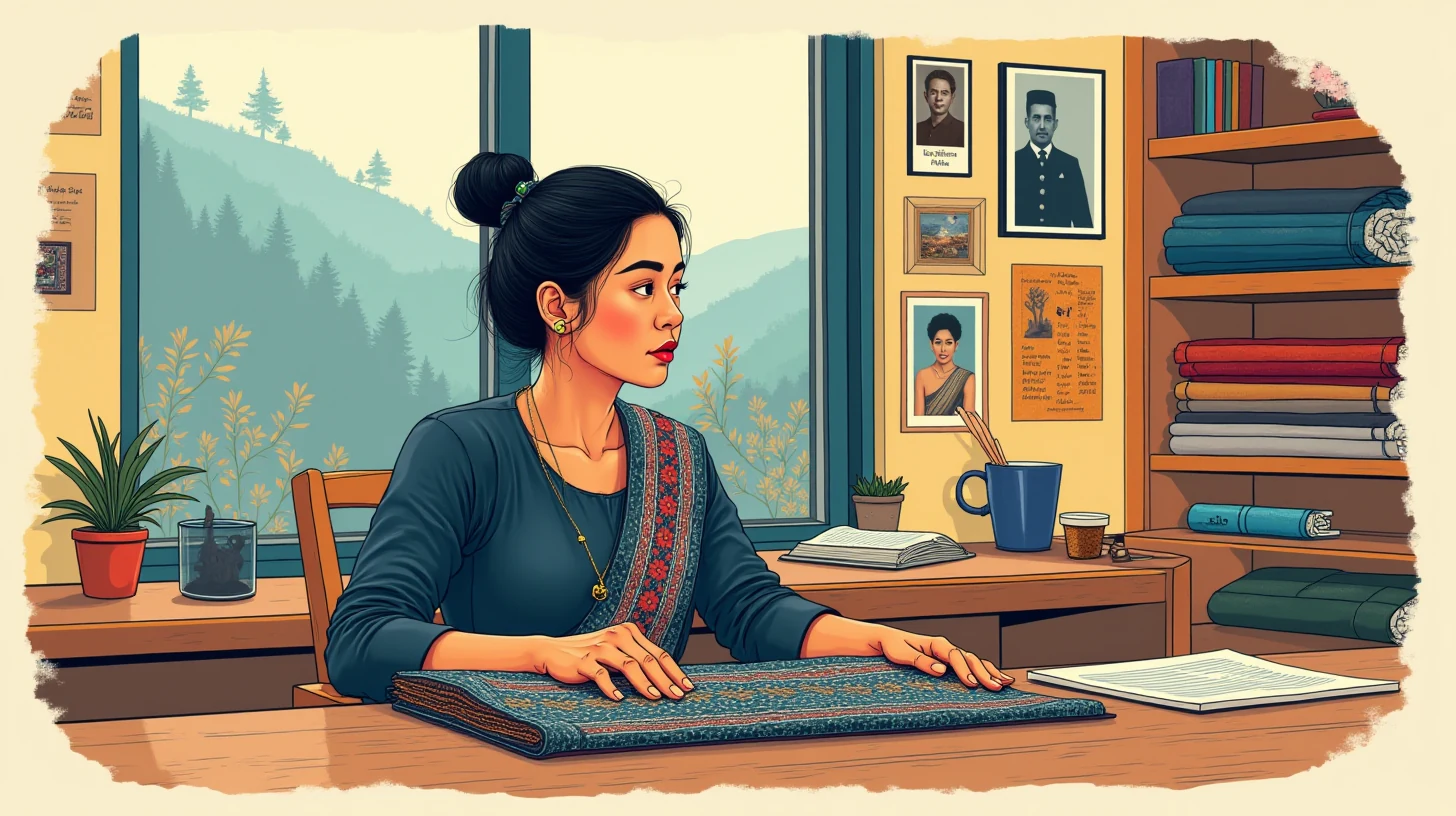
Aotemjen did remember. But she had become a designer. She had spent seven years studying textile design, four years working in factories and consultancies, and three months back in Kohima drawing her own contemporary pieces: jackets, stoles, scarves, and shawl-wraps that borrowed from traditional patterns but cut and stitched in ways no grandmother had imagined. Her Etsy shop, which she had started as a side project, had grown to ₹3.2 lakh in annual turnover by 2025. Boutiques in Bangalore and Goa were asking for wholesale orders. A designer friend from Mumbai had mentioned a fashion-week showcase: "They're looking for emerging designers with heritage work."
The Mumbai fashion week happened in May. They had space for five to twelve pieces from new designers. Aotemjen had forty pieces in her portfolio. She had submitted twelve stoles, all featuring variations of the Tsungkotepsu (Ao Naga), the Lotha Phangup (Lotha Naga), and the Angami Loramhoushü (Angami Naga). The email came on March 15th: they had accepted her entire submission. They wanted to feature her as "a contemporary heritage designer." The coverage alone would transform her business. She would need to produce the pieces in time for a May 2nd delivery.
But one detail stopped her. The Angami Loramhoushü pattern was registered in her mind—and in tribal law—as the property of the Angami community. Wearing this pattern carried meaning: it signalled rank, age, ritual status, warrior lineage. A unmarried Angami woman could not wear the full Angami Loramhoushü. A man who was not a warrior could not wear certain borders. The pattern was not just decoration. It was a social document.
Aotemjen had learned this from her grandmother. She had heard it repeated in village conversations. She had seen it enforced in the quiet social disapproval when someone from another tribe wore an Angami pattern at a festival.
Now she was planning to send twelve Angami Loramhoushü stoles to Mumbai, to be worn by strangers at a fashion week, to be photographed and tagged on Instagram, to be sold for ₹8,500 each to buyers who might never know what the pattern meant.
This is what she needed to know: did the tribe have to give permission? And if so, how?
🗓️ Tribal property and the rhythm of Naga village councils
The Naga Hoho, an apex body representing all Naga tribes across Nagaland and Manipur, published a cultural-use guideline in 2018. The guideline was titled "Preservation and Protection of Naga Tribal Identity and Intellectual Property". It stated: "All traditional Naga cultural symbols, including patterns, motifs, songs, and ritual objects, are communal intellectual property. Use of these symbols outside the community, or for commercial purposes, requires permission from the tribe's cultural authority."
The guideline did not have the force of law. Nagaland had no state legislation codifying it. But the Naga Hoho had moral standing—cultural, historical, and social. When the Hoho issued guidance, villages listened.
For Aotemjen, the cultural authority was the village council of Khonoma, the Angami village closest to her grandmother's house, where her grandmother had been born. Khonoma had a population of roughly 2,000. The village council met on the first Saturday of each month, in a wooden meeting hall on the village grounds. The meetings were open; any community member could attend and raise issues.
The council had no published form for permission requests. There was no email address, no website, no submission portal. Permission, if granted, came as a letter—handwritten or typed, signed by the village headman (Putheno) and the council secretary. The letter was then theirs to keep, to show to potential buyers, to use as evidence of legitimacy.
Aotemjen had never done this before. Her grandmother had woven her Angami Loramhoushü for family use, for wearing at festivals, for wearing in the ritual spaces where the pattern belonged. It had never been sold. It had never crossed the state border. The geometry of permission had never been questioned because the pattern had never left the village.
⚠️ The Mumbai showcase and the absent permission
Aotemjen had four weeks to produce twelve pieces. Four weeks was tight but feasible. She had two part-time stitchers working from a small studio space she rented in a converted garage in Kohima. They could produce two finished stoles per week if she cut and marked the pieces herself.
But the production deadline was not the constraint. The constraint was invisible: she had no permission letter from Khonoma.
She called her grandmother on March 17th. In Nagamese, she explained the situation. Her grandmother listened, then said something Aotemjen had not anticipated: "You should ask the council. But you should tell them you are making money from this. You should be honest about what the fashion week is."
The honesty part was important. The Naga Hoho guideline spoke of "commercial use". If Aotemjen framed this as personal creative work, cultural expression, a contemporary reinterpretation of heritage, the council might see it as acceptable. But if she was honest—if she said "I am selling these for ₹8,500 per piece, I will earn ₹1,02,000 if all twelve sell, and I am using the Angami Loramhoushü pattern to market them as authentic heritage"—then the council would see a different picture. They would see economic extraction. They would want to know: does the tribe benefit?
Aotemjen had no model for this. She did not know if the council would demand a percentage of sales. She did not know if they would refuse permission entirely. She did not know if refusing permission would invalidate her participation in the fashion week.
The Khonoma village council met on the first Saturday of April. That gave her two weeks to prepare.
🌗 The agent surfaces the Naga Council guidelines and the formal permission process
Aotemjen had heard about the agent from a textile-designer Instagram account she followed. The designer had posted: "The agent helped me find forms I didn't even know existed." Aotemjen was skeptical—she had a university degree, she understood bureaucracy—but she was also running out of options. She typed into the agent on her laptop:
"Main ek Naga designer hoon aur Mumbai fashion week mein Angami Loramhoushü pattern use karke 12 stoles bhej rahi hoon. Naga Hoho ke 2018 guideline mein likha hai ki tribal permission chahiye. Khonoma council se letter kaise mangti hoon? Aur kya mujhe paise dene honge?"
I am a Naga designer and I am sending 12 stoles to Mumbai fashion week using the Angami Loramhoushü pattern. The Naga Hoho's 2018 guideline says tribal permission is required. How do I get a letter from the Khonoma council? And do I have to pay them?
The agent surfaced the Naga Hoho's 2018 guideline and read the relevant sections. It was not published on a government website—it lived in PDF form on the Naga Hoho office website and was referenced by the Nagaland Office of the Development Commissioner Handicrafts. The guideline stated:
"Communities may grant permission for limited commercial use (sale of individual pieces) or extensive commercial use (manufacturing, wholesale, export). Communities may establish conditions, including profit-sharing, attribution, or prohibition on cultural misuse."
(Communities decide the terms. They can ask for a percentage of profit, they can require you to credit the tribe, or they can say no entirely.)
The agent then told Aotemjen what it had found about the village council process. There was no standardized form. But there was a pattern. In other Naga villages, when someone requested permission for cultural-IP use, they would:
- Write a letter to the village council (in English or Nagamese), explaining the use, the timeframe, and the commercial context.
- Request a time to speak at the village council meeting.
- Attend the meeting in person, answer questions, and listen to the council's decision.
- Receive a signed letter if permission was granted.
The process typically took one meeting. No payment was required by guideline, but some villages had negotiated royalty-sharing agreements with commercial partners.
Aotemjen found the Khonoma council's contact details via the village headman's office. The headman's phone number was listed on the Nagaland government directory. She called on March 18th.
The headman, Veipuo Zhimomi, was in his seventies. He listened to her request, asked her three questions—"Are these pieces going to be sold?", "Will the buyer know they are Angami patterns?", "Are you Angami yourself?"—and then said: "Come to the council meeting on April 5th. Come early. Bring your stoles to show us. We will decide."
The agent helped her draft a formal letter to submit to the council before the meeting:
"Khonoma Village Council, I am Aotemjen Pongener, designer. I am requesting permission to use the Angami Loramhoushü pattern in my contemporary stole designs. These pieces will be displayed and sold at the Mumbai Fashion Week (May 2–4, 2026). The estimated revenue is ₹1,02,000 (from 12 pieces at ₹8,500 each). I am seeking the council's guidance on whether commercial use of this sacred pattern is appropriate, and if conditions should be placed on that use. I am Angami by descent through my grandmother (Khonoma village). I request a decision at the April 5th council meeting."
- 📱
March 15 — Fashion week acceptance and first realization
Aotemjen receives the fashion-week acceptance email. She realizes that using Angami Loramhoushü patterns requires village council permission. She has no idea how to request it.
- 📋
March 17–18 — Agent locates the Naga Hoho 2018 guideline
The agent surfaces the guideline and explains that tribal patterns are communal IP. Permission comes from village councils. Aotemjen calls the Khonoma headman and learns that she must attend the April 5th council meeting.
- 🗣️
April 5 — Council meeting and discussion
Aotemjen presents her work to the council. She explains the fashion week, the commercial context, and her Angami heritage. The council deliberates for 45 minutes, then grants conditional permission: 5% of gross revenue to the village council's cultural-preservation fund.
- ✅
April 6 — Signed permission letter from Khonoma council
The council secretary issues a formal letter granting permission to use Angami Loramhoushü patterns for the Mumbai fashion week, conditional on the 5% contribution. Aotemjen can now produce and ship the stoles without legal ambiguity.
She submitted the letter on March 20th and marked her calendar for April 5th.
🧭 Why tribal IP is communal, why it matters, and why Naga designers navigate a different legal landscape than other Indian designers
Most of India's intellectual-property law treats IP as individual property. Copyright belongs to the creator. A trademark belongs to the business owner. A patent belongs to the inventor. If you designed a pattern and registered it at the Copyright Office (copyright.gov.in), you owned it. You could license it, sell it, enforce it against others.
But Naga (and Adivasi) cultural symbols operate under a different principle: communal ownership. The pattern is not Aotemjen's because she did not invent it. It is the Angami people's because they created it, refined it, wove it into their social system, and passed it through generations. Aotemjen is a steward, not an owner.
This creates a paradox. If Aotemjen wants to use the pattern commercially—to make a business out of contemporary stole design—she needs permission from the community. But the community has no legal apparatus to grant it. There is no "Angami Pattern Registry" with a portal and a form. There is a village council, meeting once a month in a wooden building, operating on consensus and memory.
This is not a failure of governance. This is how Naga communities have protected their culture for centuries: through social enforcement and collective memory. The problem arises when that system meets the modern fashion industry.
A textile designer in Bangalore working with Kanchipuram-saree patterns faces a different constraint: she is copying a product made by a specific commercial producer, and copyright and trademark law protect the producer. A Naga designer using Angami patterns faces a different constraint: she is navigating communal ownership without a legal framework to formalize permission.
The Naga Hoho's 2018 guideline was an attempt to bridge this gap. It stated that communal permission should be sought, that commercial use should be transparent, and that communities could negotiate terms. But the guideline had no enforcement mechanism. If a designer ignored it and sold Angami-pattern pieces anyway, there was no government body to prosecute them. There was only social consequence: the Angami community would know, and she would be marked as someone who had disrespected her ancestors.
For Aotemjen, who was Angami by descent, that social consequence was not theoretical. It was her reputation, her standing in her family, her authority as a designer within her own culture. She could not ignore the guideline without cost.
"मेरे लिए यह सिर्फ एक डिज़ाइन नहीं है। यह मेरे लोग हैं। अगर मैं इसे सही तरीके से नहीं करूंगी, तो मेरी दादी को शर्म आएगी।"— For me this is not just a design. It is my people. If I do not do this the right way, my grandmother will be ashamed.
The agent could surface the Naga Hoho guideline, but it could not decide whether the council would grant permission. The agent could draft the letter to the council, but it could not attend the meeting or negotiate the terms. Only Aotemjen could do that. She had to show up, in person, in front of the village council, with her stoles, and ask.
What it does
- 🔍Locates the Naga Hoho 2018 Cultural Use guideline and related statements from tribal councils.
- 📋Drafts formal letters requesting permission for cultural-IP use, including financial transparency.
- 🗂️Identifies village council contact details and meeting schedules, and finds state-level agencies (NHHDC, DC Handicrafts) that can issue backup recognition if village councils are unreachable.
- 📞Helps Aotemjen prepare talking points and financial disclosures for village council meetings.
What it does not do
- 🔒Never submits permission requests without Aotemjen's review and signature. The request is her statement, not the agent's.
- ⚖️Does not negotiate terms or profit-sharing on Aotemjen's behalf. She must do this, face-to-face, with the council.
- 📑Does not decide what counts as 'appropriate cultural use.' Only the tribal community can make that judgment.
- 💳Does not process royalty payments or handle fund transfers. Those are Aotemjen's responsibility and the council's.
🌱 The quiet authority of permission
On April 5th, Aotemjen walked into the Khonoma council meeting with two finished stoles wrapped in cotton. She wore a traditional Naga shawl, not to perform identity but because it was what she wore to important conversations. The council room was wooden, with long benches and a table at the front where the headman and three council members sat.
She was given fifteen minutes to present. She explained her work, her fashion-week participation, her connection to Khonoma through her grandmother. She showed the stoles: the Angami Loramhoushü pattern in the traditional indigo and red, but stitched and cut in contemporary ways. She explained the revenue: ₹8,500 per stole, twelve stoles, ₹1,02,000 total.
Then she was asked to wait outside.
The council deliberated for forty-five minutes. When she was called back, the headman read a decision. They would grant permission. But they had a condition: five percent of her gross revenue from any piece using the Angami Loramhoushü pattern would be contributed to the Khonoma Village Cultural Preservation Fund. This fund supported the training of young weavers and the documentation of traditional patterns.
The headman signed a letter on April 6th. The letter, in English, stated:
"The Khonoma Village Council hereby grants Aotemjen Pongener permission to use Angami Loramhoushü patterns in her contemporary textile designs for commercial sale, including the Mumbai Fashion Week 2026 showcase. This permission is conditional on a five-percent contribution of gross revenue to the Khonoma Cultural Preservation Fund. This letter is valid for the specific designs submitted on April 5, 2026, and for one year from this date."
Aotemjen produced the twelve stoles in three weeks. She shipped them to Mumbai on April 30th. At the fashion week, all twelve pieces sold. Her revenue was ₹1,02,000. She sent five percent—₹5,100—to the Khonoma council on May 10th, with a formal transfer slip and a thank-you letter.
The council's treasurer wrote back: "Thank you for remembering your people."
That letter is now framed in Aotemjen's studio.
She has continued designing, and every piece using a traditional Naga pattern is submitted to the relevant council for permission. The Tsungkotepsu pattern (Ao Naga) required permission from the Ao Naga cultural council in Mokokchung. The Lotha Phangup (Lotha Naga) required permission from the Lotha village in Wokha. Each council has granted permission, each with its own condition. Some asked for a percentage of revenue. Some asked for attribution on the label. One asked for her to donate two pieces per year to the tribal museum.
She has not resisted these conditions. She has accepted them as the cost of belonging to her own culture, of making a business out of patterns that do not belong to her but that she was born into. Her business has grown. Her reputation, within both the fashion industry and her own communities, is that of a designer who remembers.
That is not a small thing.