
The Leh thangka designer and the Ladakh art-and-craft licence renewal after UT-conversion
Tashi Norboo is forty-one. He was born in Leh, in the Changthang plateau region of what is now the Union Territory of Ladakh. His father was a weaver; his mother was a schoolteacher. He learned to paint thangkas — the scrolls of sacred Buddhist iconography, hand-painted in mineral pigments and gold leaf on cotton canvas — not from his parents but from a winter apprenticeship with Tenzin Dorje, an older painter whose studio sat in the old town of Leh, behind the Palace, in a house with a flat roof and south-facing windows that caught the thin mountain sun.
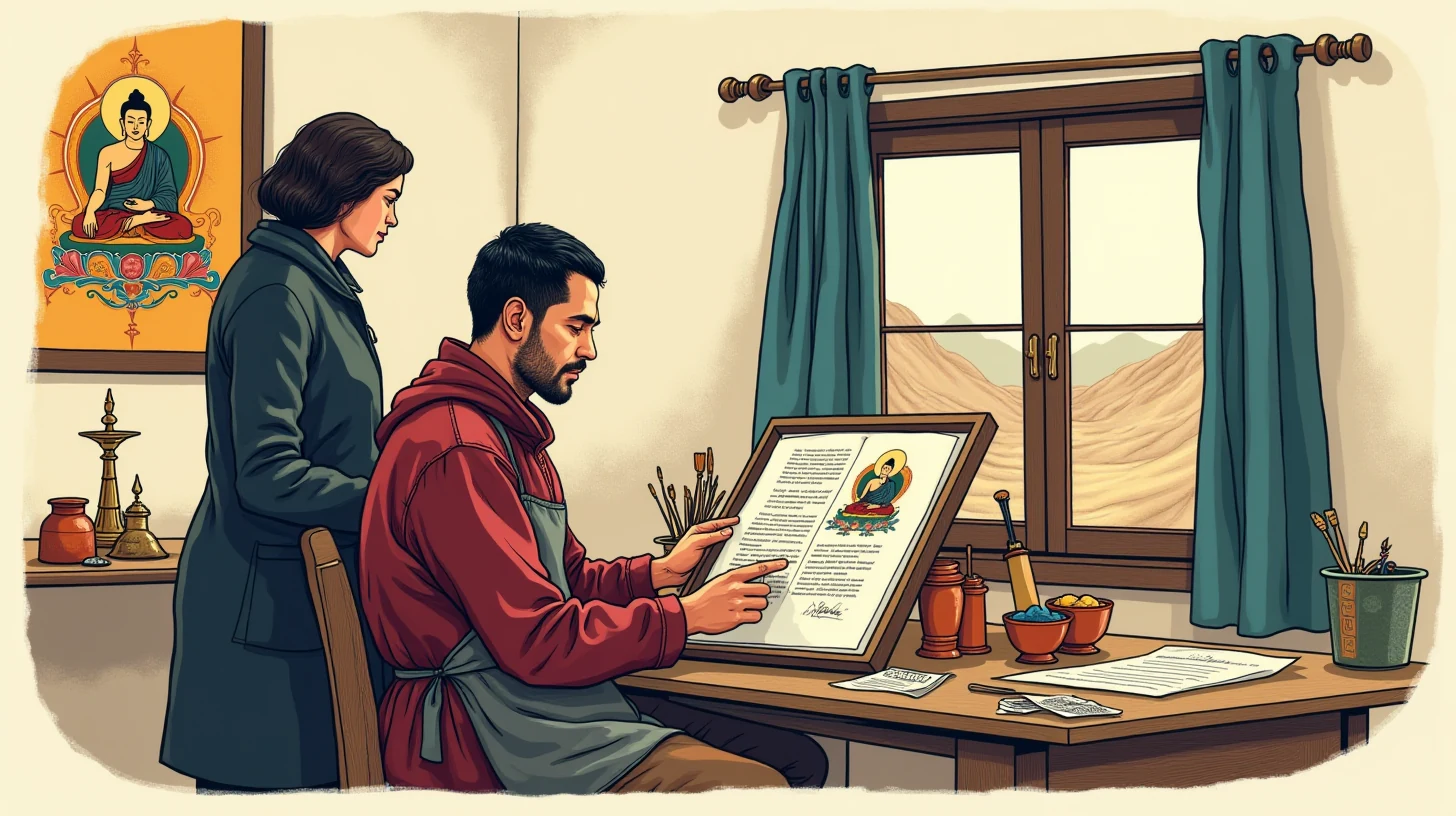
That was 1997. Tashi was sixteen. He worked for no wages, only meals, and learned to grind pigments from raw mineral ore, to prepare the cotton ground, to compose the symmetries of the Buddha's proportions — the specific ratios that Tibetan-Buddhist iconometric tradition prescribes. He learned the names of the pigments in Ladakhi and in classical Tibetan: gung for the rich yellow of turmeric, karpo for the white of chalk and crushed shell, nganmo for the deep blue of lapis lazuli. Some thangkas took three months. Some took a year.
In 2002, Tashi opened his own studio. Not a grand space — a small set of rooms in Karzoo, a neighbourhood south of the old town, with thick stone walls that kept the winter cold and the summer heat nearly bearable. He established a trade licence under the Jammu and Kashmir Shops and Establishments Act, which governed small retail and craft operations across the region. The licence was issued by the District Administration in Leh; it cost him ₹2,500, was valid for five years, and required renewal with an affidavit and a small fee paid at the District office.
For seventeen years, this was routine. He renewed it in 2007, 2012, 2017. He married in 2008. His daughter, Nandini, was born in 2010 and learned, without particular enthusiasm, to paint alongside her father from the age of eight. His son, Dorje, born in 2013, showed more temperament for it. By 2019, Tashi's studio had a reputation. He sold commissions to monasteries across Ladakh — the Hemis, Spituk, Diskit — and to private collectors as far as Delhi, Dharamshala, and the United States. His work in mineral pigments commanded prices that made sense: ₹18,000 to ₹65,000 for single-scroll thangkas, depending on size and complexity.
Then the administration changed.
🗓️ The Ladakh conversion and the vanished procedure
On August 5, 2019, the Jammu and Kashmir Reorganisation Act, 2019, came into force. The state of Jammu and Kashmir was bifurcated into two Union Territories: Jammu & Kashmir (with a legislature) and Ladakh (without one, under direct central administration). The consequences for the five hundred thousand people living on the Ladakh plateau were many and sudden: a new governance structure, a new civil administration, a new administrative code. A new Industries Department.
What nobody seemed to inherit was the detailed procedure for renewing a small trader's craft licence.
Tashi's 2017 licence expired in 2022. In March 2022, he approached the District Administration office in Leh — the same office where he had renewed it five times before — and presented the forms he had always presented: an affidavit, a copy of the previous licence, a small fee in cash. The official he spoke to, a man who had been transferred from Jammu the year before, told him to wait. The matter, he said, was under review by the Industries Department. The Industries Department was operating out of temporary offices and had not yet published its renewal procedures for traders under the new UT administrative code. He would contact Tashi when the process was clarified.
Tashi waited.
In June 2022, he returned to the office. The official told him the same thing: the procedures were still being drafted. In September 2022, he returned again. The office now had a different official — the first one had been transferred to Srinagar — and the new official had no record of Tashi's earlier visits. Tashi presented his documents again. He was told to file a request with the Industries Department via the Ladakh government website. He filed a request. No reply came.
In January 2023, Tashi decided to hire someone. He contacted a small administrative-consultancy firm in Leh that helped traders navigate licensing and permits. The consultant — a woman named Dorjey, who knew the Industries Department staff and had worked in the district administration herself before starting the consultancy — told him what she knew: the Industries Department was still drafting unified rules for all categories of traders in Ladakh. Some categories had been cleared. Craft and art studios had not. She said she would contact the Department on his behalf and would file an official request for the licence renewal.
Four months passed. In May 2023, Dorjey called him and said: "Tashi-la, they are saying that because your studio is small and produces art, it may fall under a different category — maybe handicrafts, maybe cultural exports, maybe something else. They don't have a clear answer. They want to know: Are you registered as an MSME? Do you export? Do you have GST? Once they know this, they can tell us which department actually issues your licence."
He was registered with Udyam as a micro-enterprise from 2020. He did not have a formal export licence. He had GST — his turnover had crossed the ₹40 lakh threshold in 2021 — but he had always filed returns as a domestic small business; none of his sales were itemized as "export".
- ⚖️
August 2019 — Ladakh becomes a UT
J&K Shops & Establishments Act procedures inherited by new Ladakh administration. District Administration is unclear which department now governs craft-studio licences.
- 📋
March 2022 — Tashi requests renewal
Presents the affidavit and forms he has always presented. Official says Industries Department is still drafting UT-specific procedures. Told to wait.
- 📨
June–December 2022 — No progress
Multiple visits yield no clarity. Each official claims the procedures are 'under review'. No formal written decision. No published timeline.
- 🗂️
January 2023 — Consultant Dorjey engages formally
Files official request on Tashi's behalf. Industries Department asks: Is he an exporter? Is he MSME-registered? Does he have GST? The answers will apparently determine which category he falls under.
- ⚠️
May 2023 — Waiting unresolved
After four months, Dorjey reports back: the Department still has no unified rules for craft exporters. Tashi's file is in a holding pattern.
- 💼
March 2026 — A US collector offers ₹6.2 lakh commission
The collector asks for proof of an active business licence before remittance. Tashi discovers his licence is officially lapsed, and renewal procedures remain unpublished.
Tashi paid Dorjey ₹8,000 for the consultancy work and decided to move on. He had sales to fulfil. He had commissions from monasteries. He was not going to sit in an office waiting for a bureaucracy that seemed, itself, to be waiting for something — perhaps clarity, perhaps a decision from the capital that would never arrive.
For nearly three years, he operated without a renewed licence. The District Administration did not knock on his door. The tax office — he was registered for GST and filed quarterly returns — did not ask for a licence number. His bank, J&K Bank in Leh, did not require it. He was, in practical terms, operating in a legal grey zone: his previous licence was expired, but the administration had not denied renewal and, equally, had not published the rules that would govern a new one.
Then, in March 2026, something changed.
⚠️ The US collector and the wire that cannot land
A thangka collector in Colorado — a woman named Sarah Chen who had purchased three scrolls from Tashi over the previous eight years — contacted him with a new proposal. She was curating a small private collection of contemporary Tibetan-Buddhist religious art and wanted Tashi to create a four-panel meditation thangka for her personal chapel. The commission: ₹6.2 lakh for six months of work, with a 50 percent advance by wire transfer before he began, and the balance on delivery.
It was the largest single commission Tashi had ever received.
He accepted. He arranged delivery logistics with an international art shipper in Delhi. He and Sarah exchanged contracts via email — a simple document, no legal embellishments, stipulating the iconometric specifications, the canvas size, the timeline, the payment schedule.
Then Sarah asked for something that froze him: "Tashi, before I send the wire transfer, I need confirmation that you hold a valid business licence. My accountant says this is required for a ₹6.2 lakh international art commission — she calls it a FEMA compliance thing. Can you send me a scan of your current business licence?"
He opened his files. He realized, in that moment, that he did not have one. His last valid licence had expired in 2022. The application for renewal had disappeared into the Industries Department. He had never received a rejection, a decision letter, a published rule, or a notice that his application was denied. He had simply been left in suspension.
He called Dorjey, the consultant, and explained the situation.
"Tashi-la, yeh problem hai. Bideshi wire kelie, we need a valid licence, we need FEMA clearance from the bank, we need a Foreign Inward Remittance Certificate. Your current Industries licence is expired. And jab tak Industries Department nai publish nai kiya renewal procedure, nahin milega new licence. Yeh circle hai."
(Tashi, this is a problem. For a foreign wire transfer, we need a valid business licence, FEMA clearance from your bank, and a Foreign Inward Remittance Certificate. Your current Industries licence has expired. And until the Industries Department publishes the renewal procedure, you won't get a new one. It's a circle.)
She told him she would make one more formal inquiry to the Industries Department. In the meantime, she said, they might need to consider approaching this differently: perhaps filing an export-trader registration, or an artist-residency visa for the work, or approaching the District Administration directly with a plea for an interim renewal pending the UT's final rules.
Tashi had three weeks before Sarah's accountant needed an answer. He had no idea whether the Industries Department would respond in that time. He had no idea what the final rules were, or when they would be published, or what his status as a painter selling thangkas to foreign collectors actually meant under Ladakh's administrative code.
He was, in other words, in the exact position the brief administrative limbo had created: holding a large commission, unable to accept it.
Pre-2019: J&K Shops & Establishments Act
Established procedureTrader files affidavit + previous licence copy with District Admin. Fee ₹2,500–5,000. Renewal issued within 1–2 weeks. Published renewal schedule in district office notice board.
Post-2019: Ladakh UT (2019–present)
No published procedureNo unified renewal rules published by Industries Department. Traders directed to wait for 'unified UT procedures'. No timeline for publication. No formal rejection or interim authorisation for pending applications.
Impact on craft exporters
Licence limboTashi's 2023 renewal application is unresolved. Cannot prove licence validity to foreign buyers. Cannot accept wire transfers without FEMA compliance proof. Consultant Dorjey reports no craft-studio category yet defined in new UT code.
🌗 The agent, the portal, and the forgotten category
Tashi had been given access, some months earlier, to an AI assistant that spoke Hindi and Ladakhi. A colleague in Leh — another thangka painter who had used it to parse a GST query — had suggested it. He had downloaded it on his phone, half-skeptical. The assistant claimed to know Indian government systems. He decided to try it.
He opened the app and typed, in Ladakhi:
"Kho, ma thangka-painter yin, Leh-la. Kho, UT Ladakh trade-licence renewal thob-log ma yod. US collector-la ₹6.2 lakh commission yod. She kyi bank-la valid licence srol. UT Industries Department thang-lung me ma yod. Kho srol chi-log men?"
(I am a thangka painter, in Leh. I don't have a Ladakh UT trade-licence renewal. A US collector is sending me a ₹6.2 lakh commission. Her bank wants a valid licence. The UT Industries Department has no published process. What should I do?)
The assistant replied in Ladakhi, slowly and carefully:
"Tashi-la, yara che. First, we check three things: (a) UT Ladakh ma Industries Department website la current procedures yod chi-check, (b) J&K Bank Leh la FEMA rules for artists yod chi-learn, (c) your file thang-lung Industries Department-la pending yod chi-confirm. Then, we find what category you actually belong in."
It asked Tashi to pull up the Ladakh government website. He did. It walked him through the Industries Department page — which listed licencing categories for hotels, restaurants, shops, small-scale manufacturing, but nothing explicitly for "artist studios" or "craft creators" or "traditional painters". The page also had a link to a policy document still marked "DRAFT" and dated January 2025. It had never been published.
The assistant flagged this: "Yeh important che. 'Draft' policy means the actual rules don't exist yet in law. Your application from 2023 can't be processed under rules that don't exist. This is not your fault. This is administrative gap."
It then asked Tashi whether he had GST registration, which he did, and whether he had ever itemized his sales to foreign buyers as "exports". He had not — he had simply sold to Sarah and two other US collectors as "art sales" without distinguishing them from domestic sales.
The assistant said: "This matters. Because RBI FEMA rules require that anyone earning foreign currency in excess of ₹10,000 in a financial year — whether it's exports or services or commission work — must be classified as an exporter for regulatory purposes. Your ₹6.2 lakh from Sarah puts you well into this. So technically, you need either (a) an export licence from Commerce Department, OR (b) an exemption from RBI, OR (c) classification as a self-employed artist under FEMA Schedule."
It pulled up, from the RBI website, a section on Schedule 7 of the FEMA Rules, which allows self-employed professionals — artists, consultants, writers — to receive foreign remittances directly into an Indian bank account without an export licence, provided they file the correct declaration with the bank and can prove the work is legitimate.
"Your J&K Bank branch in Leh can process Schedule 7 if you give them: (a) a declaration that you are a self-employed artist, (b) proof of your work — photographs of thangkas you've sold, correspondence with collectors, (c) evidence of your Udyam registration, (d) a copy of the contract with Sarah Chen. This avoids waiting for Industries Department renewal. The bank will issue the Foreign Inward Remittance Certificate once the wire lands."
"Kho ma ngak-la bcu-bzhon, kho art-work yin. International-la sale-karko yin. Yara Industries Department-la renewal thob-log mi-srol che. Kho bank-thang FEMA-chog po tan-sa shakti yin."— I am a painter. My work is art. It is sold internationally. I cannot wait for the Industries Department's renewal procedure that does not exist. I can approach the bank directly and ask for FEMA compliance.
"Tashi-la, yara check karko. Schedule 7 under FEMA Rules, 1999 — self-employed artists can receive foreign remittances directly. RBI nai clarified this in 2020. Your bank knows this. You don't need Industries Department renewal to accept Sarah's wire. You need bank declaration and FEMA proof. These can happen in two weeks."
(Tashi, let me confirm: Schedule 7 of the FEMA Rules allows self-employed artists to receive foreign remittances directly. The RBI clarified this in 2020. Your bank knows this. You don't need the Industries Department renewal to accept Sarah's wire. You need a bank declaration and FEMA proof. These can happen in two weeks.)
Tashi's eyes, which had been fixed on a half-finished thangka on his studio wall, refocused on the phone screen. The assistant was not telling him to wait. It was not telling him that the Industries Department's published procedures would solve this. It was telling him that there was a separate regulatory path — an older, less visible path — that had nothing to do with the UT's unfinished administrative reorganization.
The category he belonged in was not "craft studio" or "small art business". It was "self-employed artist under FEMA Schedule 7". The path was not through the Industries Department. It was through his bank.
🧭 Why artists fall through UT transitions
The Ladakh UT-conversion of 2019 was not unique. When administrative boundaries shift — when a state becomes two union territories, or when a new ministry assumes jurisdiction, or when a five-year licence regime is replaced by a new one — the entities that are most likely to disappear into limbo are those that don't fit neatly into established categories.
Thangka painters are one example. They are not restaurants. They are not hotels. They are not "manufacturers" in the sense of industrial production. They are not retailers in the traditional sense — they sell made-to-order commissions, not stock. The old J&K Shops and Establishments Act had a catch-all category — "trader" or "business operator" — that encompassed a painter's studio. It was an administrative box.
When Ladakh became a UT and the Industries Department began drafting new rules, it drafted rules for hotels, restaurants, shops, small-scale units. No one explicitly said, "What about thangka painters?" And no one explicitly said, "Thangka painters fall under the old rules until we publish new ones." The result was silence, and silence meant limbo.
This affects not just painters but textile artisans, sculptors, metalworkers, illustrators, UI/UX designers freelancing across state lines, boutique creators selling on Instagram, anyone whose work doesn't fit neatly into "manufacturing" or "retail" or "services" as traditionally defined. They disappear into administrative transitions.
What the assistant had shown Tashi was that there was a different entry point: FEMA Schedule 7, available to any self-employed artist earning foreign currency, was not new and was not dependent on the Ladakh Industries Department completing its procedures. It had existed since 1999, was clarified by the RBI in 2020, and was available immediately through his bank.
It was, in short, a more recent administrative technology than the one the Industries Department was still building. And it bypassed the gap entirely.
What it does
- 🔍Verified that Ladakh Industries Department had not published renewal procedures for craft studios as of May 2026.
- 📑Located the FEMA Schedule 7 framework that allows self-employed artists to receive foreign remittances without an export licence.
- 🗂️Identified the documents Tashi would need to provide his bank: Udyam certificate, contract with Sarah, thangka portfolio, artist declaration.
What it does not do
- 🔒Never created a false licence or document. Never submitted anything on Tashi's behalf to the bank or Industries Department.
- 💳Never processed the wire transfer or handled the money. Only explained the regulatory path.
- ✅Never decided whether Tashi 'should' accept the commission or pursue the Industries Department renewal. Only gave him the information to decide.
🌱 The thangka that waits
Tashi spent a week gathering documents. He photographed six of his completed thangkas, showing the progression from preliminary ink sketches to mineral-pigment work to final gold-leaf finishing. He collected his Udyam registration certificate, his GST registration, his bank statements showing the previous two sales to Sarah and the Colorado collector's signed commission contract. He drafted a declaration — in English and Ladakhi — stating that he is a self-employed artist specializing in Tibetan-Buddhist religious iconography and that he intends to receive a foreign remittance of ₹6.2 lakh for original artwork.
He walked into the J&K Bank branch in Leh on a Tuesday morning and asked to meet the person who handles foreign remittances. The officer he was sent to — a woman named Tenzin Dorjay, originally from Spituk — listened to his explanation, examined his documents, and nodded.
"Tashi-la, yeh clear case yin. FEMA Schedule 7, self-employed artist. Normal jo-srol yin. We process this in two, three days. Sarah kyi wire aay-ga, FIRC issue karko tanggi jo-srol yin."
(Tashi, this is straightforward. FEMA Schedule 7, self-employed artist. It's standard procedure. We'll process this in two or three days. Once Sarah's wire arrives, we'll issue the FIRC, which is the normal process.)
She asked Tashi to sign the FEMA declaration and to provide the bank with Sarah's remittance details. He did. The bank submitted his file to its compliance team. On the third day, he received a confirmation: his account was now flagged for FEMA Schedule 7 foreign remittances, and the bank was ready to receive the wire.
He sent Sarah the clearance, and the wire transfer landed four days later. The Foreign Inward Remittance Certificate was issued automatically once the funds cleared.
Tashi's registration with the Ladakh Industries Department remains unresolved. The Department has not renewed his licence. The Department has not rejected his application. The Department, as of this writing, has not published a unified renewal procedure for craft and art studios. His 2023 application sits in an administrative file, waiting.
But the thangka is being painted. Sarah's 50 percent advance is in his account. He is, in regulatory terms, on the correct side of the FEMA framework — no longer in a grey zone but explicitly classified as a Schedule 7 self-employed artist, which is the formal recognition that he is a creator whose work commands international value.
When the commission is finished, he will send it to Sarah. J&K Bank will issue a final FIRC. Sarah's accountant will have the compliance documentation.
What Tashi discovered was not that the Industries Department's gap was solved — it isn't — but that the gap was not the only door through which an artist could walk. The other door, older and less visible, had been open all along. He simply did not know it was there.
Neither did his consultant Dorjey. Neither did the District Administration official who told him to wait. The agent on his phone knew it, because it had read the RBI's FEMA rules with the same care it might read a thangka painter's application letter: not looking for the most recent regulation, but for the one that fit the actual shape of what he was doing.
For artists in the Indian economy — whether they are in transition-states like Ladakh or in established administrations like Delhi — the question is often not whether the bureaucracy can recognize what they do, but whether they can find the part of the bureaucracy that already has.
Tashi Norboo is currently accepting commissions for both traditional Tibetan-Buddhist thangkas and contemporary secular scroll-painting work. His studio is in Karzoo, Leh, and he works with clients across Asia and North America. If you are a thangka painter, textile artist, or craft creator in a UT or state with ambiguous administrative status, or if you receive foreign commissions and are unsure about FEMA compliance, the agent at gabforge.in speaks Hindi, Ladakhi, and can walk you through FEMA Schedule 7 and the regulatory paths available to you. It is free.