
The Lucknow chikankari designer and the GI authorised-user the karkhana lost
Anjum Khan sat at her cutting table in Aminabad, a quiet corner of Old Lucknow where the smell of indigo vats and tamarind paste hung in the afternoon air. It was late April 2026. In front of her lay a half-finished cream sari panel—eyelet holes marked in chalk, waiting for her needle-women, her aaree and chikankari specialists, to turn the marks into negative space and gossamer shadow-work. She had employed the same twenty-three karigars, most of them women from the surrounding lanes, for eight years. They knew her hand. She knew theirs.
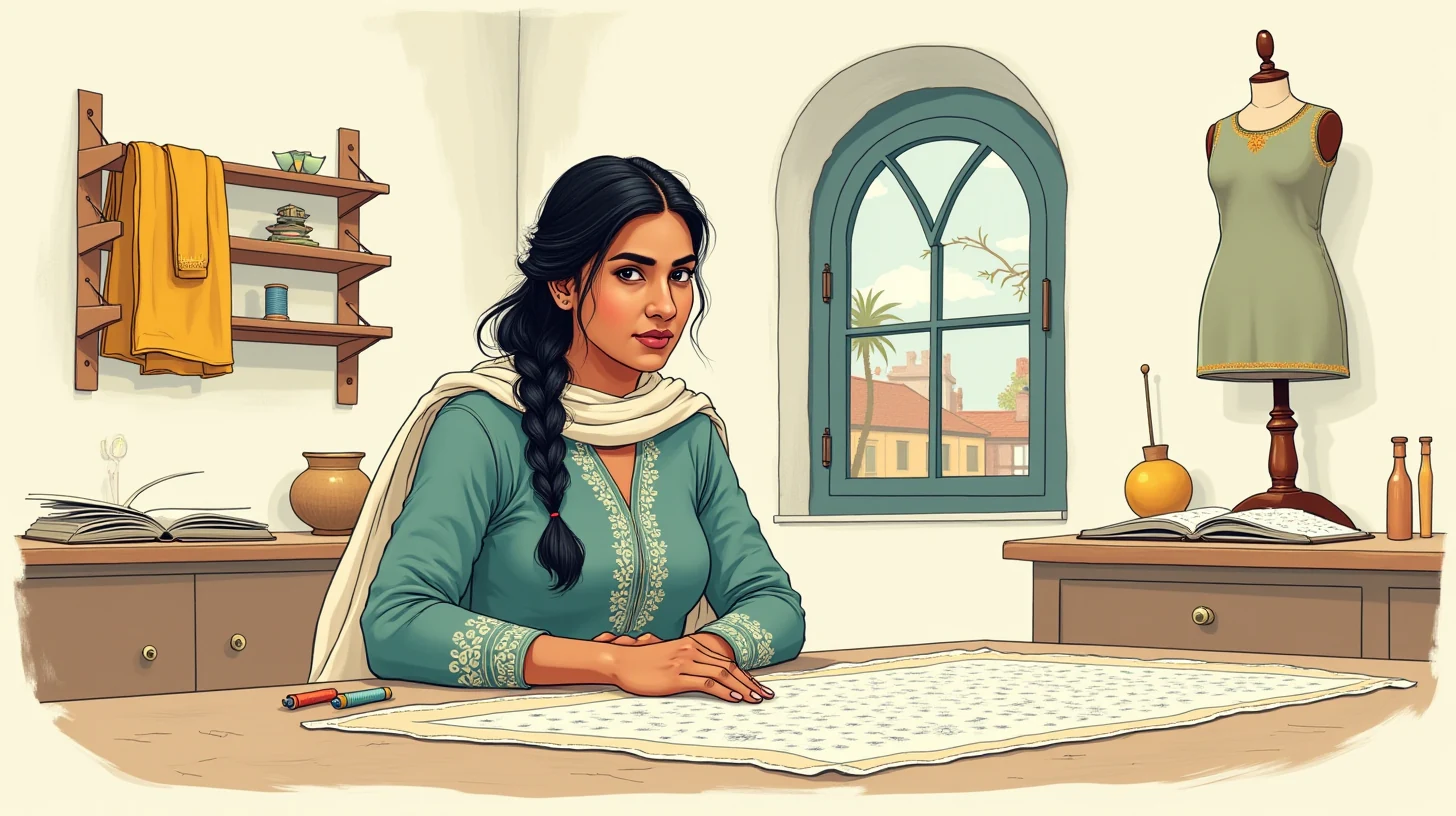
At thirty-four, Anjum had taken over the studio from her mother-in-law seven years ago—the same studio that had stitched Lucknow chikankari for three decades. Her kurtas sold to boutiques in Bangalore and Mumbai. Saris went to weddings in Delhi. A handful of her pieces had been featured in craft magazines. But her real dream had crystallized two months earlier, when an ODOP export buyer—a major procurement officer for a UAE department-store chain—had walked into her studio and asked how many ready-to-wear sets she could deliver in ten weeks.
₹38 lakhs. The number still made her fingers tremble.
The buyer had been clear: the order required an "authorised-user certificate" under the Lucknow Chikan Craft Geographical Indication. Anjum had nodded as if the phrase was familiar, but her chest had tightened. She knew the term vaguely. She knew that the GI—registered in 2008—was supposed to protect the craft, give it legal shield in export markets. But the certificate that hung on her studio wall, framed and fading in the sunlight, was in her late mother-in-law's name. And when Anjum had looked at the date printed at the bottom, she had felt her breath catch.
It had expired in 2022. Seven years had passed without renewal. No one had told her. No one had knocked on the door. No summons, no warning. The certificate had simply lapsed.
🗓️ The annual rhythm nobody keeps
The Lucknow Chikan Craft Geographical Indication was registered with IP India on 25 February 2008. It was a landmark moment for the craft—the first time the Government of India had formally recognized and protected Lucknow chikankari as a product with an origin-based identity. The GI meant that only craftspeople from Lucknow, using traditional methods, could legally use the mark. It was, in theory, a shield against imitation and a signal to buyers abroad: this work is authentic.
To use the mark—to print it on a label, to tell a buyer that the sari or kurta was GI-protected—Anjum needed to be an "authorised user" of the GI. The process was straightforward on paper. An artisan or a karkhana registered with the GI Registry at Chennai. The registration confirmed that you were eligible: a person of Indian nationality, based in Lucknow or a specified area, and practising the traditional craft. Once registered, you got a certificate. The certificate had a validity period. And when the validity ended—typically three to five years after issue—you had to apply to renew it.
In Anjum's case, the certificate had been issued to her mother-in-law in 2019, valid for three years. The renewal window opened in 2022. The deadline came and went. No reminder arrived from the GI Registry. No email. No automated SMS. The certificate simply expired, and the karkhana's right to use the Lucknow Chikan Craft mark on goods or export documentation dissolved.
- 📨
February 2019 — Certificate issued
Anjum's mother-in-law receives GI authorised-user certificate for Lucknow Chikan Craft (IP India GI Registry, Certificate No. CGI-100). Valid for 3 years.
- ⏰
February 2022 — Renewal window opens
The GI Registry sends renewal notice to the registered address (or does not send it). The artisan has 6 months to renew. No reminders after this point.
- 🛑
August 2022 — Certificate lapses
The validity period ends. The certificate is no longer legal proof of authorised-user status. The karkhana can no longer claim GI protection in any export transaction.
- ₹
April 2026 — Fresh application required
Anjum discovers the lapse when an ODOP buyer asks for proof. To use the mark again, she must file as a new applicant, not a renewal. Processing: 4–6 months at GI Registry Chennai.
Most artisans in Lucknow chikankari did not know about the renewal cycle. The craft had been passed down through families for centuries; the GI protection was a recent, bureaucratic layer. Many karkhanas—small family studios and workshops—operated without formal registration at all. Those who had certificates often kept them on a shelf, framed and forgotten. The DC Handlooms office in Lucknow had no mandate to remind artisans when their GI certificates were about to expire. The GI Registry at Chennai, which administered the system, had no way to track who had moved houses, whose contact information had changed, whose certificate was about to lapse in a given month.
The result was silent attrition. Artisans who had earned the right to use the mark—who had submitted documents proving their craft, their location, their legitimacy—lost it without ever knowing they had lost it.
⚠️ The export order that arrived too late
Anjum first met the ODOP buyer, a woman named Priya, at a craft fair in Lucknow in late February 2026. Priya worked for a procurement team that sourced artisanal goods for department stores across the Gulf. She had been drawn to Anjum's saris—the precision of the eyelet work, the fineness of the shadow stitches, the restraint of the design. She had watched Anjum demonstrate the hari pati technique, the way the needle moved from underneath the cloth to create a hollow-eyed texture.
"How many can you make in three months?" Priya had asked.
Anjum had laughed. "Depends. Thirty saris? Fifty kurtas with matching dupattas?"
"I'm thinking bigger," Priya said. She pulled out her phone. "A UAE department store—one of the biggest chains there—wants to stock Indian artisanal saris. They want fifteen different designs, fifty pieces per design. That's seven hundred and fifty pieces. Ready-to-wear. ₹500 per piece wholesale. Seventy-five thousand pieces in three months... I mean, thirty-seven and a half lakhs."
Anjum had felt her mouth go dry. ₹37.5 lakhs was more money than she had seen in her lifetime. It was enough to expand the studio, hire more karigars, buy better equipment. It was enough to send her two children to the school she had always wanted for them.
"I'll need to see your export documentation," Priya had continued. "GST, obviously. And for Indian craft going to the Gulf, the buyer's compliance team asks for GI protection if the product is GI-registered. Shows authenticity. Lucknow Chikan Craft is GI-registered, right?"
"Yes, yes," Anjum had said quickly, and Priya had smiled and walked away.
It was only after Priya left that Anjum had gone back to her studio and taken the framed certificate off the wall. She had turned it over in her hands, looking at the date at the bottom. And her heart had sunk.
She had called her lawyer—a young man named Rajesh who handled her trademark renewals and GST complications. "The certificate expired in 2022," she said. "But we still make chikankari. The same way. Can we renew it?"
"Theoretically, yes," Rajesh had said carefully. "But you'll need to treat it as a fresh application, not a renewal, because the lapse has broken continuity. You'll file Form CGI-1, submit the credentials again, proof of address, proof of craft practice, photographs of the workspace. Then you wait for the GI Registry to process it."
"How long?"
"Usually four to six months."
Anjum had closed her eyes. "Priya gave me ten weeks."
Rajesh had been quiet. "Then you have a problem," he had finally said.
Renewal (if eligible)
6 weeks (rare)If a certificate has lapsed within 12 months, some registries allow simplified renewal. Requires minimal new documentation. But Anjum's certificate lapsed in August 2022—more than 3.5 years ago. She is no longer eligible for renewal. She must file fresh.
Fresh Application
4–6 months (typical)Anjum files Form CGI-1 as a new applicant. She submits proof of nationality, proof of location in Lucknow, photographs of her studio and karigars at work, samples of her chikankari pieces, and affidavit of craft practice. The GI Registry examines the application, publishes it for objections, then grants or denies. Typical wait: 4–6 months from submission to certificate.
Anjum's timeline
10 weeks (deadline)The ODOP buyer's PO is contingent on a valid GI certificate. The buyer's importer in the UAE expects proof before releasing payment. Ten weeks from late April to early July. Anjum cannot meet both deadlines—a fresh GI application and the export delivery—with the standard processing time.
🌗 The agent surfaces the workaround
Anjum was lying awake at two in the morning in the first week of May, thinking through options that did not exist, when her cousin Fatima—who worked in a Delhi-based craft export company—called from an unexpected direction.
"I sent someone a form once," Fatima had said, her voice bright even in the small hours. "An India Stack form. Some bot thing. And it solved it faster than a lawyer. Let me send you a link."
The link took Anjum to a simple tablet interface. She had used the agent before, for GST questions. But this time, she started a new conversation. She typed, in Urdu, slowly, searching for the right way to phrase the problem:
"Mera karkhana Lucknow Chikan Craft GI mein registered tha. Certificate lapse ho gaya. Ab naya buyer hai jo GI certificate maang raha hai. Dusri oor, mera lawyer kehta hai fresh application 4-6 maheene lagega. Kya koi aur rasta hai?"
(My karkhana was registered under the Lucknow Chikan Craft GI. The certificate has lapsed. Now I have a new buyer who is asking for the GI certificate. On the other hand, my lawyer says a fresh application will take 4–6 months. Is there another way?)
The agent's response arrived within seconds:
"GI Registry Chennai ke site pe check kijiye—Expedited Examination Scheme agar available hai. Kuch GI Registry-ns fast-track processes dete hain agar applicant small artisan hai aur export order mein urgency hai. DC Handlooms Lucknow ko call kijiye; wo endorsement letter de sakte hain jo application ko fast-track kar sakta hai. Form CGI-1 mein 'Export Order Supporting Document' ke liye ek line hote hain—Priya ka email aur PO copy attach kijiye."
(Check the GI Registry Chennai website—there may be an Expedited Examination Scheme available. Some GI Registries offer fast-track processes if the applicant is a small artisan and there is urgency due to export orders. Call DC Handlooms Lucknow; they can issue an endorsement letter that might fast-track the application. In Form CGI-1, there is a line for "Export Order Supporting Document"—attach Priya's email and the PO copy.)
Anjum had read the response three times, then called Rajesh.
"Has anyone ever told you about expedited examination?" she asked.
Rajesh had paused. "I... I've heard the term. But I've never filed for it. Most of my clients are not in a hurry. Let me look into it."
What he discovered, in a handful of phone calls to the GI Registry and the DC Handlooms office, was that Anjum had three levers she had not known existed:
First, the GI Registry did offer expedited examination for artisans with export orders in hand. The scheme was not widely publicized. The processing time fell from 4–6 months to 8–10 weeks—still tight, but survivable within Anjum's deadline.
Second, the DC Handlooms office could issue a letter endorsing her application, certifying that she was an active handloom producer and that the craft practice was legitimate. This endorsement added weight to the application and signalled to the Registry that the urgency was real.
Third, the application itself—Form CGI-1—had a field for "supporting documents related to the product or applicant." An export order with a buyer's letter of intent, Rajesh explained, qualified as supporting documentation. Priya's email and the draft PO were gold.
"So I call them?" Anjum had asked.
"First, we call the DC Handlooms," Rajesh said. "Tomorrow morning."
"Main samajhti hoon ki karkhana chalaana aur court chalana—dono mein hi kanoon aur patience chahiye. Agar main apna karkhana close kar dun, toh mera parivar ka kya hoga? Lekin agar main kaanoon ko ignore karun, toh mera karkhana hi close ho jayega. Main dono rasten ke beech chalti hoon har din."— I understand that running a karkhana and navigating courts require both law and patience. If I close my karkhana, what becomes of my family? But if I ignore the law, my karkhana will close anyway. I walk both paths every day.
🧭 Why the system fails artisans, and why it matters
The GI protection was meant to be a safeguard. But it had become a trap for artisans like Anjum because the system—both the GI Registry and the craft ecosystem around it—assumed that artisans had access to legal counsel, had time to track renewal deadlines, and had a relationship with a government office that would remind them when documents were about to expire.
None of that was true for most chikankari producers. Anjum's mother-in-law had received the certificate in 2019, framed it, and moved on. She had not known that certificates expired. When she had fallen ill in 2021 and passed away in 2023, the knowledge of renewal had died with her. Anjum, inheriting the studio, had inherited the certificate but not the documentation process that came with it.
The GI Registry at Chennai—an office of IP India—administered the system for all of India's geographical indications: Basmati rice from Haryana, Darjeeling tea, Chanderi sarees, Varanasi silk, Lucknow chikankari. Hundreds of artisanal products. The office employed fewer than fifty people. It had no mechanism to track artisans' contact information, no reminder system, no proactive outreach. When a certificate was about to expire, the Registry might send a notice to the registered address—but if an artisan had moved, if a studio had changed hands, if a phone number was outdated, the notice was lost.
The GI protection was supposed to help artisans compete in export markets by guaranteeing authenticity. Instead, it became a barrier to export. Buyers in the UAE, in the US, in Europe, expected the GI certificate. Export companies like ODOP included it in their due diligence checklist. But there was no failsafe for artisans whose certificates had lapsed through no fault of their own—no "provisional export license" while a fresh application was pending, no fast-track window for artisans who were active and in good standing.
An artisan in Jaipur making Jaipur Blue Pottery faced the same problem. A weaver in Kanchipuram with a lapsed Kanchipuram Saree certificate would be turned away by export buyers. A producer in Odisha working with Odisha Filigree would lose access to overseas markets not because the craft had changed, but because a piece of paper had expired.
For most of these artisans, a lawyer was an unaffordable luxury. A CA's fee for handling a GI application—even a fresh one—ran to ₹15,000 to ₹30,000. That was a month's wages for many of the karigars that Anjum employed. An agent that could surface the expedited-examination scheme, that could organize the supporting documents, that could draft the application and tell an artisan exactly which office to call and in what order—that was the difference between a ₹38-lakh order that happened and one that evaporated.
🌱 The quiet work of renewal
By the first week of June, Anjum had filed Form CGI-1 with the GI Registry at Chennai under the Expedited Examination Scheme. She had attached Priya's letter of intent, photographs of her karigars at work, a notarized affidavit of craft practice, and the endorsement letter from the DC Handlooms office. Rajesh had guided her through each field. The agent had verified the form requirements against the IP India website and flagged that she had not yet scanned her proof of address—she had sent a utility bill photo instead—and the Registry preferred a scanned version. She had rescanned and resubmitted.
Two weeks later, the application had been published on the GI Registry's website for a thirty-day opposition period. No objections had arrived. In the second week of July—nine weeks after her deadline conversation with Priya—the certificate had been issued. It arrived by email and by courier: a new certificate, in Anjum Khan's name this time, valid until 2029, bearing the GI mark and the seal of IP India.
Anjum had framed it.
The export order had arrived on schedule. The 750 saris and kurtas had shipped in the third week of July. The buyer in the UAE had accepted the shipment. Priya had called with news of a second, larger order.
The agent had not made the renewal happen. The agent had not negotiated with the Registry or appealed to any official. But by surfacing the expedited scheme, by organizing the documents, by telling Anjum exactly where to call and what to file, it had made visible a path that Rajesh's traditional legal approach would have missed. The difference between a lawyer who says "this will take six months" and an agent that says "there is an expedited scheme that takes ten weeks"—that difference is often the difference between an order that lands and one that is lost.
This matters not because the agent is a substitute for expertise—it is not—but because expertise, for most artisans in India, is locked behind fees they cannot pay and time they do not have. An agent that democratizes access to that expertise, that turns a ₹30,000 legal problem into a ₹300 tablet conversation, changes the marginal calculus for an entire class of makers.
In Lucknow, in the studios of Aminabad and beyond, there are dozens of artisans whose certificates have lapsed, whose export orders are waiting, whose deadlines are closing in. Most of them do not yet know there is another way. But for those who find it—whether through a cousin's phone call or a forum thread or a chance conversation—the world opens a little wider.