
The Raipur Bastar Dhokra designer and the Handicraft Development Commissioner card
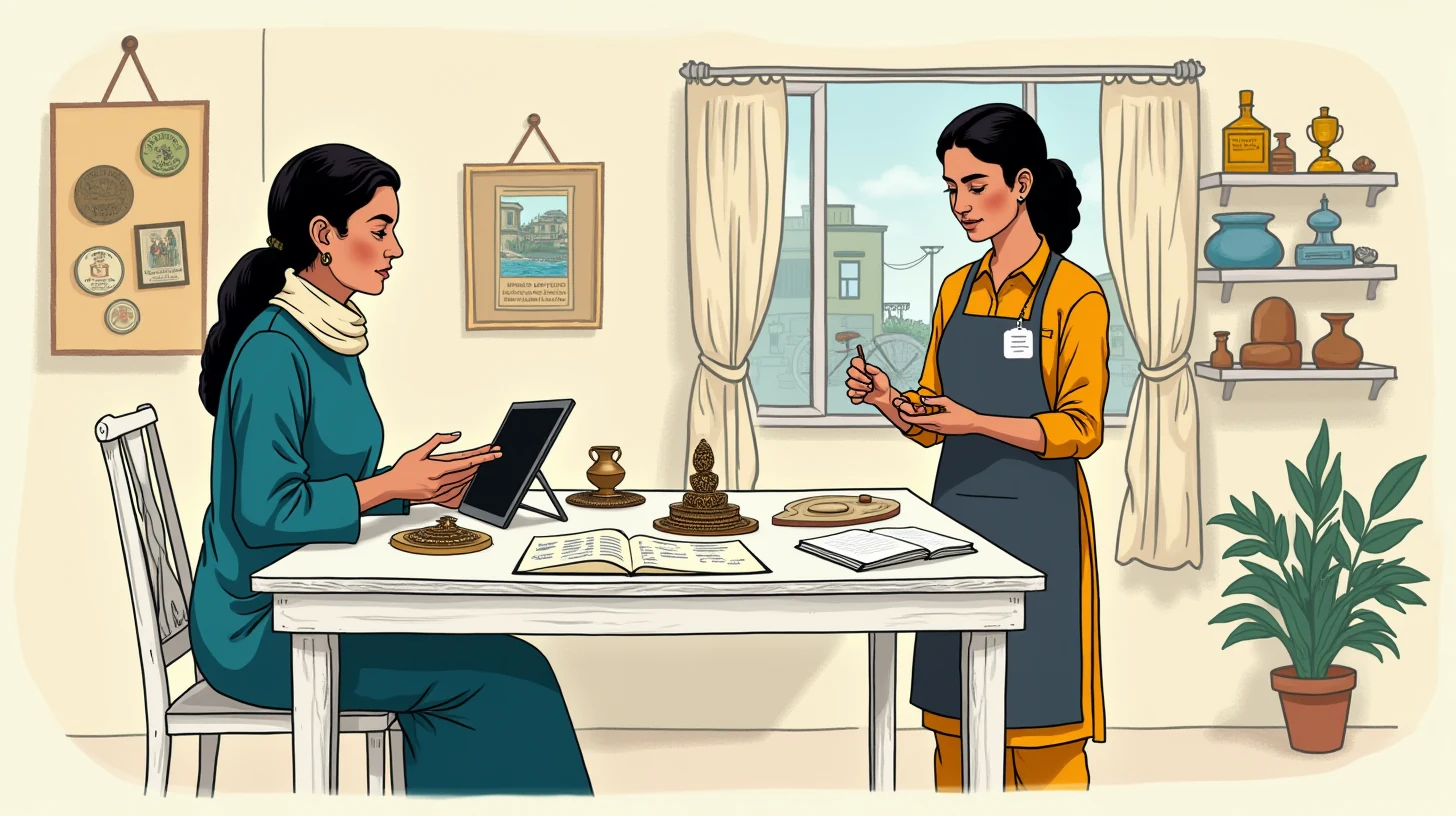
Tejaswini Sahu's studio occupies a narrow room on Shankar Nagar Road, Raipur, sandwiched between a shuttered tailor shop and a mobile-phone repair stall. She has been there for four years—long enough to sand down the concrete floor smooth, to learn the names of the street dogs, and to establish a quiet rhythm with the artisans of Kondagaon, a village seventy kilometers south, where families have cast Bastar Dhokra for four generations. At thirty-six, she moves with the precision of someone who has spent her twenties learning to see what others miss: the molecular tightness of a wax model before the bronze pour, the way light catches the hollow geometric patterns that make Dhokra distinct from mass-cast jewelry. She calls the pieces "conversational bronze." Each one is a negotiation between her vision—sketched in a Wacom tablet, refined in handwax, sent to Kondagaon as a three-dimensional brief—and the inherited muscle memory of the artisan families who know how to make the metal sing.
Her income is modest but stable. A single piece sells for ₹8,500 to ₹14,200, depending on size and intricacy. She ships to craft websites, boutique jewelry galleries in Bangalore and Delhi, and a handful of corporate clients who commission pieces for office installations. She employs no one full-time. The Kondagaon families work on commission—a percentage of the final sale price, negotiated piece by piece. She keeps meticulous digital records: receipts, payment dates, high-resolution photos of every casting, the names of each artisan contact. Her GST returns arrive on schedule. She pays income tax. By every bureaucratic measure that matters, Tejaswini runs a legitimate design studio, a micro-enterprise in India's creative economy.
Then, in late April, she received an email from a friend, Rashmi, also a designer—a textile illustrator in Mumbai. Rashmi had just been approved for the Office of the Development Commissioner (Handicrafts) Artisan Identity Card, which unlocked access to a state-subsidized marketing scheme. The card came with a certificate, quarterly subsidies for booth space at national craft fairs, and a commercial listing on the handicrafts.gov.in portal. For a designer like Rashmi, operating at the edge of formal recognition, the card was worth applying for. Tejaswini looked into it. The eligibility criteria seemed straightforward. Then she encountered the affidavit.
To apply for the DC Handicrafts Artisan Identity Card, an applicant must submit, among other documents, a "Self-Sworn Affidavit of Artisan Status" confirming direct participation in handicraft practice. For Tejaswini, the problem materialized in a single line: The affidavit must be sworn before a notary, and it requires the applicant to declare themselves either a hereditary artisan (demonstrating kinship to registered craft families) or a direct practitioner with documented training in the craft.
She is neither. She did not grow up in a Dhokra family. She learned the aesthetic through years of independent study—books on tribal metalwork, museum visits, apprenticeships with metalworkers in Madhya Pradesh, travel notebooks filled with sketches. She is a designer first, a facilitator of artisan labor second. The line between her and the Kondagaon families is deliberate: they cast; she envisages. The Geographical Indication for Bastar Dhokra, registered with ipindia.gov.in in 2019, protects the practice of artisans within the Kondagaon cluster, not downstream designers. Yet the DC Handicrafts application form did not seem to recognize this distinction. It asked for a single category: Are you an artisan? Yes or no?
- 📱
Late April — Application Submitted
Tejaswini submits her initial application to the DC Handicrafts regional office in Raipur, attaching GST certificate, business license, portfolio photos, and proof of address. Office staff acknowledge receipt.
- ⚠️
Early May — Affidavit Requirement Surfaces
A response email lists four outstanding documents: the Self-Sworn Affidavit of Artisan Status, a letter from the Chhattisgarh Handicraft Development Board (or equivalent state agency) confirming her craft registration, and two references from registered artisans or craft organizations. The deadline is twenty-one days.
- 🛑
Mid-May — Office in Training Programme
Tejaswini calls the DC Handicrafts office to clarify the affidavit language. A junior staff member informs her that the office has entered a six-week mandatory training programme on e-governance and new artisan data standards. All verification work is on hold. Phone lines will be unmonitored.
- 🧭
Late May — Pivot to State Board & Agent Consultation
On advice from a peer, Tejaswini registers with the Chhattisgarh Handicraft Development Board and consults the agent to map the affidavit ambiguity and identify a pathway forward that does not require falsifying her relationship to the artisans.
🗓️ The annual rhythm of design-craft hybridity
The Indian handicraft system rests on a historical assumption: artisans and designers are separate categories. An artisan is a person embedded in a hereditary or community craft tradition, with documented lineage and technical mastery validated by peer recognition or guild membership. A designer is a formal-education credentialed professional who may source artisanal labor but is not themselves a craft practitioner. The two roles have different tax structures, different training pathways, different government scheme eligibility, different liability frameworks.
This boundary worked cleanly when most designers were urban, salon-educated, and employed by formal enterprises. It collapses when a designer like Tejaswini lives in a Tier-2 city, works in a craft-adjacent medium, and depends entirely on relationships with hereditary artisans. She is not a hobbyist. She is not an art-school dropout. But she is also not a Kondagaon family member. The bureaucracy does not have a name for what she is.
The Office of the Development Commissioner (Handicrafts), part of the Ministry of Commerce & Industry, operates two schemes designed to support artisans:
The Artisan Identity Card and Marketing Support programme: Provides up to ₹50,000 annually in booth subsidies, online listing on the government portal, and quarterly eligibility for craft fair participation. The annual outreach is approximately ₹18 crores across India.
The Handicraft Cluster Development scheme: Supports geographically concentrated craft zones—like Kondagaon—with infrastructure, training, and export linkages.
Bastar Dhokra qualifies for the second scheme by virtue of its Geographical Indication status. The GI, registered in 2019 and renewed in 2024, protects the heritage name and technique across the cluster. But only artisans within the cluster can claim the GI tag on export paperwork. A designer in Raipur, even one who sources from Kondagaon, cannot sell as "Bastar Dhokra"—she can only sell as "contemporary bronze design inspired by Bastar Dhokra." This is not a minor distinction. The GI opens European wholesale doors, duty-free trade corridors, and collective marketing. Without it, Tejaswini is selling in an anonymous market.
The Artisan Identity Card scheme, on paper, promises access to marketing support regardless of geography. A designer-artisan could theoretically qualify if they could prove "direct participation in handicraft practice." But the definition of "direct participation" has never been published as a regulation. It exists as a phrase in application guidelines, interpreted by each regional DC office according to local precedent and whatever staff member is processing the application.
Tejaswini has never needed to enter this system before. For four years, she has managed with GST registration, a micro-enterprise classification (under ₹1 crore revenue), and selective participation in design festivals and online marketplaces. The scheme becomes relevant now because of scale: she is approaching the point where formal access to subsidized booth space at national fairs—the kind that reach wholesale buyers—would change her economics. Booth fees at events like the India International Trade Fair in Delhi or the IITF Craft Fair are typically ₹80,000 to ₹1,50,000 for a prime slot. With a DC Handicrafts card, that subsidy could drop to ₹30,000 or ₹40,000. The difference is three months of her artisan payments.
⚠️ The affidavit trap
The email from the DC Handicrafts office arrived on May 8th. Tejaswini read it three times, each time hoping the language would shift. It did not.
"To proceed with the verification of your application for the Artisan Identity Card, we require the following documents within 21 days:
(i) Self-Sworn Affidavit of Artisan Status, notarized, confirming your direct participation in the handicraft practice and your lineage (if hereditary) or training documentation (if non-hereditary);
(ii) Certificate of Registration from the Chhattisgarh Handicraft Development Board or equivalent state handicraft authority;
(iii) Two written references from registered artisans or recognized craft organizations confirming your artisan status.
On approval of the above, your application will proceed to final verification by the state board, expected to conclude within 60 days."
The affidavit requirement was straightforward. She would have to declare, under oath, that she was an artisan. The problem was not the oath itself but the definition embedded in it: direct participation in handicraft practice and either hereditary lineage or documented training.
She had the training. She could assemble a portfolio of apprenticeships, museum residencies, and self-study. But the second phrase troubled her: confirm your lineage. The form seemed designed for hereditary artisans first, with a secondary pathway for trained practitioners. Her case did not fit neatly into either. She had training, yes. But she also had no blood tie to Dhokra families, no formal apprenticeship certificate from a recognized institution (her learning was dispersed across five different mentors in three states), and—most critically—she did not perform the metal-casting herself. She designed the pieces. The Kondagaon families cast them.
If she signed the affidavit claiming to be an artisan, she would be technically lying. The Kondagaon artisans are the artisans. She is the designer. She could claim "designer-curator of artisan labor," but that phrase does not appear in any government schema. If she did not sign it, she could not apply. The office would close her file.
She called Rashmi in Mumbai. Rashmi had navigated the same affidavit process successfully, but Rashmi was a textile illustrator who worked solo—no artisan intermediaries. "I just signed it," Rashmi said. "I said I had documented training in textile design, included my university transcript and my certificate from the National Institute of Fashion Technology, and the office accepted it. They didn't ask for proof of hereditary status because I had formal credentials." Rashmi's pathway—formal education, solo practice—was not available to Tejaswini.
Tejaswini's second call was to the DC Handicrafts regional office in Raipur. She reached a junior staff member, a woman named Priya, who seemed sympathetic but distracted. Tejaswini explained her situation: designer in Raipur, sources from artisans in Kondagaon, does not perform the casting herself, but designs, supervises quality, and owns the relationship with the client. The question was simple: Could she sign the affidavit as a "designer-artisan," or would that be misrepresenting her role?
Priya's answer was hesitant. "The affidavit language is old," she said. "It was designed for hereditary artisans, really. But the government has been trying to include trained designers too. I think you can sign it as a designer with documented training. Let me check with my supervisor and call you back."
Tejaswini never received a follow-up call. A week later, she called again. This time, she reached a recorded message: "The Office of the Development Commissioner (Handicrafts), Raipur Regional Branch, is closed for a mandatory training programme on the National Handicrafts Database and e-Artisan Portal Implementation, effective May 15th, 2026. Normal operations will resume on June 27th, 2026. For urgent matters, contact the Delhi head office at [number]."
The training programme was six weeks. Her affidavit deadline was twenty-one days away. She was six hours away from the Delhi office by road or an expensive flight. She could email, but the head office in Delhi would have no record of her Raipur application. The clock was ticking on a process she did not fully understand, managed by an office that had disappeared.
What it does
- 🔍Surfaces the exact regulatory language from the DC Handicrafts scheme, the state board registration pathway, and the GI trademark implications for designer-artisan hybridity.
- 🗂️Maps three possible pathways: redefining 'direct participation' to include design supervision, registering with the state board as a precondition, or challenging the affidavit definition through formal feedback.
- 📞Identifies the correct escalation contacts: the Delhi head office, the Chhattisgarh Handicraft Development Board, and the Department of Micro, Small & Medium Enterprises (MSME).
What it does not do
- 🔒Never prepares the affidavit or advises Tejaswini on what to write in a legal declaration; that is her choice, informed by her own legal counsel.
- 💳Never submits documents on her behalf or communicates with the DC office as if representing her; all official contact remains hers.
- ✅Never decides whether her role qualifies as 'artisan' under the scheme; that determination belongs to the verification officer and, if needed, a formal legal appeal.
🌗 The agent arrives
Tejaswini found the agent through a forum post on a Chhattisgarh-focused design Facebook group. A photographer had asked whether she qualified for GST composition scheme benefits, and someone had replied: "Try the gabforge agent. It reads the actual government pages, not hearsay." She was skeptical. Most of the "AI solutions" she had encountered were generic content mills or ChatGPT wrapped in a new interface. But the agent was free to test, and her deadline was now nineteen days.
She opened the tablet one evening in the studio, after the Kondagaon artisans had finished their video call (it was their weekly production check-in). She typed, in Hindi, a straightforward question:
"अगर मैं अपनी कंपनी में ब्राउंज टुकड़े डिजाइन करता हूँ, लेकिन कंधागोन में परिवार उन्हें कास्ट करता है, तो क्या मैं आर्टिसन इडेंटिटी कार्ड के लिए योग्य हूँ?"
— If I design bronze pieces in my studio but families in Kondagaon cast them, am I eligible for the Artisan Identity Card?
The agent asked her to clarify three things:
Did she have any formal training documentation (certificates, university transcripts, apprenticeship letters) in design or metalwork?
What percentage of the final piece did she control (design, quality assurance, client relationship) versus the Kondagaon artisans?
Was she registered with the Chhattisgarh Handicraft Development Board?
Tejaswini answered:
Yes—a semester-long metalwork course from Craft Council in New Delhi (2012), self-study notes and apprenticeships with two Indore-based metal artisans (2013–2015), and a digital design certificate from a Bangalore online platform (2018).
Approximately 70% (she owned the client relationship, the design process, quality standards, and branding); the Kondagaon families owned the casting technique and material expertise.
No, not yet. She had never formalized a relationship with the state board.
The agent's response came within seconds:
"आपका डिजाइन शिक्षा और कंधागोन पारिवारिक संबंध एक 'डिजाइनर-कुरेटर' की स्पष्ट परिभाषा बनाता है। आर्टिसन कार्ड की नीति यह भाषा तकनीकी रूप से सपोर्ट नहीं करती, लेकिन Chhattisgarh Handicraft Development Board के साथ पहले पंजीकरण करें। यह प्रमाण देगा कि आप डिजाइन-केंद्रित कारीगर हैं, न कि केवल एक व्यापारी। फिर, आपके शिक्षा दस्तावेजों के साथ, आप affidavit को सही तरीके से हस्ताक्षर कर सकते हैं—'डिजाइनर-कुरेटर, प्रशिक्षित, पारिवारिक कारीगरों के साथ संचालन'।"
(Your design education and the Kondagaon family connection define you as a "designer-curator." The Artisan Card policy does not technically support that language, but register first with the Chhattisgarh Handicraft Development Board. That registration will evidence that you are a design-led artisan, not merely a trader. Then, with your education documents, you can sign the affidavit accurately—as a "designer-curator, trained, operating with family artisans." This is not a lie; it is a precise classification.)
The agent then provided specific details:
The Chhattisgarh Handicraft Development Board website (part of the state government's commerce ministry) had an online registration form for "craft practitioners and small studios." Registration was free and processed within 30 days.
Her education documents could be assembled into a "Training Portfolio" (a single PDF combining her certificates, apprenticeship letters, and dated work samples from 2012 onwards) to support the affidavit.
The affidavit itself could include the phrase "trained artisan in design and artisan-curation," which was technically truthful and more specific than the binary "hereditary or trained" the form seemed to assume.
If the Raipur office rejected her even with state board registration, she had a formal appeals pathway: a written objection to the Deputy Commissioner, Handicrafts, New Delhi, citing the clause in the National Handicraft Policy (2016) that recognizes "designer-led enterprises operating with hereditary artisans."
The precision of the agent's response shifted something in Tejaswini's thinking. She had been treating the affidavit as a binary gate—she either did or did not qualify as an artisan. The agent had reframed it: the question was not whether she was an artisan but how she was an artisan. The bureaucracy had assumed a monolithic definition. The policy documents, read carefully, actually admitted a spectrum.
She registered with the Chhattisgarh Handicraft Development Board the same week. The form took forty minutes. Within five days, she received a certificate of registration as a "Trained Craft Practitioner — Bronze Design & Artisan-Led Production." The language was not perfect, but it was official, notarized, and on government letterhead. She assembled her training portfolio, scanned her apprenticeship letters, and had them notarized at a local courthouse—₹320 total.
"मैं कारीगर नहीं हूँ, लेकिन मैं कारीगरों के साथ काम करता हूँ। मेरी भूमिका को नाम देने के लिए मैंने अपनी पूरी ताकत लगा दी है।"— I am not an artisan, but I work with artisans. I have put all my effort into naming what I actually am.
🧭 Why the system fails designer-artisan hybrids
The Artisan Identity Card scheme, as written, was designed for a post-independence India in which handicraft traditions were geographic and hereditary. An artisan belonged to a place and a family. The government could map artisans by village and caste. GST, formal education, and inter-state sourcing were non-factors.
Tejaswini represents a different India. She was born in Raipur, educated outside Chhattisgarh, trained in a dispersed network of mentors and online courses, and operates across state lines. Her relationship with the Kondagaon artisans is formal, contractual, and documented—not blood-based. She does not live in the craft zone. She does not inherit the technique. But she has spent fifteen years learning the aesthetic and another four years building a sustainable market for Dhokra pieces. By any measure of craft commitment, she is deep.
The problem is that "depth" in contemporary design does not match the binary that the DC Handicrafts affidavit assumes.
There are thousands of Tejaswinis in India. The designer-curator archetype has emerged in Madhya Pradesh textile design (wholesale buyers commissioning from weaver collectives in Indore), in Rajasthan ceramic design (Delhi-based designers coordinating with blue-pottery families in Jaipur), in Tamil Nadu jewellery design (Bangalore studios sourcing from master goldsmiths in Nagercoil). The value they add is real: they bring market access, contemporary aesthetics, consistent quality, and professional operations. They are not just traders. They are not just employers. They are a new form of artisan labor.
The scheme architects at the DC Handicrafts office probably know this. But the affidavit language has not been revised since 2009. New regulations for the e-Artisan Portal and the National Handicrafts Database (which the Raipur office is now training on) may address this, but the training programme concludes in late June, after Tejaswini's deadline passes.
This is the systemic trap: the regulation is not wrong so much as incomplete. It recognizes hereditary artisans and formally trained artisans, but it does not have a name for the person who is both trained and embedded in an artisan ecosystem. The officer processing the application wants to help, but the form does not give them permission.
Tejaswini's agent-informed workaround—registering with the state board first, assembling a training portfolio, and then signing the affidavit with precise language—sidesteps the form's incompleteness without dishonesty. It says to the verification officer: Here is evidence that this person is a legitimate practitioner in the contemporary handicraft economy. The officer, with that evidence, can approve her application without inventing a new category.
But this workaround only works if the verification officer has time, goodwill, and flexibility—conditions that are not guaranteed. A different officer might reject her out of rule-following. She might have to escalate to the Deputy Commissioner's office in Delhi, which would take months. Or she might give up, which is what happens in most cases where the bureaucracy creates a small friction point that is not worth the time to overcome.
The larger point is this: any scheme that depends on the applicant knowing the correct interpretation of an ambiguous rule has already failed the designer-artisan population it claims to support. The only way to succeed in such a system is to have access to someone (a lawyer, a consultant, an experienced peer) who can read between the bureaucratic lines. For most designers in Tier-2 cities without such access, the scheme becomes invisible by virtue of incomprehensibility.
🌱 Naming the work
Tejaswini submitted her revised application on May 28th, the eighteenth day of her deadline. She sent the state board certificate, the training portfolio, the notarized affidavit (signed as "trained artisan designer in bronze crafts and artisan-led production"), and the two reference letters from Kondagaon families confirming they had worked with her for over three years.
She did not know if the office, still in its training programme, would process her submission or if it would sit in an inbox until June 27th. She did not know if the verification officer would accept her interpretation of the affidavit language or if they would request a revision. She did not know if the National Handicrafts Database, when it launched, would have a field for "designer-curator" or if she would still be forced into the artisan/non-artisan binary.
What she did know was that she had stopped trying to fit herself into someone else's category. She had named her work precisely: trained artisan in design, curator of artisan-led production, owner of client relationships and brand. She had documented it formally. She had submitted it honestly.
The outcome is now beyond her control. But the act of naming—of taking an ambiguous position in the economy and giving it language and evidence—is its own form of clarity. Whether or not the Artisan Identity Card arrives, Tejaswini has made visible what she actually does. That visibility might not change the bureaucracy today, but it is the beginning of the change that will eventually force the bureaucracy to see her correctly.