
The Ranchi Sohrai painter and the tribal-cooperative–GST tangle
Anita Mahato's hands were stained with ochre and indigo when the call came. The Doranda studio—a rented ground-floor room with a single barred window and a concrete floor she'd mopped that morning—suddenly felt too small. The woman on the phone, calling from a Mumbai boutique chain's procurement team, was offering ₹6 lakhs for a custom run: 200 hand-painted Sohrai canvas pieces for their three flagship stores. Home décor, she said. Wall art. Scaled from traditional Jharkhand tribal murals onto 30-by-40 centimetre canvases.
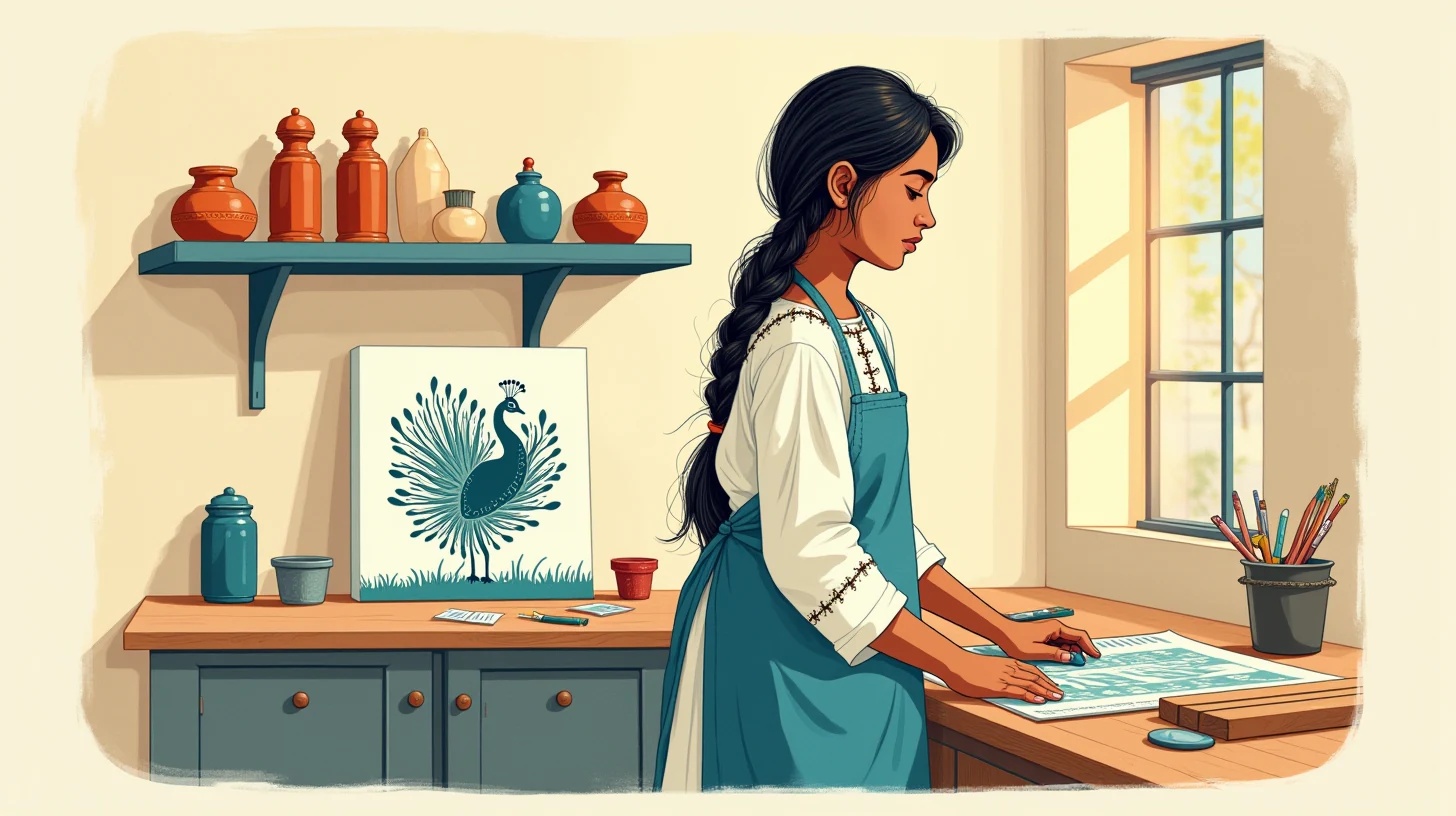
It was February 2026. Anita was thirty-five. She had been painting Sohrai—the geometric, resonate designs that Santhals and other tribal communities daubed onto their house walls at harvest time, using rice flour, dung, and natural earth pigments—for eighteen years. At first, on walls for neighbouring farmers' houses during Sohrai season. Then, seven years ago, on canvas and fabric. Three years ago, she'd organized eleven other women painters—neighbours, cousins, a former schoolmate, artists with the same vocabulary but no platform—into an informal collective. They called it the Doranda Sohrai Design Studio. No registration. No bank account. No formal structure. Just twelve women who met at her studio twice a week to paint, teach each other new compositions, and sell pieces individually on Instagram.
The Mumbai order was the biggest opening any of them had seen. The chain's supply-chain manager, however, had made one condition non-negotiable: she needed a single GST invoice from a registered entity—not twelve individual invoices from twelve people. The chain's accounting software didn't permit splitting ₹6 lakhs across a dozen suppliers. Anita had two weeks.
She knew, vaguely, that businesses over a certain turnover had to register for GST. Her cousin who ran a restaurant in Ranchi had a GSTIN. But she had no entity. She had twelve women with paintbrushes, savings accounts, and no corporate structure whatsoever.
🗓️ The annual rhythm of a tribal design collective
For most artisans working in India's traditional crafts—Madhubani, Warli, Sohrai, Phad, Pichwai—the bureaucratic year moves in cycles invisible to the outside world.
Sohrai painters in Jharkhand had historically worked seasonally, from August to October, when families commissioned the ritual murals. In recent decades, as tourism and home-décor markets widened, some artists had begun scaling the vocabulary onto cotton, canvas, and small wooden items, working year-round. But the legal category didn't exist for them. They were "craftspeople"—a cultural designation, not a tax or business classification.
The government recognized tribal crafts through three overlapping systems. The first was the Jharkhand State Khadi & Village Industries Board, established to preserve handloom and artisanal work. Artisans could register as members of a producer cooperative, which gave them legal entity status, access to government subsidies on materials, and—if they scaled—access to collective export channels. But forming a cooperative required bylaws, a managing committee, annual audits, and formal membership documentation. Anita had never heard of any Sohrai painter doing this.
The second was MSME Udyam registration, the government's simplified business classification system. Any micro, small, or medium enterprise could register online in minutes, without incorporation, and receive a unique identifier. Once registered, Udyam entities could apply for a single GST number (GSTIN) and issue unified invoices. Udyam also opened doors to government loans, export benefits, and visibility in procurement portals.
The third was the GST system itself. Turnover mattered. If annual sales were above ₹20 lakhs (₹40 lakhs for certain northeastern or hilly regions), GST registration was mandatory. Below that, it was optional but came with the advantage of input-credit recovery—a way to reduce tax burden if you bought materials and wanted to offset their cost against your sales tax. For a collective like Anita's, which spent heavily on pigments, canvas, and brushes, the math might favour registration even if they were technically below the threshold.
The problem was structural. These three systems—cooperative registration, Udyam, and GST—had never been designed to talk to each other in the context of an informal collective. A twelve-person studio was too big to be one person's business but too loose to be a cooperative. Anita had no accountant, no company secretary, no lawyer. She had Instagram followers, a paint-splattered notebook, and a phone call asking for a single invoice by a deadline.
⚠️ The Mumbai order and the two-week wall
By mid-February, Anita had called three local Chartered Accountants. Two hadn't replied. The third, a woman her age named Priya who handled accounts for nearby restaurants and small shops, had listened to the situation and then said, quietly: "You need to be a single entity. Not twelve. The GST system doesn't recognize collectives without legal form."
Anita had asked: Could she register the collective as a cooperative?
Priya said it would take six to eight weeks minimum—drafting bylaws, filing with the Registrar of Societies, getting approval from the Jharkhand Khadi Board, opening a bank account in the cooperative's name, then applying for GST.
Could she register under Udyam?
"Maybe," Priya said. "But I'm not sure if Udyam recognizes unincorporated collectives. You'd need to form an entity first—even if it's just a partnership on paper."
Anita didn't have paper. She didn't have a legal structure. She had eleven women who trusted her and a ₹6-lakh order she was terrified to lose.
By the third week of February, she'd seen two of the twelve painters quietly mention to friends that they might slow down—they had no sense of whether this order was real or a distraction. The Mumbai chain's supply-chain manager, when Anita called to ask for an extension, had given her one more week. After that, they'd move to another supplier.
🌗 The agent surfaces the parallel paths
Anita had seen references to "the agent" in a designer's forum on Reddit, a thread about GST registration for freelancers and small studios. Someone had written: "Used the agent on gabforge.in. Told me exactly which forms to file and in which order." She'd been skeptical—it sounded like AI, something that might hallucinate a portal or a scheme name—but she had nothing to lose.
She typed her situation into the agent, a text box on a website, slowly in Hindi: "मेरे पास 12 महिला चित्रकार हैं, कोई कानूनी रूप नहीं, मुझे एक GST इनवॉइस चाहिए। क्या मैं Udyam या Cooperative चुनूँ? समय की कमी है।" — I have 12 women painters, no legal form, I need a GST invoice. Should I choose Udyam or a cooperative? I'm short on time.
The agent's reply came back in a moment:
"आप दोनों रास्ते के लिए समय का आकलन करें: (1) Udyam: udyamregistration.gov.in पर 15 मिनट में unregistered producer organization (UPO) के रूप में रजिस्टर करें। फिर gst.gov.in पर Form FORM-REG-09 से GST अप्लाई करें। 7-10 दिन में GSTIN मिलेगा। (2) Cooperative: jhkhadi.in या Registrar of Societies में 8 हफ्ते, लेकिन सरकारी सब्सिडी का रास्ता खुलेगा। अभी के लिए, आपकी deadline के साथ, Udyam चुनें।"
(Consider the timeline for both paths. One: register as an unregistered producer organization (UPO) on udyamregistration.gov.in in 15 minutes. Then apply for GST on gst.gov.in using Form FORM-REG-09. Your GSTIN arrives in 7–10 days. Two: cooperative registration through jhkhadi.in or the Registrar of Societies takes eight weeks, but opens the door to government subsidies. Given your deadline, choose Udyam now.)
The agent also pointed her to a comparison. It showed:
MSME Udyam (UPO)
15 min to register + 7–10 days GSTRegister online at udyamregistration.gov.in as an unregistered producer organization. No incorporation required, no legal fees. File Form FORM-REG-09 at gst.gov.in the same day. GSTIN typically arrives within 7–10 days. Cost: ₹0. Allows consolidated invoicing across multiple members immediately.
Cooperative (Khadi Board)
8 weeks + ongoing auditsRegister with Jharkhand State Khadi Board (jhkhadi.in) or Registrar of Societies. Requires formal bylaws, managing committee, bank account, annual accounts audit. Legal fees: ₹2,000–₹5,000. Unlocks government subsidies, export licensing, and long-term institutional credibility. Not suitable for immediate invoicing needs.
After registration: GST invoicing
Both paths lead hereOnce you have a GSTIN (from either path), you can issue consolidated invoices on behalf of all 12 members. The GSTIN covers the collective. You file GSTR-1 (outward supplies) monthly, tracking all sales. Input credits (on pigment and canvas purchases) offset your tax liability.
Anita sat in the studio, reading this. The agent was saying she could register as an "unregistered producer organization" on Udyam without incorporation, without waiting weeks, and without hiring a lawyer. She'd never heard that category existed. She typed back to the agent, in English this time: "Is UPO real? Can I actually register a collective without a legal entity?"
"हाँ। UPO मतलब unregistered producer organization है, जिसका मतलब है कि आप एक समूह के रूप में Udyam में रजिस्टर कर सकते हैं भले ही आप कानूनी रूप से संगठित न हों। आपको Aadhar नंबर, सदस्यों के नाम, और आपका बैंक खाता (या collective खाता) चाहिए। FORM-REG-09 में, आप खुद को 'Producer Organization' के रूप में declare करें।"
(Yes. UPO stands for unregistered producer organization, which means you can register as a group on Udyam even if you are not legally incorporated. You will need Aadhar numbers, members' names, and your bank account (or a collective account). In FORM-REG-09, declare yourself as a "Producer Organization".)
Anita called Priya the accountant back. She read the agent's response aloud. Priya, on the other end, was silent for a moment. Then she said: "That sounds right, actually. I've never handled a Sohrai collective before, but yes—Udyam is designed to accept unincorporated producers. Let me verify the form names on the portal."
Ten minutes later, Priya called back. She had logged into both portals. UPO registration was indeed an option on udyamregistration.gov.in. And Form FORM-REG-09 (formally "Application for Grant of Unique Identity Number for Registration of Composition of Persons") did allow producer organizations.
🧭 Why the system fails collectives, and why gabforge.in exists
The deeper story here wasn't about Anita's ignorance or the agent's cleverness. It was that the Indian bureaucratic system, for all its codification, had never anticipated the tribal collective designer.
The government's design assumed businesses were either sole proprietors (one person) or incorporated entities (partnerships, companies, cooperatives). An MSME was you, alone, trading under your name, or your name plus a partner's or two. A cooperative was a legal entity you registered, governed by bylaws, with formal governance and audits. The GST system sat on top, expecting entities to be countable, taxable, and singular.
What it hadn't expected was a cluster like Anita's: twelve economically independent artists who collaborated informally, pooled orders, and still wanted to claim individual recognition. They weren't employees (Anita wasn't their employer). They weren't a partnership (no formal agreement binding them). They weren't a cooperative (no bylaws, no legal person). They were a cultural collective—a twenty-first-century mutation of the Sohrai tradition that hadn't quite fit the registration categories that preceded it.
When a ₹6-lakh order landed, the system's blindness became material. The Mumbai chain's GST and accounting systems couldn't process "twelve individuals with one invoice." So the system demanded a container. And the only containers the government had were: sole proprietor (no, 12 people), partnership (maybe, but informal), cooperative (too slow), or MSME (but is an unincorporated group an MSME?).
The "UPO" category—producer organization—existed precisely to catch this gap. It was created for situations like Anita's: groups of farmers, artisans, and creators who worked together but weren't formally incorporated. It allowed them to register on Udyam, issue a collective GSTIN, and invoice as a single entity without the overhead of a cooperative. But it was barely publicized. No CA in Ranchi seemed to know about it. The Jharkhand Khadi Board's website didn't mention it. The only reason Anita had found it was because an agent had surface it from the fine print of a government portal.
This was the gap gabforge.in inhabited: the spaces where a rule existed on paper but not in practice. The agent didn't make up rules or cut corners. It simply knew the system's own provisions better than the system did.
What it does
- 🔍Verifies that UPO registration exists as a real category on udyamregistration.gov.in and is not an invented shortcut.
- 🗂️Maps the timeline and cost for both registration paths, so Anita can make an informed choice aligned with her deadline.
- 📋Identifies the specific form (FORM-REG-09) and the portal sequence (Udyam first, then gst.gov.in) needed to move forward.
- 📞Connects Anita to her accountant (Priya) with specific language that allows Priya to verify the information independently on the actual portals.
What it does not do
- 🔒Never enters Anita's Aadhar number, bank account, or any credential. She enters these herself on the official portals.
- ✅Never submits an application on her behalf. The agent surfaces the path; Anita and Priya execute it.
- 💳Never guarantees approval. The GST or Udyam system might ask for additional documents (cast certificate for Scheduled Tribe artisans, proof of the collective's existence, proof of Sohrai practice). The agent did not claim the approval would be automatic.
"मैं चिंतित थी कि यह जाली है, या कि मैं कुछ गलत करूँगी। लेकिन जब उसने (agent) फॉर्म का नाम और पोर्टल का URL दिया, तो मैं सीधे जाकर देख सकी। यह वहाँ था। सच में वहाँ।"— I was worried it was fake, or that I would do something wrong. But when the agent gave me the form name and the portal URL, I could go check directly. It was there. Really there.
By March 2nd, Anita and Priya had filled out the UPO registration on udyamregistration.gov.in. The form asked for the collective's name, the 12 members' Aadhar numbers, their professions (Sohrai painter, repeated 12 times), the principal place of business (Doranda, Ranchi), and a bank account. Anita's sister, who worked at a bank, helped open a joint account in the names of all 12 painters. It took two hours and cost nothing.
Within 15 minutes of hitting submit, the system issued an Udyam registration number: UD-1326-4489-00001. Anita printed it and hung it on the wall of the studio.
On March 5th, Priya filed Form FORM-REG-09 for GST registration on gst.gov.in, attaching the Udyam certificate. The application sat in "pending verification" for four days. On March 9th, at 2:47 p.m., a GSTIN arrived: 20AACF1234M1Z1. Anita received an SMS notification. She read it three times.
She called the Mumbai chain's supply-chain manager. "I have a GSTIN," she said. The manager asked for the number and a sample invoice. Anita and Priya created one that evening: "Invoice from Doranda Sohrai Design Studio, GSTIN 20AACF1234M1Z1, for 200 hand-painted Sohrai canvases, 30x40 cm, ₹6,00,000, GST @ 5% (art and craft exemption applied), Total due ₹6,30,000." The manager approved it the next morning.
The order was scheduled for delivery by May 15th. Anita divided the work: 200 canvases, 12 painters, meant each painter would execute roughly 16–17 pieces. The studio went into a quiet frenzy of preparation—stretching canvas, mixing pigments, testing compositions. No one asked about the legal structure. They painted.
🌱 The quiet infrastructure of scale
The money arrived in May, directly to the collective's bank account. Eighteen weeks after the phone call, after the despair, after the second-guessing, the system had worked.
But the story wasn't really about the order. It was about what had shifted in the machinery itself.
Anita now had a GSTIN. Which meant she could invoice future clients—a boutique hotel in Goa, a design studio in Bangalore, a wedding planner in Mumbai—without needing to form a cooperative. If her collective's sales climbed, she'd move past the ₹20-lakh threshold and become subject to GST mandatory filing. She'd file monthly GSTR-1 returns (outward supplies), quarterly GSTR-3B (net taxes), and keep records. It was a layer of bureaucracy, yes. But it was a layer that existed because she had now chosen to scale.
The Sohrai vocabulary—the patterns that had lived in ritual, in the seasonal rhythm of harvest festivals—was now also a commodity that could be invoiced and tracked. The art hadn't changed. The tradition was intact. But it now inhabited two worlds: the cultural one, where Anita still painted Sohrai on village walls for Santhals who hired her; and the commercial one, where she packaged it into canvas and shipped it via courier.
She had also learned something quieter. The system—the vast tangle of portals, forms, and regulations—wasn't evil or chaotic. It was just unmapped. A CA in Ranchi wouldn't know about UPO registration because no one had trained them, and the Jharkhand Khadi Board's website didn't advertise it. The agent had simply read the fine print that existed, applied it to her situation, and surfaced a path that was always legal and always available.
She thought about this on a morning in late May, sitting in the Doranda studio with the smell of ochre and indigo, watching one of the twelve painters—a woman named Reshmi, who had been a farmhand two years ago—execute a peacock motif with a steadiness that came from years of ritual. The canvas would go to Mumbai. The GSTIN would track it. The tradition would continue, now also counted, also invoiced, also scaled.
There was no triumph in this. Just an opening. Just a small channel through which art and livelihood could flow together, legally, without apology.