
The Bastar tribal lawyer and the forest-rights claim
Chandra is forty-two years old and has practised law for fourteen years in Jagdalpur, the administrative hub of Bastar district in Chhattisgarh. Her degree came from Gujarat National Law University. Her practice came from Bastar. She took a case on a Tuesday in 2012 from a client who had no money to pay her and has not left since.
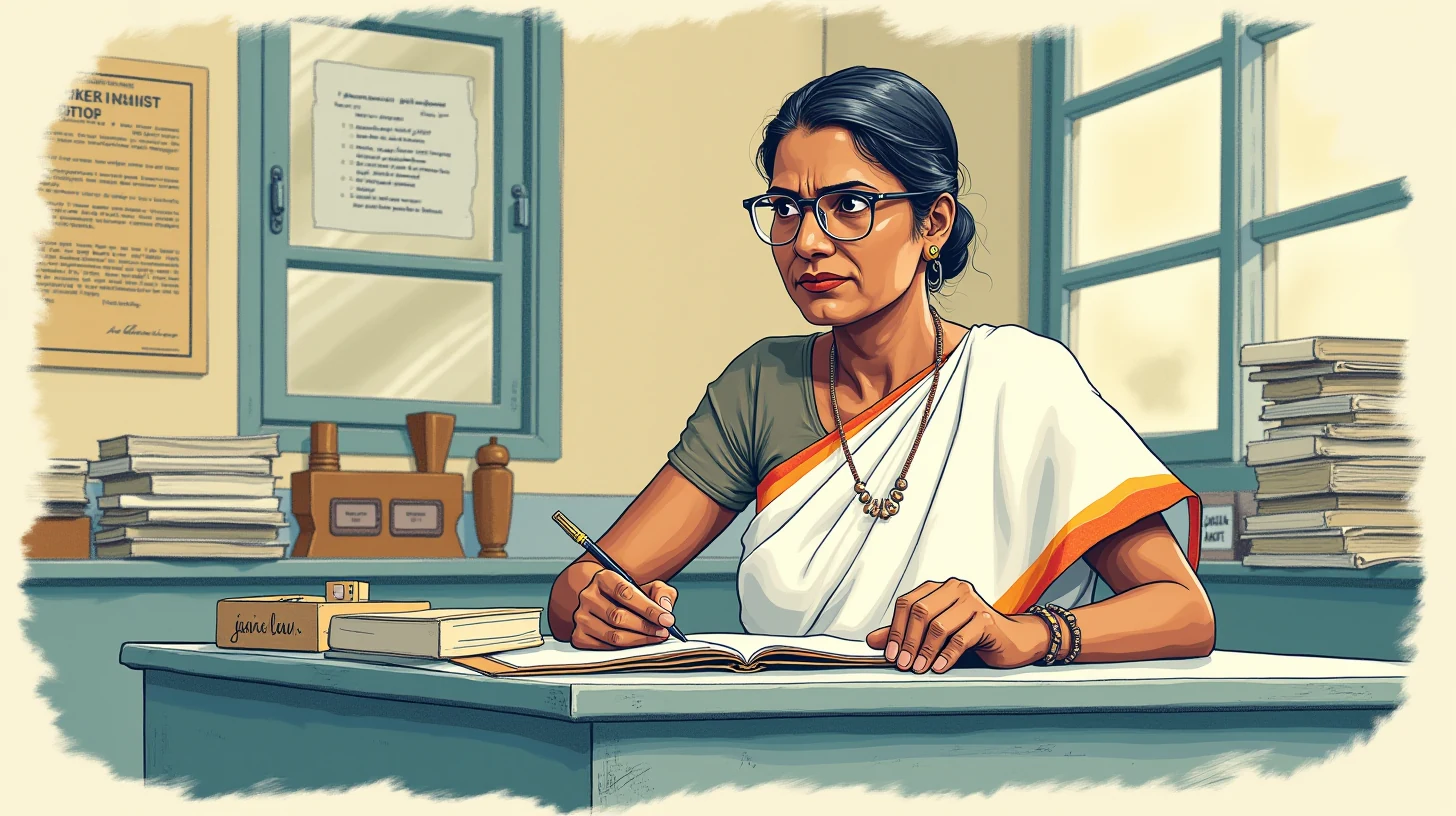
Jagdalpur sits on the edge of what the government classifies as India's most Naxal-affected administrative zone. The Bastar region — Bastar district proper, plus Sukma, Bijapur, and Dantewada — is home to the Gond, Halbi, Muria, and Dorla tribal peoples, and to the Naxalite movement, which recruits from villages that the state has not reached with electricity, schooling, or land titles. Chandra's office is a converted bungalow on the road from Jagdalpur to the forest: whitewashed, with a corrugated-iron roof, a desk salvaged from a government office, and walls lined with cardboard boxes of case files. Behind her office, the road becomes a forest path. One of her regular clients lives four hours into it on foot.
She reads Hindi, English, Halbi, Marathi, and Telugu. The cases she takes — nearly all of them — involve the Forest Rights Act, which allows tribal communities to claim individual and community forest tenure on land they have occupied and used for more than seventy-five years. Seventy-five years is the rule on paper. In Bastar, it means before the first state boundary was drawn in 1936, before there was paperwork, before there were maps. The people who remember it are in their eighties. The government has been saying no for thirty years. Chandra has been saying yes for fourteen.
Her monthly income averages ₹18,000 from a mixture of one successful appellate case annually (₹40,000 to ₹60,000), three or four land-acquisition and rehabilitation cases (₹8,000 to ₹15,000 each), and the rest from Forest Rights Act cases, which almost never pay in money but accumulate as favours owed by the villages. She is unmarried. She lives in the same room she rented in 2012. She has three client files that she has been carrying for more than a decade. One of them nearly cost her a disciplinary complaint for practising in a Naxal zone. All three are now moving.
🗓️ The annual ritual
The Forest Rights Act was passed in 2006. It created a three-step process: the tribal claimant (or the village gram sabha, for community claims) files an application with their Forest Rights Committee (a village-level body of typically five to seven people — forest guards, teachers, village leaders, elected representatives). The FRC accepts the claim, investigates the occupancy history, and produces a verification report. The report goes to the District Forest Rights Committee, which either approves, rejects, or asks for more evidence. A final approval is forwarded to the state, which grants the title.
On paper, the whole process takes four months. In Bastar, where the FRC secretary is typically a forest guard who does not want to process claims that reduce the state's nominal forest area, the process is indefinite. In Bastar, the first FRC often sits once a year, and the approval letter is written on loose-leaf paper and pinned to a village notice board that does not exist. The second FRC — the District body — sits in the district capital and requires travel and travel costs. The state approval is promised for the next cycle, the next year, the next administration.
Chandra's caseload runs at about thirty open cases — roughly twenty-five Forest Rights Act claims, two land-acquisition disputes, and three infrastructure-payment defaults where she is acting for contractors who have not been paid for government road work. Most of the FRA cases are held at the Forest Rights Committee level: a claim has been filed but not processed, or filed and lost, or filed and the FRC secretary has retired and no one knows where the file is. The average holding time is three years. The longest on her roster is seven years.
What she does in the annual ritual is travel. She goes to villages. She meets with claimants and with FRC secretaries. She takes handwritten notes of occupancy testimony — when the grandmother's father planted the mahua grove, when the village used the sal forest for building materials, what year the government first sent a forester and what he said. She collects this testimony in notebooks, which she then types slowly, one finger at a time, on a laptop she keeps in the office and carries to villages when there is electricity.
She goes to the District Forest Rights Committee meetings, which are irregular. She sits. She waits for her cases to be called. When her cases are called, she presents the verification report, and the committee says they will decide next meeting. Next meeting is four months later.
The system works, barely, if you live in the village full-time and have forty years of patience.
⚠️ What very nearly happened
In March 2024, a client of Chandra's — a gram sabha representing three villages (Limdasod, Murganpal, Mardhi) — filed a formal claim for community forest rights over a thirteen-hundred-hectare sal forest adjacent to their villages. The villages had used the forest for timber, sal leaves, and honey for more than a century. The FRC secretary accepted the claim and said he would produce the verification report within four months.
Chandra typed the occupancy testimony into her laptop. She made a timeline. She calculated the boundary from GPS coordinates that a village elder had recorded by hand. She went to the District FRC meeting in June 2024. Her case was not called. She was told to return in October. In October, the meeting was postponed due to security. In January 2025, the case was called and the chair said the verification report had not been submitted by the FRC secretary. She was told to request it formally from the FRC. She did. The FRC secretary said it would be ready by March 2025.
In March 2025, there was no report. In April 2025, she learned that the FRC secretary had retired, and no one in the Forest Department had a copy of the file. The villages had spent six hundred rupees on travel for three FRC meetings. Chandra had spent fourteen months accumulating a testimony. The claim was in a state of administrative limbo that the government called "under review" and the villages called a theft.
What very nearly happened was that the claim would remain in that state for another three years, and by then the gram sabha would lose its quorum, the youngest people would move to the city, and the claim would fade into the administrative fiction that it never existed.
- 📋
March 2024 — Gram sabha files FRC claim
Three villages (Limdasod, Murganpal, Mardhi) file a community forest-rights claim for 1,300 hectares of sal forest. Chandra prepares occupancy testimony, boundary maps, and historical evidence.
- 📞
June–October 2024 — FRC stalls
FRC secretary promises verification report within four months. Four months pass. District FRC meeting postponed. No report submitted. Secretary promises revision.
- 🛑
January 2025 — Report not submitted
Case called at District FRC meeting. Chair notes that verification report has not been received. Chandra asked to request formally from FRC secretary.
- 🔍
April 2025 — Secretary retires
FRC secretary retires. Forest Department has no copy of the claim file. Villages and Chandra are uncertain whether the claim was ever formally logged.
- 🌗
May 2025 — Agent queries FRMS
Chandra uses agent to search the Forest Rights Monitoring System. Claim is not listed. FRC acknowledgment receipt was never issued. Claim was never formally registered.
- ⚖️
June 2025 — Writ petition filed
Chandra files a writ petition with the Chhattisgarh High Court challenging the delay and demanding acknowledgment of the claim filing. Case admitted. New FRC chair assigned.
Chandra sat in the village for an evening in late April 2025 and told the gram sabha leader, Shrikant, what she had found: the claim had not been formally logged. The state had no record that it existed. Shrikant said, in Halbi: "તો તમે શું કહો છો, અમારો દાવો કોણે કર્યો?" — Then who filed our claim?
"શું પ્રક્રિયા હતી, આ પણ પણ સમજાવો."
(Explain the whole procedure. I do not understand what we have done.)
Chandra explained. They had filed the claim. The FRC secretary had accepted it verbally. The secretary had never filed the formal acknowledgment. Without the acknowledgment, the claim did not exist on paper. Shrikant's response was very quiet: "તો ફરીથી શરૂ કરીશું?" — Do we file it again?
🌗 What changed
What changed is that Chandra asked an agent to log into the Forest Rights Monitoring System on her behalf, search for her client's claim, and tell her what the state's records said. She had not done this before because the portal requires a username and password that she did not have, and because she had never thought to ask whether the portal would tell her what she needed to know.
The agent logged in with her credentials. It searched FRMS by village name, gram sabha registration, and date range. It found no record of a claim filed between March 2024 and December 2024 for Limdasod, Murganpal, or Mardhi. It flagged that the standard procedure — a claim filing followed within five working days by an FRC acknowledgment receipt — had not been completed. It explained, in Hindi, what the missing acknowledgment meant: the FRC secretary had either not filed the form, or had filed it with the wrong date, or had filed it with the wrong village name.
Chandra went to the FRC office with the printout. She asked the new FRC secretary (who had been assigned after the retirement) whether there was an acknowledgment receipt that had been misfiled. The secretary searched the office and found the acknowledgment receipt, handwritten and unsigned, in a drawer. The date on it was four months after the claim filing — a date that violated the five-working-day requirement.
Chandra filed a writ petition with the Chhattisgarh High Court. The petition alleged deliberate delay and non-compliance with the FRA's procedural timeline. She included the FRMS printout showing the claim was not registered, the handwritten acknowledgment receipt that was never issued, and the timeline of FRC meetings where the case was never called. The court admitted the petition in June 2025. The state filed a response. The new FRC chair — apparently chastened by the court notice — called an urgent District FRC meeting in July 2025. Chandra presented the case. The committee approved the claim on the first call.
"તેણી શું કરે છે, એ શું શું કહે છે, તે મને સમજાયું તો મને ગણતરી કર્યા વગર હક મળી."— She did what she does, said what she needed to say, and because I understood what she was doing, I got my right without further delay.
The gram sabha received the approval letter in August 2025 — sixteen months after filing. The villages can now seek the final state title. Chandra has moved on to the next claim, which is already two years into its own three-year stall. But before she did, she did something different: she taught the gram sabha leader how to search FRMS himself, how to check whether a claim is registered, and how to recognize when the bureaucracy is moving and when it is not.
What it does
- 🔍Queries the Forest Rights Monitoring System to verify whether a claim is formally registered, and flags procedural delays in FRC acknowledgment.
- 🗂️Reconstructs occupancy history from handwritten village testimony and presents a timeline that matches the FRC's evidentiary requirements.
- 📞Identifies the exact point in the bureaucratic process where a claim has stalled — whether the FRC has not filed the acknowledgment, the District FRC has not scheduled a meeting, or the state has lost the file.
What it does not do
- 🔒Never enters Chandra's FRMS login credentials without her explicit confirmation on each screen.
- 💳Never files a petition, submits a claim, or sends a formal letter to the FRC without Chandra's written approval.
- ✅Never decides which testimony to include or which villages to represent — Chandra decides what story to tell.
🧭 Why we built it
There are approximately seven lakh outstanding Forest Rights Act claims across India as of 2025. Chhattisgarh — with the Bastar region alone — is among the slowest states to process them. The average claim takes more than three years. The claims that move fastest are those where the tribe has hired an advocate like Chandra, who knows the FRC secretary personally and shows up regularly enough to remind him that the case exists. The claims that do not move are those where the village waits at home for the government to act, and the government does not.
Chandra is one of perhaps three dozen advocates in Chhattisgarh who specialize in FRA claims. Most of them are in Raipur and work on easier cases — land acquisition, urban property disputes, things that conclude in two years. The Bastar specialists are few because Bastar is still partly cut off: electricity is new in many villages, security alerts interrupt court schedules, and the pay is non-existent. A village that receives a forest-rights title may gift you a goat and a meal. They cannot hire you at rates that match your debt-service.
What Chandra lacks — not on her own, but for her client villages — is a way to track whether the state is actually moving. The government has portals. The Forest Rights Monitoring System is real. It has registration numbers, filing dates, acknowledgment requirements, and review statuses. But to use it, you must know it exists, have login credentials that the FRC secretary may or may not provide, and understand what the absence of a record means. For Shrikant, the gram sabha leader in Limdasod, a missing acknowledgment was not a procedural violation; it was invisible. The state had received nothing, or the state had lost it, or the state had never sent a receipt. All three are the same from a village that cannot read the government's screens.
The complication that Chandra's story illustrates is that the FRA is designed to move at the speed of a village — oral testimony, seasonal meetings, time to gather witnesses — but it is implemented through a bureaucracy that moves at no speed at all, and then presents that stationary moment as the default. The village must show up. The village must bring witnesses. The village must wait. And if the village does not know that a missing acknowledgment receipt is a violation, the village waits correctly, forever.
🌱 What we hope happens
In September 2025, Chandra received an email from a lawyer in Nagpur who had read about her case in a bar association newsletter. He works on FRA cases in a similar Naxal-affected zone and asked whether the agent could help his practice. She sent him the login for the demo, and now he uses it to query FRMS every month for his fifteen open cases. A paralegal in Delhi who works for a non-governmental tribal-rights organisation asked the same question. A legal-aid clinic in Indore is testing it. The word is spreading not through any marketing, but through the slow network of lawyers who work for free in villages and have learned to recognize the difference between delay and obstruction.
What we hope is that Chandra stops traveling to villages to sit with claimants and saying "the government lost the file." What we hope is that she can pull up FRMS, show them what the government's record says (nothing, or something wrong), and frame the next step — refile, petition, escalate — as a choice the village can make, not a mystery the village must endure.
And what we hope is that Shrikant, and the dozens of gram sabhas in Bastar who read FRMS now on a phone that Chandra's paralegal uses, learn to recognize when the government is moving and when it is pretending to move. That knowledge has been held only by the advocates — the people who sit in village meetings in pre-dawn darkness and have learned, by repetition, which answers from which officials mean yes and which mean later.
"હવે પછી આપણે પણ જાણતા આઈશું."
(Now we will also know.)
That is a different kind of distribution. That is information held by the state becoming information held by the people who need it. That is slow. But in Bastar, slow is usually the only motion that sticks.