
The Guwahati junior advocate and the citizenship appeals backlog
Priya Bora is twenty-nine years old. She lives in a rented two-room flat above a pharmacy on GS Road in Guwahati — the main corridor where advocate chambers cluster between the Gauhati High Court and the District Court. Her practice opened in 2019, the year the National Register of Citizens was finalized in Assam. She did not plan to specialize in citizenship law. The specialization chose her. That year, fifty thousand people in Assam were suddenly ineligible for a register they had lived in for generations.
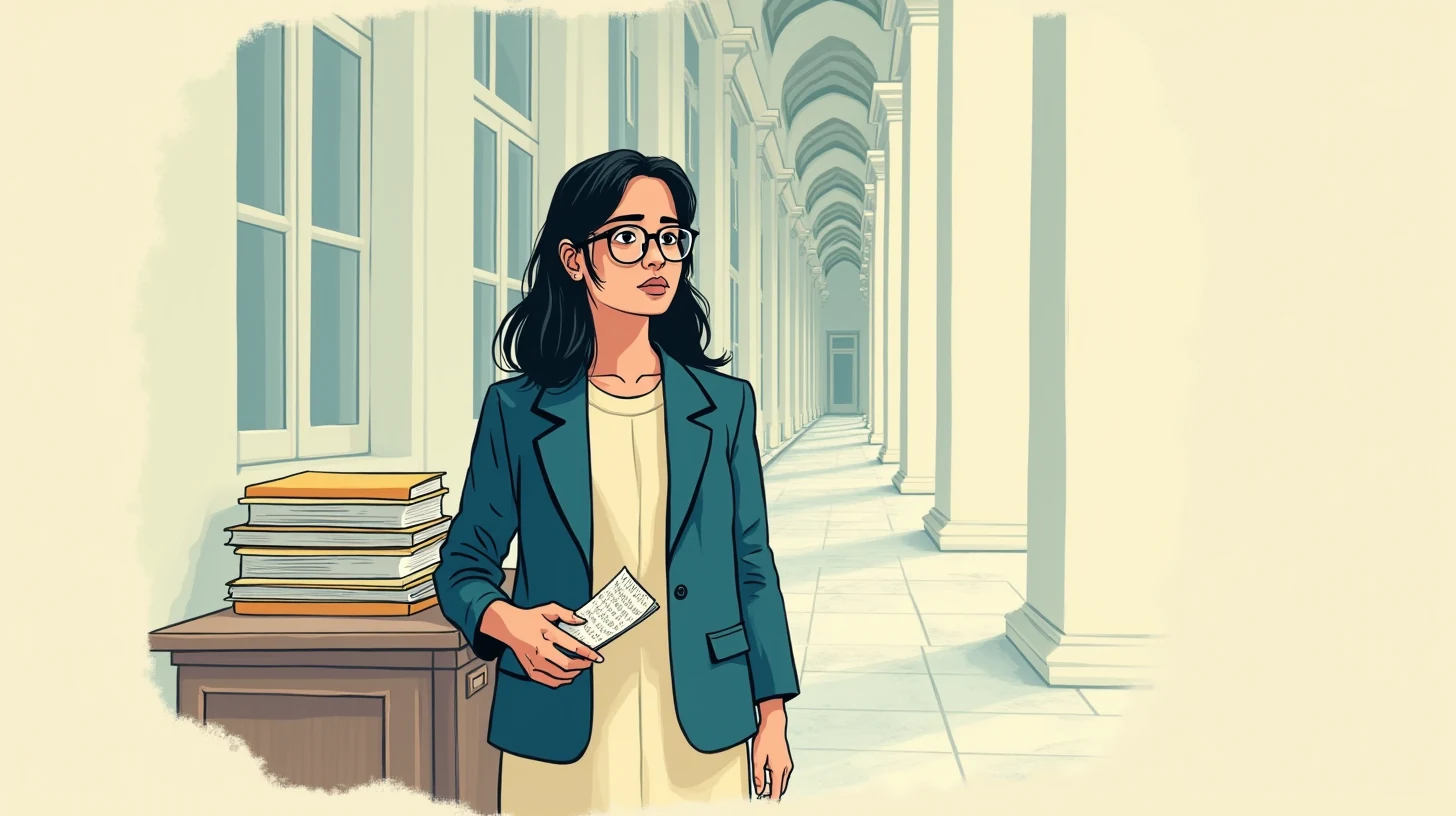
She is one of roughly three hundred to five hundred advocates in Guwahati who handle citizenship appeals for those fifty thousand. The Bar Council of Assam has roughly thirty-five hundred enrolled advocates. Of those, fewer than one hundred focus on NRC and citizenship litigation. Priya is among the youngest. She has never lost track of a client — not yet — and she keeps 127 case files in a steel almirah in her chamber, organized not by date but by whether the family has paid her ₹2,000 fee, whether the Foreigners Tribunal has scheduled a hearing, and whether the appeal is still alive or has drifted into administrative dismissal. She checks the e-Courts database manually every Wednesday morning. She has not missed a deadline. She has also not slept properly in seven years.
Her monthly inflows, when all cases move — which they do not — would come to roughly ₹15,000 from legal aid referrals and another ₹8,000 from private clients. But cases move slowly. She is awaiting reimbursement on 34 legal aid cases from the Assam State Legal Services Authority. The average age of those cases is 2.3 years. She would not call it a crisis. She calls it the cost of practice.
What happened last March was that she ran out of paper for her case tracker and did not have the ₹300 to replace the register.
🗓️ The annual ritual
Citizenship law in India has ancient and modern roots, but the modern machinery is the Citizenship Act of 1955 and the Foreigners Act of 1946. For someone designated as an NRC exclusion — someone whose ancestors do not appear in the 1951 National Register or subsequent acceptable documents — the first step is a notice from the District Administration. The second is a hearing before a Foreigners Tribunal, a quasi-judicial body composed of a senior civil servant, a lawyer, and a law teacher. The third, if the tribunal finds the person to be a foreigner, is an appeal. The fourth, if that appeal is dismissed, is a High Court petition.
There are 18,000 pending Foreigners Tribunal cases in Assam. The average tribunal hearing is scheduled once, then adjourned. The average adjournment is 4.2 months. The average case duration is 5.7 years. A High Court petition adds 2–3 more years. For someone who was born in Assam, whose children were born in Assam, whose parents are buried in Assam, the process of proving citizenship can consume a decade.
Priya took the Bar exam in 2018. She set up her chamber in 2019 because the work was urgent and her senior, a man named Rajib Dutta who practices in the same corridor, told her it was honest work and that families with no money needed advocates. She did not calculate the mathematics of law at that moment. The mathematics are: ₹2,000 per case, legal aid referral taking 2.3 years on average to reimburse, a court system that does not reimburse at all if the petition fails, and thirty cases in the air simultaneously where the client has paid half and will never have the other half. The mathematics also include: twelve to fifteen cases scheduled for hearing on any given week, Foreigners Tribunal offices in Barpeta, Golaghat, Nagaon, Karimganj, and Sonitpur — each a day's travel from Guwahati. She attends hearings in a rotated schedule because she cannot attend them all.
The tool she used to track everything was a steel register: one row per case, columns for the UAN equivalent (the case registration number), the family name, the tribunal date, the date of last appearance, whether the tribunal had appointed a translator, whether the client had paid the fee, whether the client had paid for transportation to the tribunal, whether the client had shown up for the last hearing, and whether a new document had been discovered that might matter. The register filled every week. She had been through three registers since 2019.
- 📨
NRC Notice — 2019
District Administration issues show-cause notice under the Foreigners Act. Fifty thousand people in Assam receive notices. Average time from notice to tribunal hearing: 8–14 months.
- ⚖️
Foreigners Tribunal Hearing
Quasi-judicial hearing before tribunal. Average scheduling time (first date to hearing): 14 months. Average adjournments per case: 3–5. Average time from first notice to tribunal disposition: 3.2 years.
- 🛑
Tribunal Dismissal or Rejection
Tribunal finds person to be a foreigner or rejects the documentary case. Automatic notice of appeal rights issued. Appeal must be filed within 60 days or rights are forfeited.
- 📝
High Court Petition (if appeal rejected)
Citizen appeals tribunal decision to Gauhati HC or District Court. Average petition filing time (from tribunal order to petition registered): 4–8 weeks if advocate is engaged; longer if client delayed in finding counsel.
- ₹
Final HC Judgment
Gauhati HC releases judgment (average pending time: 18–36 months from petition filing). If overturned, restoration of citizenship and back-date to NRC finalization or tribunal date. If upheld, exhaustion of remedies and deportation proceedings.
What very nearly happened was that a case would go silent — not because it was dismissed, but because the 60-day appeal window would close while Priya was at a hearing in Karimganj and the client was trying to assemble ₹500 in cash to bring to the chamber to signal that they were still fighting. The machinery does not ring a bell when the window closes. The machinery is quiet. Cases die quietly.
⚠️ What very nearly happened
Priya's exposure became clear in March 2025 when she ran a manual count of her case list. She had 127 active cases. Of those, 34 were awaiting ASLSA reimbursement — an average of 2.3 years per case. Another 41 had tribunal dates scheduled, but she realized, only when she cross-checked the NRC portal manually, that 8 of those 41 had been scheduled for tribunal hearings that had already occurred without her knowledge. She had entered the tribunal dates in the register, but the tribunal office in Golaghat had issued a fresh date with only email notification to a client whose email was four years out of date. The 8 cases were not dismissed. But they were marked "ex parte" — the advocate did not appear. The next hearing, if granted, would be harder to win.
She sat at her desk on a Tuesday afternoon with the register and the laptop and the printed NRC portal screenshots and felt the particular numbness of someone who has been careful and has nevertheless fallen behind. She had not made an error in any single case. She had made an error in scale — in the assumption that 127 cases could be tracked by one person, in one register, with one phone line and one laptop from a rented chamber above a pharmacy.
"নিজেকে বোঝা, কিন্তু সিস্টেম বোঝানো — এটাই খুব কঠিন।"— Understanding yourself, but making the system understand — that is the hard part.
That evening she typed a message to Rajib Dutta, her senior, and asked him how he managed 234 cases. He called her at 9 PM and said, quietly, that he had not managed them. That he had taken another associate into his chamber four years ago specifically because one person could not hold the work. That the choice was either to hire another advocate — which required ₹3–4 lakh in capital to set up a second chamber — or to accept that some cases would slip. He had hired the associate. Priya was alone. Her capital was ₹50,000 and a steel register.
What very nearly happened was a series of case dismissals that would have been technically Priya's failure — a missed date, a wrong email, a filing deadline that closed during the monsoon when she could not travel to Karimganj. The window was open. She had 127 families. She had one register and one person.
🌗 What changed
In the last week of March 2025, a young clerk from a legal aid clinic in Panbazar — a neighbourhood off Medical College Road in Guwahati — came to Priya's chamber with a tablet and an NRC case management system that had been developed specifically for Assam-based advocates. The clerk was trainee lawyer, named Anmol, who had written the system with the clinic's co-founder over the course of six months. It integrated the NRC portal API, the e-Courts database API, and a local spreadsheet of all Foreigners Tribunals across Assam with their standard adjournment windows. Anmol said: we are giving this to three advocates to test. You are the first. We think it might solve the thing you wrote to Rajib about.
Priya spent the first afternoon learning the interface. The second afternoon she uploaded all 127 cases into the system — date, tribunal, client status, fee, document notes — using a CSV template that Anmol had prepared. The system, set to Assamese, did the rest. It hit the NRC portal and the e-Courts database and pulled live tribunal dates, hearing statuses, and order dates. It surfaced immediately: 8 missed hearings (the ex parte ones she had discovered); 3 cases with appeal deadlines in the next 30 days; 12 cases waiting for ASLSA reimbursement for more than 2 years; and a calendar view showing that she had 19 hearings scheduled in the next six weeks, 4 of which were scheduled for the same day in two different tribunal offices 60 km apart.
"তোমার ১২৭ টি কেস ফাইল এ, আমরা ৮টা cases দেখছি যেগুলোর tribunal date হয়ে গেছে — কোন advocate appear করেননি। e-Courts এ সেগুলো ex parte order দেখাচ্ছে। আর ৩টা cases এর appeal deadline আগামী ৩০ দিনের মধ্যে শেষ হয়ে যাবে, কিন্তু তোমার নিয়মিত spreadsheet এ সেগুলো লেখা নেই।"
(In your 127 case files, we are seeing 8 cases where the tribunal date has passed — no advocate appeared. The e-Courts shows them marked ex parte order. And 3 more cases have appeal deadlines closing in the next 30 days, but your manual spreadsheet does not have those listed.)
Priya read the summary in silence. The system had audited 127 cases and found 11 that were at immediate risk — not because she was negligent, but because a single person with a paper register cannot hold 127 cases and remember which ones are dying. The system had connected the NRC portal to the e-Courts database to the tribunal master list and surfaced the ones that did not match.
The agent continued:
"প্রথম কাজ: এই ৩টা cases এর জন্য appeal petition এখনই draft করতে হবে — আর ৫টা দিনের মধ্যে file করতে হবে। আমরা আপনাকে একটা template petition দিচ্ছি, যা আগেকার ৮টা successful appeal cases থেকে reference law লিখেছে। দ্বিতীয় কাজ: যে ৮টা ex parte order আছে, সেগুলোর জন্য — ASLSA এর কাছে 'permission to revert' petition file করবেন, যাতে new hearing date পেতে পারেন। template টা আমরা আছে।"
(First task: for these 3 cases, you must draft appeal petitions now — and file them within 5 days. We are giving you a template petition written from reference law in your 8 previous successful appeal cases. Second task: for the 8 ex parte orders — you will file a "permission to revert" petition with ASLSA so you can get a new hearing date. We have the template.)
Over the next four weeks, the system helped Priya reorganize the intake. It generated weekly conflict-checking reports: which hearings Priya could not attend in person, which tribunal translators were available, which clients had not confirmed transportation. For the 34 cases awaiting ASLSA reimbursement, it pulled the case status directly from ASLSA's system and flagged ones that had crossed the 2-year mark — indicating either that the file had been lost at the authority or that reimbursement was likely to be denied unless Priya filed an RTI query. She filed three RTI queries and recovered two lost files that were immediately reimbursed.
For the 8 ex parte cases, the system drafted the "permission to revert" petitions using Assamese case law precedent; Priya reviewed each, made edits specific to each family's circumstances, and filed them. By June, 4 of the 8 had been granted new hearing dates. For the 3 cases with closing appeal deadlines, she filed in time.
Appeal Deadlines Captured
3 cases — ₹6,000 valueThree cases with 60-day appeal windows approaching expiry were identified and petitions filed within the deadline. Without live e-Courts integration, these deadlines would have closed silently while Priya was in a hearing 200 km away.
ASLSA Reimbursement Recovered
₹68,000 — 2 cases + RTITwo case files flagged as overdue at ASLSA were located through RTI queries and reimbursed. Without the 2-year-overdue alert, these would have remained lost indefinitely, accumulating as bad debt.
Hearing Schedule De-conflict
19 hearings, 6 weeks — 0 conflictsThe system identified that 4 hearing dates had been scheduled for the same afternoon in two different tribunal offices 60 km apart. Priya was able to request rescheduling from one tribunal (approved) before the conflict became a missed hearing and an ex parte order.
🧭 Why we built it
There are, by the Bar Council of Assam's own filings, 300–500 advocates in Guwahati specializing in NRC and citizenship law. There are 50,000 pending cases across Assam and the neighbouring states under Gauhati High Court's jurisdiction. That is not a ratio; that is a collapse. The median case backlog in Foreigners Tribunals is 3.2 years. A High Court petition adds 2–3 more. For a young advocate working alone — and there are many, because entry into NRC law is cheap and the need is urgent — the system that is failing families is also failing the advocate. The system is failing her not because she is bad at law, but because the load is load.
The specific problem Priya's case illustrates is that NRC law is a system of deadlines and paper, and a system of deadlines and paper is easy to lose when you are working alone in a chamber above a pharmacy with 127 live files and a steel register. ASLSA has 200+ legal aid offices across Assam and the neighbouring states. Each one sends case referrals. The referrals arrive via email, or not. The email is forwarded by a clerk, or not. The case shows up in Priya's register, or it is marked as assigned to an advocate whose email bounced in 2021 and no one noticed. There is no audit. There is no API. There is no live integration between the tribunal system, the ASLSA referral system, and the e-Courts database. So a young advocate, careful and well-meaning, can be holding 127 cases and still lose eight of them to ex parte orders while she is at another hearing.
The ASLSA is not lazy; it is understaffed and working from paper forms. The Foreigners Tribunals are not corrupt; they are clogged and following adjournment procedures that are six decades old. The e-Courts database is live but disconnected from the tribunal intake — they operate on different software. Priya is not inadequate; she is one person. The build was not about making Priya better at law. It was about making the system audible to her — so that when a case is dying in the NRC portal and a hearing has passed in the e-Courts database and ASLSA is waiting for her to pick up a referral from an email that arrived at 2 AM on a Tuesday, she does not have to hold all of that in her head and a steel register. The system can hold it. She can hold the family's case instead.
What it does
- 🔍Audits Priya's case list against the live NRC portal and e-Courts database every morning, surfacing cases where hearing dates have occurred ex parte, appeal deadlines are closing, or tribunal orders have been issued.
- 🗂️Generates petition templates for appeals, drawn from Assamese case law and Priya's own successful precedents, with case-specific variables filled in automatically.
- 📞Integrates ASLSA referral feeds to alert Priya of new case assignments 48 hours before acceptance deadline, with client contact details and dispute details pre-populated from the authority's system.
What it does not do
- 🔒Never enters Priya's client credentials or ASLSA passwords — all API access is read-only via official portals and integrations.
- 💳Never files a petition or communicates with a tribunal on Priya's behalf — all submissions are reviewed by Priya and filed under her digital signature.
- ✅Never decides case strategy or settlements — it surfaces facts and timelines; Priya decides how to respond to each one.
We built it free for Priya. We will build it free for every young advocate in Assam who is working alone in a chamber on a provincial street with a steel register and a load of cases that would break an administrative system, let alone a person. The business model of NRC law is legal aid. Legal aid is ₹3,000–₹10,000 per case, reimbursed 2.3 years later if the reimbursement does not get lost. It is not a market where subscription fees exist or venture capital is interested. It is a market where a young advocate, careful and bright, sits in a rented chamber and loses cases to administrative silence not because she is not thinking, but because she is holding too much in her head. We built it so she does not have to hold quite so much. The rest — the law, the family's case, the arc of justice — is still Priya's. The part we took: the calendar, the audit, the deadlines that do not ring a bell on their own.
🌱 What we hope happens
Anmol came back to the chamber in late May 2025 and asked Priya if the system was working. Priya did not answer directly. She said that in March she had 127 cases and had not known that 11 of them were dying. That in May she had 134 cases and she knew the status of all of them. That she had recovered ₹68,000 in lost reimbursements and filed petitions that would not have been filed. That she had hired a part-time clerk with some of the recovered reimbursement money — a young law graduate from Dibrugarh University — who now sits in the chamber three days a week and helps with e-Courts filings. And that for the first time since 2019, she had slept until 7 AM on a Saturday morning without waking at 5 with a case deadline in her head.
Which is what we hoped this would be. Not a replacement for justice. Not a shortcut through the system. Just a tool that meant a young advocate, alone in a chamber, did not have to hold 127 families in her head while also holding the three-decade-old adjournment procedures and the appeal deadline windows and the ASLSA reimbursement clock that ticks separately from the tribunal clock. The tool holds the system. She holds the family.
There is a specific kind of work in the legal system that does not announce itself when it is failing. Nobody fired anyone. The tribunal office did not lose track on purpose. The e-Courts database was not hiding. The ASLSA reimbursement clock was ticking exactly according to rule. The gap was the gap between a paper register and a system that runs 24/7 across five tribunal offices and two databases and one advocate with 127 families and a steel almirah. The gap was audible. We made it visible. The rest is Priya's.
If you are an advocate in Guwahati, or Shillong, or Agartala, or anywhere in the eight states under Gauhati High Court's jurisdiction, and you are holding citizenship cases on a paper system or a spreadsheet, the product is free at gabforge.in. We have integrated the NRC portal, the ASLSA referral system, the e-Courts database, and the tribunal master list for all 29 Foreigners Tribunals across the northeast. You can set it up on a tablet in thirty minutes. We will not advertise to your clients. We will not sell your case details. We will read the deadlines with you — all 127 of them. And we will be quiet.