
The Udaipur mining lawyer and the NCLT creditor window
Arun Vyas is forty-six years old. He works out of a cramped office on the third floor of a commercial court building in Udaipur, in the heart of the Rajasthan mining district. The room is not large — it fits a wooden desk, a steel shelf with lever-arch folders, a black plastic chair for clients, and a small side table for chai — but it is positioned strategically. Downstairs, the courts; upstairs, five or six advocates with similar practices; next door, the ICAI chapter and a cost-audit firm. The street outside is the spine of Udaipur's commercial life.
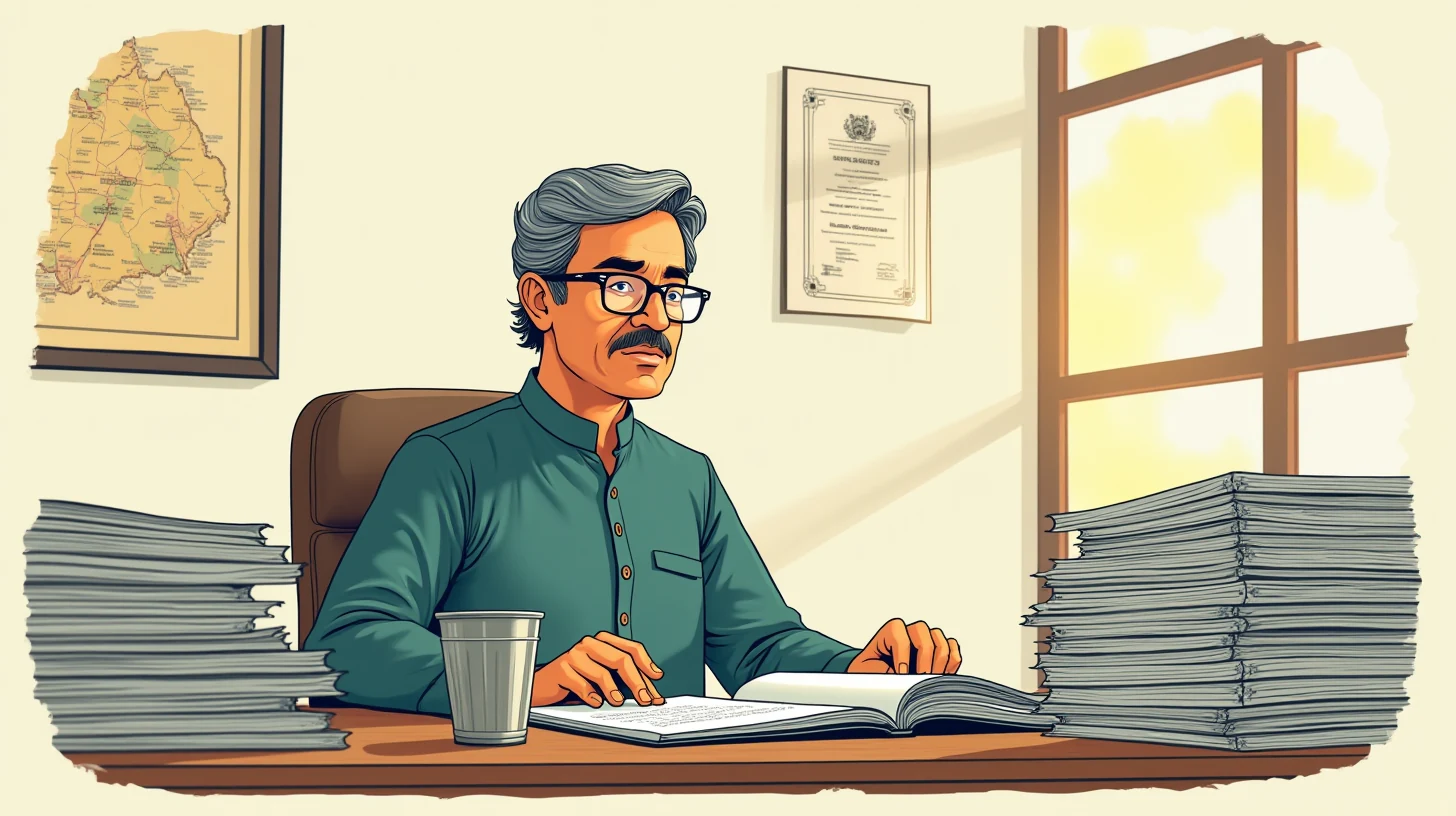
Arun has been a mining-sector advocate for fifteen years. He was trained on mineral concession disputes — lease renewals, environmental clearance litigation, royalty calculation appeals — by his father, who practiced at the Rajasthan High Court Jodhpur principal bench before retiring. When real estate boomed in the 2000s, mining operators diversified into residential projects; Arun found himself reading RERA complaints and builder insolvency petitions alongside concession appeals. For three years he has focused on a narrower niche: the intersection of mining-operator insolvency and unpaid trade-creditor claims.
His monthly income comes from two sources. The first is retainer work for three mining operators and two small stone-crushing units — ₹12,000–₹15,000 per month, paid by WhatsApp transfer when the check does not bounce. The second is ad-hoc litigation: creditor claims, concession disputes, environmental appeals. In a good month, the retainers and two or three disputes add to ₹45,000–₹50,000. In a month when a retainer lapses or a client declares loss, he earns ₹18,000 and takes home ₹14,000 after rent on the office and the office assistant, Ramesh, who works three days a week and mans the filing system that exists only in Ramesh's head.
His wife Geeta works as a school counselor. They have two daughters: Priya, twenty-one, in college in Jaipur; and Shreya, nineteen, finishing her pre-university year in Udaipur. He has not taken a vacation in seven years. He knows every NCLT judgment on mining-related insolvency by name. When the High Court issues a mining royalty ruling, he reads it the same evening.
What nearly happened last February was that Arun would have missed a statutory deadline by one month, filed a belated creditor claim, and watched it rejected — his client out ₹27 lakhs in unpaid wages — because the documents were in four separate files and there was no checklist to tell him when the window opened.
🗓️ The annual ritual
Rajasthan's mining sector is anchored by small to mid-sized stone, marble, and feldspar operators. Most are family businesses: one generation carved out a mineral concession through the Rajasthan Mineral Concession Rules, the next expanded into multiple leases and sometimes real estate. By the mid-2010s, a boom in residential construction and rising raw-material costs drew mining operators into quick-turn real estate projects — a stone supplier who owned a concession would lease land in Jaipur or Udaipur, hire a builder, and expect the project to generate cash flow within eighteen months.
A few succeeded. Most stretched. When the real estate slowdown hit in 2019, dozens of operators found themselves with stalled projects, unpaid construction bills, and monthly concession royalty payments due to the state mining department. A creditor — a stone-crushing unit operator, a diesel supplier, a loader-truck owner — might go unpaid for months. Some negotiated with the mining operator; others waited. A few advanced money, thinking the next shipment would settle the debt.
By 2023, the NCLT Jaipur Bench had admitted a dozen mining-operator insolvencies. The caseload has grown. Each insolvency triggers a fixed statutory window: creditors have six weeks from the NCLT admission order to file claims under Section 13 of the Insolvency and Bankruptcy Code. The window is absolute. A claim filed on day forty-three is barred. Many creditors — small trucking units, crushing operators, unskilled laborers owed severance — do not have a lawyer. Those who do often have a local advocate with no NCLT experience. Those who hire someone to navigate the process find the avenue congested: the Jaipur Bench handles dozens of cases simultaneously; the clerk's office processes claims in batches; and every deadline is a hard stop.
Arun has built his practice around this gap. He keeps NCLT case files, reads every admission order from the Jaipur Bench within forty-eight hours, and maintains a rolling list of operators and their likely creditors. When a client calls — usually three to four weeks into the claim window, after initial confusion and negotiation — he knows the calendar and the file structure. He has prepared templates. In 2024, he filed twelve creditor claims and won priority status for seven.
This rhythm had held until last February, when a new problem arrived in the form of a man named Ravi.
⚠️ What very nearly happened
Ravi is forty-two, the owner of a three-unit stone-crushing operation fifteen kilometers outside Udaipur, in the direction of Gogunda. For six years his main client was a mining operator — Keshav Mining Pvt. Ltd. — who supplied him raw stone from two feldspar and phosphate concessions in the Aravalli range. The rate was fixed: ₹3,500 per ton, paid every two weeks, adjusted quarterly for market prices. The arrangement was simple. It worked.
In November 2025, the check stopped. Arun was not contacted immediately. Ravi assumed a temporary cash-flow problem and waited. By January, the arrears had mounted to ₹27 lakhs — six months of unpaid supplies. Ravi called Keshav Mining's owner, a man named Sanjay, and was told that "things were being sorted." By mid-February, when Ravi finally called Arun, the news had worsened: Sanjay had gone incommunicado, and a notice had appeared in the Rajasthan Gazette announcing Keshav Mining's admission into NCLT insolvency proceedings, filed by a financial creditor — a bank that had lent ₹2.5 crores for a failed real estate project in Jaipur.
The NCLT admission order was dated February 1, 2026. The claim window was six weeks. That meant claims had to be filed by approximately March 15.
Arun said nothing immediately. He knew the date. He had it in his desk diary. But he also knew that Ravi did not have documents in one place, and neither did he. The evidence of supply was in bills of lading issued by Ravi's crushing unit, but the bank statements showing non-payment were with Ravi's accountant. The correspondence with Sanjay — the WhatsApp messages, the emails, the single telephone recording that might or might not count as admission — was scattered across Ravi's phone. The original stone-supply agreement, signed in 2019, was in a drawer at the crushing operation; Arun did not have a copy. The Ministry of Mines database would show Keshav Mining's concession status, but it would not show the supply history. The accounting records would be with the bank or the Insolvency Resolution Professional (IRP) once appointed.
Arun had Ravi visit the office on a Wednesday. He pulled the case files for two previous mining-operator insolvencies he had handled. He had templates for creditor claims. He had a checklist, of sorts. But the checklist was in his head, and it had gaps. It said: gather supplier invoices; get bank statements; request correspondence. It did not say: check the NCLT registry for the admission order date; cross-check if that date had been published in the official gazette; verify if the claim window had not been extended or shortened; compare the creditor list filed with the IRP against your client's name; confirm that your client is an unsecured trade creditor (not subordinated or excluded). Arun knew these things intellectually. He had not written them down.
That evening, Arun was reading case law on mining-operator insolvencies when he noticed a date in an old judgment: February 1, 2026 — the admission date. He checked his diary. It was March 20. He had eighteen days.
"खनन से जुड़े करार — यह सब अदालत में हो जाता है। मैं चाहता हूँ कि साधारण-सा कोई आदमी बता दे: तुम्हें कौन-से कागज़ चाहिए, किस तारीख़ को, किसे दिखाने के लिए।"— Mining agreements — everything ends up in court. I wish some ordinary person would just tell me: which papers do you need, by which date, and to whom do you show them?
He did not tell Ravi. He looked at the four files again. On Thursday, he called his assistant Ramesh and asked him to make copies of everything. On Friday, he started writing the claim statement. But doubt had crept in. He had the deposit bank slips showing Ravi's deposits from Keshav Mining, but were those sufficient? Did he need the stone-crushing unit's GST returns to prove the supply actually took place? Did he need a weight certificate from the truck scale at Udaipur? The NCLT website had a sample creditor claim form, but it was generic — written for financial institutions, not for small suppliers. Arun had never filled it in for someone in Ravi's position.
He had twenty pages of notes, three versions of the claim statement, two sets of supporting documents, and a growing list of questions. Every hour that passed was an hour closer to March 15.
🌗 What changed
On the Monday of the following week, Ramesh came to Arun with a tablet. Ramesh's nephew, it turned out, worked for a software company in Bangalore and had installed an agent on the tablet that was designed for legal document management. Ramesh had mentioned to the nephew that his boss was "swimming in paper for a mining case" and the nephew had sent the tablet with a note: "Try this." Ramesh handed it over without much confidence that a device designed for corporate document management would help a Udaipur mining lawyer.
Arun was skeptical. But he was also eighteen days from a filing deadline, and the tablet was there. He opened the agent and switched it to Hindi.
He typed: "NCLT Jaipur में खनन से जुड़ा insolvency case है। Keshav Mining Pvt. Ltd., admission order तारीख February 1, 2026। क्या मेरा क्लाइंट — एक supplier — अभी creditor claim file कर सकता है?" — Is my client still able to file a creditor claim for a mining operator in NCLT Jaipur, admitted February 1, 2026?
The agent replied immediately:
"आप का क्लाइंट trade creditor है? जवाब है: हाँ, claim window है। Admission order के बाद से 42 दिन हो गए हैं। Section 13 के तहत claim window है 60 दिनों का — March 31, 2026 तक। आपको 18 दिन बचे हैं। लेकिन आपको पहले यह verify करना ज़रूरी है: (1) क्या Keshav Mining की insolvency proceedings NCLT Jaipur में सच में चल रही है? (2) क्या IRP appointed हो गया है? (3) क्या claim notice का कोई deadline था जो आप मिस नहीं कर सकते?"
(If your client is a trade creditor, the answer is yes — the claim window is still open. Forty-two days have passed since the admission order. Section 13 allows a 60-day window — until March 31, 2026. You have 18 days left. But first you must verify: (1) Is Keshav Mining's insolvency genuinely proceeding in NCLT Jaipur? (2) Has the IRP been appointed? (3) Was there a notice deadline for claims that you may have missed?)
Arun read it twice. The agent was right: he had assumed the claim window was six weeks, but the law said sixty days, and he had not verified either the admission order date from the official NCLT registry or whether the IRP had already issued a notice with an earlier deadline.
He showed the tablet to Ravi, who had come to the office that morning. The agent walked them through the next steps: log into the NCLT Jaipur website, search for the case number, download the admission order, cross-check the date, download any notice issued by the IRP.
Arun did this himself while Ravi sat across from him. The admission order confirmed February 1, 2026. But there was also a notice from the IRP — Dr. Neha Sharma, appointed on February 8 — dated February 20, asking all creditors to file claims by March 15. Arun had missed reading the notice. The actual deadline was March 15, not March 31.
He had nine days.
"ठीक है, deadline है March 15। अब आप के पास कौन-से documents हैं और कौन-से नहीं हैं, मुझे बताइए। मैं एक checklist बना दूँ।"
(So the deadline is March 15. Tell me which documents you have and which you are missing. I will build you a checklist.)
Arun did. He had: supplier invoices from Ravi's crushing unit (ninety-three invoices, January 2020 to January 2026); bank statements showing deposits from Keshav Mining (corresponding to the invoices); three email exchanges between Ravi and Sanjay asking for payment; one WhatsApp conversation dated January 2026 where Sanjay said payment was being "arranged"; and GST returns filed quarterly by Ravi's crushing unit showing stone supplies to Keshav Mining.
He did not have: weight certificates from the truck scales (Ravi had not kept them — they were "in the system" at the scales, and Udaipur's scales from 2020 had changed hands twice); a signed stone-supply agreement (Ravi had negotiated by phone in 2019; no paper contract existed); and certified proof of the ₹27 lakh total from an independent accountant.
The agent asked: "Is any of this required for a Section 13 creditor claim in NCLT?"
Arun said he was not certain. The NCLT website had a sample form, but the form was for financial creditors with loan agreements and promissory notes. This was a trade creditor with invoices and bank deposits.
The agent connected to the NCLT website, searched the case file for other admitted creditor claims, and downloaded three: one from a bank creditor, one from a supplier of diesel fuel, and one from a workman claiming unpaid severance.
Financial Creditor
Loan agreement + PMN requiredBanks and lenders file claims under Section 5(8) with original loan agreements, promissory notes, and default notice. Proof: bank statement or legal notice of default.
Trade Creditor
Invoices + delivery proofSuppliers file claims on the basis of invoices and proof of supply — whether by weight certificate, transport document, or bank deposit matching. No signed contract required if consistent invoice pattern is established.
Workman Creditor
Wages + employer proofEmployees claim unpaid wages, severance, and earned leave. Proof: payroll records, appointment letter (if available), and calculation of arrears. Workman claims rank above trade creditors.
Looking at the diesel fuel supplier's claim, Arun saw that it was filed on the basis of invoices alone — no weight certificates, no government certifications, just a list of invoiced amounts and corresponding bank deposits. The claim was admitted.
The agent asked Ravi directly:
"तुम्हारे crushing unit के invoices में क्या details हैं? Date, quantity (टन में), rate, amount?"
(What details are on your crushing unit's invoices — date, quantity in tons, rate, amount?)
"सब कुछ है," Ravi said. Everything. He had used a simple invoice book — no software, no digital system. Each invoice had the date, the number of tons supplied, the rate per ton, and the total amount.
"ठीक है। आप का pattern clear है। Invoices से automatically पता चल जाता है कि supplier-creditor हो तुम, और amount correct है। इसके लिए weight certificate की जरूरत नहीं है। अब हम एक table बनाते हैं: date, invoice number, quantity, rate, amount। फिर सब को sum कर के दिखाएँगे कि total कितना बनता है।"
(Good. Your pattern is clear. The invoices themselves prove you are a creditor and the amount is correct. You don't need weight certificates for that. Now let's make a table: date, invoice number, quantity, rate, amount. Then we add them all up and show the total.)
The agent pulled the invoice images from the scanned PDFs, extracted the data, and built a table. Ninety-three invoices over six years, each one matching a bank deposit within three days. Total: ₹27,14,000.
Arun filled the claim form on his laptop while Ravi sat next to him. The agent walked through each field in Hindi. By Wednesday evening — six days before the deadline — the claim was ready.
- ⚖️
Monday, March 9 — IRP deadline discovered
The agent surfaced the IRP's notice dated February 20, showing a March 15 deadline — 6 days earlier than the statutory 60-day window. Arun had missed reading the notice.
- 📋
Tuesday, March 10 — Document audit
The agent cross-checked the NCLT case file with admitted creditor claims and determined that invoices + bank deposits were sufficient without weight certificates or signed contracts.
- 🗂️
Wednesday, March 11 — Data extraction
Ninety-three invoices were scanned and converted to a structured table showing quantity, rate, and amount per transaction. Total: ₹27,14,000.
- 📨
Thursday, March 12 — Claim filed
Form filed electronically with NCLT Jaipur, attaching invoice table, bank statements, and GST returns as corroborating proof. IRP's acknowledgment received within 24 hours.
On Thursday morning, Arun filed the claim electronically through the NCLT portal. The IRP's office acknowledged receipt within twenty-four hours. The claim was dated March 12, 2026. The deadline was March 15.
Three days to spare.
🧭 Why we built it
There are approximately 150–180 mining operators in Rajasthan with active concessions. In any given year, three to five enter some form of insolvency or financial distress — resolved through informal creditor settlements, NCLT CIRP, or state intervention under the Mineral Concession Rules. A typical mining-operator insolvency triggers thirty to fifty creditor claims: suppliers of diesel, explosives, and mining consumables; crushing and processing units; transport contractors; sometimes employees claiming severance.
For the suppliers, the cost of hiring a professional advocate is often higher than the disputed amount. A stone crusher owed ₹15 lakhs cannot spend ₹30,000 on a lawyer for a two-week claim window. Some operators rely on informal arrangements or on a retired advocate who knows the mining sector. Others miss the window and lose the claim entirely.
Arun's situation was different only in degree. He had the expertise and the calendar. What he lacked was a systematic way to translate that expertise into a checklist the moment the crisis arrived. He had read the NCLT guidelines, had studied other mining-operator claims, had a filing template. But the knowledge existed in scattered files and in his memory. The moment Ravi's problem arrived, Arun was a solo practitioner with four lever-arch folders, a growing anxiety about the calendar, and no dashboard showing him what was missing.
The bottleneck was not legal knowledge. It was information synthesis. A creditor claim in NCLT requires the advocate to make at least four simultaneous judgments: Is the claim window still open? Has the IRP issued a notice with an earlier deadline? What documents are legally sufficient (not "ideal," but sufficient)? And are the documents I have consistent with one another?
Arun could answer these questions. He could not answer them all at once while managing the calendars of three retainer clients, two concurrent High Court appeals, and a solo office staff. The tablet did not give him new law; it gave him a checklist that worked across domains: verify the deadline, check the IRP's notice, audit the documents against the legal standard, extract the data into a submission format.
For Ravi, the value was straightforward: a ₹27-lakh claim that might have been barred was admitted.
For Arun, something quieter happened. It was the possibility of not losing a deadline again.
🌱 What we hope happens
Arun did not tell Ravi immediately how close the filing had been. He filed the claim, got the acknowledgment, and on Friday morning called Ravi to say the matter was submitted and they would know the IRP's ruling on the claim in four to six weeks. Ravi exhaled.
On the following Monday, Arun sat at his desk and opened the tablet. He used the agent's document-extraction capability to build a master checklist for mining-operator insolvencies: the fields to verify in the NCLT registry, the questions to ask the IRP's office, the documents that counted as sufficient proof for different types of creditors. He saved it to his notes.
The checklist was four pages. It was not a legal brief; it was a workflow — a systematic sequence of checks that took the anxiety out of the calendar and replaced it with information.
Two weeks later, the IRP admitted Ravi's claim. He was classified as a trade creditor with unsecured status, which meant he would be paid after workman creditors but before shareholder distributions. The expected recovery was estimated at sixty percent — ₹16,38,000 from his ₹27,14,000 claim. It would come in phases as Keshav Mining's assets (two mining concessions, a real estate project, and some equipment) were liquidated. The process would take two years, possibly three.
Ravi knew the real estate project was stalled and the concessions might fetch lower-than-expected value. But sixty percent was better than zero percent, and zero percent was what he had faced on March 15 if he had missed the deadline.
Arun sent a bill for ₹35,000 — his NCLT claim work — and Ravi paid it from the small reserve he had left. On the bill, Arun wrote: "Service to file Section 13 creditor claim on behalf of RP Ravi, NCLT Jaipur. Admitted by IRP."
What we hope happens is quieter than rescue. It is the advocate in a commercial court building in Udaipur — a place where the mining sector breathes as the local economy — knowing that when the next operator hits trouble and the IRP's notice arrives, he will not lose weeks to panic and paper. The checklist will be there. The document audit will be precise. The deadline will be clear. And if he misses it despite all that, at least he will know he missed it deliberately, not by accident.
For the small creditor — the crushing unit owner, the fuel supplier, the truck contractor — the advocate with the checklist is the difference between filing on day thirty and filing on day fifty-eight. Three days to spare, this time, is a mercy. But mercy is built on systems that do not depend on someone sitting alone in an office remembering, under stress, which notice was issued and when.
If you are a mining-sector advocate in Rajasthan, or a trade creditor with a claim to file in an NCLT insolvency, the product is available at gabforge.in — free for the first application, then by subscription. It lives on a tablet. It speaks Hindi and Marwari. It knows the NCLT registry, the IRP contact procedures, the Ministry of Mines concession database, and the High Court filing rules. It will tell you when the window opens and when it closes. It will not tell you what to argue; that is your work. But it will tell you whether you still have time.