
The Agartala surgeon and the waiting-list crisis
Dr. Ravi Sinha is forty-eight. He lives in Agartala with his wife Priya, a schoolteacher, and the silence of two adult children who left at sixteen and have not returned. His eldest, Aryan, is in London. His younger son, Vikram, is in Bangalore. Ravi's government salary is ₹1.8 lakh per month—unchanged for eight years. He spends it on Aryan's tuition, Vikram's rent, aging parents in Kolkata, and the operating supplies the hospital stopped funding a decade ago. He arrives at GB Pant at 6:30 AM even on days he is not scheduled to operate.
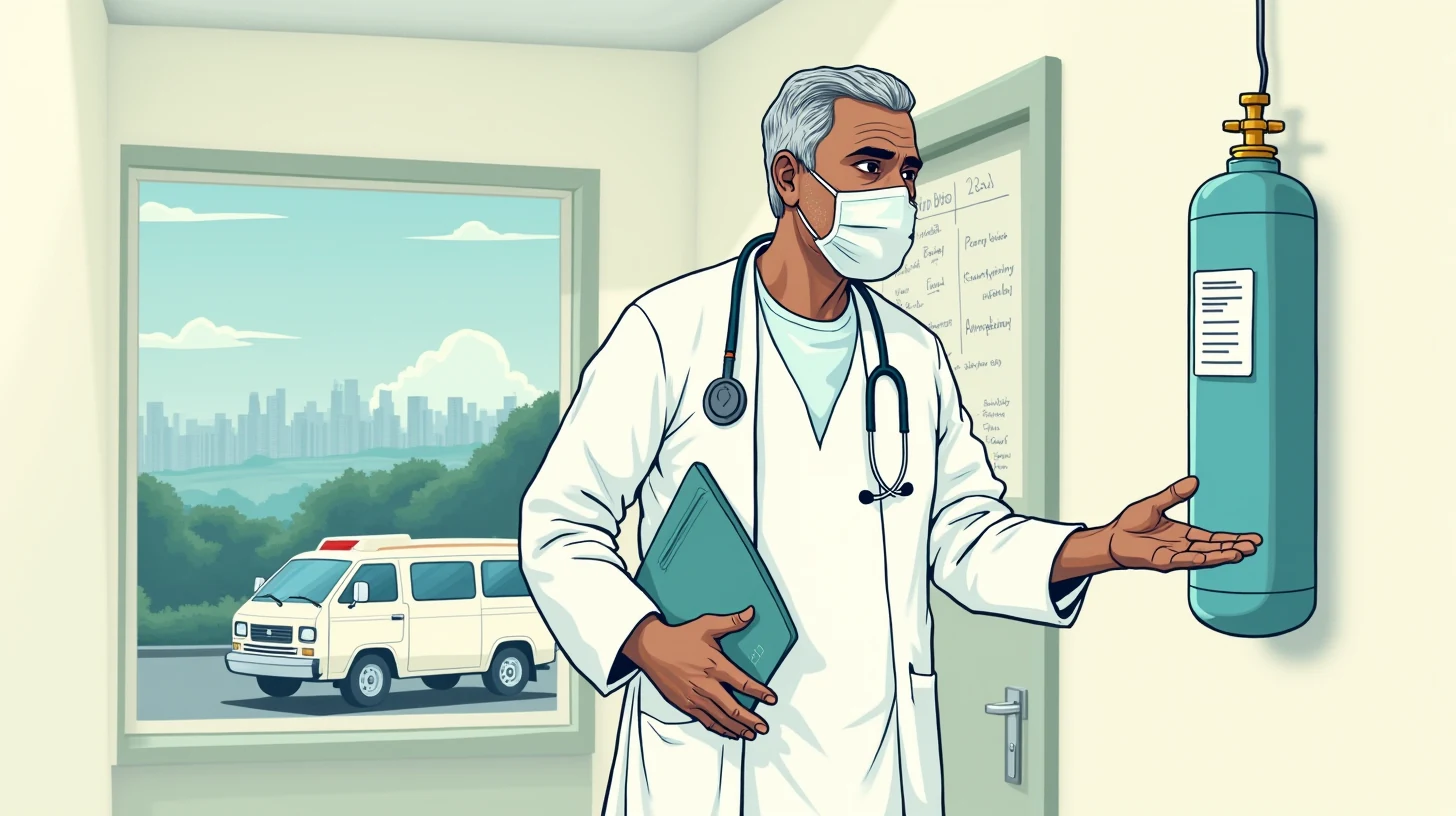
GB Pant is Tripura's only tertiary centre—700 beds serving 3.67 million in Tripura, 1.1 million in Mizoram, and referrals from Manipur. A Bangladeshi patient with a blocked artery comes expecting two-week surgery; an Indian farmer arrives with chest pain and is told to wait four months. Ravi operates Monday through Friday, 7:30 AM to 1:30 PM, then spends afternoons deciding who will be scheduled next, who will wait, and who will seek care in Dhaka. He has not had a full Saturday off in three years.
What is unusual is not his work. It is what happened when his daughter-in-law, visiting from Bangalore with a tablet and a question, handed him a problem he could not solve alone.
🗓️ The annual rhythm
In 2018, the cardiac waiting list was nine patients. Four cases per week. Average wait: two weeks. By 2022, eighteen patients. By early 2026, forty-three. The waiting list quintupled while operating theatre time remained constant: four cases per week, no growth.
Cardiac disease in Tripura is not waiting. Rubber plantation workers—50,000 of them—have occupational risk: chronic respiratory exposure, poor nutrition, stress. The elderly population is growing. And Tripura sits on the Bangladesh border: cardiac patients from Comilla and Sylhet arrive in Agartala because government surgery costs ₹80K–₹1.2L versus ₹4–6L in Dhaka. The economics are irresistible.
- 📅
2018 — Ravi joins GB Pant
Waiting list: 9 patients. Average wait: 2 weeks. Four cases per week. Capacity matches demand.
- 📈
2022 — First pressure point
Waiting list grows to 18 patients. Average wait reaches 4 weeks. Ravi begins tracking outcomes by hand. No administrative system exists.
- ⚠️
Early 2026 — Crisis visibility
Waiting list reaches 43 patients. Average wait: 16 weeks for Indian patients, 12 weeks for Bangladeshi patients. Emergency cases add 2-3 weeks to any scheduled patient's turn.
- 📰
April 2026 — Newspaper headline
The waiting list becomes public. The Agartala Times publishes the figures. Health ministry asks why. A government study finds an 800-case annual shortfall in surgical capacity.
Every Monday morning at 6:45 AM, Ravi reviews the patient files on his desk—thirty to forty, each marked with clinical category: elective, urgent, emergent. He calculates the sixteen-week wait from today. He knows which patients will still be alive in sixteen weeks, which will decompensate, which Bangladeshi families cannot stay that long. He has become expert at calculating who can wait and who cannot.
⚠️ What very nearly happened
On February 14, Ravi counted the files: thirty-seven waiting for cardiac surgery. Three marked urgent—acute valve disease needing surgery within two weeks. Twenty-four were Indian patients waiting three to eight months. Eight were Bangladeshi patients. Five were referrals from Mizoram and Manipur.
He calculated the total wait time: four cases per week, thirty-seven cases equals nine weeks minimum. Emergency referrals came in at two per week, adding three to four weeks. For Indian patients already waiting three to eight months, nine more weeks meant sixteen to twenty weeks total. For Bangladeshi patients, nine weeks meant going home.
This calculus—cost difference, willingness to travel, cash payment, shortage of time—shaped every surgical schedule. He was, without intending to be, a rationing system. One forty-eight-year-old man, deciding every Monday morning, who would be treated and who would be deferred.
"আমাদের সমস্যা নয় যে আমরা অপারেশন করতে পারি না। আমাদের সমস্যা যে আমরা সবাইকে অপারেশন করতে পারি না। সেটা ভিন্ন কিছু।"— Our problem is not that we cannot do surgery. Our problem is that we cannot do it for everyone. That is something different.
🌗 What changed
On March 18, Ravi's daughter-in-law Sneha called from Bangalore. She had been visiting Priya in Agartala and had one question: "Papa, do you want me to set up the agent on a tablet before I leave? My team uses it at the hospital."
Ravi almost said no. But Sneha left the tablet anyway with one instruction: "Open it and ask about your patient backlog."
Friday morning, before rounds, Ravi opened the agent on the tablet and set it to Bengali. He asked: "আমার ৩৭ জন রোগী waiting list এ আছে। মোট কত সময় অপেক্ষা করছে?" — I have 37 patients on my waiting list. What is the total wait time?
The agent extracted data from his hand-tracked files, cross-referenced patient dates, factored in emergency admissions, and produced a timeline that matched his calculations exactly. But then it produced a visualization—a curve showing waiting-list growth since 2018, and what happened if one additional surgeon was added.
"ডাক্তার সাহেব, আপনার ৩৭ রোগী average ১৬ সপ্তাহ অপেক্ষা করছেন। এক সার্জন add করলে wait time হবে ৮ সপ্তাহ। GB Pant এ capacity আছে second theatre এর জন্য। কিন্তু Tripura health department এর নেই hiring authorization। এটা system problem।"
(Doctor, your 37 patients are waiting an average of 16 weeks. If one surgeon is added, wait time becomes 8 weeks. GB Pant has capacity for a second theatre. But the health department has no hiring authorization. This is a system problem.)
Ravi read it three times. The frontier of his expertise was not surgical—it was administrative. He showed the output to his senior registrar Anita.
Anita said: "Should we make this visible?"
Ravi nodded. Making the waiting list public meant the state government would have to answer. The agent had produced what his hand calculations had not: a document with named constraints and an undeniable trajectory.
Ravi met with hospital administrator Mr. Chatterjee and showed him the output. He said: "We need to publish the waiting list. To make the problem impossible to ignore."
Mr. Chatterjee hesitated. "If we publish it, the state will ask why we lack capacity."
Ravi said: "We do. That is the point. It should be visible."
🧭 Why we built it
On April 10, the waiting list appeared on the hospital lobby board: 37 cardiac cases, 42 general surgery cases, 18 orthopedic cases. Ages, diagnoses, and wait times listed.
"Current wait time for elective cardiac surgery: 16 weeks."
The Agartala Times photographed it. The headline: "GB Pant Hospital Reveals Surgical Crisis: 97+ Patients Waiting."
The state health minister asked why. The health department commissioned a study. Result: GB Pant received 1,200 surgical cases per year, had capacity for 400. Shortfall: 800 cases—two-thirds of annual need went unmet.
There are 3.67 million people in Tripura. An unknown number have cardiac disease or surgical need. The fraction who receive surgery in time is small.
What it does
- 🔍Extracts waiting list data from hospital records and surfaces the buried total — 37 cardiac cases, 16-week average wait — making the problem visible when the surgeon alone cannot force visibility.
- 📊Models the impact of system changes — shows that adding one cardiac surgeon reduces wait time from 16 weeks to 8 weeks, naming the constraint that is actually blocking care.
- 📞Surfaces system problems as distinct from surgical problems — identifies that the bottleneck is hiring authority, not surgical skill, so the state health department knows what decision to make.
What it does not do
- 🔒Never enters hospital records directly — all data comes from the surgeon's own files, typed or authorized by him before the agent touches it.
- 💳Never submits findings to government agencies or media — it only surfaces the data to the surgeon, who decides whether to publish or present.
- ✅Never decides which patient gets scheduled — it analyzes the waiting list, but Ravi and Anita make every surgical scheduling decision.
We built it for the surgeon who is drowning in Monday-morning decisions and has no administrative assistant. For the hospital system where capacity has stopped growing but demand has not. For the state health department that could not see, until the data was made public, that the shortage was not of surgeons but of operating theatres and surgeon positions.
Ravi will keep operating four cases per week. His salary will remain ₹1.8 lakh, unchanged. The waiting list will remain visible on the hospital lobby board. Patients from Tripura, Mizoram, Manipur, and Bangladesh will arrive and be told their wait is four months. But the difference is that the system is no longer invisible. The constraints are named. The state government knows that the decision to hire a second cardiac surgeon is not a nice-to-have. It is the decision that will determine whether cardiac surgery in the Northeast remains a four-month wait or becomes something accessible.
🌱 What we hope happens
It is May 2026. The visiting surgeon proposal from Shimla is still in negotiation. The hiring freeze remains. But the waiting list is visible. The problem is undeniable.
Ravi was asked by a health journalist why he invests energy in a system the government has not solved. His response:
"The frontier of Indian medicine in the Northeast is not a shortage of skill. It is a shortage of beds, operating theatre time, and surgeon positions. I trained at AIIMS Delhi. I know how to do cardiac surgery. We have the equipment, the imaging, the training. What we lack is basic infrastructure to apply that skill to everyone who needs it.
In Dhaka, a patient is promised surgery within two weeks and pays ₹4 to 6 lakh. In Agartala, an Indian patient waits four months. That is not a medical problem. That is a system problem."
The question is whether Tripura's government will decide that cardiac surgical capacity must match cardiac disease burden. If so, he can mentor a junior surgeon and reach sustainable rhythm. If not, the waiting list will keep growing. The mathematics will not pause.
The agent is free. It will remain free for this user—the cardiac surgeon with a waiting list invisible for eight years, now forced into public view.