
The AIIMS resident and the referral overload that broke the system
Dr. Arjun Singh is thirty-two years old and grew up in South Delhi Defence Colony, where his father worked with the Delhi Development Authority and his mother was a school principal. He completed his MBBS from Delhi Medical College in 2015, his MD in Internal Medicine at AIIMS Delhi from 2017 to 2019, and spent three years as a consultant in emergency medicine at Sir Ganga Ram Hospital before accepting a postdoctoral residency at AIIMS Delhi in August 2024. The position came with ₹1,20,000 per month, on-campus housing in Block K, and the assignment to manage a 120-bed general medicine ward, coordinate referrals with four subspecialty departments, and supervise two junior residents and one resident intern.
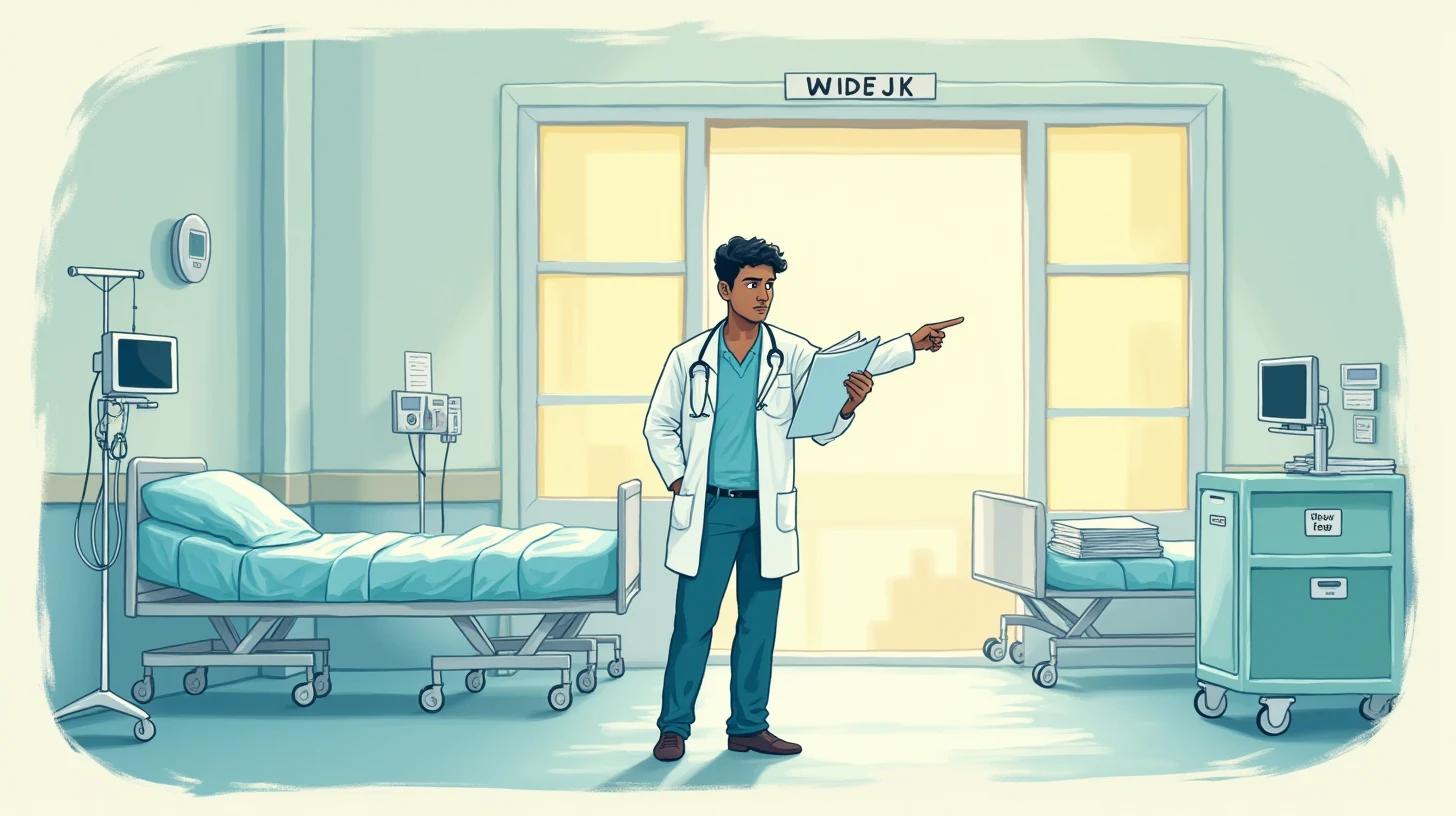
AIIMS Delhi is India's flagship government hospital—1.2 million annual outpatient visits, the premier teaching institution where India's future specialists train. Arjun had trained there before. He understood the workload. What he did not anticipate was what would happen in his first winter.
His ward received general medicine overflow: patients from the outpatient clinics, the emergency department, and smaller affiliated primary health centers across Delhi with acute respiratory infections, cardiac decompensation, renal failure, or undifferentiated illness that did not clearly belong elsewhere. The system worked because surges were absorbed by three senior doctors rotating shifts. The rhythm had held for years.
In November 2024, after Diwali, the rhythm broke.
🗓️ The annual ritual
Delhi's air quality collapses every November. Diwali fireworks combine with stubble-burning from Punjab, and thermal inversion traps particulate matter. The air quality index peaks at hazardous levels—800–1000 micrograms per cubic meter—nearly twenty times the WHO safe threshold.
The medical consequences are predictable. Respiratory medicine admits acute infections and pneumonia. Cardiology admits elderly patients whose heart disease destabilizes under oxygen stress. Nephrology sees acute kidney injury cascading from respiratory distress. AIIMS administrators have planned for this surge for a decade.
The practical response, however, is not hiring additional staff. The response is increasing workload expectations for existing senior residents. As Arjun's department head explained: "This is a teaching hospital. Residents are the flexibility in the system."
The residents absorb the surge. The system absorbs nothing.
- 🌫️
November 1–15 — Pollution spike and admission surge
Air quality index reaches 850+ micrograms per cubic meter. Respiratory, cardiac, and renal admissions surge. General medicine receives overflow. Ward occupancy climbs from 95 to 125 beds in two weeks.
- 🛑
November 4 — Junior resident absence
One junior resident develops a respiratory infection from patient contact and goes on medical leave. Recruitment takes 3–4 weeks. Arjun is now the only senior-level physician.
- ⚠️
November 12–19 — Overload normalizes
Ward census reaches 145 patients. Arjun manages alone: 7–8 hour morning rounds, afternoon admissions, evening assessments, night calls every 2–4 hours. Sleep drops to 4 hours. Error rate increases.
- 💔
November 20 — Anxiety collapse
Arjun experiences acute anxiety attack while writing admission notes. Occupational health clinic finds nothing wrong. Department frames continuation as a choice: accept the workload or be marked as someone 'who could not handle AIIMS.'
Arjun's ward, which typically held 85–95 beds with three senior doctors, was receiving 25–30 new admissions per day. By mid-November, every bed was full. By late November, the hospital admitted patients to hallways—placing beds between existing beds, creating a two-tier system with no space for equipment, isolation, or privacy.
On November 4th, one junior resident developed a respiratory infection and went on medical leave. The recruitment process took three to four weeks. The position remained vacant for the entire winter. By November 12th, Arjun was the only senior-level physician in a 120-bed ward that now held 145 patients.
His daily routine became mechanical and unsustainable. He arrived at 7 AM and began ward rounds—reviewing overnight admissions, checking laboratory results, writing medication orders. With 145 patients, a complete round took seven to eight hours. During those rounds, new admissions continued arriving. By 1 PM, fifteen to twenty new patients had been admitted, none yet assessed. By 6 PM, when duty ended, he had assessed perhaps sixty percent of new admissions. The remaining patients—acutely ill, decompensating—remained to be seen. He would stay until 9–10 PM, then sleep in the on-call room. The night bell rang every two to four hours. A patient with chest pain. A patient with altered mental status. A patient spiking fever. A patient with dropping oxygen saturation.
He was not sleeping more than four hours per night. He was making critical medical decisions for 145 patients based on assessments that, due to overflow, could not include complete daily evaluation. By mid-November, he was making errors: ordering a repeat investigation completed the day before; missing a medication chart a junior resident had written incorrectly; discharging a patient whose antibiotic course was incomplete. None caused immediate patient harm. All signaled what was happening: a system running beyond capacity, producing mistakes because it had no choice.
"यह सिस्टम काम नहीं करता — और अगर मैं इसे काम कराने की कोशिश करूँ, तो मैं टूट जाऊँगा।"— The system does not work — and if I try to make it work, I will break.
⚠️ What very nearly happened
On November 19th, a 67-year-old patient with acute heart failure triggered by pollution-related respiratory stress was admitted. On initial assessment, the patient was hemodynamically stable—breathing comfortably on 2 liters of oxygen, no acute distress. Arjun prescribed diuretics and oxygen, ordered an echocardiogram, planned transfer to Cardiology the next morning.
That night at 2 AM, the patient developed paroxysmal nocturnal dyspnea—acute pulmonary edema. The nursing staff called Arjun. He arrived to find the patient in severe respiratory distress, oxygen saturation dropping despite maximum supplemental oxygen. He increased oxygen flow, called anesthesia to prepare for possible intubation, started high-dose IV diuretics.
The patient stabilized within an hour. By morning, he was breathing easier. Arjun called Cardiology at 8 AM to expedite transfer. Cardiology responded that every bed was full with their own admission surge. The patient would have to wait. Arjun managed him through another day. That evening, as he was writing admission notes for fifteen patients waiting to be documented, he experienced what would later be diagnosed as an acute anxiety attack: chest tightness, inability to breathe despite adequate oxygen, a sensation of watching himself from outside his body.
A junior resident found him slumped in the ward office chair and took him to the occupational health clinic. The physician—an older doctor who had worked at AIIMS twenty years—examined him, ordered an ECG (normal), reviewed vital signs (normal), and listened to him describe the workload, the 145 patients, the lack of sleep.
The physician said, "This happens. This will happen every winter for you. You take time, you rest, you come back. There is no other way in this hospital."
The implication was unambiguous: the hospital would not change. He would have to change.
He was given a sedative and advised to take the next day off. He returned the following day.
🌗 What changed
On November 21st, Arjun's younger sister Priya, who works in digital marketing for a Delhi startup, came to visit him at the hospital. She found him in the ward office, eating a cold chapati from the previous evening's dinner, head back, eyes closed, asleep in the chair. She sat next to him without waking him.
When he woke, she asked plainly how many hours he was sleeping. He told her. She asked how many patients he was responsible for. He told her. She pulled out her phone and installed an application she had heard about—the AI agent that helps with government paperwork—and set the language to Hindi.
Over the next two hours, they used the agent to document his workload. The agent helped them build a formal record: ward census exceeding 145 beds, one senior resident, three patients per senior resident per night during crisis periods, sleep duration four hours, error rate increasing. The agent cross-referenced this against international standards: UK (maximum 4 patients per senior resident), United States (maximum 5 patients, hour limits enforced), Australia (maximum 5 patients, mandatory day off after night shifts). It identified regulatory frameworks in India—National Medical Commission guidelines (silent on work hours), Ministry of Labour provisions (technically applicable but never enforced), Resident Doctors Association's documented advocacy on exactly this issue.
"अर्जुन भैया, तुम्हारा काम-भार इंटरनेशनल स्टैंडर्ड से 3x ज्यादा है। यह सिर्फ तुम्हारी समस्या नहीं है — यह संस्थागत समस्या है। तुम्हारे RDA को यह डॉक्यूमेंटेशन चाहिए।"
(Arjun bhai, your workload is 3 times higher than international standards. This is not just your problem — it is an institutional problem. Your RDA needs this documentation.)
On November 22nd, Arjun reached out to the RDA representative at AIIMS Delhi, a senior resident in orthopedics named Dr. Vikram Sharma. He shared the documentation the agent had helped compile. Vikram looked at the numbers, recognized them immediately, and said, "We have been waiting for someone to document this properly. Three times the safe ratio. Perfect. I am escalating this to the RDA executive."
The RDA at AIIMS Delhi is India's most active medical resident union. It has led strikes, documented doctor violence, advocated for resident safety, and shaped national policy on physician issues. Within 48 hours, the RDA had filed a formal grievance with AIIMS administration, citing unsafe staffing ratios, excessive work hours, and lack of institutional support. The grievance was filed not as Arjun's personal complaint, but as a systemic issue affecting the entire residency cohort.
Workload documentation
145 patients : 1 senior residentThe agent matched his ward numbers against international standards (UK max 4 patients, US max 5 patients). Documentation established that the workload was systemic, not individual. RDA used this to file institutional grievance.
RDA escalation
Nov 22 — formal grievance filedThe Resident Doctors Association took the case as a cohort issue, not individual weakness. Arjun was no longer alone. RDA framed it as unsafe working conditions — institutional liability, not a resident character flaw.
Institutional response
Contract hiring expedited; ward splitAIIMS administration, facing RDA grievance and documented unsafe ratios, expedited contract hiring for three junior residents (completed by December 15) and split Arjun's ward into two 60-bed units. Workload normalized by late December.
The institutional response came swiftly, not because administration suddenly cared about resident wellness, but because it preferred negotiation to a full RDA strike. Within two weeks, AIIMS had expedited recruitment and hired three contract-based junior residents. By December 15th, positions were filled. Arjun's ward was split into two 60-bed units, each with two senior residents. The workload returned to sustainable levels. Hallway beds were removed. Patients had privacy again.
By late December, when air quality improved and respiratory admissions dropped, ward census returned to normal—95 to 110 beds. By mid-January, the crisis was over.
But Arjun was left behind. He had not slept well in eight weeks. He had developed a persistent tremor in his hands—combination of sleep deprivation, anxiety, and occupational overuse. He had lost 12 kilograms. By late January 2025, he was burned out—functioning at the threshold of collapse, sleeping with sedatives, having withdrawn from fellowship interviews, his entire world compressed to the hospital.
🧭 Why we built it
There are approximately 12,000 postdoctoral residents training across India's medical colleges at any given moment. The postdoctoral residency is the final training step before a doctor becomes fully qualified to practice as a specialist. The majority of India's future specialists are being trained in environments where unsustainable workloads are normalized and burnout is treated as an individual failure rather than systemic problem.
The data is stark. Indian medical residents have suicide rates approximately four times higher than the general population. Depression screening shows rates of 40–60% at any given time. Residents work an average of 60–80 hours per week, with on-call duties that make continuous sleep impossible. The National Medical Commission, which governs Indian medical education, has no enforceable standards protecting against this. The NMC curriculum requires competency in management and research. It is silent on work hours. It is silent on wellness.
What protects against unsustainable workloads in some hospitals is leadership commitment to recognizing residents as human beings whose capacity is finite. Those institutions hire adequate staff, enforce work-hour limits, provide mental health support, recognize surge management as institutional rather than resident problem. AIIMS Delhi has not made this commitment—not because the institution is cruel, but because the "committed resident" absorbing the surge has worked institutionally for decades. It produces doctors. Some break, but most survive.
For a resident like Arjun, the pathway out required: documentation that burnout is not a character defect; evidence that the workload is unsafe; collective solidarity; and external accountability through the Resident Doctors Association.
What it does
- 📊Matches the resident's workload against international standards (UK, US, Australia) and Indian regulatory frameworks (NMC, Ministry of Labour) — establishing that unsafe conditions are systemic, not individual.
- 🔗Connects the resident to the Resident Doctors Association, which has collective leverage — transforming an individual complaint into institutional liability.
- ⚖️Documents the exact number of patients, hours, error frequency — the data that administration cannot dismiss as subjective or emotional.
What it does not do
- 🔒Never submits a grievance on the resident's behalf — each document is reviewed by the resident, and the decision to escalate remains theirs alone.
- 💼Never negotiates with the institution — that role belongs to the RDA and the resident. The agent provides evidence; the union provides power.
- ✅Never promises that escalation will be fast or that the institution will change — history shows change requires documentation, pressure, and time.
We built this resource for residents in Arjun's situation. We have collected data on work-hour standards from teaching hospitals across the UK, the United States, and Australia. We have mapped the legal framework in India around resident protection—sparse but not nonexistent: Ministry of Labour work-hour provisions, NMC guidelines on duty hours, Resident Doctors Association's documented precedents for negotiating working conditions. We are documenting institutional policies at major teaching hospitals—which enforce work-hour limits, which have resident wellness programs, which have escalation procedures when workloads exceed safe thresholds.
🌱 What we hope happens
In February 2025, once the workload normalized and Arjun began sleeping again, Priya asked him: "If you could change anything about the residency, what would it be?"
He said, "I would change the assumption that a resident has infinite capacity. I would change the idea that if you break, you are weak. And I would change the silence—the fact that nobody says this is a problem until someone collapses."
The resource is free at gabforge.in. We have native Hindi, Tamil, Telugu, Marathi, Kannada, Gujarati, Bengali, Punjabi, Odia, and Assamese. The application helps residents document their workload—hours worked, number of patients, sleep duration, error frequency—and match that documentation against international standards and Indian regulatory frameworks. It connects them to the Resident Doctors Association's local chapters and to the legal pathways for escalation if the institution refuses to respond.
If you are a postdoctoral resident at AIIMS Delhi or another major teaching hospital working in unsustainable conditions, the resource is free. Tell us about your workload. Tell us what you are managing. Tell us what you need. We will help you document your conditions in a way that creates institutional accountability. We will show you the pathway toward either sustainable work or strategic exit.
And we will acknowledge the fact that we should not have to offer any of this at all. The system should protect you. Until it does, we will stand with the residents who refuse to break under weight they should never have carried alone.