
The Barmer ambulance doctor and the scorpion venom database that didn't exist
Dr. Vikram Singh is forty-two years old. He graduated from SMS Medical College Jaipur in 2005, completed his mandatory government rural service bond in a Primary Health Centre in Jaipur district, and in 2012 accepted a posting as Senior Resident Emergency Medicine physician at Barmer District Hospital. The hospital sits on the western edge of the Thar Desert in Rajasthan, two hundred sixty kilometers from Jaipur and one hundred twenty kilometers from the nearest academic medical centre at AIIMS Jodhpur. He is still there.
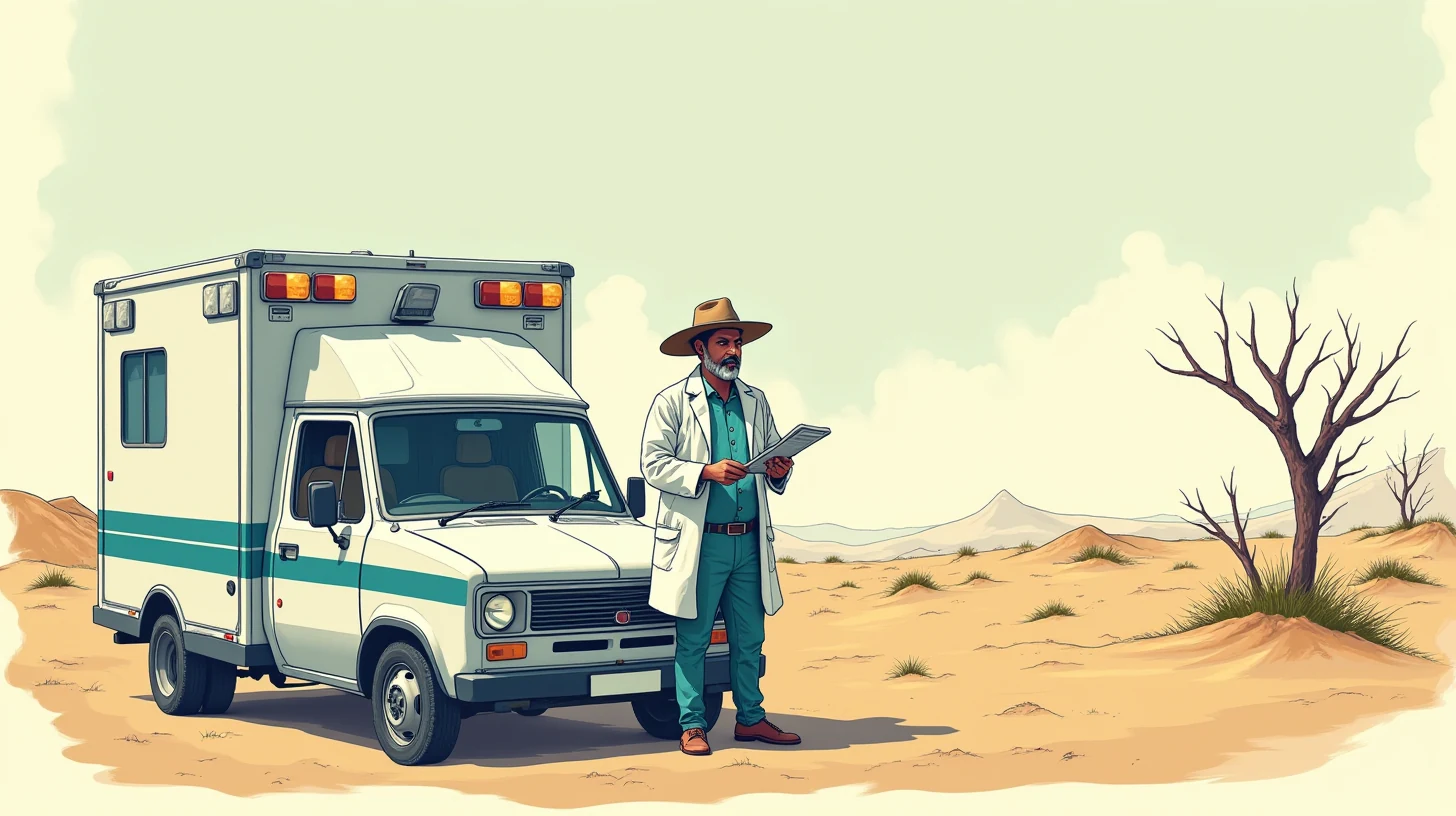
The posting came with no formal job description, no specialist backup, and no toxicology reference for the region's endemic snake and scorpion species. The nearest herpetologist was in Jodhpur—a distance that made real-time consultation impossible for acute envenomation cases. Vikram learned by necessity: he developed a field protocol for scorpion sting triage based on clinical presentation, taught himself herpetology from Indian Institute of Science publications, and built, by hand, a laminated species identification card that hangs from his ambulance visor. In twenty-two years of emergency medicine in the Thar, he has treated over four hundred scorpion and snake envenomation cases. He has intubated heatstroke patients whose core body temperature exceeded forty-two degrees Celsius. He has managed obstetric emergencies in villages where the next medical facility was a two-hour ambulance ride across empty scrubland.
By every measure that matters in emergency medicine, he has become the specialist the region was never designed to have.
But by 2025, the weight of being the region's only specialist had begun to show. And then a twelve-year-old girl named Neha was brought to his ambulance, stung by a scorpion he could not identify, and everything changed.
🗓️ The annual ritual
Rajasthan's public health system is structured around a hierarchy: Primary Health Centres in villages serve populations of five to ten thousand with basic care—vaccinations, maternal delivery, chronic disease screening, and, in theory, referral. District hospitals provide secondary care: surgery, emergency medicine, obstetrics. Medical colleges and AIIMS provide tertiary care and specialist consultation. The system works on paper. In practice, for emergency medicine in a desert region where specialists do not volunteer to post, it means that one emergency physician becomes, by circumstance and necessity, the specialist for a population of 1.6 million.
Barmer District covers approximately twelve thousand square kilometers—an area larger than the state of Rhode Island—with infrastructure scattered across high desert and scattered villages. Every summer, as ambient temperature rises to forty-five to fifty degrees Celsius, the district's one hundred-bed hospital fills with heatstroke cases: patients arriving in ambulances without air conditioning, their core temperatures already above forty-one degrees, their kidney function failing, their blood electrolytes in dangerous disarray. Vikram's protocol requires aggressive ice-water immersion, IV crystalloid rehydration calculated by weight and urine output, continuous core temperature monitoring, and ICU beds with mechanical ventilation.
The hospital's ICU has six beds. During peak summer, the emergency ward operates at one hundred fifty percent capacity. Patients wait in hallways. Fans substitute for air conditioning. Vikram manages heatstroke cases without backup: no intensive care specialist, no nephrologist for acute kidney injury, no neurologist for heat-induced seizures.
- ⏰
March–April — Dry season preparation
Temperatures exceed 45°C. Antivenom supply is checked; IV fluids are stocked; cooling beds are prepared. Vikram revises his heatstroke protocols and sends reminders to PHC doctors in the district via WhatsApp about early warning signs of heat illness.
- 🔥
May–July — Peak heat and scorpion season
Emergency ward fills with clusters of heatstroke cases. Simultaneously, monsoon-season rains drive scorpions out of burrows; envenomation cases triple. Vikram works 12–14 hour shifts. The ICU remains at full capacity. Off-hours consultation happens via WhatsApp photographs of specimens.
- 🌧️
August–September — Monsoon complications
Snake bites increase. Waterborne disease cases emerge. Obstetric emergencies (pre-eclampsia, eclampsia) rise due to dehydration and poor antenatal care in remote villages. Vikram has intubated pregnant women during hypertensive crises.
- 🩺
October–February — Consolidation and training
Emergency volume drops. Vikram uses this window to document cases, train PHC doctors, update his toxicology reference, and attend to administrative work. No real rest occurs; administrative burden increases as the state asks for protocol documentation and case reports.
Scorpion cases follow a different severity curve. Rajasthan is home to fifty-three species of scorpions. Of these, only six are known to be lethal: Palamneus swammerdamii (black scorpion, highly venomous), Mesobuthus tamulus (red scorpion, the most common lethal species), Hottentotta species (yellow scorpion), Lychas species (variably venomous), and two others with narrow geographic distribution. The remaining forty-seven species are non-lethal and cause local inflammation only. For a field emergency physician, distinguishing between lethal and non-lethal means identifying the species from the patient's description or, occasionally, from a photograph taken by family members in the field.
A patient stung by Mesobuthus tamulus enters a cascade: parasympathetic cholinergic toxicity in the first hours (profuse salivation, lacrimation, bronchospasm, bradycardia, hypotension) followed by sympathetic toxicity (hypertension, tachycardia, arrhythmias, pulmonary edema). Mortality in untreated cases is five to eight percent. In rural areas with delayed presentation, it reaches fifteen to twenty percent. Management requires antivenom (supplied by the government at no cost to the hospital) and aggressive supportive care: mechanical ventilation, vasopressors, ICU monitoring.
A patient stung by a non-lethal species requires only pain management and local wound care.
The distinction is binary. Give antivenom to a non-lethal sting and you waste a dose of a resource that has finite supply and limited shelf-life. Do not give antivenom to a lethal sting and the patient dies within hours. In Barmer, Vikram has no laboratory confirmation, no toxicology reference, and no herpetologist to call. He has only the patient's presentation, the description of the scorpion (often vague: "brown and small"), the location of the sting, and his clinical judgment.
⚠️ What very nearly happened
In July 2019, a twelve-year-old girl named Neha was brought to Vikram's ambulance by her father, carried on a cloth stretcher, stung on the left ankle while fetching water from a hand pump in the family's courtyard at dawn. The scorpion was not brought. The father described it as "small, brown, possibly a local one—the type we see every season and they don't usually hurt anyone."
Neha presented with mild local pain and some swelling at the bite site. No systemic symptoms: heart rate eighty-six beats per minute (normal), blood pressure normal, alert and oriented, no salivation or other autonomic signs. Every clinical indicator suggested a non-lethal species sting.
Vikram's protocol at the time was to observe such cases for four to six hours and discharge if no systemic symptoms developed. The hospital's antivenom supply was contingent on state procurement, and batches arrived late. For every dose used on a non-lethal case, a lethal case later in the summer might go without.
He began the observation. At four hours, Neha remained asymptomatic. At five hours, she was still comfortable, asking her father for water. At six hours, Vikram signed discharge papers. The father thanked him. They left.
Two hours after discharge, at approximately midnight, Neha's father brought her back to the emergency ward. She was in respiratory distress, breathing at thirty-five breaths per minute, her oxygen saturation at eighty-four percent on room air. Her saliva was pouring—she was drooling continuously, unable to swallow. Her pupils were pinpoint. Her heart rate had dropped to forty-eight beats per minute. She was, clinically, in the acute cholinergic phase of a lethal scorpion envenomation.
The ambulance that had brought her back had no oxygen. She had deteriorated in transit. By the time she arrived at the hospital, she was minutes from full respiratory arrest.
"આપણો વિચાર આપણો ફરક છે — પણ વિચાર તો રાત્રે બદલાઈ જાય છે."— Our judgment is our difference — but judgment changes in the night.
Vikram intubated her immediately. He administered the Indian Polyvalent Antivenom (twenty milliliters intravenous), started a dopamine infusion for her hypotension, and placed her on mechanical ventilation. He spent the night at her bedside, checking her blood gases at two-hour intervals, adjusting her ventilator settings, watching for arrhythmias. Her heart rate began to stabilize at six in the morning. By the next afternoon, her respiratory status had improved enough to attempt extubation. She was awake and, mercifully, she did not remember the night.
She was discharged after five days. She went home with her father to the same courtyard where the scorpion had stung her.
The scorpion that stung her was never identified. But based on the delayed onset (eight hours) and the specific pattern of cholinergic toxicity, Vikram's post-discharge analysis suggested it was a Hottentotta species—a yellow scorpion common to the Barmer region. Juvenile Hottentotta deliver high venom loads relative to body weight. The delay in symptom onset had masked the case's severity. A clinical observation protocol that worked for adult stings might not work for children. Neha had survived through luck: her father had been frightened by the deterioration and brought her back, not because he recognized the toxicity, but because something felt wrong. If he had followed Vikram's discharge advice and kept her home, she would have died in his arms after respiratory arrest.
For six months after Neha's case, Vikram could not walk past the pediatric ward without thinking about the eight-hour window when she was home, asymptomatic and dying by degrees, while he thought the case was solved.
🌗 What changed
Vikram spent the six months after Neha's case reviewing everything published about scorpion envenomation in India. He contacted the Indian Institute of Science's toxicology department. He reached out to herpetologists at AIIMS Jodhpur and at Rajasthan University of Health Sciences. He compiled a list of the fifty-three scorpion species in Rajasthan, with their geographic distribution, size (and therefore relative venom load), onset of toxicity (ranging from immediate to eight hours), severity profile (lethal versus non-lethal), and the specific antivenom that was effective against each species.
He discovered that no such database existed in the public health system. Rajasthan's state medical directorate had no toxicology reference. India's National Health Mission had no centralized envenomation protocol. Medical colleges taught herpetology only to undergraduate students and did not maintain field references for practicing emergency physicians. Each hospital in scorpion-endemic regions maintained its own ad-hoc protocols, often based on trial and error and the personal experience of the longest-serving doctor, rather than on systematic literature review.
The information existed—scattered across journals, textbooks, and the tacit knowledge of specialists in a few major cities. But it had not been gathered, organized, or made accessible to a field emergency physician in the Thar.
Species Identification Guide
53 species, color-coded by lethalityCommissioned a medical illustrator to create a laminated guide organized by color, size, and geographic region. Photographs of the district's common species, annotated with venom potency and geographic range. Distributed to every PHC in Barmer.
Decision Trees for Antivenom
Antivenom administration keyed to patient age, sting location, time of presentation, and symptomatology. If stung in Barmer (yellow scorpion more likely), if the sting was on the hand (higher venom load), if onset delayed beyond four hours (likely non-lethal), observe; if earlier onset, administer antivenom and proceed to ICU.
District-Wide WhatsApp Consultation
24/7 herpetology supportPHC doctors in the district can photograph a specimen and send it to Vikram. He identifies the species within minutes, provides immediate management guidance, and coordinates ambulance transfer if antivenom is indicated. By 2023, this informal network had become the de facto toxicology standard for Barmer.
In late 2019, Vikram did something that would normally be outside his job scope: he commissioned the medical illustrator from Jaipur to create the species identification guide. He had the laminated cards printed and distributed them to every PHC in the district, traveling to remote health centres by motorcycle and jeep. He built a small herpetology reference library in the hospital's emergency ward: photographs, management protocols, case studies of his own patients, and a decision matrix.
By 2023, Vikram's informal reference system had become the de facto toxicology standard for Barmer District. Other emergency physicians in the district began calling him for identification guidance. PHC doctors sent photographs via WhatsApp. The state medical directorate, recognizing the need, contracted with him to develop a formal scorpion management protocol that could be adopted district-wide.
But the system remained fragile. It depended on Vikram's continued tenure in Barmer and on his willingness to remain the unofficial toxicology consultant for a region of 1.6 million people. It was maintained on laminated cards and WhatsApp calls rather than through formal infrastructure. If Vikram retired, or transferred, or fell ill, the system would collapse—and the next emergency physician posted to Barmer would begin again, without reference, relying on intuition and luck.
🧭 Why we built it
There are approximately fourteen hundred government emergency physicians serving in rural India—roughly one for every eight hundred fifty thousand people in rural areas. In urban centres, the ratio is one emergency physician per two hundred thousand people. The rural deficit is structural: emergency physicians are trained in urban teaching hospitals and prefer to practice in urban centres where there is specialist backup, continuous learning, and proximity to family. Rural postings are seen as punishment transfers or as temporary hardship assignments.
"અમે આમાં આવ્યા નથી, પણ અમે આમાં જીવી ગયા છીએ — અને આમાં માણસો બાકી છે જેમને સહાય કરવાની જરૂર છે."
(I did not come here for this, but I have lived here for this — and there are people here who need help. You cannot leave them.)
The consequence is that when a rural emergency arises, it is managed by a generalist or by a single specialist who has, through years of isolated practice, become expert in a narrow set of crises. Vikram's toxicology reference system should not have existed. Rajasthan's state medical system should have had a centralized envenomation protocol. The knowledge should have been codified, taught, and maintained through formal institutions.
Instead, it was built by a single emergency physician who had the initiative to learn, the grit to document, and the luck to find a way out before the system consumed him entirely. The pattern repeats across rural India: the first-line emergency physician becomes the specialist by necessity, the informal knowledge keeper, the person who trains the next cohort because no one else will. They build systems that work—and then they burn out, or they transfer, or they retire, and the system collapses because it was never designed to persist without the founder.
We are beginning to map these gaps: the clinical expertise that exists in fragmented form across rural India, the informal protocols that work but are not documented, the specialists who emerge by circumstance rather than by design. Vikram's toxicology reference is one instance of a thousand instances where the medical system's blindness creates both a crisis and an opportunity. These are the practitioners who need a platform not for marketing their expertise but for formally documenting it, for connecting it to the practitioners who need it, and for ensuring that the knowledge they have built through sacrifice and trial persists beyond their own tenure.
What it does
- 🔍Identify a scorpion species from a description or WhatsApp photograph using the regional herpetology reference he built, and determine lethal versus non-lethal with high accuracy.
- 📋Triage a patient by symptom onset (immediate vs. delayed), sting location (hand vs. foot), and patient age to decide antivenom administration, reversing Neha's near-death by changing the observation protocol for pediatric cases.
- 🚑Manage the full clinical care of envenomation and heatstroke cases from triage to ICU discharge, coordinating with PHCs across the district via WhatsApp to catch delayed presentations early.
What it does not do
- 🔒Never makes antivenom decisions without clinical examination; the decision tree is a guide, not a substitute. Photographs are second-best to physical assessment.
- 💊Cannot provide continuous specialist backup to every PHC in the district in real-time; WhatsApp consultation has latency and misses urgent cases where transport time matters.
- ✅Cannot create a sustainable system alone; the protocol requires formal state adoption, training infrastructure, and a second emergency physician so that one doctor's transfer does not collapse the regional network.
🌱 What we hope happens
By 2024, Vikram had been in Barmer for twelve years. His salary as a government Senior Resident was sixty-eight thousand rupees per month—a figure that had not changed since 2018 despite annual inflation. He was not permitted to maintain a private practice. Requests for transfer to an urban centre had been denied because the district hospital had "essential staff shortages," and his departure would leave the emergency ward without specialist coverage.
His family lived in Jaipur, two hours away. His wife, a school teacher, had turned down promotions that required relocation. His two children attended school in Jaipur and came home to their father once every two weeks. His mother had had a fall in 2023 and required increasing supervision. He had not seen her in three months.
The work was meaningful. The cases he handled—the children he intubated, the mothers he delivered safely through obstetric crises, the scorpion victims he saved—these were real lives saved because he was there and because he had built expertise over years. But the meaning did not translate into career advancement, financial security, or family stability.
In October 2024, Vikram submitted a formal request for secondment to the state medical directorate, proposing a one-year assignment to develop a formal Scorpion Envenomation and Desert Emergency Medicine Protocol that could be adopted across Rajasthan's rural health system. The proposal was detailed: a comprehensive manual, species identification guide, a training curriculum for PHC doctors, and a state-level toxicology reference hotline. The request was approved. He was reassigned from Barmer District Hospital to the state's Directorate of Health at Jaipur for one year, at the same salary.
For the first time in twelve years, he was not in the desert.
As of May 2026, he is halfway through the assignment. He has completed the species identification guide. He is finalizing the management protocol. He is training a cohort of PHC doctors from seven districts on heatstroke management and envenomation triage. And he is living in Jaipur, seeing his mother twice a week and his wife and children every evening.
He does not know whether the protocol will be sustained after his assignment ends. The state's Directorate of Health changes leadership frequently. Priorities shift. The document he is creating may be filed and forgotten. But for now, the work is moving forward, and he is no longer the only specialist in the desert.
There is a specific kind of expertise in Indian rural medicine that does not announce itself. It is built by a single doctor who notices what is missing, who learns what should have been taught, and who documents what should have been codified by government years ago. And then that doctor is released, briefly, to formalize what they have learned. Vikram is one of them. There are hundreds more—in obstetrics, in pediatrics, in trauma surgery, in public health—scattered across rural India, building systems that work in the absence of systems designed to work.
If you are a rural health practitioner, a PHC doctor, a district hospital physician, or a specialist serving a region with informal protocols that work but are not documented, this is the space where gabforge.in is focusing: documentation of field expertise, connection to practitioners who know, and pathways for that knowledge to be formally recognized and sustained. Tell us about your practice. Tell us what you know that is not documented. Tell us where the system has a gap.
The platform is in progress. We are listening.