
The Bastar surgeon and the invisible boundary between care and conflict
Dr. Rajesh Sharma is forty-two years old. He finished his MBBS from Pt. Javaharlal Nehru Medical College in Raipur in 1998 and completed his MS in General Surgery from AIIMS Bhopal in 2005. For the first thirteen years of his career, he worked in private practice and at government hospitals in administrative districts—Raipur, Durg, Bilaspur—where the work was steady, the complications were manageable, and his family lived in the same city where he worked. His wife Neela is an accountant; his daughter Aisha was in school in Raipur; his son Arjun was eight. Life had the texture of a middle-class Indian family: school fees, annual leave in the Himalayas, a small house in the Devendra Nagar neighborhood where he had treated half the families on the street.
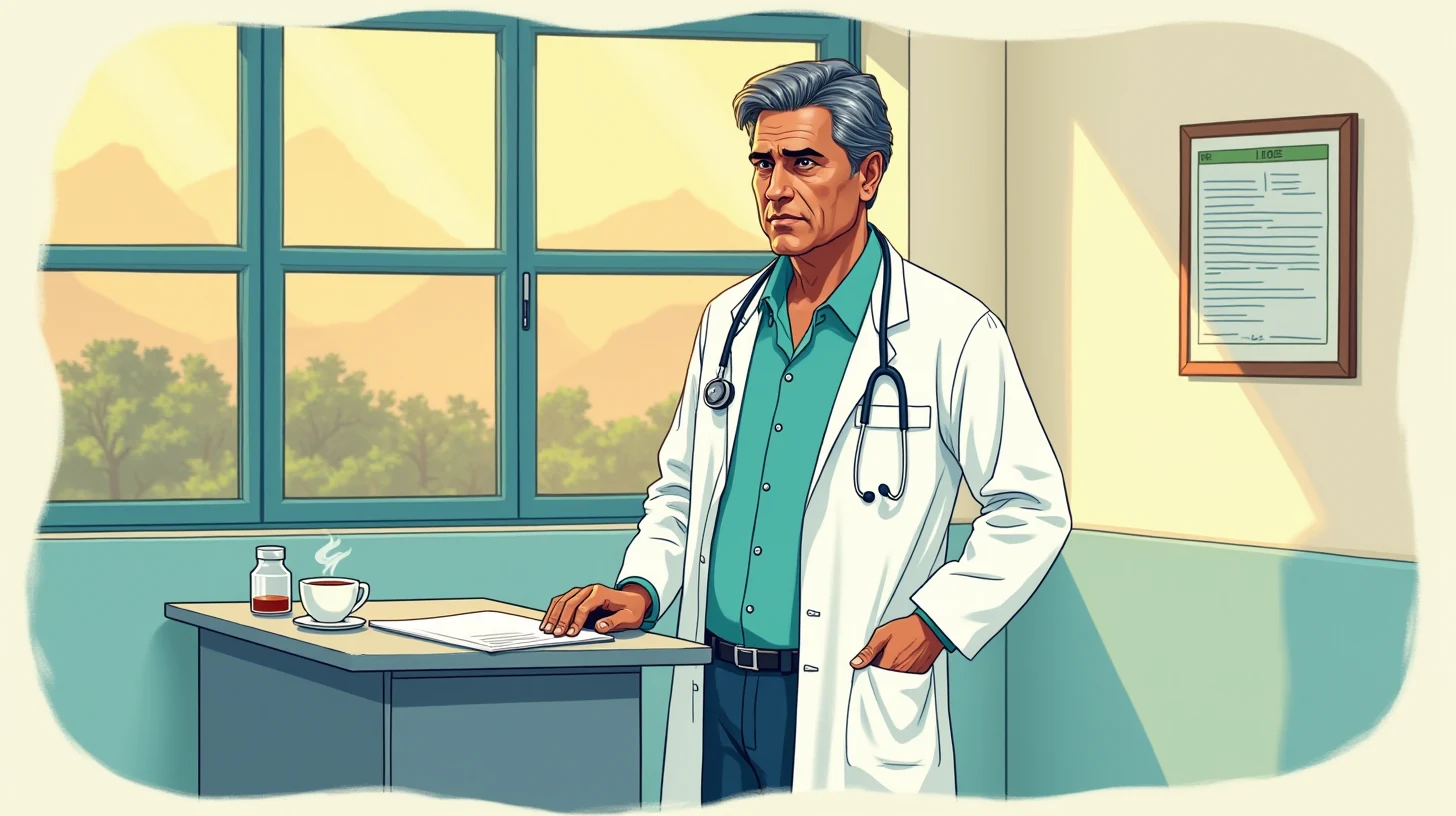
In 2021, the Health Services Directorate of Chhattisgarh invited him to apply for a position as Senior Surgeon at Bastar District Hospital. The hospital served as the tertiary referral centre for a population of 1.8 million spread across nine blocks of one of India's most volatile Naxal-affected zones. The position carried a monthly salary of ₹1,12,000, plus dearness allowance, plus housing allowance. The hospital needed him urgently: three sanctioned surgical posts were vacant, referrals were backing up, and the previous surgeon had left abruptly two years prior without a handover. He was technically exempt from the mandatory rural posting requirements for senior doctors. He accepted anyway.
The posting letter arrived in June 2021. It stated clearly: the civil administration and the CRPF had security contained. The hospital was in a protected zone. No occupational risk existed beyond the normal risks of surgical practice in a government hospital. He read this and signed the letter and drove to Bastar with three suitcases and a plastic bag containing the names and phone numbers of two colleagues who worked there and who had warned him that the job was harder than it sounded.
He was right. It was.
🗓️ The annual ritual
Bastar district sits at the heart of the Red Corridor—the cluster of Naxal-affected zones that runs through Chhattisgarh, Jharkhand, and Odisha. The violence is not theoretical. In 2010, Naxals had ambushed a CRPF convoy on the Raipur-Jagdalpur highway, killing seventy-six personnel. In 2017, they had set off an IED near the district magistrate's office in Bastar town, killing three civilians. In the five years before Rajesh arrived, there had been seventeen confirmed clashes between armed Naxals and CRPF personnel in the district, resulting in ninety-three deaths: forty-one Naxals, thirty-eight CRPF, twelve civilians and security personnel from other agencies.
The Bastar District Hospital sits two hundred meters from the district magistrate's office and the district police headquarters. It is surrounded by a security fence. There are armed police standing outside the emergency entrance. The government's official position is that this makes it a protected facility. The lived reality of working there is different.
In Rajesh's first six months, the hospital admitted three gunshot wound victims. Two came from a Naxal IED that had detonated on the Raipur-Jagdalpur highway; the third came from a firefight between CRPF personnel and armed Naxals that had spilled into residential areas near the hospital compound. One of the gunshot victims died on Rajesh's operating table. Two others recovered after extensive surgical intervention and intensive care. By the end of the first year, there had been four more admissions: a police officer with a chest wound, two CRPF personnel with limb injuries, one civilian caught in blast trauma.
None of these admissions were formally recorded as Naxal-related injuries in the hospital's statistics. They were recorded as "vehicular trauma," "industrial accident," or "unspecified injury." The state health department's portal did not track occupational injury rates by district. The medical superintendent did not ask questions. The government's statistics showed that Bastar was a normal district with normal surgical caseloads. This was technically true. It was also false.
- 🩺
2021 — First six months: three gunshot wounds
IED injuries from highway ambush and CRPF-Naxal firefight. One death on operating table. Two survivors. Recorded as 'vehicular trauma' and 'unspecified injury.' Government classification: normal district.
- 🏥
2022 — Surgical equipment failure: X-ray downtime
X-ray machine fails; repair requires three-week clearance from state health department because vendor fears security risk. Rajesh adapts surgical protocols. Operating theater has no anesthesia ventilator for two years; manual bag-valve-mask ventilation becomes routine.
- ⚠️
2023 — Staffing crisis: second surgeon requests transfer
Original posting had three sanctioned surgeon positions. Rajesh remains the only surgeon. Second colleague requests transfer to AIIMS Raipur citing family security concerns. Request rejected: no vacant position exists. Rajesh becomes sole surgical capacity for 1.8 million population.
- 📊
2024 — Daughter's question: 'Papa, you are safe, right?'
Teenage daughter reads news article about Naxal violence in Bastar, realizes her father works there. Direct question forces confrontation with unacknowledged occupational reality. Rajesh calls health department; told no formal hazard has been identified and therefore no premium justified.
- 🔀
2025 — CRPF pathway: formal designation as Consulting Surgeon
CRPF Medical Services formally designates Rajesh as Consulting Emergency Surgeon for Bastar Division, with explicit acknowledgment of occupational hazard. Letter enables AIIMS Raipur transfer and DNB trauma surgery position within weeks.
The clinical work was extraordinary. Beyond the expected case mix—appendicitis, hernia, trauma from agricultural and road accidents—there was a steady stream of patients connected directly or indirectly to conflict. Women who had been assaulted by armed groups. Men with injury patterns consistent with torture. Children with blast trauma and shrapnel wounds. A guerrilla fighter who had been shot and had walked forty kilometers through the forest to the hospital, arriving with a festering abdominal wound and sepsis, who survived his surgery and whose discharge was a question mark between clinical triumph and bureaucratic confusion.
The diagnostic equipment reflected the scarcity of a conflict zone. The ultrasound machine had never been serviced because the vendor would not visit until clearance was confirmed from the district magistrate, and the district magistrate's office moved slowly on approvals that implicitly acknowledged security risk. The surgical theatre lacked an anesthesia ventilator for two years after the previous one failed. Rajesh performed emergency surgeries using manual bag-valve-mask ventilation with an anesthetist squeezing a rubber bag for the duration of the operation, which could last four hours. This is not how surgery is supposed to be done. This is how it was done in Bastar.
⚠️ What very nearly happened
He asked for a hazard allowance in his second year of posting. The request went to the state health department's payroll branch, which responded formally: no occupational risk had been formally identified and therefore no premium could be justified. He could apply for danger pay once an occupational hazard had been formally documented by the district magistrate's office and once the CRPF had issued a formal assessment of security risk. Both would require him to initiate a petition, which would require him to flag himself as someone unwilling to accept the posting's implicit conditions—a category from which career advancement does not follow.
He asked for a transfer. The request went to the State Health Services Directorate, which responded that Bastar's position was his posting and his posting was not eligible for discretionary transfer until a replacement was identified. Raipur did not have an open position. The second surgeon position that had been vacant when he arrived was still vacant. His own departure would leave Bastar with zero surgeons, a situation the health department could not administratively permit. He was, without anyone saying it explicitly, trapped.
What very nearly happened was that he would have remained in Bastar indefinitely. The work was necessary. The patients needed him. By any external measure, he was the kind of surgeon that health policy was designed to keep in remote, dangerous places. The cost of his staying, which no one was measuring, was becoming untenable.
"मुझे नहीं पता था कि घबराहट को कैसे आधिकारिक बनाया जाए — सरकार ने कहा कि खतरा नहीं है। तो मैं किसी चीज़ के लिए प्रीमियम माँग सकता हूँ जो सरकार के अनुसार मौजूद नहीं है?"— I did not know how to make fear official — the government said there is no danger. So how could I ask for a premium for something that, according to the government, does not exist?
His wife Neela was living in Raipur with the children. They saw him on weekends when he drove the two hundred kilometers from Bastar in a government vehicle, sitting in the back seat, not driving himself, as a security precaution. In December 2023, his daughter Aisha, who was seventeen, called him and said she had read a news article about Naxal violence in Bastar. She had looked up the hospital online. She realized where he worked. She asked directly, in Hindi, without preamble: "Papa, aap safe hain na?" — Dad, you are safe, right?
He could not answer confidently. The hospital had security gates and a visible police presence. It was not safe in the sense that the conflict surrounding it was real and episodic and unpredictable. He was, objectively, working in a location where the probability of trauma admissions directly related to armed conflict exceeded the probability in any government hospital in an administratively peaceful district. He could not tell his daughter this. He told her he was fine. He was not fine.
That evening, he called the health department's occupational health cell and asked about hazard designation. He was told, again, that no formal hazard had been identified. He called the district magistrate's office and asked what process existed for a healthcare worker to formally report occupational risk. He was transferred between three officials. The final official told him, with some irritation, that formal risk assessments were performed by the CRPF Security Operations Centre, and the hospital's most recent assessment, filed in 2019, had classified it as "standard protected civilian facility." If Rajesh believed this classification was inaccurate, he could petition for a new assessment, but the petition would need to come from the district administration, not from an individual doctor.
🌗 What changed
In August 2024, Rajesh attended a continuing medical education seminar on trauma surgery at AIIMS Raipur. During a break, he encountered Dr. Neeta Nayak, a medical officer at a CRPF camp primary health centre in Bastar district. They were both drinking chai in the courtyard, and the conversation turned to the challenge of practicing medicine in a Naxal zone.
Dr. Nayak asked whether he had approached the CRPF Medical Director for Bastar Division. She explained that the CRPF ran parallel medical services in conflict zones, and unlike the civilian health department, the CRPF maintained occupational hazard protocols and occupational health insurance for its personnel. She suggested that Rajesh contact the Medical Director about a formal arrangement: the government hospital could designate Rajesh as a consulting surgeon for CRPF emergency referrals.
If the CRPF formally recognized him as a consulting surgeon for their medical system, two things would happen. First, the CRPF would need to document his occupational exposure in their records, creating a parallel occupational health record independent of the state health department's classification. Second, and most importantly, if he ever needed to leave the posting, the CRPF documentation would serve as evidence of occupational risk that had been formally acknowledged by an armed forces agency—evidence that would carry weight with a labor magistrate that the government's denial could not match.
It was not a perfect solution. It did not give him hazard pay. It did not change his government salary. But it was a pathway he had not seen before.
Rajesh contacted the CRPF Medical Director in September 2024. He proposed a formal arrangement: the government hospital would designate him as the consulting surgeon for CRPF emergency referrals. The CRPF would provide written acknowledgment of the occupational exposure this role entailed. In return, he would be available on-call for CRPF emergencies and would provide consulting notes submitted to the CRPF medical records system.
The CRPF Medical Director, after consulting with the regional command, approved the arrangement. In October 2024, Rajesh received a formal letter designating him as "Consulting Emergency Surgeon for CRPF Medical Services, Bastar Division." The letter explicitly stated that the appointment recognized "the inherent occupational hazards associated with providing surgical services in a Naxal-affected operational area." It included him in the CRPF medical personnel occupational health insurance scheme. The letter was typed on official CRPF letterhead, signed by a brigadier, and bore the weight of military institutional acknowledgment.
"डॉक्टर शर्मा, यह पत्र आपके व्यावसायिक जोखिम को आधिकारिक रूप से स्वीकार करता है। CRPF के चिकित्सा प्रणाली में, सशस्त्र-संघर्ष क्षेत्र में काम करने वाले चिकित्सकों को व्यावसायिक स्वास्थ्य बीमा दिया जाता है। यह पत्र उस बीमा को सक्षम करता है। यह केवल एक पत्र है, लेकिन यह आपकी सरकारी नियुक्ति के दस्तावेज़ को बदल सकता है।"
(Dr. Sharma, this letter officially acknowledges your occupational risk. In the CRPF medical system, doctors working in armed-conflict zones are given occupational health insurance. This letter enables that insurance. It is only a letter, but it can change the documentation of your government posting.)
He held the letter for a week without doing anything with it. Then, in December 2024, he applied for a position as Senior Resident in the trauma surgery department at AIIMS Raipur. The position was normally filled by senior surgeons with academic credentials or private practice backgrounds. His application was nearly rejected because he lacked academic publications. But when the interview committee reviewed the CRPF designation letter and learned that he had spent four years providing emergency surgical services in a Naxal zone, the dynamics of the interview shifted entirely. The committee offered him not the consulting position he had applied for, but a position as Senior Resident in the trauma surgery department—a role that would allow him to pursue a Diploma of National Board in trauma surgery while maintaining a senior physician's salary.
State Health Department
₹1,12,000/month, no premiumOfficial position: Bastar District Hospital is in a protected zone. No occupational risk exists. Formal hazard designation would require acknowledging what the government denies. Pathway to recognition: blocked.
CRPF Medical Services
Occupational health insurance recognizedCRPF acknowledges occupational risk in armed-conflict zones and insures personnel accordingly. Not designed for civilian doctors, but willing to recognize consulting exposure. Pathway to recognition: available to those who understand the boundary.
Academic Medical Institution (AIIMS)
Senior Resident + DNB trackAIIMS values occupational risk evidence from credible sources (CRPF letter). Interview committee recognized the CRPF designation as institutional credibility that compensated for lack of academic publications. Pathway recognition: leverageable.
His transfer request to AIIMS Raipur, when submitted alongside the CRPF letter and the AIIMS appointment, was approved within three weeks. In February 2025, he joined AIIMS Raipur's trauma surgery department. He is currently completing his first semester of DNB training. He works with anesthesia ventilators that are serviced regularly. His colleagues include specialists. His patients include trauma from all causes, not only conflict.
The replacement surgeon for Bastar District Hospital has not been recruited. The post remains vacant. The hospital continues to operate with reduced surgical capacity.
🧭 Why we built it
There are, conservatively, one thousand five hundred to two thousand government doctors posted in Naxal-affected zones across India. They work in Bastar, Bijapur, and Sukma in Chhattisgarh; in Gadchiroli in Maharashtra; in portions of Jharkhand and Odisha. The government's official position is that these zones are secure and that posting doctors there carries no occupational premium beyond the normal risks of medical practice. The lived experience of every doctor in these zones is that the violence is real and that they are working in conditions that no doctor in a peaceful district faces.
The state's denial is not accidental. It serves a financial purpose: if the government formally acknowledged occupational risk in conflict zones, it would have to pay occupational hazard allowances—a commitment that would cost hundreds of millions of rupees per year across India's Naxal-affected states. It would have to recruit doctors under hazard-premium terms, which would require salaries substantially above the standard rural posting rate. It would have to admit, at an institutional level, that parts of its health system are embedded in active conflict zones—an admission with political costs that no state government is willing to bear.
So instead, the government maintains two fictions: one, that the conflict zones are safe; and two, that if a doctor is killed or injured in a conflict zone, it is a personal tragedy, not an occupational casualty.
But Rajesh's story illustrates that the fiction is permeable. The CRPF, which has no political investment in denying conflict, acknowledges occupational risk and insures against it. The CRPF's occupational health system is not designed for civilian doctors, but it is designed to recognize exposure to armed conflict, and that recognition can be leveraged by a doctor who understands where the boundary lies.
There are other boundaries too. Labor magistrates, if presented with credible evidence of occupational risk, can order hazard designation. Some state officials have, in the past, approved occupational hazard designation for doctors in similar circumstances. Some security agencies run occupational health protocols that can be accessed through inter-agency coordination. The pathways are not visible on government websites. They are not advertised. But they exist.
🌱 What we hope happens
Rajesh sent us a message in April 2025, three months into his AIIMS position. He said that the work at AIIMS was different—complex cases, institutional resources, colleagues to consult. He said his daughter had called to ask about his postings schedule and had seemed relieved when he said all his placements were in Delhi. He said he did not know whether he would ever have requested transfer if the CRPF letter had not arrived, and that the letter would never have arrived if he had not been at a chai break in a hospital courtyard when a colleague happened to mention the CRPF occupational health system.
Which is what we are building toward. Not every doctor in a Naxal zone will have access to that collision point. Not every doctor will have a colleague who knows about CRPF occupational health protocols. Not every doctor will be able to create parallel documentation that will be recognized by alternative institutional systems. Many doctors will remain in Bastar, in Sukma, in Gadchiroli, working without hazard pay, without recognition of their occupational risk, without a pathway out that doesn't require a chance conversation with someone who knows the system's hidden boundaries.
We have mapped the Naxal-affected zone medical landscape across Chhattisgarh, Maharashtra, Jharkhand, and Odisha. We know which security agencies have occupational health systems. We know which officials can formally acknowledge occupational risk. We know which institutions have, in the past, approved occupational hazard designation for doctors in similar circumstances. We know the forms and the petitions and the bureaucratic sequences that work. We know the difference between the government's denial and the pathway that exists outside of it.
If you are a doctor posted to a Naxal-affected zone and you are wondering whether you are trapped, the resource is free at gabforge.in. Tell us your state, tell us your zone, tell us what you are trying to do next. Tell us whether your workplace is one where the violence is real and the government denies it. We have read the notices. We know the geography. We know where the pathways are hidden, and we will show you the way out. And we will be quiet about the fact that you should never have had to find it yourself.