
The Coimbatore pulmonologist and the occupational disease they cannot yet prevent
Dr. Arjun Nayar is forty-one years old and has been a pulmonologist for fourteen years. He spent three years at Madras Medical College in Chennai, two at Christian Medical College Vellore — one of India's most prestigious medical institutions — and nine at Coimbatore Medical College and Hospital (CMCH), where he now leads the Department of Respiratory Medicine. His clinic overlooks the road toward Tiruppur, the textile manufacturing heartland of Tamil Nadu. On any Tuesday afternoon, three of the five patients in his outpatient clinic are textile mill workers. On his ward rounds — which he does three mornings a week at 7:30 AM before formal clinic begins — he sees something that troubles him more than any diagnosis in a patient sitting upright in his chair: the pattern.
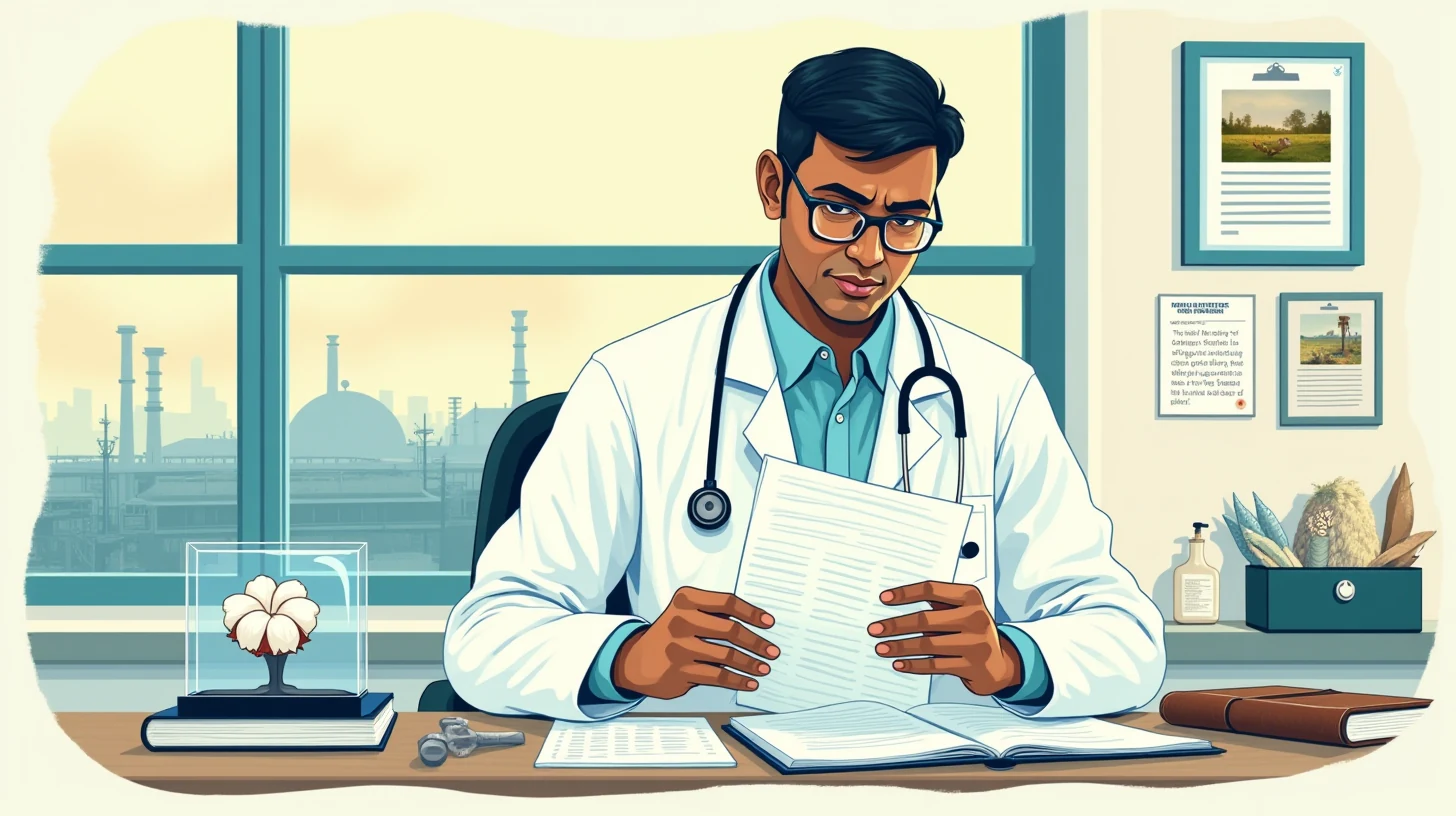
His income has oscillated between ₹4.5 lakh and ₹7 lakh annually, depending on consultation fees and referral volume. This year it has climbed to ₹6.8 lakh by May. The climb is not because people are getting healthier. It is because they are getting sicker — more mills, more workers, more breathlessness, more cotton fiber settling into lungs that should not be breathing it. What Arjun has learned in nine years at CMCH is that occupational disease in Coimbatore is not a medical problem that treatment can solve. It is a system problem that treatment merely manages while the system remains unchanged.
🗓️ The annual rhythm of textile mill disease
In November 2023, the Tamil Nadu government released updated occupational health guidelines for textile mills, reinforcing the Occupational Safety, Health and Working Conditions Code, 2020. The guidelines specify dust exposure limits: in spinning departments, air velocity should not exceed 0.5 meters per second. Textile workers should have access to respiratory protection. Mills should conduct health screening every two years. The guidelines are clear. The enforcement is not.
Coimbatore district has approximately 900 to 1,000 registered textile mills. The Tamil Nadu Labour Department has 140 occupational health inspectors for 8,300 textile mills across the entire state. An inspector working eight hours per day can realistically inspect three mills per week. To inspect every Coimbatore mill once per year would require 77 inspectors working exclusively on textile occupational health. There are not 77 inspectors. There are not even enough to inspect every mill once every five years.
The result is a hollow law. Textile mills operate with de facto autonomy on dust control. Workers breathe unfiltered air. The regulations exist on paper. The enforcement exists in imagination.
- ⚖️
Nov 2023 — Government issues guidelines
Tamil Nadu reissues occupational health standards for textile mills, including dust exposure limits and biennial health screening requirements. The guidelines are clear.
- 🫁
Year 6–10 of mill employment — Early-stage disease
Workers with 5+ years of textile mill exposure develop early-stage airway obstruction. Spirometry shows FEV1/FVC ratios 15–20% lower than non-exposed controls. The disease is present. Screening does not happen.
- 🛑
Year 12–15 — Recurrent infections begin
Workers begin cycling through hospital admissions with acute bronchitis exacerbations — two to three times per year. Each admission costs ₹40,000–₹80,000 in hospital care. The pattern is visible to clinicians. It is invisible to inspectors.
- 📋
2019 vs. 2026 — Last inspection gap
A mill like Reliance Textiles, where Arjun's patient Murugan worked, has not been inspected for dust exposure compliance in seven years. By the time an inspection arrives, the worker has permanent lung damage.
Arjun knows this rhythm intimately. He has reviewed the Labour Department's inspection records for Coimbatore mills. The last recorded inspection of Reliance Textiles — where one of his long-term patients, a spinner named Murugan, worked for thirty-one years — was in 2019. It was now 2026.
⚠️ What nearly happened (and what happens every week)
On March 9, 2026, at 7:30 AM, Arjun was doing rounds in the respiratory ward of CMCH. Sixteen beds. Eleven occupied. Of the eleven, seven were textile mill workers. Of the seven, five had been admitted with acute exacerbations of chronic bronchitis. Their average age was fifty-two. Three were under forty-five.
One patient — Murugan, fifty-three years old, a spinner at Reliance Textiles — had been admitted on February 28 with a three-week cough, green sputum, and oxygen saturation at eighty-four percent. His chest X-ray showed hyperinflation and bronchial wall thickening consistent with chronic obstructive pulmonary disease. His occupational history: thirty-one years in the mill. Fifteen of those years in the spinning department, where air is saturated with cotton fiber dust, humidity is kept at sixty-five to eighty-five percent to improve thread strength, and ventilation, Arjun's notes said, was "inadequate."
Arjun asked Murugan: "How many times in the last five years have you had this — cough, fever, hospitalisation?"
"Three times," Murugan said. "Last year twice. This is the third."
"Have you ever worn a mask at work?"
"No, sir. The spinning master says masks slow you down. You have to breathe hard to pull the thread. Masks are for the people in the blending unit, where there is visible dust. In spinning, the dust is fine. You cannot see it."
Arjun wrote in the chart: "Patient educated on occupational exposure. Advised mask use. Advised to transition to lower-dust-exposure role. Prognosis: unlikely to change without work redesign."
The prognosis was not clinical pessimism. It was professional certainty born from nine years of watching the same pattern. Thirty-one years in a textile mill had written itself into Murugan's lungs. The damage was permanent. What remained was management — steroids, bronchodilators, antibiotics during infections, oxygen at night — not prevention. Management could add years to his life. What could have prevented this — early detection, dust control engineering, respiratory protection from age twenty-two onward — was now impossible.
"நுரையீரல் என்பது ஒரு முறை கெட்டுவிட்டால், அது மீண்டும் புதிதாக வராது. ஆனால் நாம் மிலுக்கு போவாதிருந்தால் அது கெடாது."— The lung, once damaged, does not regrow. But if we had not gone to the mill, it would not have broken.
🌗 What changed (and what stayed the same)
In May 2026, Arjun began meeting with Occupational Health Resource and Information Center (OHRIC), a Chennai-based NGO that works on worker health advocacy. OHRIC had connections with textile worker unions in Coimbatore. Together, they planned a worker awareness program: twelve weekly sessions in union meeting halls, teaching textile workers to recognise early respiratory symptoms, understand their rights under occupational health law, and file complaints with the Labour Department when dust controls failed.
On the surface, this was a small step. The program did not address the root cause — mills not investing in dust control, government not enforcing standards. But Arjun had learned something in nine years: visibility precedes action.
He had also built something that surprised him in its weight: a registry. Every textile worker admitted to the respiratory ward at CMCH now received a standardised occupational health form — age, years of mill employment, specific department (spinning, weaving, blending), symptoms at admission, spirometry results, chest imaging. Over nine years, this accumulated data on 340 textile workers with occupational airway obstruction. The registry was unpublished, sitting on Arjun's encrypted drive, but it was a record — a longitudinal picture of how occupational disease in Coimbatore textiles had progressed over a decade.
He began training junior residents in occupational medicine. CMCH had four respiratory medicine residents. Two of them — in their third year — were now doing their thesis research under Arjun's mentorship: one on dust exposure measurement in spinning units, another on the prevalence of occupational asthma in textile workers.
"நாம் செய்கிற வேலை அவசியம். ஆனால் ஒரு டாக்டர் மட்டும் மாறாட்டை கொண்டு வரமுடியாது. ஆனால் ஆயிரம் குரல்கள் — ஆயிரம் ரிகிஸ்ட்ரி எந்ட்ரி, ஆயிரம் தசிஸ் — அது பல்தியனை பிற்றினங்களுக்கு தெரியப்படுத்த முடியும்."
(This work we do is necessary. But one doctor cannot bring change alone. But a thousand voices — a thousand registry entries, a thousand theses — that can force the system to notice.)
The barrier, as Arjun understood it, was not clinical knowledge or diagnostic capability. It was institutional leverage. A single doctor running a clinic cannot mandate government inspections or force mill owners to invest in engineering controls. But a body of evidence — registries, prevalence studies, resident theses, worker testimony — can shift the system's default from "occupational disease is inevitable" to "occupational disease is a system failure that we choose to tolerate."
Registry of 340 workers
9 years of dataStandardised occupational health forms at admission. Every textile worker with airway obstruction documented with age, exposure duration, severity, and trajectory. This registry is not yet published, but it is a longitudinal record that proves occupational disease in Coimbatore is not anecdotal — it is systematic.
Resident theses
Evidence generationTwo residents are conducting thesis research on dust exposure measurement and occupational asthma prevalence in textile workers. Once published, these studies will provide the documentation that a single ward round cannot.
Worker awareness program
12 weekly sessionsUnion-based education on occupational rights, early symptom recognition, and Labour Department complaint filing. Shifts knowledge burden from clinician to worker. Generates documented complaints that justify future inspections.
🧭 Why this matters beyond Coimbatore
Arjun had, over nine years, conducted three occupational health surveys of mills in Coimbatore district — in 2018, 2021, and 2024. Each survey involved recruiting 100 to 150 textile workers, conducting occupational histories, spirometry testing, and chest X-rays. The findings were consistent: workers with 10+ years of exposure had FEV1/FVC ratios fifteen to twenty percent lower than age-matched controls in non-dusty occupations.
The 2024 survey — sitting on his laptop, due to be submitted to the Indian Journal of Occupational Health in June 2026 — showed something sharper: workers under age forty who had been in textile mills for more than five years already had early-stage airway obstruction. These were men and women in their thirties with lung function that typically appeared in people aged fifty-five and older.
On March 19, 2026, Arjun was invited to a meeting with the Coimbatore Textile Mills Association — twenty-three mill owners, HR managers, and occupational health consultants in a conference room at the Coimbatore Club. They had read a summary of his 2024 survey findings in a local Tamil newspaper. The District Medical Officer had leaked them, Arjun suspected, to create pressure.
The meeting lasted two hours. Arjun presented data: prevalence of airway obstruction by exposure duration, cost of hospital admissions per worker per year (₹40,000 to ₹80,000 for acute exacerbations), estimated years of productive work lost per worker (five to ten years due to disability), and international guidelines for dust control engineering. In spinning units, air velocity should be below 0.5 meters per second. Coimbatore mills averaged 1.2 to 1.8 m/s — more than double the safe level.
One mill owner — Mr. Krishnan from Surya Mills — asked: "Doctor, what is the cost of retrofitting a mill to meet these ventilation standards?"
Arjun said: "A spinning unit with 300 spindles — modern extraction equipment, ducting, filters — costs between ₹20 to 40 lakhs. Maintenance and filter replacement adds ₹3 to 5 lakhs annually."
Krishnan did the mental math out loud: "For a mill with 400 workers, that is ₹50,000 to ₹100,000 per worker in capital cost. Our profit margin per worker is ₹15,000 to ₹25,000 per year. The payback period is twenty years, assuming zero operational difficulties."
"The payback period is zero," Arjun said, "if you account for the reduction in absenteeism due to respiratory illness, the reduction in turnover, the reduction in insurance claims, and the reduction in compensation suits under occupational health law."
Another mill owner — Ms. Devi from TamilText Industries — said something that stayed with Arjun long after he left the room:
"Dr. Nayar, I do not dispute your data. But I also do not employ only myself. I employ 380 workers. If I spend ₹30 lakhs on dust control, I must cut costs elsewhere — wages, training, new recruitment. My workers will go to other mills that do not invest in dust control. The economic logic works only if all mills invest simultaneously, which requires government mandate. You are asking one mill owner to absorb the cost of a market failure. What you need is not a doctor asking mill owners to be ethical. What you need is regulation — mandated dust exposure limits, regular monitoring, penalties for non-compliance. That is a government problem, not a mill owner problem."
She was correct. Arjun left the meeting knowing this.
What it does
- 📊Cross-references occupational history with disease severity — if a worker has 12+ years in spinning and early airway obstruction, flags the high-risk trajectory and discusses prevention options before deterioration.
- 🔍Searches occupational health law and landmark cases — finds whether a mill's dust exposure level violates the Code, 2020, and what the enforcement penalty could be.
- 📝Generates standardised registry forms and occupational health intake templates — reduces administrative overhead so Arjun's team can scale from 340 documented workers toward hospital-wide occupational screening.
What it does not do
- ⚙️Never designs dust control engineering — that requires industrial hygienists and mill-specific assessments, not AI suggestion.
- 🔒Never makes policy recommendations to government — it surfaces evidence, but the Labour Department makes enforcement decisions.
- 💼Never tells a mill owner what to invest in — it shows cost-benefit data, but the owner's capital allocation decision remains theirs alone.
🌱 What we hope happens (and what Arjun has chosen to do)
It is now May 2026. Murugan has been discharged from CMCH and is back at work in the spinning unit at Reliance Textiles, still without a mask, still breathing cotton fiber dust at exposure levels that exceed the law. His next acute exacerbation will likely come in September or October — during the mill season when production increases and workers take extra shifts. The cycle will continue.
When asked why he continues to invest time in occupational health work — teaching residents, building registries, organising worker programs — when the structural problem remains unchanged, Arjun says:
"In occupational medicine, you are always treating the result of a system decision. A mill owner decided not to invest ₹30 lakhs in dust extraction. Twenty-five years later, a worker arrives in the hospital with permanent lung damage. I can treat the damage. I cannot undo the decision. But what I can do is make the decision visible.
A registry of 340 workers with occupational disease is not invisible. A thesis on dust exposure measurement is not invisible. A worker telling the Labour Department that her mill has no extraction systems is not invisible. The frontier of occupational health in Coimbatore is not a shortage of treatment. It is the gap between visibility and action.
The disease is visible to me. The exposure is visible to the worker. But the system that caused the exposure — the mill owner's profit calculation, the government's weak inspection capacity, the labour law that exists but is not enforced — that system is still opaque. My job is to make it transparent. Once it is transparent, maybe one Labour Department official notices. Maybe one mill owner sees the registry and realises the liability. Maybe one worker, knowing her rights, files a complaint that triggers an inspection. Maybe not. But the alternative is to treat the disease silently, mill by mill, worker by worker, until the person in front of me deteriorates.
I choose transparency. Even if it works slowly."
Arjun goes back to the ward on Monday morning at 7:30 AM. There are new admissions. The beds turn over. The registry grows. The feedback loop — between hospital data and labour enforcement — remains incomplete, but it is being built, one registry entry, one resident thesis, one worker program at a time.
In Coimbatore, the frontier of occupational health is not ICU care or advanced diagnostics. It is the choice between accepting preventable disease as inevitable or making it impossible to ignore.