
The Dhanbad pulmonologist and the silicosis patients nobody knows how to treat
Dr. Rajesh Kumar is forty-two years old. He finished his MBBS from Rajendra Institute of Medical Sciences (RIMS) in Ranchi in 2003, and his postgraduate MD in Respiratory Medicine in 2007. In 2008, he accepted a posting as Senior Consultant in the Department of Respiratory Medicine at Sadar Hospital in Dhanbad — a coal-mining city of 1.2 million people, two-thirds of whom live within five kilometres of active or abandoned coal mines.
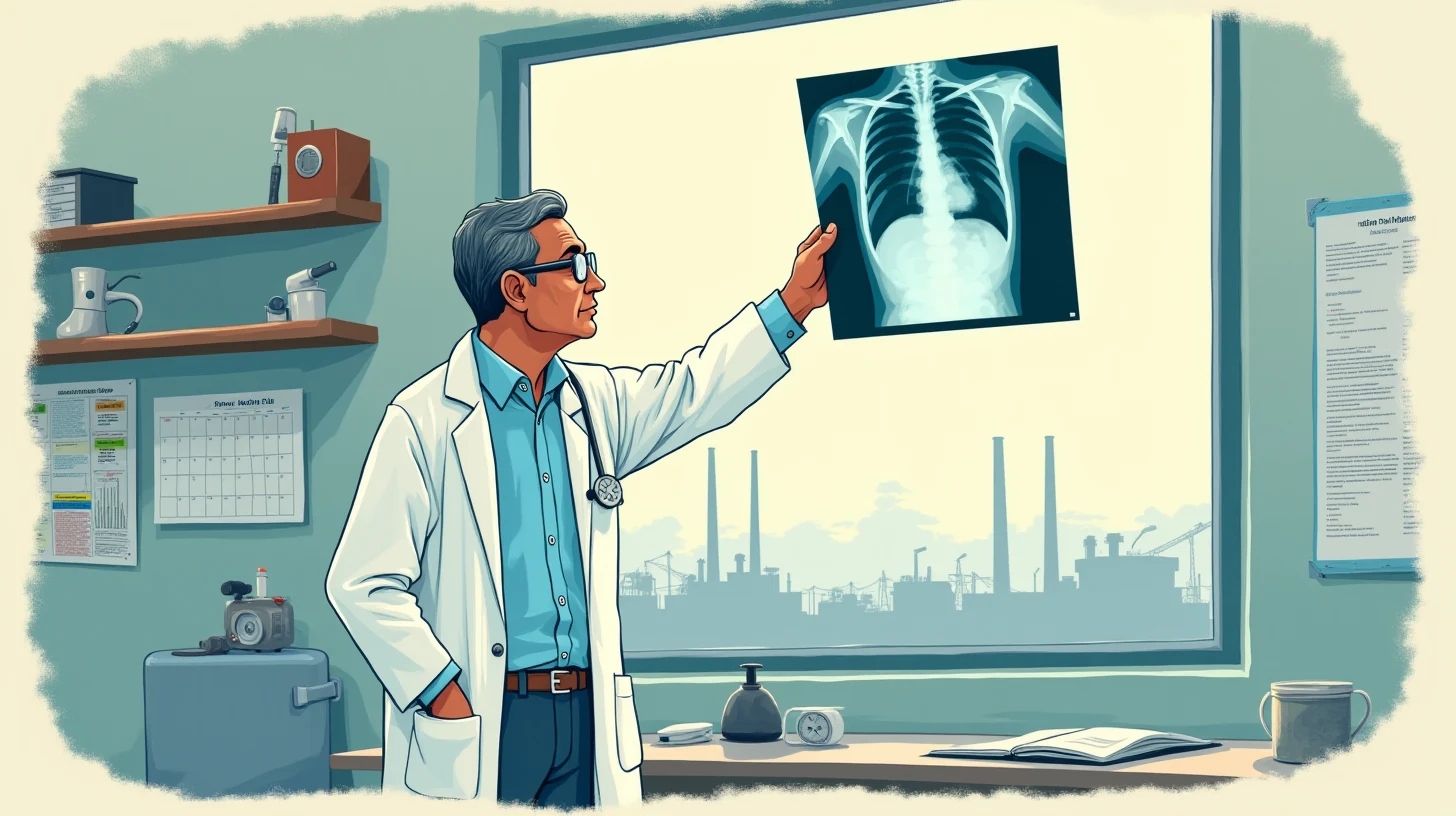
Dhanbad, for nearly a century, was India's coal capital. The Eastern Coalfields — the mining region spanning Dhanbad, Giridih, and Bokaro — produced forty percent of India's coal. That coal funded railways, powered steel mills, and electrified Indian cities. The cost of that coal was extracted, lung by lung, from the mineworkers who dug it. Half a million of them, active and retired, still live in Rajesh's district. When he arrived in 2008, the state had no occupational health specialist in Dhanbad. No spirometry laboratory. No radiologist trained to read occupational lung disease patterns. No occupational health infrastructure of any kind. Rajesh became that infrastructure, alone, because there was no alternative.
Twenty years later, he is still the only one.
🗓️ The annual ritual
Silicosis is a progressive, incurable occupational lung disease caused by inhalation of crystalline silica dust. It occurs in coal mining, stone cutting, foundry work, and glass manufacturing. In coal mining, it arises not directly from coal dust — which causes coal worker's pneumoconiosis, or CWP — but from silica that sits alongside coal seams. A coal seam in Dhanbad is surrounded by layers of clay, shale, and silica-rich rock. When a mineworker cuts coal, the blast shatters the surrounding rock. He inhales a mixture of coal dust and silica. Over ten to twenty years, the silica particles lodge in the lung alveoli and trigger a fibrotic response: the lung tissue hardens, scars, and loses its ability to exchange oxygen. The scarring is permanent and irreversible.
The disease has three stages. Stage 1, or "simple" silicosis, shows on a chest X-ray as small rounded opacities — tiny white dots scattered across the upper lung fields like sand on a beach. The worker has no symptoms yet, or only a mild cough. He continues mining because he has no way to know that his lungs are being destroyed. Stage 2 is when the dots merge into larger patches and the worker begins to feel it: shortness of breath on exertion, chronic cough, fatigue. A Stage 2 mineworker can still do light work but cannot do his old job. If he stays in the mine, Stage 2 progresses inexorably to Stage 3 — complicated silicosis — where the lung is essentially scarred into non-function. At Stage 3, the worker cannot breathe walking up stairs. He cannot work. His only option is to sit at home and slowly asphyxiate, unless he can access disability pension or medical care.
But Dhanbad's medical system was not built to diagnose him at Stage 1 or Stage 2. It was designed to treat him after he had already progressed to Stage 3, gasping for air.
- 🗓️
Stage 1 — Simple silicosis
X-ray shows small rounded opacities in upper lung fields. Worker has no symptoms or mild cough. Disease is invisible to the worker; he continues mining.
- ⚠️
Stage 2 — Developing disease
Patches merge. Worker feels shortness of breath on exertion, chronic cough, fatigue. He can still do light work but cannot continue mining. This is the window for intervention.
- 💨
Stage 3 — Complicated silicosis
Lung is scarred into non-function. Worker cannot walk upstairs without gasping. Cannot work. No cure exists. Oxygen therapy extends life but cannot reverse scarring. Five to ten years of progressive disability.
The Sadar Hospital, where Rajesh worked, had a single X-ray machine installed in 1995. When a Dhanbad mineworker came with a persistent cough, the standard diagnostic pathway was automatic: order a chest X-ray, see a pattern, call it TB. The radiologist — usually a general radiologist, not a subspecialist — had no training in occupational disease patterns. If he saw the scattered dots characteristic of silicosis, he might not recognize them at all. He might call it "chronic inflammation." Or he might miss it entirely. The mineworker would be started on a four-month TB drug regimen. The TB drugs would not work because he did not have TB. His symptoms would persist. After six months, if he had not given up, he would be referred to Rajesh — if anyone knew a pulmonologist existed.
That was when Rajesh entered the system. Not as part of any plan. Simply because the mineworker arrived and nobody else knew what was happening inside his lungs.
⚠️ What very nearly happened
In his first year at Sadar Hospital, Rajesh reviewed the lung disease cases accumulated in the hospital's records. He found ninety-seven patients diagnosed as "TB" in the previous three years. He re-examined them systematically. Fifty-two of them had the classic X-ray pattern of silicosis. Thirty-one of them had complicated silicosis — Stage 3, beyond treatment. None of them had actually had TB. All of them had been treated with anti-TB drugs that did not work, for months, while their silicosis progressed untreated.
He called a meeting with the district health officer and the state occupational health authority. He explained what he had found: a systematic misdiagnosis of occupational disease as tuberculosis, leading to unnecessary drug toxicity, false treatment trails, and progression of untreated silicosis. He proposed that the hospital establish an occupational disease outpatient clinic with dedicated spirometry, and that he would train the radiologist to read occupational patterns.
The district health officer listened politely. The state authority said it was a good idea, but occupational health infrastructure was not budgeted at the district level. If Rajesh wanted to develop occupational health services, he would need to submit a formal proposal to RIMS in Ranchi, wait eighteen to twenty-four months for approval, then coordinate through the state health ministry.
Rajesh had ninety-seven misdiagnosed patients and no time for bureaucracy.
He decided to do it anyway, without approval.
🌗 What changed
Over the next two years, Rajesh used his own salary to purchase a basic spirometer — a device that measures lung function by having a patient breathe into a tube. The spirometer cost ₹3.5 lakhs, paid for in instalments from his ₹87,000-per-month salary. He trained a nursing technician to operate it. He created a simple form to record occupational history: years in mining, type of mining, whether the worker had used respiratory protection. He began seeing mineworkers in an informal occupational health clinic, running Friday afternoons after his regular respiratory medicine OPD ended.
Within six months, he had identified and documented forty-two cases of Stage 1 and Stage 2 silicosis — mineworkers who had not yet become incapacitated, who could still work if moved to a non-mining occupation, and who had a chance of not progressing further if taken out of dust exposure. Rajesh wrote to the state mining authority requesting a process for occupational disease certification, so that mineworkers could apply for disability benefits or occupational disease compensation.
The mining authority said occupational disease recognition was a central government function, not a state function. A mineworker would need to apply to the Employees' Compensation Commission (ECC) under the Workmen's Compensation Act, and the ECC would require an affidavit from a designated occupational health specialist. There were no designated occupational health specialists in Dhanbad.
Rajesh applied to become designated. The application was rejected because designation required a formal degree in occupational health medicine. He had an MD in Respiratory Medicine, not occupational medicine. A one-year diploma in occupational health existed, but it required leaving Dhanbad for a year — and no leave would be granted without a replacement doctor, which the state health system did not have.
So Rajesh continued without designation. He continued documenting cases. He continued watching workers progress from Stage 2 to Stage 3 because there was no formal pathway for them to claim compensation and no government system to support their transition out of mining.
Diagnosis
Rajesh's clinic, Friday afternoonsSpirometry, occupational history, X-ray pattern recognition — all funded by Rajesh's salary, operated informally outside the official system. No government budget. No designated roles.
Compensation
ECC, but requires specialist affidavitA mineworker can theoretically apply for occupational disease recognition and disability benefits. But the ECC requires proof from a designated occupational health specialist — a position that does not exist in Jharkhand.
Transition
No retraining, no income supportA mineworker diagnosed with Stage 2 silicosis should leave mining. But if he is fifty years old with no education beyond eighth grade and no alternative income, what does he do? Retraining programs do not exist.
🧭 Why we built it
By 2010, Rajesh had documented more than 150 cases. By 2018, he had documented over 800. By 2020, when the national regulations finally triggered a formal occupational health clinic at Sadar Hospital — staffed with a general physician and a spirometry technician, with Rajesh providing consultations — his informal diagnosis network had already saved dozens of workers from unnecessary TB drug toxicity.
But the clinic was still understaffed. There was no occupational health specialist position. The clinic operated with minimal budget. And most critically: there was still no compensation pathway, still no formal recognition mechanism, still no systematic program to take workers out of hazardous exposure before they became incapacitated.
"ये जो ऑक्सीजन की बोतलें हैं, ये आखिरी सीढ़ी हैं। इससे पहले की सीढ़ी नहीं है। इस आदमी के लिए सब कुछ खत्म हो गया।"— These oxygen bottles are the last rung of the ladder. There is no rung before this. For this man, everything is finished.
Rajesh had a patient named Hari, a coal miner who worked for forty-two years in an open-pit mine. Hari came to Rajesh in 2010 with severe dyspnea — he could not climb stairs without gasping. The X-ray showed confluent opacification of both upper lung fields — advanced, complicated silicosis. Rajesh diagnosed him clearly: occupational disease, irreversible, Stage 3. He explained that Hari could not return to mining, that he should apply for occupational disease compensation, that the lung scarring was permanent and progressive.
Hari was fifty-eight. His pension as a retired miner was ₹12,000 per month. Mining was the only work he had ever known. He asked Rajesh what he could do.
Rajesh told him the truth: "Your lungs are scarred. The scarring is permanent. We can give you oxygen when you have trouble breathing. We can give you bronchodilators and inhalers. But the disease will progress. In the next five to ten years, your breathing will get worse. You will need oxygen most of the time. You should spend time with your family. You should think about what you want to leave behind."
Hari lived for eight years after that conversation, his breathing progressively deteriorating. He died in 2018 at sixty-six, gasping. His widow received no compensation because Hari had never formally applied for occupational disease recognition. There was no clear process, and he could not navigate bureaucracy while dying.
"हमारे यहाँ खानों में काम करने वाले लोग सिलिकोसिस से मरते हैं, पर कोई नहीं जानता कि उन्हें यह बीमारी खान से आई है। वे TB मान लिए जाते हैं, वे निमोनिया मान लिए जाते हैं। कोई नहीं कहता कि यह खान की बीमारी है। कोई मुआवजा नहीं। सिर्फ एक बोतल ऑक्सीजन।"
(In our mines, workers die of silicosis, but no one knows the disease came from the mine. They are thought to have TB. They are thought to have pneumonia. No one says this is an occupational disease. No compensation. Only an oxygen bottle.)
What Rajesh discovered, over twenty years, was that silicosis diagnosis was not a single problem but a cascade of problems, each one blocking the solution to the next. Problem 1: No specialist infrastructure. Jharkhand has 33 million people and one occupational health specialist — Rajesh himself, de facto, though he lacks formal designation. There is no occupational health residency program, no research infrastructure, no pathway for a young doctor to specialize in occupational medicine. When Rajesh retires, the knowledge dies. Problem 2: No early detection. Most mineworkers are never screened until symptoms force them to a hospital. By that point, they are usually in Stage 2 or Stage 3. The economic window for intervention — when they could change occupations and avoid severe disease — has already closed. Problem 3: No compensation infrastructure. The Workmen's Compensation Act exists, but the process for claiming occupational disease benefits is Byzantine. A worker must apply to the ECC with an affidavit from a designated specialist. The worker must prove the disease was caused by occupational exposure — burden of proof on the worker, not the employer. The employer will deny liability. The worker must hire a lawyer. The case goes to hearings. The timeline is three to five years. Many workers die before the case resolves. Problem 4: No exit infrastructure. Even a mineworker who is diagnosed with silicosis and wants to leave mining has no alternative income source. If he is fifty, has worked in mining his entire life, and has no education beyond eighth grade, what does he do? There are no retraining programs for occupational disease victims in Jharkhand. No government transition schemes. He can apply for a disability pension if he receives formal occupational disease recognition, but the pension is usually inadequate. He faces a choice between staying in the mine and accepting disease progression, or leaving mining and accepting destitution.
Rajesh has documented this dilemma hundreds of times.
🌱 What we hope happens
There are, conservatively, five hundred thousand mineworkers in the coal regions of Jharkhand, and forty thousand in mica and stone-cutting industries. Of those, occupational health research estimates suggest that ten to fifteen percent — roughly fifty to seventy-five thousand people — have silicosis or coal worker's pneumoconiosis that is either undiagnosed or misdiagnosed.
The cost of that disease is paid by the workers themselves: in lost wages, in progressive disability, in early death, and in families destabilized by the death of the primary earner. The medical system does not recognize it as a systemic problem because each case appears isolated — a patient with respiratory symptoms, treated episodically, discharged. The isolation is the system's design. The mining companies benefit from occupational disease remaining invisible. The government benefits from not having to establish compensation infrastructure. The medical system benefits from treating symptoms without addressing cause. The mineworker pays the cost alone.
Rajesh understood this twenty years ago. He built occupational disease diagnosis into his practice not because the government asked him to, but because the mineworkers needed him to. He trained his own technician. He funded his own spirometer. He created his own diagnostic protocols. He remained in Dhanbad for twenty years when he could have transferred to a teaching hospital in Ranchi or Bhopal and accelerated his academic career — because he understood that the moment he left, there would be no one to carry the work forward.
He was not wrong. The work has not been carried forward. The occupational health clinic at Sadar Hospital still operates with minimal staff. No other government hospital in Dhanbad has established occupational disease services. The state still has not created specialist positions in occupational medicine. Young doctors are not trained in occupational disease recognition. And every month, mineworkers come to the hospital with a persistent cough and are told they have TB.
We are building a diagnostic resource for occupational lung disease: a guide that works for both workers and for doctors. For workers: an occupational history form, a guide to understanding your X-ray, and a pathway to occupational disease recognition and compensation — state by state, because the process varies. For doctors: a reading guide for occupational disease patterns on chest X-ray, a protocol for spirometry interpretation in occupational disease, and a referral network to occupational health specialists who can provide backup.
The medical system was not designed for this problem. But the problem exists. And the workers exist. Rajesh has been the system for twenty years, alone in Dhanbad, because the institutional system failed. We will not replace institutional responsibility with individual effort. But until the institutions change, we can provide the information that the institutions have withheld.
If you are a mineworker in Jharkhand or eastern India and you have a persistent cough, the resource is free at gabforge.in. Tell us your work history. We will review your X-rays against occupational patterns. We will tell you whether your disease is occupational or something else. If it is occupational, we will guide you through the compensation process for your state. We will read the regulations. We know the timelines. We know the forms. And we will help you claim the recognition that the system has denied you for two decades.
If you are a doctor working in a coal region and you are seeing patients who do not fit the standard diagnostic boxes, the resource is there for you too. Occupational disease recognition is not taught in medical school. It is learned by doctors like Rajesh, in the field, by seeing many cases and being willing to question the standard diagnoses. We will compress that learning curve. We will give you the pattern recognition that Rajesh learned over two decades, in a form you can use tomorrow.
And we will name the gap, which is the first step to closing it.