
The Gangtok doctor and the monsoon bridge
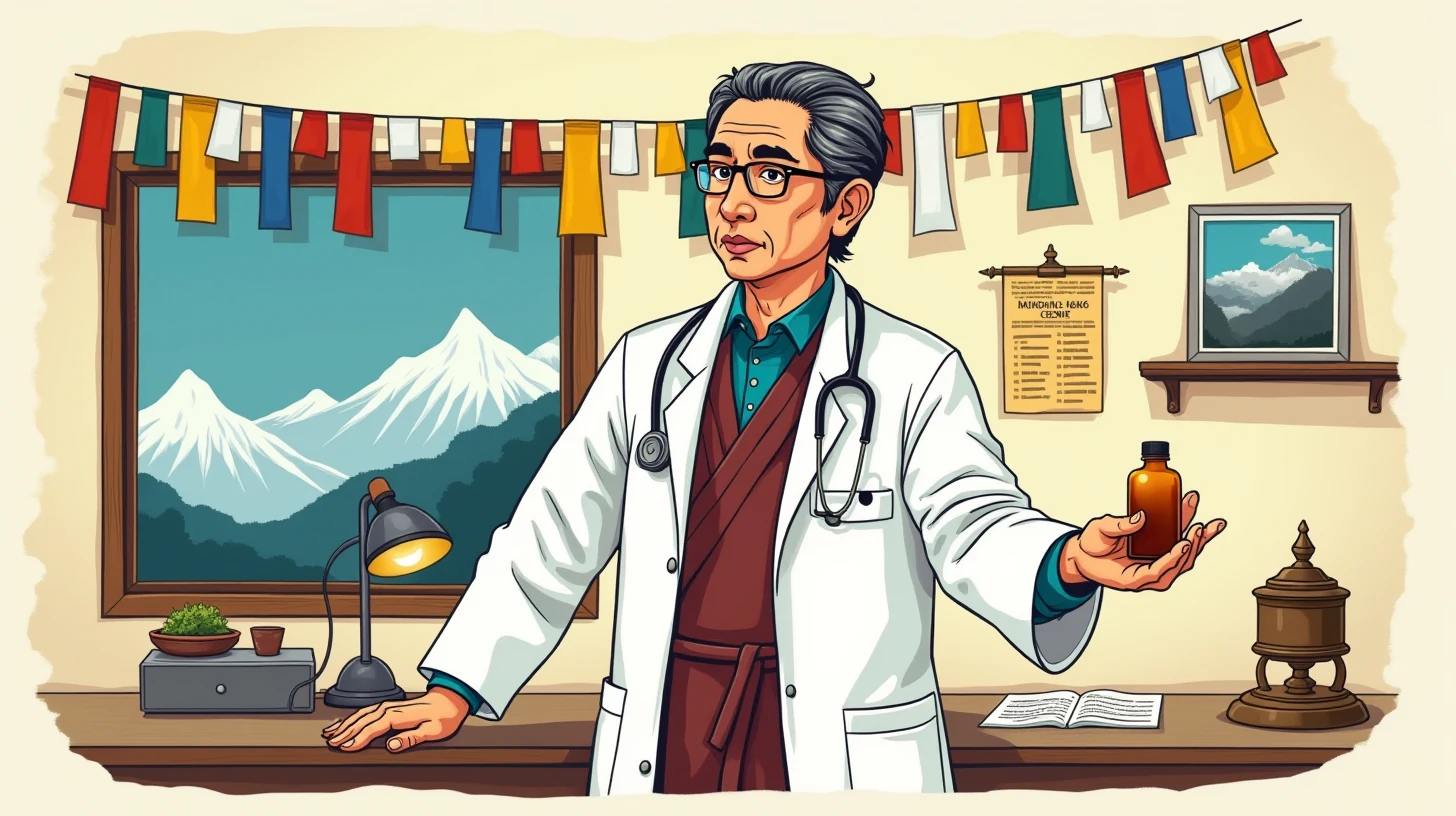
Dr. Tenzin Dorjee is forty-one years old and has been a general physician for sixteen years—six years at Sir Thutob Namgyal Memorial Hospital (STNM) in Gangtok, Sikkim's only tertiary care centre, and ten years in private practice before that. His clinic sits in the Lal Bazar neighbourhood of Gangtok, on the ground floor of a narrow building with a window that faces the Teesta River valley and, beyond it, the layered monsoon clouds descending from June to September over Kangchenjunga. He works Monday to Friday: 10 AM to 1 PM at STNM (ward rounds and casualty consultations), 3 PM to 7 PM in his clinic, and takes emergency calls from remote villages on weekends.
His income oscillates sharply. May shows ₹1.9 lakh in earnings—down from a good month's ₹3.2 lakh. The monsoon brings a fracture for private practice in Sikkim: patient volume drops 30 to 40 percent because roads that connect villages to Gangtok become impassable, washed into waterfalls. But monsoon brings a different crisis for hospital medicine—isolation. From June to September, villages in North Sikkim and West Sikkim are reachable only by helicopter, at a cost of ₹30,000 to ₹50,000 per flight, weather permitting. Emergency transport by foot and porter takes sixteen hours. Maternal complications, stroke, myocardial infarction, acute respiratory distress: delays of 8 to 14 hours are common. And during those delays, patients are not treated by a licensed physician. They are treated by a traditional healer, an Amchi—a Sowa-Rigpa practitioner rooted in Tibetan medicine, with knowledge of high-altitude pathology that no medical college in India teaches.
Tenzin had not, in his medical training at Sikkim Manipal University, been taught how to integrate with an Amchi. Nor had he been taught how to undo their treatment. That gap, he would come to understand, was the frontier of Sikkim's medicine.
🗓️ The annual ritual
Sikkim sits on an altitude gradient—from the Teesta River valley at 300 meters to Kangchenjunga's summit at 8,586 meters. Altitude-triggered disease is endemic. Acute Mountain Sickness (headache, nausea, fatigue above 2,500 meters), High-Altitude Pulmonary Edema (pink frothy sputum, breathlessness, mortality high if oxygen is unavailable), High-Altitude Cerebral Edema (confusion, ataxia, death within hours if descent is delayed)—these are not rare conditions in Sikkim. They are seasonal events, particularly among pastoral communities, trekkers, and construction workers who move between elevations.
The monsoon from June to September creates a second predictable pattern. Roads close. Helicopters are grounded by cloud cover for weeks. Remote villages—Lachen in North Sikkim, Dzongu in North Sikkim, West Sikkim's high settlements—disconnect entirely. A woman in labour with complications cannot reach STNM Hospital. A man with stroke symptoms cannot reach a CT scan. The choice, by geography and weather, falls to what is available: a village Amchi, a faith healer, or no formal medicine at all.
Tenzin had encountered Amchi practitioners in his clinical work—he knew they existed, were respected in their villages, treated patients with herbal medicines rooted in Tibetan medicine texts centuries old. What he did not know was whether they were competent, what they knew, or whether their medicines were safe to combine with hospital treatment. In his medical education, they were not discussed. They existed in a category called "traditional practice," which, in the curriculum, was separate from "medicine."
- 🗓️
June onset — Roads become waterfalls
Monsoon rains arrive. North Sikkim and West Sikkim villages are reachable only by helicopter. Ground transport takes 16 hours. Patient volume in Gangtok clinics drops 30–40%.
- ⚕️
Weeks 2–8 — Isolation deepens
Patients with chronic illness, maternal complications, or acute illness in remote areas are treated by local Amchi. Emergency helicopter flights cost ₹30,000–₹50,000 and are weather-dependent.
- 🏥
Delayed arrival at hospital
When patients reach STNM, they have often been on Amchi-prescribed herbal medicines for 1–4 weeks. Hospital doctor must decide: integrate or start over.
- 🌱
September — Roads reopen
Follow-up care resumes. The relationship between village system and hospital system has either strengthened (if integrated) or fractured (if dismissed).
⚠️ What very nearly happened
On June 3, 2026, at 11:47 AM—Tenzin remembers the time because it was recorded in the patient note—the STNM switchboard transferred an emergency call to his clinic phone. A woman's voice, laboured with emotion, speaking Sikkimese with Hindi borrowings: she was calling from Lachen village in North Sikkim, a settlement three trekking hours from the nearest Primary Health Centre. Her son, Dorje, thirty-four years old, a high-altitude pastoralist in the alpine meadows, had come down four days ago with joint pain in his knees and shoulders that had started at 4,500 meters elevation. The pain had woken him at night. He had descended to his family's lower settlement at 2,800 meters in Lachen. The pain had not improved. He had begun taking something the village Amchi had prepared.
Tenzin asked the questions he had been trained to ask: Which joints? When did it start? Fever? Redness? Previous episodes? The woman on the phone—Pema, his mother—did not have the clinical vocabulary for this. She knew that Dorje was suffering, that he could not move without grimacing, that he had begun a course of brown pills and an amber oil from the Amchi.
This was the threshold moment, though neither of them knew it. A thirty-four-year-old pastoralist with altitude-triggered polyarticular pain was on an unknown course of Tibetan herbal medicine in a village where the next physician-level intervention was a three-hour helicopter ride away—if the monsoon clouds broke, if the helicopter was available, if the government had not diverted it to another emergency.
"सिक्किम को दो चिकित्सा प्रणालियाँ हैं — एक अस्पताल में दूर है, एक गाँव में करीब है। मरीज़ को चुनना होता है, वह दोनों नहीं ले सकता।"— Sikkim has two medical systems—one is far away in a hospital, one is near in the village. The patient must choose. They cannot have both.
What Tenzin was thinking but could not yet articulate was this: polyarticular pain starting at altitude, in a pastoralist exposed to animals and contaminated food and high-altitude hypoxia, could be tuberculosis of the bones, or brucellosis, or high-altitude-triggered acute rheumatic fever, or most likely a crystalline arthropathy from dehydration and exertion at elevation. But it could also be an autoimmune polyarthritis—lupus or seronegative rheumatoid arthritis—that would require corticosteroids. And corticosteroids would be dangerous if the underlying cause was untreated infection. The Amchi's herbal remedy, if it contained anti-inflammatory plants like Tibetan gentian or saffron, might be managing pain. But it might also be masking a progressive infection or worsening an inflammatory picture in ways that would only become obvious at lower altitude and normal oxygen saturation.
🌗 What changed
Dorje and his mother arrived at STNM Hospital's casualty ward at 3:15 PM, after a two-hour jeep ride on a road that, Pema said, "was becoming waterfalls." His knees were visibly swollen, warm to the touch. His shoulders had restricted range of motion. He moved with the careful steps of someone in significant pain. Temperature 37.2°C—slightly elevated. C-reactive protein elevated on the rapid test. White blood cell count normal. No fever in the classical sense. No obvious source of infection.
The clinical picture was puzzling. High inflammation without fever usually meant either a low-grade chronic infection or an autoimmune response. The Amchi's assessment—pain as excess-heat imbalance requiring cooling herbs—was not medically explicable by Tenzin's training. But neither was it obviously wrong. Heat and inflammation were, in a way, related concepts in different languages.
Tenzin asked to see the Amchi's medicines. Pema produced two bottles: a viscous amber oil and small dark pills. Tenzin opened the first—camphor, probably saffron, possibly turpentine. The pills were harder. He took a photograph and sent it to Dr. Sonam Tshering, a physician at the government Ayurvedic Hospital in Gangtok who had, unusually, studied both allopathic pharmacology and Sowa-Rigpa medicine in formal training.
The reply came in fifteen minutes: "Likely Tibetan gentian, saffron, and possibly processed mercury compounds. Cannot say without lab analysis. Mercury is traditional but banned in modern Sowa-Rigpa practice. If present, even in small doses, needs monitoring. The oil is camphorated. Anti-inflammatory effects are likely real. But if there is mercury, we have a serious problem."
Mercury. That changed the clinical equation entirely.
Tenzin went to the casualty ward and said to Dorje: "I need to keep you in hospital for two days. We will do blood tests, X-rays of your joints, and a test for mercury exposure. The Amchi's medicine is probably working for pain, but it might contain something that will cause problems if combined with other medicines. We need to know what we are working with."
Dorje looked at him with the wariness of someone about to be told that his healer and the hospital doctor were on opposite sides. He said: "Will you stop the Amchi's medicine?"
"Not yet," Tenzin said. "But we need to know if it has mercury. If it does, we stop it slowly, not suddenly. If it does not, we can keep using it and add hospital medicine on top."
The blood work came back by evening. No mercury detected in serum. No evidence of acute infection. What they did find: very high C-reactive protein (11.2 mg/L, normal below 3.0), elevated uric acid (8.9 mg/dL, normal below 7.0), and a faint antinuclear antibody pattern suggestive of early autoimmune activity.
The picture resolved. Not infection. Not altitude-related crystalline arthropathy from simple dehydration. This was a systemic autoimmune response—possibly early lupus, possibly seronegative rheumatoid arthritis—triggered or exacerbated by high altitude. The Amchi's anti-inflammatory herbs were, by accident or by centuries of empirical knowledge, appropriate for symptom control. The herbal medicine was not the enemy. It was a partial solution that needed to be understood within an allopathic framework.
That night, Tenzin spent two hours in the STNM library reading about high-altitude-triggered autoimmune flares. Altitude hypoxia could trigger latent autoimmune diseases. Dorje's family history suggested genetic predisposition. The descent to 2,800 meters had not fully resolved the hypoxia. The autoimmune flare, once started, would not stop with herbal medicine alone. But it could be managed with a combination of anti-inflammatory herbs (which the Amchi understood) plus slow-dose corticosteroids and long-term immunomodulation (which required hospital oversight).
The question that stayed with him was this: How do I design a treatment plan that uses both systems? Not one or the other. Both.
Tenzin went to the government Ayurvedic Hospital and sat with Dr. Sonam Tshering, who occupied a strange niche: trained as an allopath first, then fascinated by Sowa-Rigpa, then formally trained in Tibetan medicine in Dharamshala, and now trusted by both allopathic doctors and by Amchi.
Tenzin said: "The patient has autoimmune polyarthritis triggered by altitude. The Amchi gave him gentian, saffron, and probably processed herbs I cannot identify. The pain has improved. But he needs steroids. If I start prednisone, will it interfere with the Amchi's preparation?"
Sonam said: "No direct chemical interference. But there is a philosophic problem. In Sowa-Rigpa, we treat autoimmune disease as excess wind-heat imbalance. We cool and settle. Steroids, in your framework, are also cooling-and-settling—they suppress inflammatory heat. The Amchi and you are actually working toward the same outcome, just from different starting languages. The problem is that neither of you is speaking to the other."
"So I can combine them?"
"More than combine them. You should integrate them. Tell the Amchi what you are doing. Tell Dorje that both medicines are working on the same problem. Give steroid doses that do not override the herbal work, but support it. Monitor together."
Tenzin went back to the casualty ward and, with Pema as interpreter, called the Amchi in Lachen. His name was Phuntsok. He was sixty-eight, had been an Amchi for forty years, had trained in Dharamshala when the practice was still informal in Sikkim, and had never spoken to an allopath about a patient before.
"फुन्त्सोक-ला, आपकी दवाई काम कर रही है। प्रयोगशाला दिखा रही है सूजन अच्छी हो रही है। मैं एक और दवाई जोड़ूँगा — ठंडा करने वाली और शांत करने वाली दवाई जो पश्चिमी डॉक्टर इस्तेमाल करते हैं। यह आपकी जड़ी-बूटियों के साथ काम करेगी, उनके विरुद्ध नहीं। मैं आपको रक्त परीक्षण की रिपोर्ट भेजूँगा। कृपया तेल और गोलियाँ देते रहें।"
(Phuntsok-la, your medicine is working. The laboratory shows the inflammation is getting better. I will add one more medicine—a cooling and settling medicine that Western doctors use. It will work with your herbs, not against them. I will send you the blood test reports. Please keep giving the oil and pills.)
There was a long silence on the phone. Then Phuntsok said something in Sikkimese that Pema translated as: "In forty years, no doctor has asked what I think. You are asking. I will do what you say."
Dorje stayed in STNM for four days. Tenzin prescribed a low-dose prednisone schedule (0.5 mg/kg, tapered over eight weeks), continued the Amchi's herbal preparation, added naproxen (250 mg twice daily with food to prevent gastritis), and arranged follow-up blood work to monitor for steroid side effects and disease progression.
He also did something unusual. He wrote a letter to Phuntsok in lay Sikkimese, explaining what autoimmune polyarthritis was, what each medicine did, what the blood test numbers meant, and what outcomes they were looking for. He sent it with Dorje when the patient returned to Lachen. And he asked Phuntsok to call STNM Hospital every two weeks with updates.
The GabFORGE medical agent was installed on a tablet in the STNM casualty unit during this time. When Tenzin needed to verify a specific drug interaction between the Amchi's herbal formula and prednisone—a verification that might take days of manual research—he typed the question in Nepali into the agent on his phone.
"यो Tibetan gentian र saffron को formula छ। Prednisone साथ interact गरछ कि होइन? Dosing क्या छ — 0.5mg/kg tapering। Memory को लागि चिन्तित छु।"
(This is a Tibetan gentian and saffron formula. Does it interact with prednisone? Dosing is 0.5 mg per kilogram tapering. I am concerned about memory side effects.)
The agent cross-checked the herbal constituents against allopathic pharmacokinetics, surfaced a mild warning about saffron and corticosteroid combination increasing gastric risk (which Tenzin was already mitigating with the naproxen precaution), and recommended monitoring liver function at weeks 4 and 8. This specific verification—which would have required a call to a pharmacology colleague or hours of manual literature search—took ninety seconds. Tenzin photographed the response and sent it to Phuntsok with a simplified Sikkimese translation.
What it does
- 🔍Verifies the safety of herbal medicines through lab analysis, drug-interaction screening, and consultation with practitioners trained in both systems.
- 🗂️Explains to the patient and the Amchi why hospital treatment is needed, in language both understand, treating traditional knowledge as legitimate rather than competing.
- 📋Designs a combined protocol where herbal and allopathic medicines work toward the same outcome—not replacement, but amplification.
What it does not do
- 🔒Never dismisses traditional medicine as superstition or inferior. Never assumes the Amchi is wrong without evidence.
- 💳Never forces the patient to abandon traditional treatment. Never enters the village system as a competitor but as a collaborator.
- ✅Never decides for the patient or the Amchi. The diagnosis and treatment plan are explained, discussed, and agreed.
By August, three months into the monsoon, Dorje's C-reactive protein had dropped to 4.1 mg/L—still elevated, but moving toward normal. He was walking without pain. He had returned to the meadows at lower elevation (2,200 meters, not the original 4,500) and was doing light herding work. Phuntsok reported, by phone through Pema, that Dorje "moves like before, but careful, still taking both medicines." The prednisone was being tapered. The herbal preparation would continue for six months.
🧭 Why we built it
What had started as a conflict between two systems of medicine had become, by intention and accident, a coordinated treatment protocol. Sikkim's healthcare frontier is not a shortage of medical knowledge. Tenzin knows this with certainty now. The Amchi understands pain and fever and local disease better than most allopaths. The hospital understands systemic illness and rare conditions better than the village. What Sikkim is short on is translation. The knowledge exists in two languages, and there is no dictionary between them.
By September 2026, Tenzin has treated four more patients using integrated allopath-Sowa-Rigpa care. Each required a conversation with the local Amchi. Each required him to spend time understanding what the herbal medicines were supposed to do, what their pharmacological effects might be, and where they might conflict with allopathic drugs. Each one worked. None have required emergency hospitalization beyond the initial presentation. The monsoon continues to isolate villages. The helicopter flights continue to be expensive and weather-dependent. But the patients receiving integrated care are, by measurable markers (weight, pain scores, lab values), doing better than patients who either abandoned traditional medicine or continued it without medical oversight.
Tenzin knows, rationally, why this is difficult to scale. Medical education in India trains doctors exclusively in allopathy and treats all other systems as historical curiosities. Sikkim's government has made space for Sowa-Rigpa—it is formally recognized, practitioners are registered, there is a government hospital—but there is no curriculum that teaches allopath doctors how to work with Amchi. If a physician wants to understand drug interactions between Tibetan herbal preparations and allopathic medications, they must find someone like Sonam and ask. There is no formal framework.
🌱 What we hope happens
It is May 2026. Dorje is back in his village, managing his herds at 2,200 meters, pain-free for the first time in two years. His mother, Pema, has his hospital discharge summary memorized, and when neighbours ask about their own ailments, she explains: "Allopath and Amchi together. Not one. Both." The monsoon is coming again. Tenzin is preparing for it—four more patients on provisional integrated protocols, three Amchi he has contacted to explain what he is trying to do, two conversations scheduled with Sonam about drug interactions in chronic disease management.
He is spending four to five hours per week on this work, unpaid, alongside his clinic and hospital shifts. He has not asked the hospital for official acknowledgment or funding. He is treating it as a clinical problem, not a system problem, because the system does not yet have a category for what he is doing. The question that stays with him—and this is what Tenzin says when asked why he continues to put in unpaid hours—is about the frontier of Sikkim's medicine. "One good Amchi, one good allopath—separately, they can handle most illnesses. But if they cannot talk to each other, they are parallel systems, not one system. During monsoon, that parallelization kills people. It delays treatment. It fractures trust. It wastes the knowledge that both systems have. In Sikkim, for monsoon medicine, I am building the dictionary."