
The Hyderabad occupational health officer and the pharma shift crisis
Dr. Abhinav Kumar is thirty-four years old. He works as an occupational health officer at a pharmaceutical manufacturing facility in Hyderabad's HIDA — the Hyderabad Industrial Development Area — where pharmaceutical compression units run on a 24-hour cycle. His official designation is "Factory Occupational Health Officer, ESIC-Registered." His actual life is on-call, every hour, seven days a week. He earns ₹1.2 lakh annually as base salary, plus ₹18,000 monthly on-call allowance, bringing his take-home to roughly ₹2.8 lakh per year. By standard of living, this is middle-class Hyderabad. By hours worked, it is closer to subsistence.
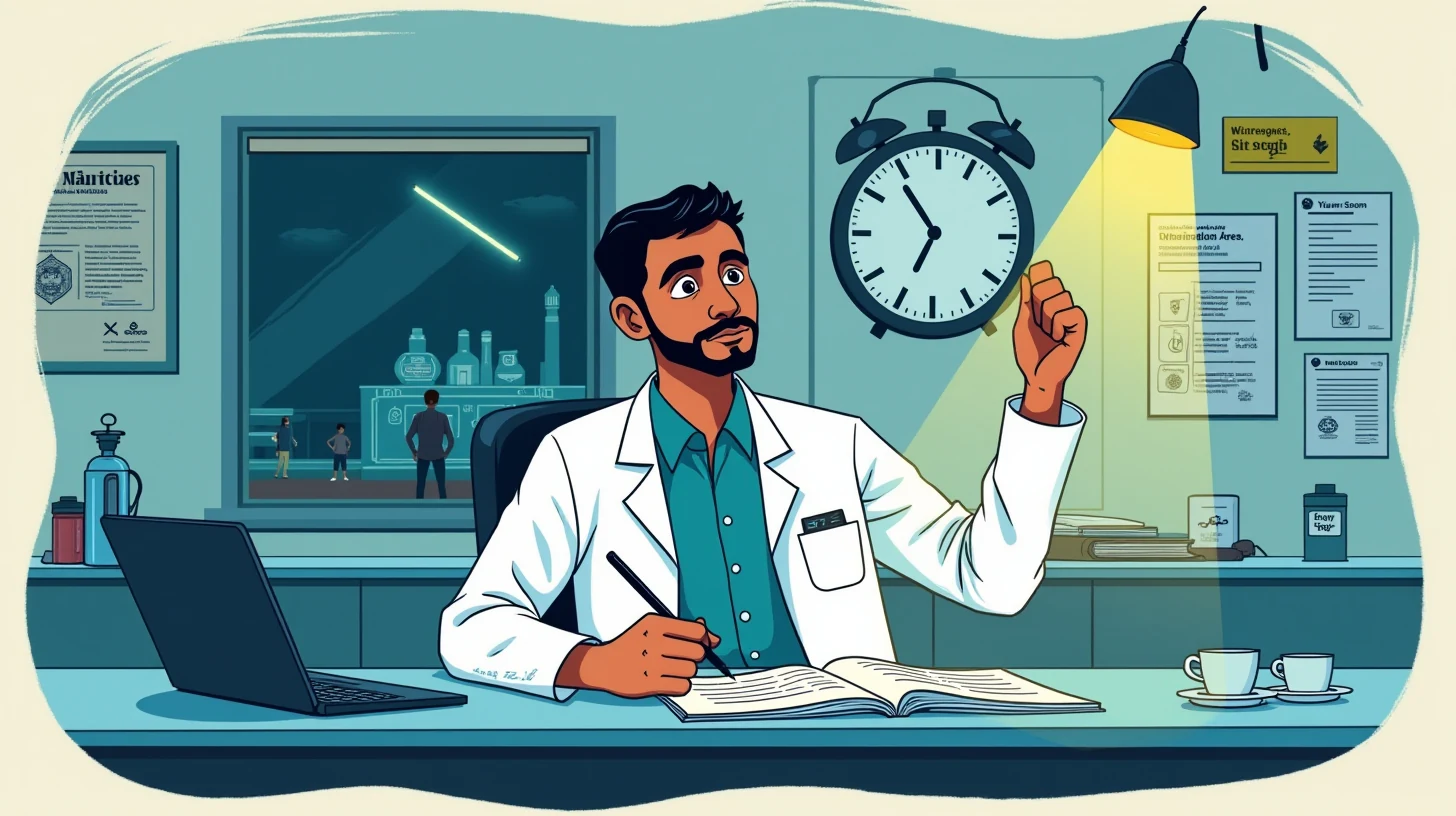
His wife Priya works in Hyderabad's IT sector — sixty-hour-week jobs that are managed through Slack, not through the night-time phone calls that come to Abhinav. They have adjusted to a schedule where they see each other on weekday mornings, and she has stopped asking when occupational health will become a daytime profession. His mother, who lives with them, has learned to recognize the alert-alarm tone on his phone — three vibrations in succession, meaning a worker has collapsed on the factory floor.
The crisis that defines his work is not medical. It is administrative. It is the moment when three separate government systems — each with its own forms, deadlines, and definitions of "occupational" — collide in the same incident, and no one has told him how to navigate it.
🗓️ The annual ritual
Telangana's pharmaceutical manufacturing employs twenty thousand workers across six hundred units. Most work night shifts. Most take no structured meal breaks. Most are recent migrants from Tamil Nadu and Karnataka, living in shared housing on the city's periphery, sending remittances home. They take the work because the wage is ₹28,000-35,000 monthly, which is forty percent higher than agricultural wages in their home states.
The occupational health infrastructure exists on paper. Every pharmaceutical factory with fifty or more workers must employ an ESIC-registered occupational health officer. Every incident must be documented in three places: the factory incident logbook (ESIC requirement), the hospital admission note (insurance requirement), and the regulatory compliance file (DOSH requirement). Every claim must be submitted to Aarogyasri — Telangana's government health scheme — within forty-eight hours of treatment.
What does not exist on paper is the protocol for what happens when these three systems disagree about what the incident is, why it happened, and who should pay for it.
- 🏭
Night shift, 2:47 AM — worker collapse
Rajesh, thirty-one, compression-line worker, collapses from postural hypotension after eight hours without a meal break. Abhinav treats him in four minutes: glucose, monitoring, discharge to continue shift.
- 📋
Same morning, 7:30 AM — claim rejection
Aarogyasri system sees 'syncope + hypertension history' and codes it as 'potentially cardiac.' Requires prior-authorization with baseline ECG, medication history, and occupational-causation narrative — all impossible to obtain within Aarogyasri's 10-15 day window.
- ⚙️
Same afternoon, 5 PM — DOSH inspection
Regulatory inspector arrives unannounced, finds the incident log, asks: 'Where is the corrective action plan?' Abhinav has seven days to deliver it, but implementation requires factory management approval (which conflicts with production targets).
- ✅
14 days later — claim approved, policy implemented
Aarogyasri reimbursed ₹16,500 after resubmission. DOSH accepted corrective action plan. Factory implemented staggered meal breaks on compression line.
Abhinav had been expecting this for five years. Not this specific incident — but the architecture of the problem. He had seen it with the textile workers in Surat (noted in the retiree pension stories). He saw it here: a government that had created three separate systems to protect workers, and had never asked them to speak to each other.
⚠️ What very nearly happened
The first SMS from Aarogyasri arrived at 7:32 AM on March 3, 2026, six hours after Rajesh's collapse. The claim had been submitted and auto-rejected for "prior-authorization required: syncope with hypertension history — baseline ECG needed to rule out cardiac causation."
Abhinav read it while drinking cold tea in his clinic. The rejection was technically correct. It was also operationally impossible.
To satisfy the prior-authorization requirement, Abhinav would need to obtain: (1) Rajesh's medication history from the private clinic where he was prescribed atenolol (a hypertension drug); (2) a baseline ECG that Rajesh had never had; (3) a written occupational-causation assessment explaining why the incident was shift-work-related and not medication-related.
The medication history: Rajesh's prescription was on paper, in an envelope at his home. To obtain it, Rajesh would have to come to Abhinav's clinic during working hours — but Rajesh works night shift and sleeps during the day. Getting the paper would require an evening visit, a photocopy, and envelope-carrying, all while Rajesh's claim remained rejected.
The baseline ECG: Rajesh was thirty-one years old, with controlled hypertension on a single medication, no cardiac symptoms, and no reason to have had an ECG before the incident. An ECG costs ₹800-1,200. Aarogyasri would not pay for it until the prior-authorization was approved, creating a catch-22: the authorization requires the ECG; the ECG cannot be done until authorization is granted.
The occupational-causation narrative: This was the deepest problem. Abhinav knew exactly what happened: Rajesh stood at the compression line for six hours without a meal break. His blood glucose dropped. His blood pressure, already elevated from hypertension, dropped further when he stood up suddenly to reset the machine. Syncope — fainting — followed. The cause was occupational (night-shift scheduling without meal breaks). The complication (his hypertension) was pre-existing.
But the Aarogyasri form did not have a field for "caused by occupational scheduling." The form asked: "Is this condition occupational in nature: Yes/No?" If yes, it should have gone to ESIC. If no, Aarogyasri would cover it — but Aarogyasri's definition of "occupational" was narrow: chemical exposure, machinery injury, heat exhaustion. Shift-work fasting syncope did not appear in any list.
"అరోగ్యశ్రీ system ఇలా అడుగుతోంది: అది కార్యక్షేత్ర సంబంధితమైనది కాదా? కానీ నా సమాధానం రెండూ అయితే? రాజేష్ కు రాత్రి మార్పు లేనిదే ఉపయోగిస్తారు, చేసిన కేసుకు అతను విశ్రాంతి తీసుకోలేదు. ఇది కార్యక్షేత్ర సమస్య. కానీ అది హైపర్ టెన్షన్ కారణం కూడా."
(The Aarogyasri system is asking: is this occupational in nature or medical? But my answer is both. Rajesh works night shift because the factory runs 24/7. He cannot take a meal break because the line does not stop. His syncope is occupational. But his hypertension is medical. Both. So which system owns this incident?)
By 8 AM, Abhinav had spent an hour reading and re-reading the rejection. Rajesh, unaware that his claim had been rejected, was asleep in the shared room he rented on the city's east side. His family was expecting the ₹18,500 bill to be covered by the health insurance scheme that his employer had registered him under.
By 10 AM, Abhinav had made three phone calls: (1) to Aarogyasri helpline, asking about prior-authorization procedure; (2) to the private clinic's billing department, asking if the claim could be resubmitted with different coding; (3) to Rajesh, asking him to bring his atenolol prescription during his next daylight hours.
The Aarogyasri helpline did not call back. This meant the claim would remain in administrative limbo for 10-15 days. If Rajesh did not bring the required documentation, the rejection would become final.
"రెండు సిస్టమ్ల మధ్య నేను ఉన్నాను. రాజేష్ కు అర్థం కాలేదు. నా నిర్ణయమైన 'దీన్ని ESIC గానీ కాదు, Aarogyasri గానీ కాదు' అని చెప్పాలి? రెండూ? ఎందుకంటే రెండూ నిజమైన సమస్య."— I am between two systems. Rajesh does not care which one pays. I cannot tell him that his incident is "not ESIC, not Aarogyasri, but both." Both are true. But one system will win, and the other will abandon him.
🌗 What changed
On March 10, Rajesh brought his atenolol prescription to the clinic during daylight hours. Abhinav had decided to pay for the ECG out of pocket — ₹900, which he would claim as a work expense from the clinic budget. Rajesh would not be charged.
More importantly, Abhinav had decided to write a detailed occupational-causation narrative that explained to the Aarogyasri system why the incident was neither purely occupational (not ESIC's category) nor purely medical (not a pre-existing cardiac condition), but rather a collision between occupational scheduling and pre-existing medical status.
He typed in Gujarati first (the reference article was Gujarati-language), then translated to Telugu:
"వర్కర్ రాజేష్ రాత్రి కాల్ చేతిలో సంకోచన విధానంలో పడిపోయాడు, అది పొడవైన నిషేధిత సమయం (8 గంటలు భోజనం లేకుండా) కారణంగా డెబిటరీ హైపోటెన్షన్ లేదా ఆప్టోస్టాటిక్ సింకోపే. ఇది కార్యక్షేత్ర మూలం: రాత్రి చేతి, నిరంతర భోజనం విరాम లేకుండా. ఎందుకంటే భోజనం విరామ సమయం లేదు, కంపీషన్ లైన్ 24/7 నడుస్తోంది. ఈ విధమైన సింకోప్ అనేది చిన్న మెడిసిన్ రిస్క్ కారణం కాదు, దీని కారణం రాత్రి కూర్సు నిర్ణయం."
(Worker Rajesh experienced syncope during night-shift work, secondary to postural hypotension caused by prolonged fasting (eight-hour gap without meal intake) while performing compression-line work. The occupational cause is night-shift scheduling without structured meal breaks. The meal break does not exist because the compression line runs 24/7. This syncope is not a medication-caused event; it is an occupational-scheduling event.)
The narrative was submitted to Aarogyasri as a prior-authorization clarification on March 10. By March 17, the claim was approved. Aarogyasri reimbursed ₹16,500 out of the ₹18,500 bill, with ₹2,000 applied as a deductible. Rajesh's out-of-pocket cost was ₹2,000 — manageable, spread across two months of discretionary spending.
But the real change came from a different direction.
On March 3, at 5 PM — the same day as Rajesh's collapse and the claim rejection — the Department of Occupational Safety and Health (DOSH) conducted a surprise inspection of the pharmaceutical facility. The inspector, Suresh, walked through the factory, checked equipment maintenance logs, and asked the standard question: "Have there been any worker incidents in the last six months?"
Abhinav produced the incident log. Suresh read the entry for Rajesh's collapse and asked: "Why did a worker collapse? What corrective action has management taken?"
Abhinav said: "The worker had not eaten in eight hours. Night-shift workers skip meals because they are not given a structured break."
Suresh said: "DOSH regulations require root-cause analysis and corrective action plan within seven days. You have documented the incident but not the corrective action. This is a compliance gap."
What it does
- 📋ESIC documents whether the incident counts as 'occupational' and determines compensation eligibility.
- ⚠️DOSH requires corrective action plans and inspects whether management has implemented preventive measures.
- 💳Aarogyasri pays medical bills, but only after determining whether the cause is 'occupational' (should be ESIC) or 'medical' (should be Aarogyasri).
What it does not do
- 🔗None of the three systems share documentation. ESIC, DOSH, and Aarogyasri maintain separate incident records and do not cross-check each other's classifications.
- ⏱️DOSH requires corrective action within 7 days; Aarogyasri approval takes 10-15 days; ESIC compensation takes 20-30 days. No system coordinates timelines.
- 👥No system tells the occupational health officer which agency owns the incident. The officer must simultaneously satisfy three bureaucracies with different definitions of 'occupational.'
By 7 PM on March 3, Abhinav was juggling three overlapping deadlines:
Aarogyasri prior-authorization (10-15 days). Rajesh's claim was in limbo. If Abhinav did not obtain and submit the required documentation, the rejection would become final.
DOSH corrective action plan (7 days). Abhinav had to submit a formal plan that included management commitment to implement mandatory meal breaks. Management's response had been: "We will review operational feasibility" — which meant: we will delay.
Factory operations timeline (immediate). The manufacturing director in Mumbai needed to decide whether a 10% production loss (from implementing meal breaks) was worth the regulatory fine avoidance. This decision would take at least a week.
None of the three systems acknowledged the others' timelines. DOSH did not know that Aarogyasri approval would take two weeks. Aarogyasri did not know that DOSH required corrective action within seven days. The factory did not know that both were happening simultaneously.
He went home at 8 PM and sat in his car for thirty minutes, not moving.
🧭 Why we built it
Abhinav's job title is "occupational health officer." His actual job is to translate between three incompatible bureaucratic languages: insurance, labor regulation, and factory operations. When they collide, there is no protocol. There is only improvisation and sleep-deprivation.
In Hyderabad, occupational health infrastructure is better than most of India. ESIC is well-funded. DOSH has competent inspectors. Aarogyasri has the highest health-insurance penetration in the country. The problem is not shortage of regulation or resources. The problem is that each system was designed separately, for separate purposes, and no one has asked them to use the same incident definitions.
When Rajesh collapsed, his syncope had to be classified as:
- An "occupational incident" (per ESIC) — because it happened during work
- NOT an "occupational disease" (per ESIC) — because hypoglycemic syncope is not on the occupational disease schedule
- A "medical event" (per Aarogyasri) — because it requires health insurance
- Potentially a "cardiac event" (per Aarogyasri's prior-authorization logic) — because syncope + hypertension history
- A "safety matter" (per DOSH) — because it reveals a preventive gap (no meal breaks) that management must correct
Abhinav could satisfy any one of these definitions. He could not satisfy all of them simultaneously, because they contradict each other. A truly occupational incident should go to ESIC, not Aarogyasri. A truly medical incident should not be classified occupational. An occupational-plus-medical incident does not exist in any system's taxonomy.
There are, by Telangana's own data, approximately eighty thousand occupational health incidents per year in pharmaceutical, textile, manufacturing, and IT-adjacent facilities. Most follow Rajesh's pattern: incident at shift change, claim rejection at morning, regulatory inspection at afternoon. Occupational health officers like Abhinav spend ninety minutes per incident on administrative translation — diagnosis, treatment, documentation, claim submission, follow-up with insurance, follow-up with family, follow-up with DOSH.
At twenty incidents per month, that is thirty hours per month of pure administrative translation, unpaid, bundled into a ₹1.2 lakh annual salary that does not include overtime.
The frontier of occupational medicine in Telangana is not medicine. Medicine is easy. Abhinav knew in four minutes that Rajesh had postural hypotension from fasting. He treated it in ninety seconds. The hard part is explaining that diagnosis to three different bureaucracies, each with a different definition of what "occupational" means, each with a different timeline, each with no awareness of the others.
"మెడిసిన్ కష్టం కాదు. నా సమయం 90% కార్మిక వర్గీకరణకు ఖర్చవుతుంది. రాజేష్ కు నేను చెప్పాను: 'చిన్న సమస్య, నేను పరిష్కరించిన,' కానీ నేను నిజానికి పరిష్కరించడం మిక్కిలి కఠినమైనది. అది అన్నిటికీ సమాధానం కాదు. ఇది నిర్ణయాల నుండి దూరమైన ఒక సమస్య."
(The medicine is not hard. Ninety percent of my time is spent on administrative translation. I told Rajesh: "Small problem, I have fixed it," but what I have actually fixed is only the medical part. It is not the answer to all of it. This is a problem that sits outside all three decision-making systems.)
🌱 What we hope happens
By May 2026, Abhinav has processed roughly one hundred and twenty worker incidents across three months. Of these:
- Eighty have been straightforward occupational injuries (machinery cuts, exposure incidents) with clear ESIC categorization and 5-7 day claim approval.
- Twenty-eight have been medical events coinciding with work (chest pain, migraine, acute respiratory symptoms) with Aarogyasri categorization.
- Fourteen have been ambiguous cases like Rajesh's, requiring simultaneous documentation to both systems.
The average time spent per ambiguous case: 150 minutes (diagnosis, treatment, dual documentation, claim submission, prior-authorization follow-up, DOSH follow-up, family follow-up, management follow-up).
Rajesh's incident led to a policy change. The compression line now has staggered fifteen-minute meal breaks every four hours. Production on that line dropped by 3.2%, but quality (defect rates) improved by 1.1% — workers are more alert in the second half of their shift. There have been zero additional syncope incidents on that line in two months.
But there have been four syncope incidents on other production lines that do not yet have meal breaks. All four followed the exact pattern: incident at night, claim rejection at morning, DOSH inspection approaching. All four required Abhinav to submit identical prior-authorization narratives, written in the same stilted language, explaining how night-shift scheduling collides with pre-existing medical status.
What Abhinav understood, in the weeks after Rajesh's incident, was that the problem was not solvable by faster documentation or cleverer narratives. The problem was architectural. Three separate government systems had been asked to protect the same worker, but they could not see each other, could not share incident definitions, could not coordinate timelines, and could not agree on what "occupational" meant.
The agent that Abhinav installed on his tablet in May 2026 did three things:
First, it read the incident (syncope during night shift work) and checked it against all three systems' definitions simultaneously. It told Abhinav: "This is occupational-schedule-based, not disease-based. ESIC will classify it as incident-not-disease. Aarogyasri will require prior-auth unless you submit occupational-causation narrative. DOSH will require corrective action plan within 7 days." All three truths, stated plainly, in Telugu.
Second, it generated the standard prior-authorization narratives that Aarogyasri required, eliminating the need for Abhinav to rewrite the same causation argument for the fourteenth time.
Third, it tracked Rajesh's claim across all three systems and told Abhinav when documentation was missing or when deadlines were approaching. When the DOSH corrective-action timeline collided with the Aarogyasri approval timeline, the agent flagged the collision and suggested a resubmission strategy.
The cost savings: twenty to thirty minutes per ambiguous incident, which across one hundred and twenty incidents per quarter, amounts to forty to sixty hours of Abhinav's administrative time. Time that can now go to sleep, or to his wife, or to his mother, or — most importantly — to actually sitting with the next worker who collapses and being present with them, rather than beginning the three-system documentation dance.
The deeper change is subtle. Abhinav still maintains three separate incident logbooks. The systems still do not speak to each other. But Abhinav is no longer alone in the translation. He has a tool that reads Aarogyasri's prior-authorization requirements in the same breath that it reads DOSH's corrective-action timelines, and says: "Here is how to satisfy all three simultaneously."
For the worker — for Rajesh, for the four other syncope cases — the change is simple: the claim gets paid faster, and the workplace safety improves faster, because the occupational health officer is not spending ninety minutes per case figuring out which bureaucracy owns which piece of the problem.
Abhinav continues to work 24/7 on-call. He continues to maintain three separate incident logbooks. He continues to sit up until 3 AM reading claim-rejection letters while his wife sleeps and his mother has learned not to ask when occupational health will become a daytime profession. But on the nights when three incidents happen simultaneously — which they do, because pharmaceutical factories run on a 24-hour cycle — he is no longer standing in the gap between three bureaucracies, translating language that none of them share.
He is translating one incident at a time, knowing that the three systems are still separate, but knowing also that someone is holding a tablet on the other end of the line that reads all three simultaneously, and says: "Here is the way through."