
The RIMS infectious disease specialist and the fragmented crisis
Dr. Arijit Kumar Meitei is forty-three years old. He lives in a small rented flat in Thangmeiband, a working-class neighbourhood of Imphal, within walking distance of RIMS. He is married to a schoolteacher who has been working online since her school was shut by conflict. They have no children. He has been an infectious disease specialist for eighteen years—twelve at RIMS Imphal, six years of training before that. His monthly salary is ₹78,000 as an associate professor. His hardship allowance, for working in a conflict-affected state, is ₹3,000 per month, applied inconsistently. He has not taken a single day off in fourteen months.
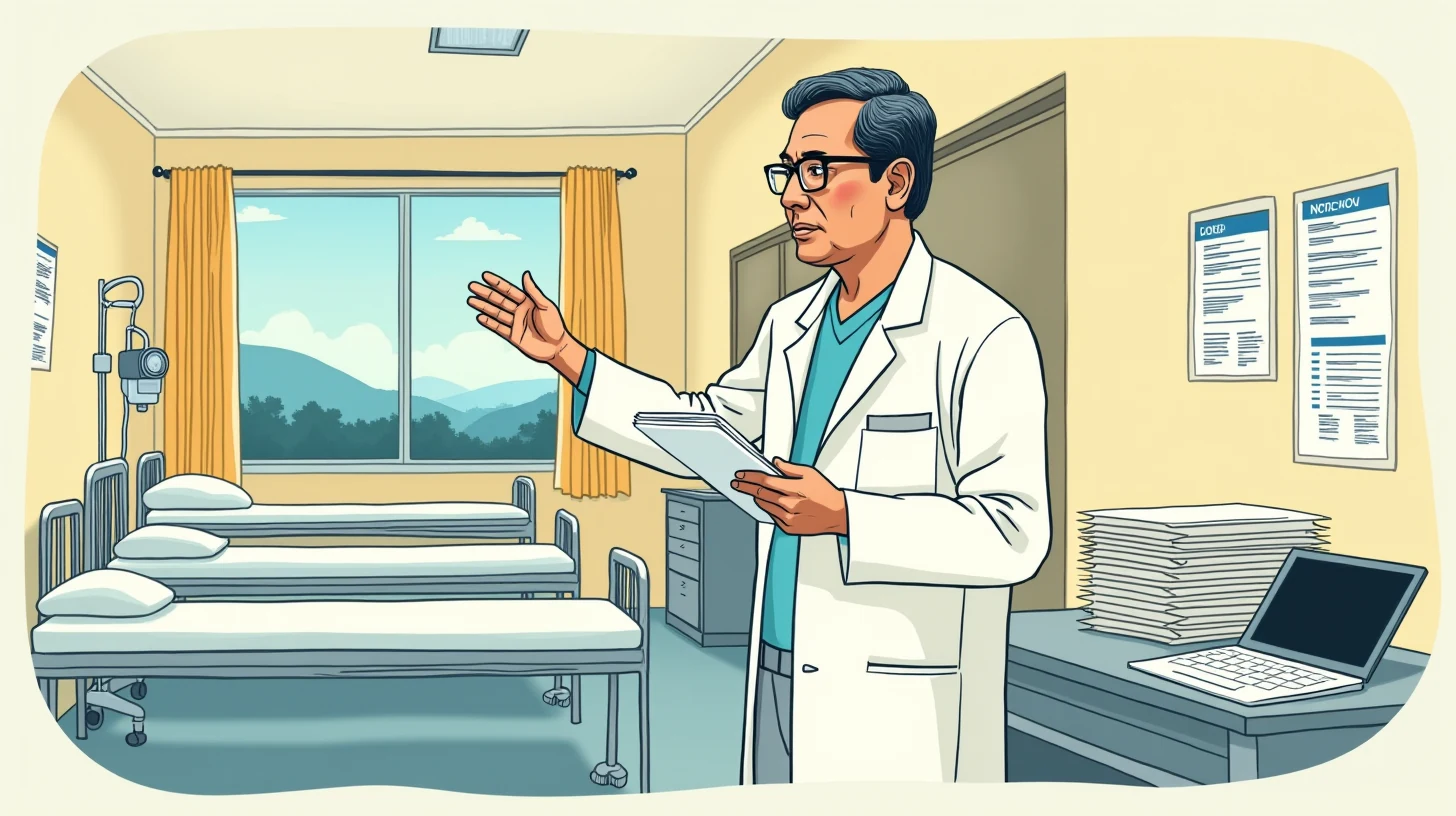
RIMS Imphal is a 450-bed teaching hospital and Manipur's only medical college. It is, by default, the state's only tertiary care facility for infectious diseases. Everything that cannot be managed at a district hospital—everything means serious HIV, serious TB, serious combinations of both—gets referred to Arijit. Everything means patients from Imphal Valley, the Meitei-majority urban centre where he works. And everything also means patients from the hill districts: Senapati, Tamenglong, Ukhrul, Churachandpur. These are Kuki-Zomi-majority areas, historically mixed-ethnicity, now conflict-fractured since March 2023. The roads between valley and hills are open, intermittently. The healthcare system is not.
🗓️ The system before the rupture
Before March 2023, Manipur's HIV and TB infrastructure was already strained but functional. NACO operated 80+ ART centres across the state. RNTCP had district TB coordinators and a supply chain from the central warehouse through district pharmacies to village health workers. Arijit's ward had 68 beds and ran at approximately 85% occupancy—high, but manageable. Patients from the hills had a clear pathway: village-level ASHA testing, district CHC diagnosis, district ART centre for chronic care, referral to RIMS if acute complications arose.
The conflict changed the system's topology. By May 2023, most of the health workers in hill-district ART centres—predominantly Meitei, recruited from Imphal—had been reassigned or had left voluntarily for safety reasons. Replacements did not arrive. The district TB coordinators, similarly, faced pressure and harassment. Supply chains bifurcated. Medications began routing through alternate channels—some through state warehouses, some through army logistics. Trust in public facilities fragmented.
- ⚖️
March 2023 — Conflict begins
Ethnic violence erupts between Meitei-majority Imphal Valley and Kuki-Zomi-majority hill districts. Initial response: curfews, sporadic violence, healthcare workers cautious but working.
- 📨
April–May 2023 — Health worker exodus
Meitei health workers in hill-district ART and TB centres report safety threats. RIMS staff report harassment during commute. Reassignments are ordered. Replacements are announced but do not arrive.
- 🛑
June 2023–Dec 2023 — The silence
For six months, no new diagnoses reported from rural CHCs. ART centres operate skeleton staff (ASHA workers only) or close for extended periods. Patient access drops by ~70%. HIV and TB progression occurs silently in hill districts.
- ₹
April 2026 — The convergence
Patients with advanced AIDS (CD4 <50) and MDR-TB begin arriving at RIMS casualty. Arijit's ward capacity overwhelmed. Seventeen HIV patients admitted with treatment gaps of 3–6 months.
What happened in those six months was not a shortage of treatment. RIMS had antiretroviral therapy. The state had TB drugs. The barrier was trust. A patient who could not reach an ART centre, who had been told the centre was closed, who had heard from neighbors that the health worker was not coming anymore—that patient stopped taking medications. Or they took them inconsistently, hoping the regime would still work. Or they sold them because the family needed rice.
⚠️ When good intentions create invisible harm
On April 18, 2026, at 6:32 AM—Arijit logged the time in the casualty admission register—an ambulance brought a twenty-eight-year-old man to RIMS. His name was Thangkhulo. He was from Senapati district, in the Kuki-majority hill zone. His mother had traveled with him in a shared taxi, a journey that should have taken ninety minutes but took four hours because of security checkpoints and intermittent road closures at the valley-hills boundary.
Thangkhulo was conscious but incoherent. His skin showed patchy discolouration—oral candidiasis, thrush. His breathing was fast and shallow. His temperature was 39.1°C. Arijit examined him in the casualty—the clinical picture was immediate and grim. CD4 count was almost certainly below 200; the respiratory symptoms suggested either Pneumocystis jirovecii pneumonia (PCP) or tuberculosis. The blood tests came back at 10:45 AM. CD4: 32 cells/μL. Viral load: 750,000 copies/mL.
In other circumstances, this would be a straightforward admission: start antiretroviral therapy immediately, treat the opportunistic infection, manage the acute phase over two to three weeks, discharge on outpatient follow-up. In Manipur in April 2026, it was an admission into a ward running at 115% capacity—78 patients in 68 beds, with 12 sleeping in the corridor, 4 in the dining hall (converted to overflow), 2 sharing beds.
"When did he last take his ART?" Arijit asked Thangkhulo's mother.
She looked at the floor. "Three months. He stopped. He said he could not get the medications in Senapati after the troubles started. He said the ART centre was closed."
The Senapati ART centre was, technically, open. It had a skeleton staff—one ASHA worker—and an empty health worker position. The district pharmacy, which was supposed to supply it, was routing most stock through district hospital in Senapati town, which is in the Meitei-majority valley portion of the district. The hill portions of the district—where Kuki populations lived—were not receiving regular supply deliveries because the delivery person was afraid to travel there. So patients like Thangkhulo had a choice: try to reach Senapati town (controlled by Meitei security forces, frightening if you are Kuki), or wait until you were sick enough to make the desperate four-hour journey to RIMS.
"গুলিবন্দুক আছে পাশে, ঔষধ আছে দোকানে — পৌঁছানো কে?"— Bullets on the street, medicine in the clinic—how do I get there?
Arijit had seen this pattern seventeen times in the preceding eight weeks. Young HIV patients, mostly from the hill districts, who had lost access to antiretroviral therapy during the conflict, who had waited months for roads to open or for their families to save money for the taxi fare, who arrived at RIMS with CD4 counts below 50. Of those seventeen, two had died in the hospital. Nine were still admitted, taking up beds. Six had been discharged on intensive regimens with follow-up plans that, Arijit's private assessment told him, they would not be able to maintain if they returned to districts without functioning ART centres.
The good news—the medications are available, the protocol is correct, NACO has funding—was producing invisibly bad outcomes. Patients were surviving the acute illness but returning to districts with no care infrastructure. They would interrupt therapy. They would come back eighteen months later with viral resistance and opportunistic infections that would need longer, more complex treatment. The difference between "saved a life" and "delayed death" was becoming indistinguishable.
🌗 What the agent revealed
In the third week of Thangkhulo's admission, when his CD4 was climbing slowly—from 32 toward 120—and he was conscious and asking questions, Arijit spoke with him about what happened next. Not the pharmacology (Arijit had already explained the therapy), but the logistics. How would Thangkhulo return to Senapati? Would the ART centre actually be open? Who would monitor him if his CD4 did not continue rising?
Thangkhulo pulled out a tablet his mother had borrowed from a relative. On it, through a patient community WhatsApp group, someone had mentioned the agent—a tool that verified whether government health services were actually functional, that could check whether an ART centre had a staff roster, whether medications were in stock, whether there was a backup plan if the centre closed again.
Arijit was sceptical. He said, "Ask it if the Senapati ART centre is going to stay open."
Thangkhulo typed, in Meitei: "সেনাপতি ART কেন্দ্র কেন খোলা থাকবে?" (Will the Senapati ART centre stay open?)
The agent checked the Manipur State AIDS Control Society (MSACS) roster for Senapati district. The health worker position, vacant since May 2023, had been filled on April 10, 2026—eight days before Arijit's conversation with Thangkhulo. The new health worker, posted from Imphal with a security allowance and a commitment from the district hospital that the centre would operate five days a week, had taken charge. The agent replied in Meitei:
"সেনাপতি ART কেন্দ্রে নতুন health worker নিয়োগ হয়েছে এপ্রিল ১০-এ — Dr. Romesh Khongji, trained, এখন duty তে। কেন্দ্র সপ্তাহে পাঁচ দিন খোলা। তুমি discharge হলে, তুমার মা-বাবাকে এই তিনটা নম্বর দেবো — MSACS officer, district doctor, ART centre staff। তারা জানে তুমি আসছো — Arijit ডাক্তার থেকে referral এসেছে।"
(The Senapati ART centre has a new health worker as of April 10—Dr. Romesh Khongji, trained, now on duty. The centre is open five days a week. When you are discharged, I will give your mother these three phone numbers—the MSACS officer, the district doctor, the ART centre staff. They know you are coming—a referral has come from Dr. Arijit.)
Arijit read it over Thangkhulo's shoulder. He asked the agent about Thangkhulo's specific situation: CD4 of 32 on admission, likely PCP, now responding to therapy. What was the highest risk for relapse?
The agent outlined: CD4 remains <200 for the first three months post-ART initiation; opportunistic infection (PCP) takes 6-8 weeks to fully resolve; if Thangkhulo misses doses, viral rebound occurs within days; if the ART centre closes again, CD4 will drop back to AIDS range within six weeks.
"So the weak link is not the drug supply," Arijit said aloud. "It is whether the centre stays open and whether he believes it will."
The agent confirmed: "Correct. You have solved the acute problem—his CD4 is climbing. You have solved the access problem—the new health worker is posted. The unsolved problem is: will he return for his two-week visit, and will he return for his three-month visit? That depends entirely on whether he trusts the system will be there."
Arijit discharged Thangkhulo on day 14, with intensive therapy instructions, three phone numbers, and—for the first time in his career—a printout from the agent showing the current staff roster of the Senapati ART centre, updated that morning. He said to Thangkhulo's mother: "The centre is real. The person is real. Their phone number is real. Call them when you are one hour away. Make sure someone is there."
🧭 Why the system broke and what would fix it
Two days after Thangkhulo's discharge, Arijit attended a meeting of the Manipur State AIDS Control Society task force, convened to discuss "restoring ART centre capacity in conflict-affected zones." There were sixteen attendees: district NACO officers, health department representatives, NGO coordinators, and Arijit.
The MSACS program officer, a woman named Anita who had held the position for five years and had watched the system work and then collapse, opened with epidemiology: "We have lost contact with approximately 40% of patients on ART in hill districts since March 2023. We estimate 600 patients interrupted therapy. We have had seventeen AIDS-attributable deaths in hill districts in the past year, compared to an average of three deaths per year pre-conflict. We have not had new diagnoses reported from rural CHCs in Senapati, Tamenglong, or Ukhrul in six months. Not because incidence dropped. Because testing capacity collapsed."
A district officer asked: "Is it funding? Can we hire more staff, reopen the centres?"
"The funding exists," Anita said. "What does not exist is safety. Health workers are afraid. Transportation is disrupted. Supply chains are rerouted through army logistics in some areas. And the patients—patients have no money for transport and no confidence that the centre will be functioning when they arrive."
Arijit said: "And if they wait until they are sick enough, they come to RIMS. I have seventeen patients right now with severe immunosuppression, all of whom needed ART three to six months ago, all of whom require at least two weeks of hospital care. The opportunity to prevent this was in the district six months ago. We are now in salvage mode."
What he did not say aloud, but was thinking clearly: the conflict had created two HIV programs operating in parallel, with a wall between them. One in Imphal Valley—dysfunctional but functioning. One in the hill districts—non-existent. The virus does not care about ethnic boundaries. The patient system does.
Imphal Valley ART Program
Functional (overcrowded)RIMS has specialist care, second-line drugs, PCP and TB co-infection management. Patients can access care at reasonable transport cost. Urban infrastructure intact. The problem: ward at 115% capacity, waiting list of 13 patients for admission.
Hill District ART Program
Nominally restored (trust unknown)New health workers posted (April 2026) with security allowance. Five-day-per-week schedules announced. Supply chain officially restored. The unknown: will patients return to a centre that abandoned them six months ago? Will the centre stay open if conflict flares again?
The Weak Link
Patient adherence + continuityNeither supply nor staffing. A patient with CD4 <50 who spent six months without therapy, now on intensive regimen, must return every two weeks. He must believe the system will not abandon him again. That belief cannot be restored by administrative order.
Anita asked Arijit: "If we reopen the ART centres with mobile staff and armed escorts for the health workers, would that solve it?"
"No," Arijit said. "You would restart supply. But patients who have missed six months of ART have progressed to AIDS. They need hospital beds. They need intensive therapy management. They need someone—not once, but repeatedly—to explain why they must stay on therapy even when they feel better. This is not a supply problem. It is a disease management problem. RIMS is the only place with the capacity."
The task force took notes. The official conclusion was to "implement mobile ART clinic circuits" and "accelerate health worker reposting." These were good things. They would help. But they would not solve the deeper problem, which Arijit kept returning to: you cannot reopen trust by administrative order.
🌱 The frontier of Manipur's medicine
It is May 2026. Thangkhulo is back in Senapati, attending the ART centre every two weeks. His CD4 is now 142 cells/μL. He is still far from immune restoration, but the trend is correct. Whether he will continue returning depends on whether the centre remains open and whether his confidence in that stability holds.
Arijit is still in the RIMS infectious disease ward. His census has dropped slightly—71 patients in 68 beds instead of 78. The waiting list at casualty for admission is down to eight. The supply of second-line TB drugs is more consistent. The MSACS task force has released its action plan: repost 15 more health workers to hill-district ART centres, establish weekly supply deliveries, and—Arijit notices this—begin a tele-consultation pilot between RIMS and district hospitals.
Arijit is spending four to six hours per week on something that is not in his official job description: coordinating with district doctors and ART centre staff to set up video consultation capability so that hill-district patients can consult him without the four-hour journey. This does not improve his salary. It cannot be listed on his appraisal. But his calculations show that if he can shift 30% of follow-up consultations to telemedicine, he can reduce ward admission pressure by eight to ten beds per month.
"It is not elegant," he said when describing the plan. "It is not published research. It is not a new drug. It is: we have a phone, they have a phone, we can talk, I can adjust their therapy, I can tell them to go to the district doctor if something changes. It is the frontier of what I can do with the tools I have without waiting for the system to be fixed."
The question that stays with him—when he is asked why he continues investing unpaid hours in something that will not improve his appraisal or his salary—is about the frontier of Manipur's medicine itself.
"We are not short on antiretroviral drugs," he said in our final conversation. "We have the medications. We have the knowledge. We know how to treat HIV. What we are short on is continuity. One patient, one doctor, one ART centre—that they can manage. But continuity requires every link to hold: the centre stays open, the patient trusts it enough to return, the doctor knows the patient's history, the patient comes back for monitoring. Conflict broke one link. When one link breaks, the whole chain collapses."
Arijit is rebuilding that chain one consultation at a time—by admitting patients into corridors because there is no other option, by calling district hospitals and asking them to understand that their collapse creates his overcrowding, by trying to use a phone line to do the work of a functioning health system. He is doing it because the alternative is to acknowledge that the frontier of Manipur's medicine in 2026—in a state that reported India's first HIV epidemic in 1989 and still carries one of India's heaviest HIV burdens—is not a shortage of treatment.
It is a broken link in a chain that was already fragile. And the medicine to restore it is not in a pharmacy. It is the simple, nearly invisible work of a doctor and a health worker saying, to a patient who stopped coming when the system failed: "We are here. We will stay. Come back."
Whether that promise holds depends on whether the conflict itself holds still. Which is beyond Arijit's department. Which is why he is trying to solve it with a phone, before the system breaks again.