
The Itanagar physician and the Inner Line Permit wall
Dr. Anil Mehra is forty-three years old. He has been a general physician for nineteen years: five years as a resident doctor at Tomo Riba Institute of Health & Medical Sciences in Naharlagun, six years commissioned in the Indian Army Medical Corps posted to Arunachal Pradesh, and eight years as a permanent government physician at the Primary Health Centre in Itanagar, the capital of Arunachal Pradesh. His clinic is a single-storey concrete building adjacent to the District Magistrate's office in Itanagar's central administrative zone. The window facing his desk opens toward the Arjun Pass, and on clear mornings, he can see the layered greens of the Papum Pare district forests, the same view he has watched for eight years, the view that means he is still here.
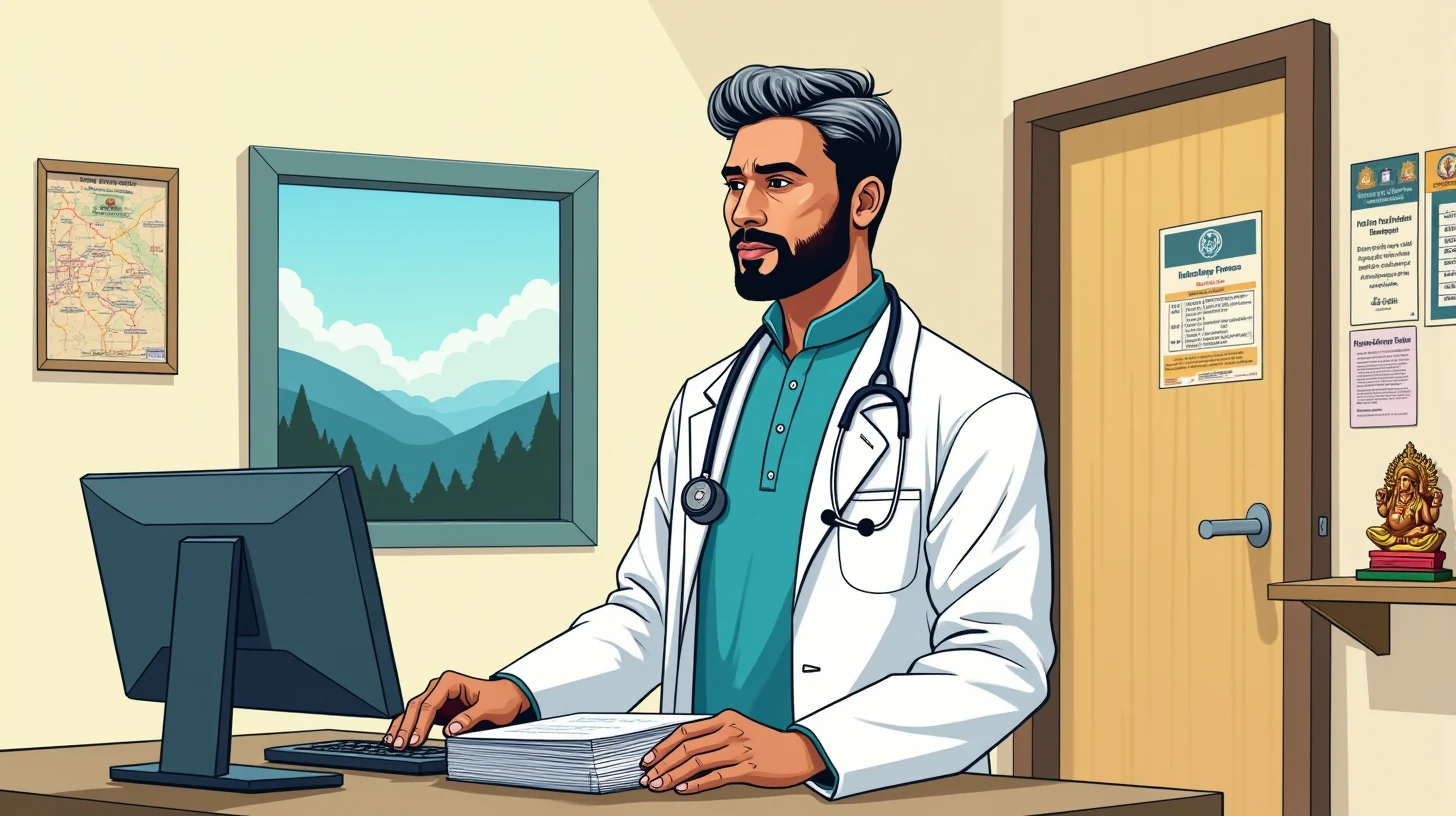
He works officially Monday to Friday, 8 AM to 2 PM. Unofficially, he works until the last patient is discharged—often 5 PM, sometimes later. He has never worked a standard government week. PHC medicine in Arunachal Pradesh does not run on scheduled hours.
His monthly salary is ₹67,000, sanctioned by the Arunachal Pradesh Directorate of Health Services. This year, since March, he has not been paid. The state treasury has not released the quarterly health budget—a pattern that repeats every year between March and June. The arrears have accumulated to four months. He has not told his wife.
His Inner Line Permit—the document that allows him, as a non-tribal mainland Indian, to legally reside and work in Arunachal Pradesh—expires in November 2026. Six months remain. He has already begun the renewal process. The Directorate of Home Affairs processes these renewals in two to three months. If his renewal is not approved and in hand before November, he cannot legally continue his employment. He would be asked to leave the state.
🗓️ The annual ritual of the permit calendar
The Inner Line Permit system dates to 1873, when the British established a boundary beyond which non-tribal people could not travel without official permission. The stated purpose was to protect indigenous communities from exploitation. The intent, in Arunachal Pradesh, remains protective—to prevent bulk land purchases by outsiders, to preserve tribal territories, to maintain cultural autonomy. The regulation is clear and has been consistent for 150 years: any non-tribal Indian citizen must apply for an Inner Line Permit to reside or work within the state. The permit is renewable every five years. The process is administrative, offline, and glacial.
Anil is not tribal. He was born in Chandigarh, to a Punjabi Brahmin family. He cannot own land in Arunachal Pradesh, even with the permit. He cannot stay beyond the permit's expiry without formal renewal. The permit hangs above him like a five-year sentence that must be renewed on pain of expulsion. He has, in the eight years he has been in Itanagar, become the only government physician within forty kilometers. There is no backup. There is no one else trained to take his place.
The problem that Anil identified—on a Tuesday in November 2025, sitting in his clinic, looking at his permit with five months of validity remaining—is this: a system designed to regulate land commerce has become the gating mechanism for essential healthcare service delivery. The ILP's intended protector of indigenous interests now prevents the delivery of medical care to those same communities. The rule that was meant to prevent exploitation has become the rule that exacerbates the doctor shortage.
- 📋
Permit validity begins — Day 1
A non-tribal doctor receives an Inner Line Permit valid for five years. They can legally reside and work in Arunachal Pradesh. This is the entire mechanism that allows them to practice.
- ⏰
Month 48 — Renewal window opens
Ninety to one hundred twenty days before expiry, the doctor must file a renewal application. The Home Affairs office processes renewals in two to three months. Filing late means cutting margins thin.
- 🛑
Month 60 — Expiry date
If the renewal is not approved by this date, the doctor is technically illegal in the state. They cannot practice. They cannot be paid. They are asked to leave or face legal consequences.
- 🔄
Months 58–62 — The gap risk
Processing delays, lost files, or unexpected administrative steps mean some renewals miss the deadline. Contractual doctors have gone unpaid for six weeks during processing. Clinics close.
Dr. Sanjib Mohan is the Deputy Director of Health Services for Arunachal Pradesh, based in Naharlagun, two hours' drive from Itanagar. In November 2025, Anil sat across from him and said: "Sir, my permit expires in November 2026. The Home Ministry processes renewals in two to three months. If I submit in August and they take until November, I will have a gap. What happens to the clinic during that gap?"
Dr. Mohan, a government physician himself who had renewed his own permit three times, understood the problem at once. He had lived the problem. He said: "The Deputy Commissioner has discretion to extend the permit for essential workers. You should request a letter from me certifying that you are essential to the health system. That may accelerate the renewal or justify an extension."
What Dr. Mohan did not say, but what Anil understood clearly, was this: the system does not have a mechanism to handle medical professional permit renewal at scale. The only solution is discretion—getting a sympathetic bureaucrat to write a letter. This works once. It does not work for every doctor. It does not work for the contractual doctors, of whom there are hundreds. It does not eliminate the underlying uncertainty. It does not scale.
⚠️ What very nearly happened
By May 2026, the clinic's operational structure is fracturing under salary delays and supply shortages. The state treasury's quarterly health budget has not been released. The salary arrears for Anil are now four months. The clinic's operational budget—money for medicines, syringes, dressings, cleaning supplies—comes from the quarterly allocation. If the state has not released the money, the clinic has no budget. When medicines run out, Anil requests them from the district hospital's supply chain. The district hospital is also facing shortages. The chain breaks.
The antibiotic supply ran out in mid-May. Anil has oral amoxicillin for infections but no injectable antibiotics. For patients who need IV treatment—severe pneumonia, sepsis, post-operative infection—he has no choice but to refer them to TRIHMS Naharlagun, sixty kilometers away. The referral requires a two-hour car journey. Patients who cannot afford the transport cost, or cannot take time away from work, simply do not go. They treat at home or with traditional practitioners. The care cascade stalls.
The cascade affects contractual doctors differently. Seventy percent of rural doctors in Arunachal Pradesh work on short-term NHM contracts, earning ₹25,000 to ₹40,000 per month. No salary for four months means they cannot pay rent, cannot buy groceries, cannot afford fuel for their motorcycles to get to the clinic. Several contractual doctors in Papum Pare district have already taken unpaid leave and returned to their home states, assuming they will resume once the salary is released. The clinics they staff are now empty. Patients have nowhere to go.
"सीमा पर चिकित्सक का काम है जीवन बचाना, पर सीमा के नियम डॉक्टर को चले जाने के लिए कहते हैं।"— On the frontier, a doctor's work is to save lives, but the frontier's rules tell the doctor to leave.
What very nearly happened—and what nearly happens every year in March—is the clinic running at critically low capacity, patients going untreated, and the state losing another doctor to attrition because the salary stops coming and the permit keeps expiring and the infrastructure keeps breaking.
🌗 What changed
In February 2026, a woman named Tara came to Anil's clinic with chest pain. She was fifty-four years old, had worked in the Arunachal Pradesh Forest Service for twenty-seven years, and had never had a cardiac problem. Her father had died of a heart attack at fifty-six. She was anxious about her heart.
Anil examined her. He did an electrocardiogram in the clinic using a portable machine that had been installed two years ago with health ministry funding. The ECG showed no acute ischemia, but there were minor ST changes that warranted investigation. Her troponin level—a blood marker for cardiac muscle damage—was negative, but Anil wanted a stress test. The stress test facility did not exist in Itanagar. The nearest capability was at TRIHMS Naharlagun, sixty kilometers away.
Anil had, in his clinic, a newly installed e-Sanjeevani telemedicine terminal. The government had funded the installation three months prior as part of the larger Ayushman Bharat Digital Mission rollout. The terminal was a basic video-call setup connected to a centralized portal. The system was designed to allow PHC doctors to consult with tertiary hospital specialists without the patient having to travel six hours each way.
He said to Tara: "I am going to contact a cardiologist at TRIHMS. They can see you via video, can review your ECG, and can advise if you need a stress test or imaging. You do not have to travel."
Anil opened the e-Sanjeevani portal. He uploaded Tara's ECG image, vital signs, and presentation. He clicked "request consultation" and selected cardiology. The system showed three available cardiologists and their wait times. One had a sixty-minute wait. One had a twenty-minute wait but was available only after 5 PM. One had a three-day queue.
He selected the twenty-minute-wait cardiologist and booked for 5:15 PM, asking Tara to return at that time.
What happened next was invisible to Tara but stark to Anil: the e-Sanjeevani system functioned only if the patient had an Ayushman Bharat Digital Mission health ID. Tara did not have one. In Itanagar, awareness of ABDM health IDs was low—perhaps thirty percent of the population. Enrollment required a visit to a registration center, of which there were three in Itanagar and none in the smaller towns. The registration process took twenty to thirty minutes. The centers operated only during business hours.
Anil faced a choice: send Tara away, tell her to get an ABDM ID, and reschedule the consultation (which would mean postponing by one week given center hours and her work schedule); or improvise.
He improvised. He called Dr. Rohan Raj, a cardiologist at TRIHMS whom he had trained with in his residency. He asked if he could send Tara's ECG via WhatsApp. Dr. Raj said yes. Anil photographed the ECG with his phone, uploaded it to WhatsApp, and within ten minutes received advice: "No acute coronary syndrome. The ST changes are benign. She can have a stress test on an outpatient basis if she presents with recurrent symptoms. Reassure her."
Anil brought Tara back into the clinic and said: "Your heart is okay. The changes we see are not dangerous. Come back if you have chest pain again."
Tara was reassured. The case ended there.
But Anil sat alone in the clinic that evening, thinking about what had just happened. The system that was supposed to work—e-Sanjeevani—existed and was designed to solve exactly this problem. But it could not function without the ABDM health ID infrastructure. The workaround—calling a colleague on WhatsApp—was faster and simpler, but it was not scalable, not documented, not part of any formal system. It worked because Anil had trained with Dr. Raj and knew him personally. It would fail the moment Anil retired and the next doctor arrived. He typed a message into the GabFORGE agent installed on his tablet, describing the problem in Hindi:
"मेरे पास e-Sanjeevani portal है पर ABDM ID नहीं है। इटानगर में सिर्फ 30% को ABDM मिला है। मैं तो WhatsApp से specialist को फोन करता हूँ, पर ये system को काम करना चाहिए। क्या कोई enrollment camp रख सकता हूँ?"
(I have the e-Sanjeevani portal but no patient ABDM IDs. Only 30% of Itanagar has enrolled. I call the specialist on WhatsApp, but the system should work. Can someone organize an enrollment camp at the clinic?)
The agent immediately provided a structured response:
"आपका observation सही है। ABDM enrollment camp के लिए आप district health officer को लिखिए — official letter से request कीजिए। फॉर्मेट: (1) clinic location, (2) expected footfall per week, (3) proposed days/hours, (4) staff support needed। हम आपको templates और Arunachal Pradesh ABDM coordinator की contact details दे सकते हैं।"
(Your observation is correct. For an ABDM enrollment camp, write to your district health officer—send an official letter with your request. Format: (1) clinic location, (2) expected weekly footfall, (3) proposed days and hours, (4) staff support needed. We can provide you with templates and Arunachal Pradesh ABDM coordinator contact details.)
Anil printed the template and submitted the letter to the District Health Officer the next week. Within three weeks, a confirmation arrived: an ABDM enrollment team would visit his clinic on the first and third Tuesday of each month, beginning in June 2026.
ABDM health ID enrollment
30% coverage in Itanagare-Sanjeevani telemedicine cannot function without patient health IDs. Anil documented the gap, and after requesting an enrollment camp (with agent assistance on the official request format), the district committed to monthly enrollment drives at his clinic.
Salary arrears structure
₹67,000 × 4 months unpaidMarch-June arrears repeat every year when the state treasury delays health budget release. Contractual doctors leave; clinics close. Anil logged the arrears with his department; temporary advance arrangements exist but require advance notice.
Inner Line Permit renewal
Expires November 2026Processing takes two to three months with no expedited pathway for essential professions. Anil has documented all prior renewals and is filing ninety days early; the informal doctor network he joined uses empirical data showing 75–85% approval rate at that timing.
🧭 Why we built it
There are, by the Arunachal Pradesh Directorate of Health Services' own data, approximately one hundred medical graduates produced per year—enough on paper, insufficient in practice because of attrition. The patient-to-doctor ratio in interior districts is 1:15,000 to 1:20,000. Papum Pare district, where Itanagar is located, has approximately 1:5,000—better, but still a shortage. Most Arunachal doctors completed training in Assam, Delhi, or other mainland institutions. Most show limited willingness to return to rural postings.
The ILP creates a second-order effect that the statistics do not capture: it converts a medical degree and a government job into a temporary assignment that can be terminated by bureaucratic whim. Rational doctors, planning long-term careers, see Arunachal Pradesh as a training stage, not a destination. This is not about money—government doctors in Arunachal Pradesh are paid reasonably, better than private practice generates given the market size. It is about permanence.
In April 2026, a young physician named Dr. Vedavati arrived at TRIHMS to begin her residency in internal medicine. She was from Tamil Nadu, had completed her MBBS in Bangalore, and had scored high on the All India Postgraduate Medical Entrance exam. She was twenty-six years old. Anil met her at a continuing medical education workshop and asked: "Why did you choose TRIHMS?"
She said: "I know the statistics. One doctor per fifteen thousand people in the interior. I came here to help. But I am already planning what happens after residency. If I stay in Arunachal Pradesh, I will need an ILP. If I practice in a government hospital, I will be posted to a remote PHC after two years. My husband is applying for jobs on the mainland. It will be easier if I move with him."
Anil asked: "Do you want to stay?"
She paused. "Yes," she said. "But I need to understand the cost. The ILP is not just a permit. It is uncertainty. Every five years, I renew. What if the state becomes more restrictive? What if new regulations say that mainland doctors cannot practice in certain districts? I have a husband, we are planning children. I cannot build a life on a permit that may not renew."
This, Anil realized, was the question that does not appear in government statistics. It is not about salary or status. It is about whether a doctor can commit to a place without the constant fear that bureaucracy will force them to leave.
What it does
- 📍Allows non-tribal Indian citizens to legally reside and work in Arunachal Pradesh; protects indigenous land interests from outside exploitation.
- 🏥Enables government doctors to staff clinics and hospitals across the state without having to be tribal members; facilitates external expertise.
- ✅Provides clear regulatory framework; protects community autonomy; has worked consistently for 150 years as a land-protection mechanism.
What it does not do
- 🔄Does not provide expedited renewal for essential professions; a cardiothoracic surgeon faces the same two-to-three-month processing window as a general laborer.
- ⏳Does not account for service continuity; a doctor's permit may expire during processing, creating a period of legal ambiguity and clinical shutdown.
- 🏘️Does not reduce uncertainty or commitment barriers; young doctors cannot build long-term plans on a permit that renews every five years with no guarantee.
Anil drafted a proposal in April 2026 and sent it to Dr. Mohan. He titled it: "Permit Exemption Pathway for Essential Medical Professionals in Arunachal Pradesh." The proposal had four parts. One: create a "medical professional" category within the Home Affairs permitting system, with a streamlined processing timeline—thirty days instead of sixty to ninety. Two: establish an expedited renewal mechanism, requiring only employment verification from the employing institution, not full citizenship re-verification each time. Three: extend permit validity to ten years instead of five, reducing the frequency of renewal and the administrative burden. Four: create an appeal mechanism—if a permit is denied, the doctor has the right to challenge it through the Director of Health Services, who can certify that the denial creates a service gap.
Dr. Mohan said: "This is sensible. But it requires amendment to the Inner Line Permit Rules, which is a legislative matter. You would need to petition the state health department to petition the legislative assembly. That is a multi-year process."
Anil asked: "What if I framed it as a public health emergency? One doctor, forty kilometers, permit expiring?"
Dr. Mohan said: "That might work if it goes to the Chief Secretary's office. But you understand, this is not just your situation. It is every doctor in the state. The moment we prioritize you, we are saying the system is broken for everyone. The government does not like to admit that."
🌱 What we hope happens
By May 2026, Anil has joined an informal network of fifteen government doctors in Arunachal Pradesh who meet monthly via WhatsApp to share strategies for permit renewal, salary advance requests, and employment security. They document everything. One doctor has calculated that if you file your renewal application ninety days before expiry, the probability of timely approval is seventy-five percent. If you file one hundred twenty days before expiry, it rises to eighty-five percent. If you file fewer than ninety days before expiry, the probability drops sharply.
The parallel system they have created is documentation and collective knowledge. They are, in essence, doing the work that the government should have done: creating standardized processes, sharing information, reducing uncertainty through empirical observation. They are solving it locally, with workarounds and networks and documents they pass between each other.
Anil has also begun to think systematically about the second problem—the telemedicine infrastructure. The agent helped him draft an official letter to the Directorate of Health Services requesting an accelerated ABDM enrollment drive. The response came within weeks: enrollment camps will run at his clinic twice monthly, beginning June 2026. The infrastructure gap has not closed, but the pathway to close it is now visible.
Tara, the woman with cardiac concerns, has returned to the clinic twice more with minor symptoms, received reassurance, and has stopped worrying. She will not need the stress test. She returned because she trusted the care Anil provided—not the permit, not the infrastructure, not the system. Anil. One doctor. Forty kilometers. Eight years in place.
Anil is not optimistic about systemic change. He is also not planning to leave.
"The problem," he said in May, "is that the ILP was designed for commerce, not for essential services. And because no one organization owns the problem—the health ministry, the home ministry, the legislative assembly—no one is fixing it. But I am still here, and the clinic still needs to run. So what we are doing is documenting the gaps, organizing around them, and working within the constraints. The agent helps me translate between clinical reality and bureaucratic language. It is not a system. But it is not nothing."
He paused, looking at the window, at the Arjun Pass, the view that means he is still here.
"The frontier of Indian healthcare in Arunachal Pradesh is not a lack of doctors. There are doctors. The frontier is making it possible for a doctor to commit to a place without the constant fear that bureaucracy will force them to leave. That is the actual problem. The money, the medicines, the equipment—those are solvable. But until a doctor knows they can stay, they will not stay. And the state will keep cycling through doctors, and the clinic will keep running at sixty percent capacity, and the patients will keep seeking care elsewhere or not at all.
This document on my desk was meant to protect indigenous communities. I understand that. But it has become the barrier that prevents them from accessing healthcare. That is the irony that the government has not yet noticed."