
The Kalahandi pediatrician and the sickle-cell crisis in the KBK belt
Dr. Priyanka Behera is thirty-one years old. She finished her MBBS from SCB Medical College in Cuttack in 2015, completed her MD in Pediatrics in 2018 from the same institution, and in 2019, after a brief stint in a private hospital in Bhubaneswar, accepted a District Child Health Officer posting in Kalahandi district—one of Odisha's poorest and most remote districts, tucked into the southwestern corner of the state in the KBK (Kalahandi-Kandhamal-Koraput) belt where tribal populations comprise the majority and poverty is measured in hunger, malaria, and endemic sickle-cell disease. Her grandmother's family was Kandha tribe, and Priyanka had spent childhood summers in a tribal village learning the language and understanding, even then, that tribal Odisha had no pediatricians. By 2024, five years into the posting, she had become the only government pediatrician serving 1.6 million people across six blocks—and the weight of that role, its impossible calculus, and its daily confrontation with preventable deaths, had begun to reshape how she understood medicine itself.
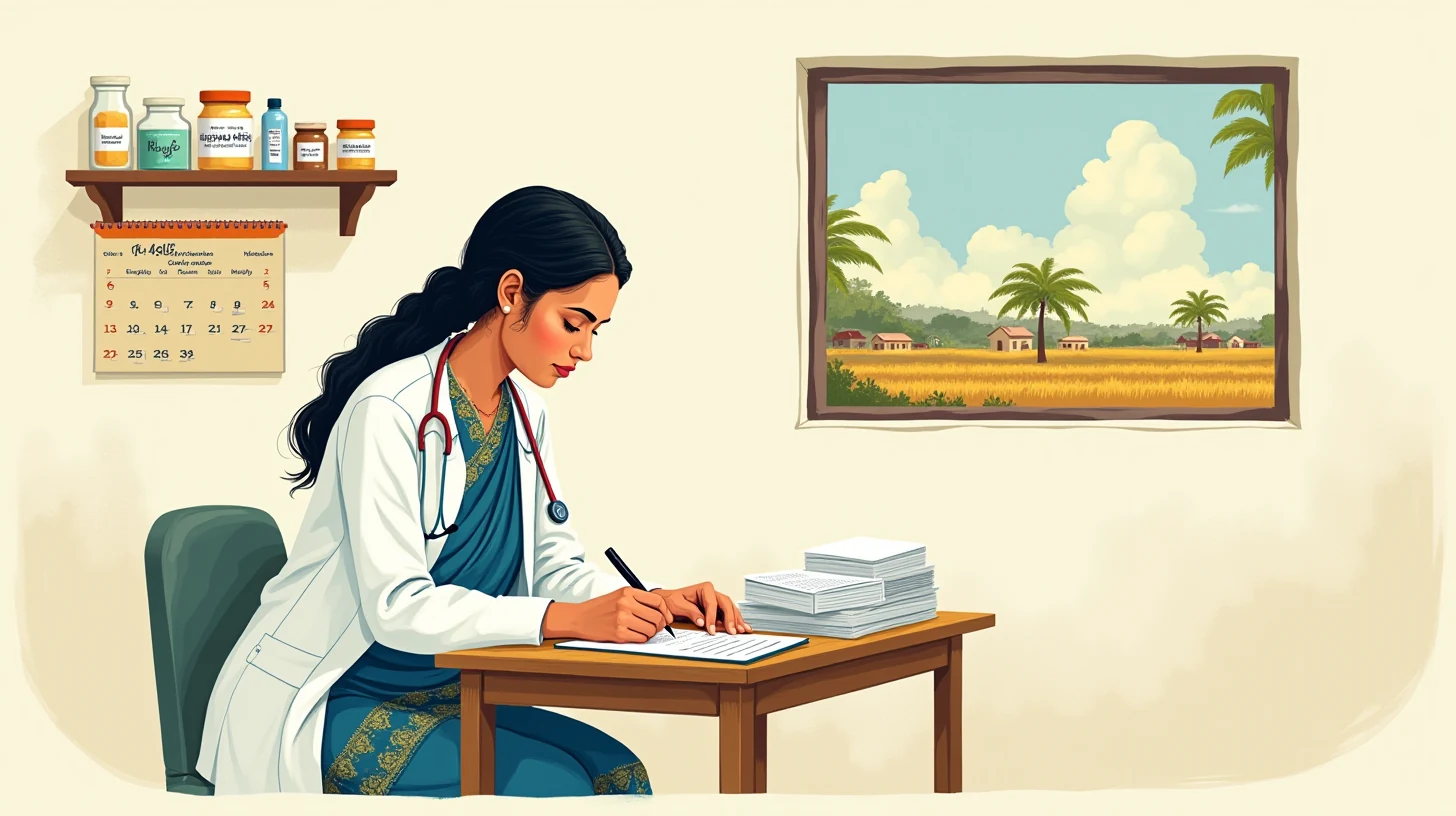
For decades, the sickle-cell disease in tribal Odisha had been invisible because the children carrying it were invisible to the health system. Now, Priyanka had made it visible. And in doing so, she had discovered that visibility itself was a kind of burden.
🗓️ The annual ritual
Kalahandi has seen the worst of India's public health failures. It was the epicenter of the 1965–66 famine that killed thousands. Fifty years later, chronic malnutrition remains endemic—seventy percent of children under five are underweight. Sickle-cell disease, carried by fifteen percent of the tribal population and expressed as disease in one in fifty to one in hundred births, was virtually undiagnosed until the last five years. There is no hemoglobin electrophoresis machine in the district. The nearest sickle-cell clinic is in Bhubaneswar, 450 kilometers away. Hemoglobin electrophoresis—the test that confirms sickle-cell disease—is not available anywhere in Kalahandi. The district hospital can do hemoglobin counts, blood films for malaria, and urine tests. It cannot do liver function tests, blood cultures, or the specialized test that would tell a family their child has sickle-cell disease.
The health infrastructure consists of one district hospital in Bhawanipatna (150 beds, built in 1970), three block-level community health centres, and twenty-three primary health centres. Only the district hospital has reliable electricity. The pediatric ward has fifty beds across two rooms in a building with windows that open onto a courtyard where medical waste burns every morning. During the burn, smoke fills the ward. There is no NICU, no pediatric ICU. Critical infants are managed alongside sick children in the general pediatric ward. Five nurses cover fifty beds—each nurse ten patients, which is impossible for critical care. In monsoon, the roads to block health centres become impassable for six months.
This is the ground Priyanka works on. She has memorized which symptoms require which diagnoses based on the tests she can get. She has built a WhatsApp consulting network with pediatricians in Bhubaneswar and Cuttack. She has created a protocol for sickle-cell vaso-occlusive crises using oxygen, IV fluids, and morphine—the only interventions available. She has trained the nursing staff to recognize early sepsis in malnourished children because sepsis is the leading cause of death in her ward.
It is not good medicine. It is the best medicine Kalahandi can provide.
- 🏡
Village — no diagnosis (age 0–4)
Child lives in tribal settlement forty kilometers from district hospital. Fever and bone pain are common; parents assume malaria. No screening, no diagnosis. Child enters system only when crisis becomes life-threatening.
- 🚑
Transport crisis — ₹8,000 ambulance
Family has no money for private ambulance (monthly agricultural laborer income is ₹8,000–₹10,000). Government ambulance system exists but is slow; road is impassable in monsoon. Delay of hours to days.
- 🏥
District hospital — stabilization only
Priyanka provides oxygen, fluids, morphine. No hemoglobin electrophoresis to confirm disease. If acute chest syndrome or complications develop, transfer to Bhubaneswar is required.
- ⏰
Tertiary referral — 450 km away
SCB Medical College in Cuttack or AIIMS Bhubaneswar has the equipment for confirmatory testing and exchange transfusion. Journey takes 12–24 hours. By then, complications have often set in.
⚠️ What very nearly happened—and did
In late November 2023, a four-year-old girl named Anima was brought to the district hospital by her grandmother, Sula. Anima was from a Kandha village forty kilometers from Bhawanipatna, reached by a path that becomes a stream in monsoon. Sula was seventy-something—births in tribal villages are often unrecorded—and had brought Anima on her hip across bad roads, a three-hour journey, because the child had developed high fever and cried with pain.
Anima was severely malnourished. Weight ten kilograms (normal for four-year-old: 14–16 kg). Hemoglobin 7.2 g/dL (normal: 11.5–13.5 g/dL). Temperature 103.2°F. Respiratory rate sixty breaths per minute (normal: 20–30). Abdomen distended. Continuous crying about leg pain—pointing to knees and shins.
Priyanka recognized it immediately. Fever. Severe anemia. Bone pain in knees and shins. Respiratory distress. This was a vaso-occlusive crisis—sickling in the bones causing ischemia and pain. But Anima had never been screened for sickle-cell disease. The grandmother had simply thought the child was "dubla"—thin, weak. Fevers in tribal villages are so common from malaria, from tuberculosis exposure, from the thousand infections that poverty enables, that they are not noteworthy.
Priyanka admitted Anima immediately. IV fluids, oxygen, morphine. Blood draw for hemoglobin count and blood film to rule out malaria. She did not have hemoglobin electrophoresis, but the clinical picture was clear—she presumed sickle-cell disease and treated accordingly.
The blood film came back positive for malaria—Plasmodium falciparum. So Anima had both malaria and a vaso-occlusive crisis. Priyanka added antimalarial treatment.
For forty-eight hours, Anima's condition stabilized. Fever came down. Respiratory rate normalized. Pain subsided. Sula, sitting on the floor next to the bed, allowed herself to hope.
On the morning of the third day, fever spiked again. Respiratory rate climbed to fifty. Lethargy set in. Priyanka examined her and found what she feared: liver enlarged, spleen palpable, oxygen saturation dropped to 92 percent. Acute chest syndrome—sickling in the lungs triggering inflammation and respiratory failure.
The WhatsApp consultation was clear: Anima needed higher oxygen, blood transfusion, and exchange transfusion. None available in Kalahandi. She needed to be transferred to Bhubaneswar.
Priyanka arranged it. The only option was a private ambulance at ₹8,000—roughly Sula's monthly income if she worked in the fields every day. Sula did not have it. Priyanka paid it from her own pocket. She spent two hours on the phone coordinating with a private facility that agreed to admit on BSKY retrospective coverage.
The ambulance left at 4 PM. At 9 PM, Priyanka's phone rang. Anima had died during the transfer. Two and a half hours in the ambulance. Oxygen saturation continued to drop. One seizure, then she stopped breathing. The emergency room received a dead child.
"ଶସ୍ତ୍ରକୁ ଖୋଜି ଖୋଜି ଆମେ ତାଙ୍କୁ ବାଲିରେ କଟେ ଦେଇଛୁ।"— Searching for the treatment, we buried the child in sand.
🌗 What changed
Priyanka did not sleep that night. She called the superintendent and requested an autopsy. Autopsies are difficult—they require family consent, and the family was grieving—but Priyanka was clear: this child was evidence. The autopsy would document it.
Sula consented. The report came three weeks later: acute chest syndrome with pneumonia and sepsis. The child had developed bacterial pneumonia on top of the sickle-cell crisis, a secondary infection the malnourished immune system could not fight.
What the autopsy could not say, but Priyanka knew, was that Anima had died of six layered failures: (1) never screened for sickle-cell disease, (2) severe chronic malnutrition leaving hemoglobin critically low, (3) concurrent malaria triggering sickling, (4) secondary bacterial infection because immune system was overwhelmed, (5) exchange transfusion not available anywhere in the district, (6) transfer happened too late.
Any one failure could have been addressed with different systems. Combined, they were lethal.
In the month after Anima's death, Priyanka designed a sickle-cell screening program. She identified all children under five in her outreach clinics—brought by Auxiliary Nurse Midwives for monthly developmental assessments and immunizations. She trained the ANMs to collect blood spots on filter paper from every child under two, to be tested for hemoglobin at the district hospital. She did not have money for hemoglobin electrophoresis, so she used a sickle solubility test—₹50 per child, not as precise as electrophoresis, but it catches the trait and disease.
In three months, she identified seventy-three children with sickle-cell disease or trait. Seventy-three children, most of whose parents had no idea. She counseled families, explained what the disease meant, taught them how to recognize crisis, gave them a protocol: on first sign of bone pain or fever, go to the PHC immediately, do not wait. She trained PHC health workers to recognize crisis and start treatment—fluids, pain management—before sending to the district hospital.
The program worked. In 2024, she saw six vaso-occlusive crises reach the district hospital ward, down from an estimated thirty or forty occurring in the community undetected. Of the six, five were managed successfully. One child died of liver bleeding—a complication she could not prevent.
But the program created a different crisis. Once you identify disease, you are responsible for treating it. Parents who now knew their child had sickle-cell disease began asking: how do I cure this? The answer—that sickle-cell disease cannot be cured, that the goal is prevention of crises and management of complications—was not acceptable to families told that modern medicine could cure everything.
One family brought their sickle-cell child to a private hospital in Bhubaneswar and spent three lakhs on "stem cell therapy" advertised as a cure. The disease did not improve. They came back to Priyanka angry, saying she had not told them the right cure existed. Another family consulted a witch doctor who promised to remove the "curse." The child died of a preventable infection under the witch doctor's care.
The screening program had saved lives. But it had also exposed a gap: the gap between what diagnosis enables and what cure requires. Priyanka had given families information that made their situation more complicated and more painful, not less.
"ଏଟା ଆମ system ର ବିଫଳତା ନୁହେଁ, ବରଂ ଆଫ୍ରିକୀୟ ସଂସ୍କୃତିର ମୂଳ ଉଦ୍ଦେଶ୍ୟ। screening ବିନା ଏହି ଦୁଃଖ ଧୀରେ ଧୀରେ ଆସୁଥିଲା। screening ସଙ୍ଗେ ଏହା ତୀବ୍ର ଏବଂ ଦୃଶ୍ୟମାନ ହୋଇଯାଏ। ଗୋଟିଏ ଶିଶୁ ଆম screen ରେ ଧରା ପଡିଲେ, ତାହାର ପରିବାର ଗୋଟିଏ ମୁଖ୍ୟ ପଛାରେ ଅଛି।"
(This is not a system failure but a fundamental crisis of medicine. Without screening, sickle-cell deaths came slowly, hidden in "fever" and "weakness." With screening, the disease became visible and families demanded a cure that does not exist. When one child is identified, that family begins looking for solutions—but the solutions are in Bhubaneswar, 450 kilometers away.)
🧭 Why we built it
Identified cases
73 children in 3 monthsPriyanka's screening program found seventy-three children with sickle-cell disease or trait between January and March 2024. Most had never been diagnosed. Most parents were unaware. Without screening, these children are invisible to every system.
Hospital admissions (managed)
6 crises, 5 survivedIn the prior year, an estimated thirty to forty vaso-occlusive crises occurred in the community undetected, with deaths unknown. After screening and training PHC staff, six reached the hospital, five were managed successfully, one died of liver bleeding.
Cascade barriers
Village → ambulance → hospital → tertiaryFour transport and institutional barriers, each a point of failure. One child, one ambulance cost of ₹8,000, one family unable to pay, one death. BSKY covers retrospective admission but not the transport cost that determines whether the child ever arrives.
There are across India's tribal districts approximately two hundred districts with populations over one million and fewer than one pediatrician per 500,000 children. Kalahandi is one of them. For most, pediatric medicine is not a specialty—it is a crisis management system where children die of preventable causes and the doctors witness it and develop a particular numbness: the understanding that the gap between what should be done and what can be done is not something they will solve in their career.
But some doctors—Priyanka among them—do not accept that numbness. They build prevention programs out of their own money. They train health workers in protocols the state should fund. They screen for disease they cannot cure, because identifying disease is the first step toward a future where it can be cured.
These doctors are not heroes. Heroism language avoids responsibility—it says rural doctors are exceptional people doing exceptional work, rather than saying rural health systems are so underfunded that basic specialist care requires personal sacrifice. But these doctors are also not interchangeable. They have chosen a specificity—a place, a disease, a population—and built systems around that choice. When they leave, what they have built leaves with them, unless someone has documented it and someone else cares enough to carry it forward.
Priyanka is leaving Kalahandi. She was approved for a transfer to Bhubaneswar where she can do academic medicine, mentor students, and access the facilities to manage sickle-cell disease properly—with hemoglobin electrophoresis, blood banks, exchange transfusion capacity. The choice was presented as an opportunity. It felt like abandonment. If she left, there would be no pediatrician in Kalahandi. If she stayed, she would remain in a district where managing her specialty was inadequate, where she was paying from her own pocket for prevention work the state should fund. Both paths were unsustainable. She applied for the transfer.
She has six months remaining. During those six months, she is documenting everything: the screening protocol, the crisis-management pathway, the staff training modules, the educational materials, all in written form so the next pediatrician—if one is assigned—will not start from scratch. She is trying not to think about what happens if no replacement is assigned at all.
What it does
- 🩺Verify a child's sickle-cell status against screening records and flag follow-up clinic dates before crisis develops.
- 📋Match symptoms to BSKY-covered emergency procedures and help families understand what Anima's transfer should have cost and what BSKY actually covers.
- 🗂️Document Priyanka's screening protocol, crisis-management workflow, and staff training modules so the next pediatrician in Kalahandi—if one is assigned—inherits the knowledge instead of starting from zero.
What it does not do
- 🔒Never prescribes treatment or enters a child's medical record—all clinical decisions remain with Priyanka and her team.
- 💳Never processes BSKY claims or handles reimbursement—it surfaces what the scheme covers so families understand the financial barrier.
- ✅Never decides which family gets transferred or which child is a priority—it prevents the invisibility that made Anima invisible.
🌱 What we hope happens
There is a specific kind of missed medicine in rural pediatrics that does not announce itself. Nobody took anything. The national health policy exists. The state health scheme exists. The RMNCH+A program exists. The gap is that no one connects them. No one ensures the screening happens. No one documents what Priyanka learned. No one tells the next pediatrician that seventy-three children in their district have sickle-cell disease.
We are building a resource for rural doctors in India who are managing endemic diseases in districts with no specialist infrastructure: a disease-management wiki where doctors can document the protocols they have created, share them with other doctors in similar districts, and hand them off to their replacements. The protocols are not textbooks. They are the specific, practical knowledge of what works in places where the textbook approach is impossible.
If you are a rural pediatrician managing sickle-cell disease in a tribal district, or a government doctor managing any condition that your district should not have to manage alone, the wiki is free at gabforge.in. Document your protocol. It will not prevent you from having to leave. But it might change what happens to the patients you leave behind. Sula's grandchild might have been screened by someone before the fever started. The next Anima in Kalahandi might be visible, and visible children do not die of invisibility.