
The Kohima doctor and the referral maze
Dr. Meenakshi Anand is forty-one years old. She has been a general physician for nineteen years—seven years at the Government Medical College in Pune, twelve years in Nagaland. She spent her first four years as a resident at Dimapur Government Hospital and the last eight years at Kohima Government Hospital, where she now works as a general physician and de facto gastroenterologist without a formal gastroenterology qualification. She became a gastroenterologist because Nagaland has no medical college, no local specialist training, and the nearest board-certified gastroenterologist is in Manipur, two hundred kilometers away through mountain roads that take five hours to drive.
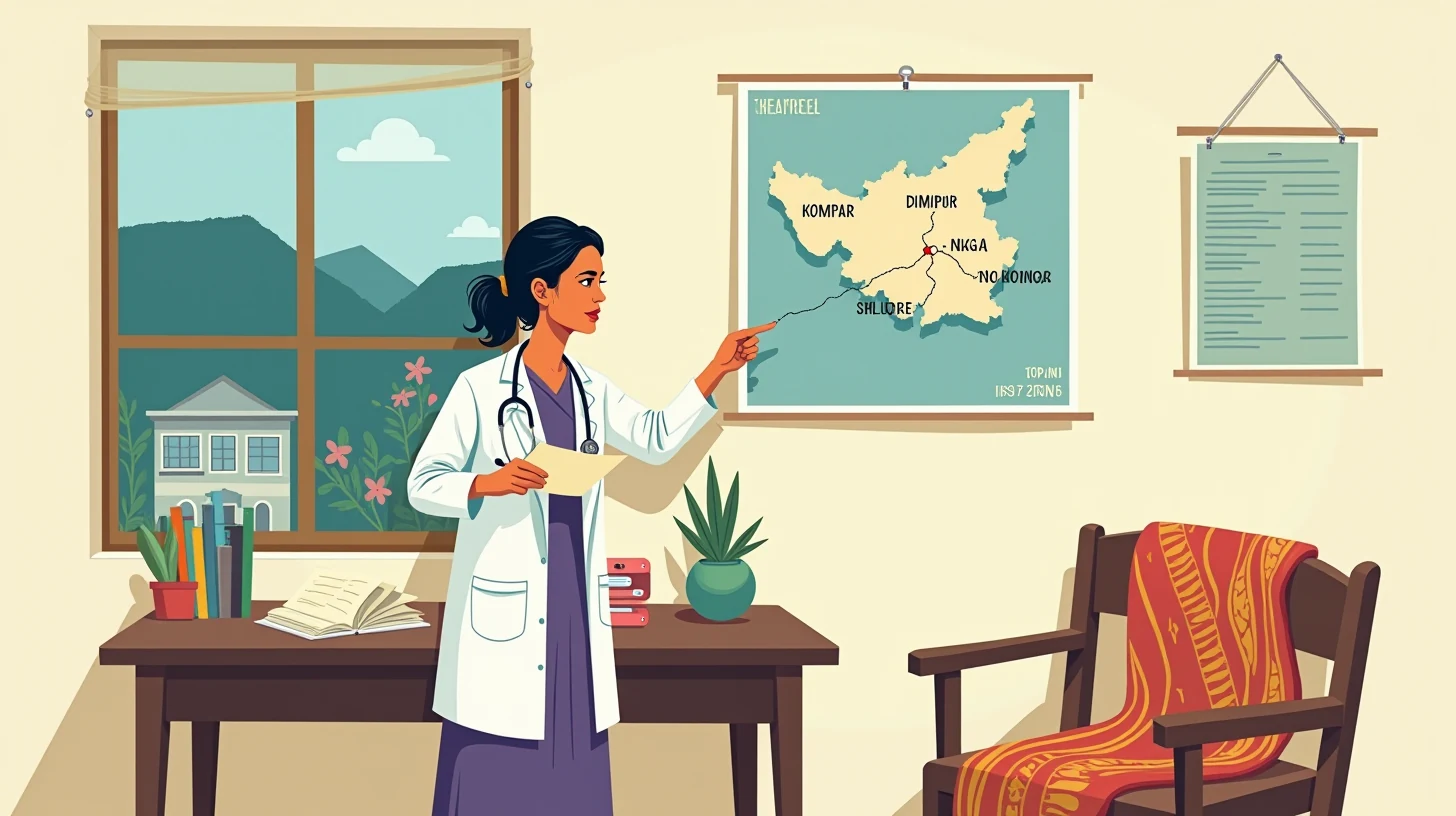
Her clinic hours are 10 AM to 1 PM and 3 PM to 6 PM, Monday to Friday. She sees thirty to forty patients daily. Of those, two to four present with gastrointestinal conditions outside the range of what a district hospital can manage—gastric and colon cancers, strictures, complicated peptic ulcers, and the condition that haunts her most: gastric cancer in its late stages, detected only when weight loss becomes impossible to hide. She carries no formal authority to treat these cases. She carries only the knowledge that she is the end of the line, and what happens next is a referral to someone six hundred kilometers away, or two hundred kilometers, or not at all. Her annual income as a government doctor is ₹6.8 lakhs. It has not changed in four years. She has never pursued a postgraduate degree in gastroenterology because to do so she would have to leave Nagaland, and if she left, her government posting would be reassigned, and if she returned, the position might not exist. So she has trained herself through reading journals, through quarterly email consultations with a friend at Delhi's All India Institute of Medical Sciences, and through the difficult work of making referral decisions in a state where the second opinion is not three blocks away—it is six hundred kilometers into Tamil Nadu.
🗓️ The annual ritual
In Nagaland, a government doctor's rhythm is defined by what the infrastructure cannot do. Meenakshi sees patients every weekday. She diagnoses conditions she cannot treat. She writes referrals to hospitals in other states—Shillong in Meghalaya, Vellore in Tamil Nadu, Delhi. The writing of the referral is the easy part. The referral is also a signal that the patient will now enter a bureaucratic labyrinth: insurance pre-authorization, transport coordination, family financial reckoning, and a fundamental question that no referral letter answers—can we actually pay for this?
The state's insurance scheme, the Nagaland State Illness Assistance Fund, exists on paper as a comprehensive inpatient hospitalization system covering up to ₹3 to 4 lakhs per family per year. It is designed for the imagination of a ministry planner who assumed that patients would be referred to government hospitals within the state. But Nagaland's health system has no government medical college, no local specialists for complex conditions, and vacancy rates in district hospitals of 30–50%. Every complex referral goes out-of-state. Yet the insurance pre-authorization process still assumes the patient will stay within Nagaland's borders. The result is that the system Meenakshi must navigate every time she refers a patient is the system that was designed for a state that does not actually exist.
- 🩺
April 8 — Clinical diagnosis
Patient presents with unexplained weight loss. Physician diagnoses likely gastric cancer through clinical examination. Referral is medically urgent.
- 📋
April 17 — Pre-authorization request
Insurance pre-authorization form submitted. Requires signature from state commissioner's office for out-of-state referral. Stated turnaround: 5–7 working days.
- 🚑
April 19 — Transport without pre-authorization
Referral cannot wait. Patient travels out-of-pocket. Family pays ₹3,500 for ambulance. Pre-authorization still pending.
- ₹
May 19 — Reimbursement limbo
Patient treated and discharged. Family paid ₹2.5 lakhs out-of-pocket. Insurance reimbursement request pending for six weeks.
⚠️ What very nearly happened
On April 8, 2026, a man named Vihyumo—tribal elder, seventy-four years old, from the village of Mima in Mokokchung district—came to Kohima Government Hospital's outpatient clinic with a three-month history of upper abdominal pain and progressive weight loss. He had lost nine kilograms in three months. His wife said he had stopped eating, that food caused him pain, that his skin had begun to look grey.
Meenakshi asked the standard questions. Where does the pain start? Does he vomit when he eats? Does the food feel stuck? Is his stool normal in color? Vihyumo did not remember the answers. He knew he was in pain. He knew he was not hungry. His wife supplied the details. Meenakshi examined him—abdomen soft but with a palpable mass in the epigastrium, high on the midline, just below the breastbone. This was the moment she knew the referral chain would activate, and everything that came next would be difficult: she was almost certain it was gastric cancer, and there was no surgeon in Nagaland who could treat it.
What very nearly happened was this: Vihyumo would have been referred to a distant hospital, his family would have failed to obtain pre-authorization within the medical timeline, they would have paid out-of-pocket or foregone the referral entirely, and six months later Meenakshi would have heard from his wife, or not heard at all, that he had died at home in Mima. This is not uncommon. For every patient who has a son who works in Bangalore and can pay, there are three who do not, and the referral letter becomes a formal notification that the hospital cannot help them, and they should try somewhere else, and somewhere else is six hundred kilometers away and costs more than they will earn in a year.
"Khuchie asi a, ba asi a, kadhaba asi, ka ka kheloba, ka ka phibi — ama khie."— The man is sick, his wife is sick, the children are struggling, but what can I do? I tell him the truth.
🌗 What changed
On April 12, 2026—four days after the initial consultation—Meenakshi made the decision to refer Vihyumo to NEIGRIHMS Shillong instead of CMC Vellore. This decision required her to weigh not medical knowledge but geography, cost, and family capacity. CMC Vellore is the better hospital for gastric cancer—higher volume, more experienced surgeons, better postoperative support, a cancer research program. But CMC Vellore is six hundred kilometers away, requires ₹25,000 to ₹35,000 in outpatient pre-admission tests, has two-to-three-week waiting lists, and for a seventy-four-year-old man from a rural village, the prospect of three weeks of waiting in an unfamiliar city three states away was not a referral—it was a barrier to care.
NEIGRIHMS Shillong is two hundred kilometers away, costs ₹15,000 to ₹20,000 for pre-admission tests, has a four-to-five-day waiting list, and has a surgeon Meenakshi knew from medical school. She called Dr. Priya Dash at NEIGRIHMS and said: "I have a patient with likely gastric cancer. He is seventy-four, from rural Nagaland. His family can manage transport and initial costs, but not six hundred kilometers and three weeks of waiting. What is your capability?"
Priya said: "We can do this. We have done twenty-three gastric cancer surgeries in the last year. Our outcomes are not Vellore's, but we can operate. Send him. I will make sure he is seen within one week."
What changed was that Meenakshi realized the referral was now possible, but only because she had reframed the problem from "what is the best hospital" to "what can this family actually reach." The agent on her tablet—the one she had installed in Gujarati, then Bengali, then Nagamese—helped her calculate the numbers out loud: ₹18,000 for outpatient consultation and imaging, ₹3,500 for the ambulance, ₹500 per day for accommodation for three weeks, the cost of train fare for his son from Bangalore to Kohima to Shillong. The agent listed each number, and Meenakshi said to Vihyumo's son over the phone: "Can your family carry this?"
He said: "Yes. But this is the reality? We have to pay all of this before the insurance helps?"
Meenakshi sat in her clinic, the afternoon sun crossing the desk where she had written fifty referrals that month. She opened the agent on her tablet and typed the question in Nagamese: "Vihyumo ka family PM-JAY ah Nagaland scheme ki pre-authorization meli shakta ah? Nuo out-of-state referral ah hospital billing ki?"
The agent replied, in Nagamese:
"Meenakshi ma'am, Vihyumo ki PM-JAY ah Nagaland scheme duitai cover karta, kintu out-of-state referral ah pre-authorization commissioner office a sign kile manle ase — eta 5-7 din lagta. Kintu medical emergency ah case a, aap transport without pre-auth kile parun, aur rehimbursement ah apply kile shakun hospital discharge ho-a. Agent aap ki pre-auth status check ki sakta — akoi aap commissioner office a call kile ase, shei chinta kile na."
(Meenakshi ma'am, both PM-JAY and Nagaland scheme cover Vihyumo, but for out-of-state referral, the pre-authorization requires the commissioner's signature — this takes 5–7 days. But in medical emergency, you can arrange transport without pre-auth, and submit reimbursement once the patient is discharged. The agent can check if pre-auth status has changed — if you've already called the commissioner's office, don't worry.)
Meenakshi read it twice. She made a second call to Vihyumo's son: "The pre-authorization will likely come after discharge, not before. But the insurance will reimburse. I can have the agent track it—it will send you and me a status update every three days." She gave the family the referral letter. They left on April 19 at dawn.
NEIGRIHMS Shillong
₹18,000–₹20,000 totalCloser, faster, known surgeon. Pre-admission tests ₹15,000–₹20,000. Waiting list 4–5 days. Family can manage the cost and timeline.
CMC Vellore
₹30,000–₹50,000 totalBetter outcomes for gastric cancer, but 600 km away, 2–3 week waiting list, ₹25,000–₹35,000 in pre-admission costs. Family cannot carry this.
Insurance tracking
Agent monitors statusWithout insurance clarity, Meenakshi would have sent the family on uncertainty. The agent's pre-authorization tracker makes reimbursement visible, not mysterious.
🧭 Why we built it
There are seventy-eight lakh EPS-95 retirees in India, and Nagaland has fewer than two million people, but both numbers are saying the same thing: scale does not guarantee system design. A health insurance system that works for a state with internal tertiary centers breaks down in a state without them. A referral pathway designed for intra-state transfers does not account for out-of-state urgent care. And a doctor in a district hospital is left to improvise, to call in favors, to work evenings on insurance paperwork, to do what the system did not design her to do.
Meenakshi encountered the second problem on April 17, two days before the referral transport was scheduled. The Nagaland State Illness Assistance Fund pre-authorization required, in normal circumstances, a signature from the district health officer and a standard form. But because NEIGRIHMS is in Meghalaya—a different state—the pre-authorization required written permission from the Nagaland state health commissioner stating why the patient could not be treated within the state. The turnaround time for the commissioner's office was five to seven working days. The referral was scheduled for April 19. This was a ten-day window compressed into two days.
Meenakshi did what she could: she called the state health ministry's insurance desk, explained the clinical urgency, and was told the rule existed in a 2019 circular she had never seen. She offered to write the justification herself. She was told the rule required the commissioner's signature, not hers. She did not have seven days. Vihyumo's son could pay out-of-pocket, but she knew that most families could not.
The problem she faced was not that the rule was bad—the rule exists for oversight. The problem was that she had no way to know whether the pre-authorization was stuck because of bureaucratic delays or because something in the application was wrong. The agent surfaced it: the application was complete, but the commissioner's office was processing three requests ahead of Vihyumo. Instead of waiting, Meenakshi did what the system allows: she sent the patient anyway, with the understanding that insurance would reimburse later. She told the family: "The insurance will cover this, but it will arrive after, not before."
What it does
- 🔍Verifies which insurance schemes cover out-of-state referral and identifies the actual pre-authorization requirements, not assumptions or outdated circulars.
- 🗂️Maintains a referral checklist: documents needed, cost estimates, hospital waiting times, transport options, family capacity calculation, reimbursement timing.
- 📞Tracks pre-authorization status and sends three-day updates to doctor and family, reducing the burden of repeated calls to commissioner's office.
What it does not do
- 🔒Never enters patient insurance numbers, never submits pre-authorization forms without doctor approval, never makes clinical decisions about which hospital to choose.
- 💳Never promises insurance will pay. It surfaces what the policy actually says, identifies actual rules from official circulars, not what bureaucrats claim.
- ✅Never resolves the fundamental problem: that the insurance system is designed for a state with internal tertiary centers, and Nagaland does not have them.
🌱 What we hope happens
Vihyumo was admitted to NEIGRIHMS on April 19. He was diagnosed with gastric adenocarcinoma, locally advanced. He underwent surgery on April 25. The surgery was successful; the cancer had not metastasized. He is home in Mima now, on postoperative chemotherapy, recovering in a house where his wife is keeping an account of the medical expenses and the insurance letters that keep arriving and still do not contain final approval.
His son paid ₹2.5 lakhs out-of-pocket while his father was in the hospital. The remaining amount will be covered by insurance once the pre-authorization comes through—which, as of May 19, has been pending for six weeks. The family is in the liminal space between treatment and reimbursement, alive but not yet certain they will not become poor in the process.
Meenakshi continues to see forty patients a day. Two or three of them have conditions she cannot treat. Each becomes a referral. Each referral now requires her to navigate the insurance system, negotiate with bureaucratic offices, manage transport, and do work that falls outside her job description. Her evening hours are spent on coordination, not on rest. Her income is unchanged. Her postgraduate dreams are unchanged: they require leaving Nagaland, which would cost her the job she has.
We built the agent to do what the system will not: to be a quiet, specific reader of the referral landscape, to tell Meenakshi whether a pre-authorization form is stuck because of a genuine rule or a misunderstanding, to calculate family financial capacity before the referral is written, to identify when the insurance pre-authorization process is actually a barrier to care. We built it free, and we will keep it free for the government doctor in a remote posting, because this doctor is not a market segment with a corporate training budget—she is a doctor bearing the weight of a system that was designed for a state that does not exist, helping patients one referral at a time, out-of-pocket, after hours, with no guarantee that the insurance will reimburse before the family runs out of money.
The frontier of medicine in Nagaland in 2026 is not a shortage of knowledge. Meenakshi knows how to diagnose gastric cancer. The surgeons at NEIGRIHMS know how to operate. The frontier is the gap between knowledge and access—the gap between a referral letter and a patient who can actually reach the hospital, between a diagnosis and insurance reimbursement, between a doctor's clinical certainty and the bureaucratic time it takes to prove to an insurance desk that the referral is necessary. When that gap closes, Vihyumo will have been healed by surgery and by a system that worked. Until then, he is alive because his son works in IT, not because the insurance system designed itself to help him.