
The Kolkata resident and the safety infrastructure battle after RG Kar
Dr. Asha Mukherjee signed her appointment letter at IPGMER/SSKM Kolkata in June 2023, fresh from finishing her MBBS and her NEET-PG examination. She had placed well enough to choose her posting—not from sentiment, but from calculation. IPGMER/SSKM, despite its difficulty, was where you became a doctor. The hospital was the reference point. Its name on a CV opened doors. She had grown up in South Kolkata, had done her clinical rotations in SSKM's wards, and knew precisely what the job would demand: thirty-six-hour on-call shifts, extreme patient loads, aging infrastructure, and the institutional patience required to survive a government hospital where there were 2,400 beds and approximately sixty-five resident doctors rotating through them. She had accepted this calculation as the price of the credential.
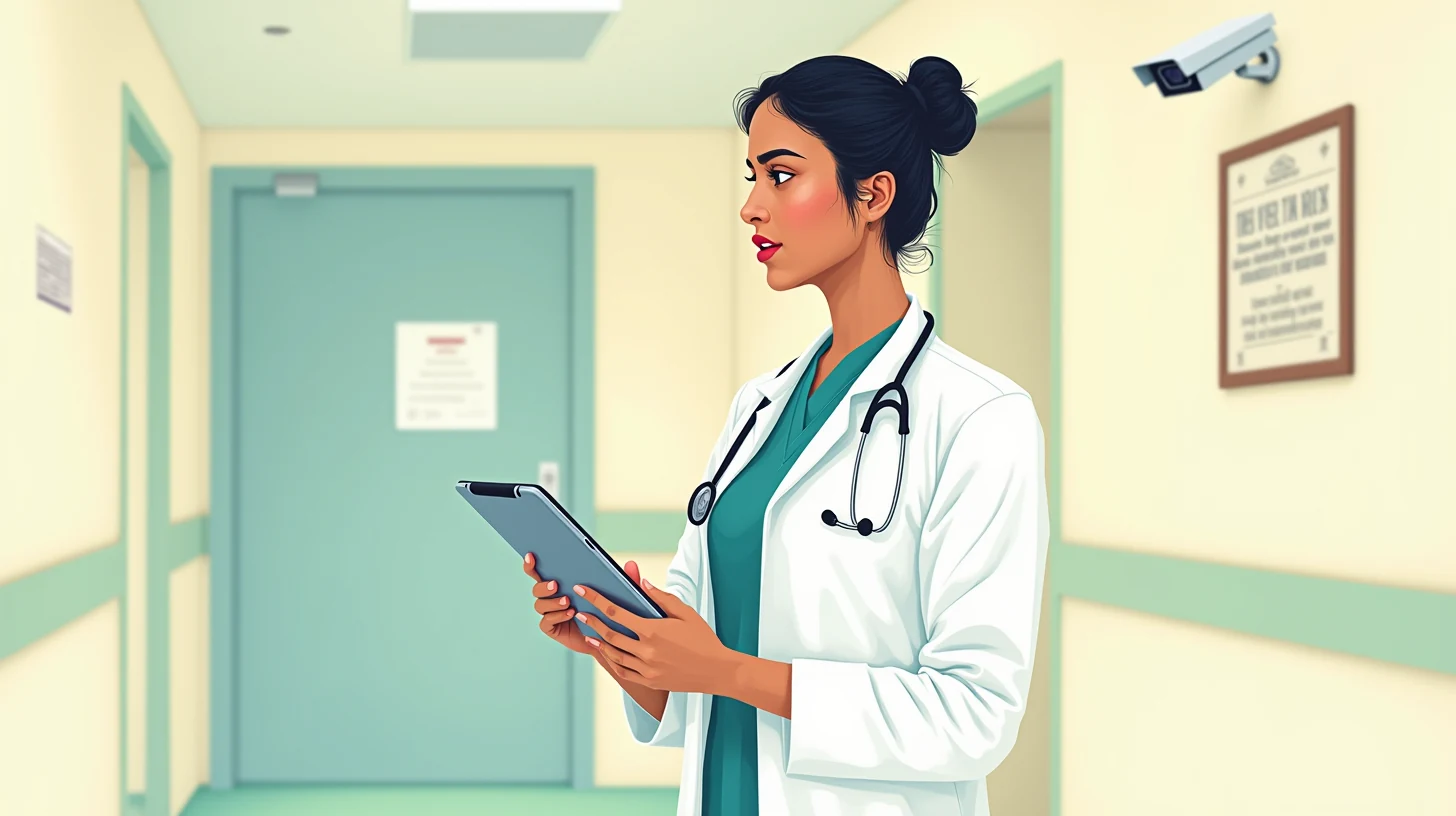
She was twenty-six years old. She had never calculated the cost of safety.
In September 2024, fifteen months into her posting, that calculation changed.
🗓️ The annual ritual
On the surface, IPGMER/SSKM Kolkata operates according to an established rhythm. Resident doctors are posted on three-month rotations through different wards: medicine, surgery, paediatrics, obstetrics, emergency. Each rotation includes on-call duties, where a resident is responsible for their ward throughout a thirty-six-hour shift, sleeping only if no acute admissions arrive. The patient-to-resident ratio is extreme—often, a single resident manages fifty to eighty patients across a night shift. The infrastructure reflects its age: the hospital was built in 1836, expanded significantly in the 1970s, but has not undergone major renovation since the late 1990s. The on-call rooms are housed in a converted building adjacent to the main hospital, a ten-minute walk through poorly lit grounds. CCTV coverage exists in the main corridors and lobby, but when Asha began paying attention to these details, she discovered that thirty-two of the fifty-six cameras were non-functional, and the three that worked were monitored by a single security guard at the main gate—a man over sixty who spent most of his shift sitting down.
This is the architecture. It has been the architecture for decades. It is the architecture that resident doctors negotiate by not calculating its specific dangers; by focusing, instead, on the patient load, the credential, the forward momentum of the career. Asha had done this naturally, the way her senior residents did it, the way her batch-mates did it. You did not think about the access protocols of the on-call room. You did not think about whether anyone could hear you if you called for help. You thought about passing the examinations, getting your name in the journals, securing your reference letters.
⚠️ What very nearly happened
On September 9, 2024, a final-year resident at RG Kar Medical College in Kolkata was raped and murdered in a seminar room adjacent to a general ward. The resident had been on-call, exhausted from a sixteen-hour shift, and had taken a break to rest. The investigation revealed that the rest room had no working CCTV, no security access control, and that the building was unmanned at night—a sequence of failures that, Asha would later realize, was not unique to RG Kar.
The RG Kar killing fractured something inside the system. On September 10, resident doctors across India refused the calculation they had been making. The strike that followed lasted for weeks. By October, the Government of India had announced a National Task Force on Doctor Safety, and state governments were being forced to acknowledge that institutional architecture for protecting doctors did not exist—or existed only in name.
Asha watched this unfold from the residents' common room at IPGMER/SSKM. Many of her batch-mates wanted to join the strike. The strike represented something larger than pay or hours: it was the assertion that medicine should not demand the surrender of bodily safety as a condition of employment. Some residents joined. Asha did not. Her mother had chronic health issues, and Asha's salary—₹68,000 per month before taxes—was needed at home. The financial risk of a prolonged strike, with no certainty the hospital would backfill her stipend, was a calculation she could not make.
But she attended the strategy meetings. She signed the petition for institutional safety measures. And, critically, she began paying attention to what the absence of basic security actually meant—not as an abstract question, but as a specific inventory of failures in the place where she spent one-third of her life.
"আমরা যে বিশ্বাস করি তার অর্থ হলো যে সিস্টেম কখনো আমাদের দেখতে দেবে না যতক্ষণ না আমরা বাধ্য করি।"— We have to believe the system will never see us unless we force it to.
🌗 What changed
In October 2024, as part of the hospital's post-RG Kar response, IPGMER/SSKM management announced it would conduct a safety audit. Asha volunteered for the resident safety committee. The audit was meant to be an internal exercise—a checklist exercise, a box-ticking mechanism to show the health commissioner that the hospital was responsive. But Asha approached it differently. She treated it as a forensic inventory.
By November, she had documented what decades of deferred maintenance and understaffed security had produced. The CCTV system covered approximately fifteen percent of the actual vulnerable spaces. The on-call room access was controlled by a key lock issued to every shift worker for the past decade—meaning any person who had ever worked an on-call rotation could theoretically still enter the rooms. The door locks on the individual on-call rooms were broken and could be opened by pushing. The security staff on the evening shift was two guards; at night, one. Neither had any training in emergency response or assault awareness.
The hospital had zero panic buttons. It had zero direct phone lines from the wards or rest areas to the security office. If a resident felt unsafe, they had to leave the location where they felt unsafe and find a phone in a central location.
- ⚖️
September 9, 2024 — RG Kar killing
A final-year resident murdered in an unsecured seminar room. No CCTV, no access control, no security presence. Investigation reveals pattern of institutional silence on previous assaults.
- 🛑
October 2024 — Safety audit begins
IPGMER/SSKM management announces internal audit. Asha volunteers for the resident safety committee and documents 47 specific incidents and infrastructure failures over three months.
- 📨
January 2025 — IMA escalation
Asha's documented report is filed with the Indian Medical Association. The IMA makes it public and files it with the state health commissioner. Superintendent's response shifts from bureaucratic sympathy to authorization for action.
- ₹
April 2025 — Infrastructure complete
₹28 lakhs allocated. Forty-eight new CCTV cameras installed, 24-hour monitoring activated, panic buttons in 20 locations, electronic door locks, 8 new security staff hired and trained, Deputy Superintendent appointed for safety.
There was no protocol for reporting assault. If a resident was assaulted, the presumed pathway was to approach the hospital superintendent's office during business hours and fill out a form. The form was filed. Nothing happened. The resident's identity became known within the hospital. The incentive to complain was overwhelmed by the certainty of institutional indifference and the risk that complaint would mark you as someone who caused trouble—a label that, in a system where advancement depended on institutional goodwill, was professional poison.
Asha presented these findings to the hospital management in November 2024. The response was bureaucratic empathy: "Yes, we understand the concerns. These are valid points. Budget is being allocated for improvements. This is a priority." Nothing changed. The budget cycle moved at the speed of government procurement. Asha was a junior resident. She would not see results from this cycle during her posting.
She made a decision. In December 2024, she began recruiting other residents and nurses to document not just infrastructure failures, but specific incidents: moments when safety systems had failed but an assault had not occurred. A colleague had been grabbed inappropriately by a patient's relative during a night shift and had not reported it because she did not believe reporting would lead to anything except a label as difficult. Another resident had been alone in a storage corridor when the lights had failed. A third had discovered that an on-call room door had been jammed and could not lock. Asha compiled these into a formal document—forty-seven documented incidents over three months, with dates, times, locations, and the specific way each incident revealed the absence of infrastructure.
In early January 2025, she took this document to the Indian Medical Association's West Bengal chapter. The IMA, energized by the post-RG Kar moment, was actively advocating for safety reforms across the state. They took Asha's report. They made it public. They filed it with the state health commissioner and the hospital superintendent with an explicit message: "This hospital is dangerous for women residents. Here is documented evidence of forty-seven specific failures. The hospital's management has acknowledged these problems. The hospital has not acted."
Within two weeks, the hospital superintendent called the resident safety committee for a meeting. The superintendent was visibly angry—the document had made the hospital look bad in the press. But he was also, suddenly, authorized to move. The state health commissioner had called him directly. Emergency funds would be allocated. CCTV installation would be accelerated. Panic buttons would be installed in rest areas. On-call room doors would be replaced. Security staff would be increased. A 24-hour safety hotline would be established, with a designated administrative officer to receive and investigate complaints. The superintendent gave a timeline: six weeks for core infrastructure.
It took three months. By late April 2025, IPGMER/SSKM had installed forty-eight new CCTV cameras, implemented twenty-four-hour monitoring in a dedicated control room, installed panic buttons in twelve rest areas and eight on-call rooms, replaced all on-call room door locks with electronic access systems, hired eight additional security personnel trained in basic emergency response, established a direct phone line from the wards to security, and appointed a Deputy Superintendent for Health and Safety—a senior official whose sole responsibility was to investigate complaints and coordinate institutional response. The work had cost approximately ₹28 lakhs. The superintendent had found the money by reallocating funds and escalating the project to the state health secretary.
"এই সিস্টেম আপনাকে শোনে না কারণ আপনি নিরাপদ নন। এটি আপনাকে শোনে যখন এটি আপনার নিরাপত্তার অভাব স্বীকার করতে বাধ্য হয়।"
(The system does not hear you because you are unsafe. It hears you when it is forced to acknowledge that your safety is missing.)
🧭 Why we built it
The specificity of Asha's victory was also the specificity of her circumstance. She had institutional allies—the IMA paid attention, the state health commissioner's office was responsive, the press covered medical labor. For every Asha in a metropolitan medical college where these allies exist, there are dozens of residents in secondary and tertiary hospitals across India navigating safety crises in isolation. At a district hospital in West Bengal with a government posting, there is no IMA chapter. There is no press coverage of medical labor safety. There is no state health commissioner's office that responds urgently to resident complaints. Those residents face a different choice: accept the unsafe conditions, or speak up and pay a price.
The RG Kar crisis created a political moment where institutional silence became, temporarily, untenable. The National Task Force on Doctor Safety announced guidelines. State health departments issued orders for safety infrastructure. But implementation has been uneven. As of May 2026, major teaching hospitals in metropolitan areas—AIIMS Delhi, PGIMER Chandigarh, IPGMER Kolkata—have implemented genuine safety protocols. But at the district level, compliance is minimal. Many hospitals have installed token CCTV cameras without functional monitoring. Complaint protocols exist on paper but not in practice. The fear of retaliation for speaking up about safety failures remains the dominant institutional signal.
What it does
- 🔍Twenty-four-hour monitoring with a dedicated control room and trained security personnel who can respond within three minutes to a panic-button activation.
- 🗂️A complaint protocol that explicitly protects complainants from retaliation—with a designated senior official whose performance metrics include measuring whether residents who filed complaints faced subsequent harassment.
- 📞Direct phone lines from vulnerable spaces (on-call rooms, rest areas, lesser-used corridors) to the security control room, eliminating the need to leave an unsafe location to call for help.
What it does not do
- 🔒Token CCTV cameras installed without functional monitoring systems, or monitored by a single security guard who cannot possibly respond to multiple simultaneous emergencies.
- 💳Complaint protocols that exist on paper but lack real investigation capacity, confidentiality protection, or designated accountability for how complaints are processed.
- ✅Structural solutions that address only the most visible aspects of a safety failure while leaving the underlying institutional culture—where residents expect retaliation for complaining—unchanged.
There is a specific kind of institutional violence in healthcare that operates through the production of compliance through fear. A resident doctor is exhausted, unsafe, and aware that complaining will be marked against them. Over time, this produces a population of doctors who have learned to accept conditions they would never ask a nurse to work under, who have internalized the message that safety is not a right but a privilege earned through seniority, and who, when they eventually become senior residents or faculty, pass that internalization forward to the next cohort. The RG Kar killing broke that cycle temporarily. But the system has shown it can live with visible safety improvements as long as the underlying machinery—the capacity to retaliate against residents who disrupt institutional preferences—remains intact.
We are documenting this machinery. Not to condemn it, but to map it clearly for residents who are asking whether speaking up is worth the cost.
🌱 What we hope happens
Asha did not stay at IPGMER/SSKM for her second-year senior residency. She had been eligible for advancement. She was not selected. The official reason given was that the hospital's second-year positions were limited and the other candidates had marginally better clinical evaluations. The unstated subtext was clear: being the resident who had publicized institutional failures is not advantageous when the institution is distributing advancement opportunities.
She completed her residency at IPGMER/SSKM without advancement and then took a position at a private medical college in Bangalore in June 2025. Better hours, ₹1,25,000 per month, and the capacity to build her academic credentials without the institutional retaliation that activism in a government hospital invites.
When she left IPGMER in May, the safety infrastructure was functioning. She had directly and publicly forced a government institution to acknowledge that it had been failing in its basic duty to protect its employees. The institution had moved. But the price she had paid was advancement within that institution. The system had delivered a clear message: you can push for change, but you will pay for it. The payment is calibrated precisely at the point where it is too expensive for most residents to choose, but not so expensive that it prevents the occasional resident from paying it.
The RG Kar crisis created a moment where pushing was possible. But as of May 2026, a year and a half later, most residents at most government hospitals are still choosing not to push. They are choosing silence because the institutional machinery for calculating the cost of speaking up is working exactly as designed. Asha's story was one where the calculation came out in her favour—she had allies, she had options, she had the material security to absorb a setback. Most residents do not have these things.
We are building a guide for residents navigating this landscape—a resource that maps which hospitals have implemented genuine safety protocols versus those that have made superficial changes, that documents the state-level policies on doctor safety that theoretically exist, and that connects residents to legal support, peer networks, and advocacy organizations that can provide protection when institutional silence is the default. But we are also going to be honest about the personal cost of activism in a system that punishes visibility. We will not pretend that pushing a hospital to protect its residents is costless.
We will be clear about the ways institutions retaliate—through performance evaluations, through limited advancement, through social exclusion—and we will be equally clear that there is no legal structure in most states that prevents these forms of retaliation. An advancement denial can always be justified on clinical grounds. A negative evaluation can always be framed as feedback on institutional fit. Social exclusion is not a crime. The system works because the retaliation is always deniable.
If you are a resident at a government medical college or teaching hospital in West Bengal, and you are asking whether speaking up about safety is worth the cost, the resource is free at gabforge.in. We will tell you which hospitals have institutional allies who will listen, which state-level officials are responsive, how to document failures in ways that create pressure for action, and what happened to the residents who pushed before you. We will not tell you speaking up is cost-free. We will tell you what the cost is, what it looks like, and how to evaluate whether you can absorb it.
And we will tell you plainly: the RG Kar resident should have been safe. Asha should have been safe. No resident should have to choose between accepting an unsafe workplace and paying a professional price for refusing it. The system has not changed enough to make this choice disappear. What we can do is tell you, clearly, how the system works, and give you tools to navigate it when you decide that safety is worth pushing for.
If you are a medical resident in West Bengal asking these questions, Asha's story is in the system. Search by hospital, by year, by the specific safety failure you are documenting. The agent knows the state health department's complaint protocols, the IMA chapter contacts in Bengal, the legal support organizations that protect whistleblowers, and the precedent cases where residents have successfully forced institutional action. We have read the RG Kar investigation. We know how long change takes. We know what it costs. We will read it with you.