
The Lucknow resident and the hundred-hour week that broke her
Dr. Priya Sharma is thirty years old. She lives in a rented one-room flat in Rajendra Nagar, Lucknow, five kilometers from KGMU campus. She finished her MBBS from KGMU in 2020, completed her mandatory internship, and in 2023, after clearing her NEET-PG examination on the first attempt—a score in the top five percent of her cohort—accepted a postgraduate residency in the Department of Internal Medicine at KGMU Lucknow, the institution where she had studied as an undergraduate.
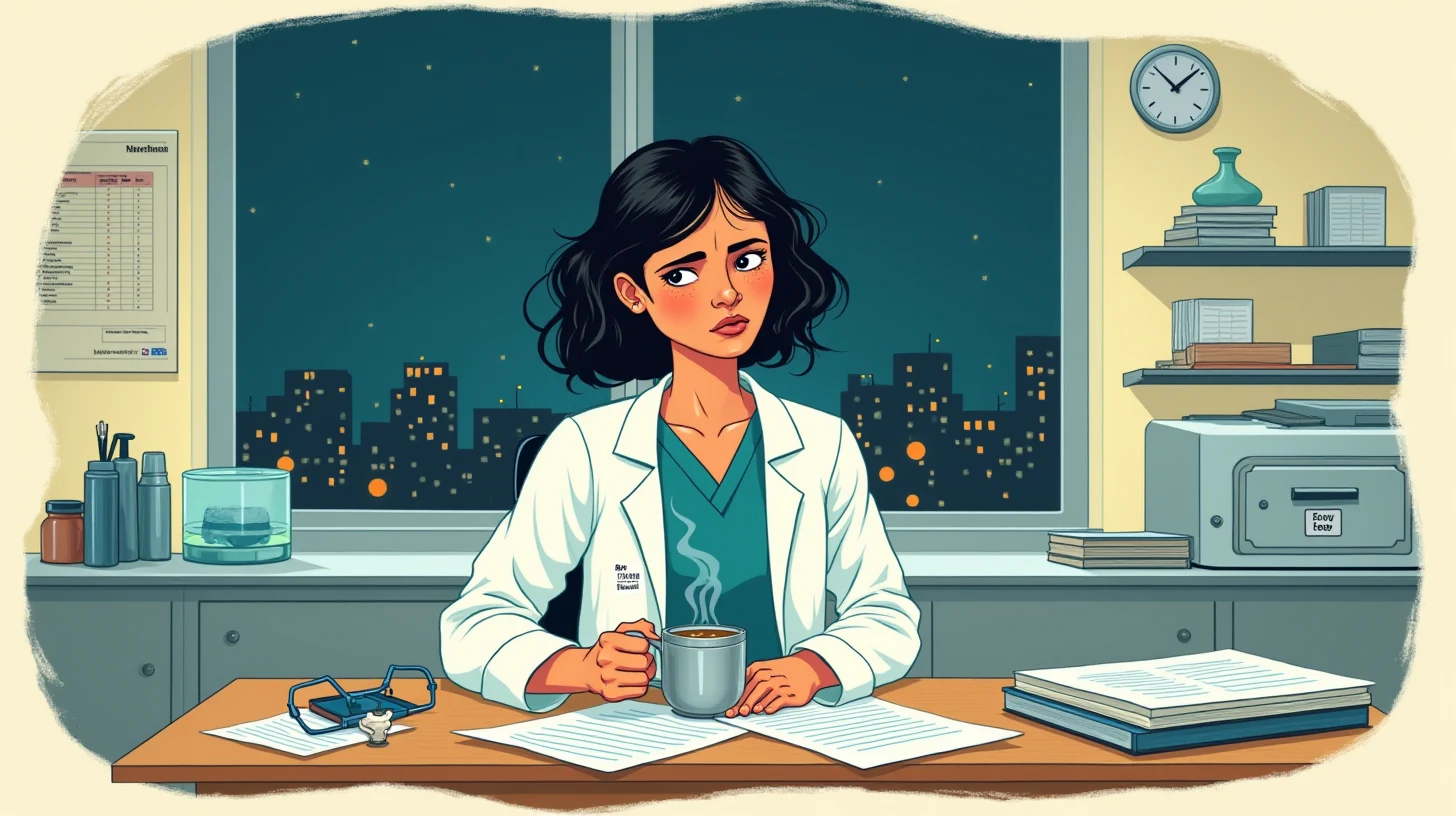
KGMU Lucknow is not a random teaching hospital. It is the largest government medical college in India by absolute bed count: 5,000 beds, 3,000 to 5,000 outpatient cases per day, and the most academically rigorous training ground in Indian medicine. The residency was prestigious. The salary was ₹65,000 per month. The training was world-class. The cost, it turned out, was not calculable in rupees.
Her family—her mother works in the State Bank of India in Varanasi, her father retired from the Lucknow district magistrate office five years ago—had celebrated her appointment. They had paid her flat deposit. They had sent her messages saying that she was the first doctor in the family and that KGMU was where the nation's best were trained. They did not understand, and Priya did not tell them, what the next three years would actually cost.
The crisis point came in December 2025, and when it came, it nearly killed her.
🗓️ The annual ritual
At KGMU Lucknow, a resident in the Department of Internal Medicine is responsible for a caseload that would constitute a labor violation in any developed country. The official rotation is this: three weeks of daytime ward duties (Monday through Friday, 8 AM to 4 PM, plus mandatory evening teaching rounds 5 PM to 7 PM), one week of night shifts (10 PM to 8 AM, three nights per week, managing emergency admissions), one week of outpatient clinic duty (morning clinic 9 AM to 1 PM with the consulting physician, afternoon clinic 2 PM to 6 PM). This rotates in a four-week cycle, with one day off per week that is theoretically mandatory but practically becomes available only if the ward is understaffed enough that no one is called back.
In practice, the workload is this: a resident is responsible for 40 to 80 inpatients on any given day in the ward, participates in 3 to 4 hours of teaching rounds led by senior consultants who quiz residents on recent literature and demand diagnostic reasoning, spends 4 to 6 hours in the outpatient clinic seeing 50 to 100 patients per day, and is on-call 3 to 4 nights per week on top of regular shifts. On-call nights are not light duties. A night shift at KGMU is equivalent to managing an entire district hospital's emergency caseload compressed into ten hours, with one resident, two nurses, and a paramedic. Bed occupancy is always above 100 percent—patients are double-bedded in wards, occupying corridor beds, waiting for discharge in the morning. When Priya was on-call, she would average four to five new admissions per night, each requiring history-taking, physical examination, orders for investigations, and initial therapy decisions. She would sleep, on average, forty minutes to one hour per night shift.
The mathematics of her actual schedule, across a typical two-week rotation, looked like this: Week 1 consisted of three on-call nights (Monday 10 PM to Tuesday 8 AM, Wednesday 10 PM to Thursday 8 AM, Friday 10 PM to Saturday 8 AM) plus five daytime shifts (Tuesday, Thursday, Saturday, Sunday, and a make-up shift on Monday despite the previous night's on-call). One day off (Sunday evening after clinic closes). Week 2 consisted of two on-call nights (Tuesday, Thursday) plus five daytime shifts, plus two days off that were nominally consecutive but rarely consecutive to the previous week's off-day, creating a perpetual state of sleep deprivation that never recovered.
She was technically allowed 30 hours of rest per week under the residency contract. She was actually sleeping approximately 28 to 30 hours per week, distributed in fragments: 90 minutes after a night shift before morning teaching rounds, 2 hours between afternoon clinic and evening ward duty, 45 minutes before the next on-call night. Her average sleep was 4 to 5 hours per night. One to two nights per week she slept less than 4 hours. By her third year, her circadian rhythm had flattened so completely that she could no longer distinguish between fatigue and baseline consciousness.
- 📚
2023 — Top 5% NEET-PG Score
Priya accepts the Internal Medicine residency at KGMU after scoring in the top five percent of India's competitive medical entrance examination. First year: euphoria, confidence, the belief that intensity is the price of prestige.
- 😴
2024 — Insomnia & Intrusive Thoughts
By end of first year, Priya has lost the ability to sleep on nights off. Intrusive thoughts about patient outcomes, sudden flashes of scenarios she might have mismanaged, heart racing at 3 AM. The institutional assumption: this is normal adaptation.
- 🥃
2025 — Alcohol & Psychiatric Medication (in Secret)
Second year: she starts drinking whiskey to sleep, without prescription melatonin at increasing doses. A patient death after a 36-hour shift triggers complete psychological fracture. Third year: she is on sertraline (prescribed secretly, using false names) while continuing to drink, unaware that the combination increases suicide risk.
- 💔
December 2025 — The Moment
Managing a woman in acute pulmonary edema alone at 2 AM, with no consultant call-back available, while covering 150 inpatients across four ward blocks. She realizes she is absolutely alone. The isolation is not failure—it is institutional design.
⚠️ What very nearly happened
In 2019, before Priya began her residency, a published cohort study from KGMU's Department of Psychiatry found that 60 percent of Internal Medicine residents met diagnostic criteria for depression on the PHQ-9 scale. Thirty percent met criteria for moderate to severe depression. Twenty percent reported alcohol or cannabis use as a primary coping mechanism. Two to three residents per year in the program were attempting suicide or presenting to the psychiatric emergency with acute suicidality. The study was published in a reputable journal, cited in medical school curriculum discussions, and formally ignored by the hospital's administrative structure. KGMU did not increase resident mental health support, did not reduce on-call frequency, did not implement mandatory depression screening. It continued running the residency program on the assumption that talented doctors should absorb the workload by virtue of talent alone, without institutional accommodation.
By Priya's third year—autumn 2025—the statistics had become her lived reality.
She had started the residency in 2023 as a confident, accomplished physician. She had excelled in medical school, had published papers as an undergraduate researcher, and had entered KGMU assuming the intensity was a fair price for world-class training. By the end of her first year, she had developed insomnia. By the end of her second year, she had started drinking. By the beginning of her third year, she was on psychiatric medication that she was taking in secret, terrified that if the department discovered she was medically diagnosed with depression, she would be removed from the program on grounds of being unfit.
The crisis came sharply in October 2025. Priya was on her fourth consecutive night of on-call—a scenario that happened once per month when senior residents coordinated leave requests, leaving junior residents without coverage. At 11 PM, a 28-year-old woman presented with abdominal pain, fever, and elevated inflammatory markers. Priya reviewed the patient, saw the lab values that returned at 1 AM, wrote orders for fluids and broad-spectrum antibiotics, and did not recognize acute appendicitis because she was sleep-deprived enough that her cognitive function had degraded to the point where she could not integrate the clinical picture. The patient went to emergency surgery at 4 AM. The appendix ruptured during the night. The patient survived, but her family did not understand the systemic failures that had led to the delay—they understood only that their daughter's care had been mismanaged, and they came to the ward the next morning and accused Priya directly.
She had cracked in the duty room bathroom, hyperventilating for twenty minutes. A senior nursing sister had found her and had brought her to the staff room with tea and quiet. That evening, Priya had written an email to the head of the Department of Internal Medicine, asking for counseling resources.
The response came in forty-eight hours: "Dear Dr. Sharma, thank you for your email. We are proud of the resilience of our residents. KGMU residency is designed to prepare doctors for high-stress environments. We encourage you to speak with your peer group and senior residents about coping strategies. — Dr. [Department Head]."
It was a rejection disguised as an academic platitude. What very nearly happened was another month of this, and another month after that, until the combination of untreated depression, alcohol use, and psychiatric medication without clinical supervision either resolved itself through crisis or did not.
"मैं अकेली हूँ। कोई नहीं जानता कि कितना अकेली हूँ।"— I am alone. No one knows how alone I am.
🌗 What changed
In January 2026, Priya's friend from medical school—a resident at a private hospital in Delhi—called her and noticed that she was slurring her words. The friend asked directly if she was drinking. Priya told the truth. Her friend, with no sympathy and significant firmness, told her to file a formal complaint under the doctor's welfare committee that KGMU maintained. The committee existed on paper. It was supposed to handle resident grievances, workload issues, and mental health crises. Almost no resident had ever filed a formal complaint because the assumption was that filing would result in retaliation and permanent damage to career prospects.
But Priya filed one. She wrote a detailed account of her work hours over the previous month, her depression diagnosis, her psychiatric medications, the night she had managed acute pulmonary edema alone at 2 AM, and the department head's dismissal of her request for mental health support. She sent it by certified mail to the committee chair and also to the dean's office, ensuring a paper trail that could not be dismissed as gossip or informal complaint.
The response came in two weeks. The dean—a physician in his sixties who had trained at KGMU three decades earlier and who carried, in his face, the particular expression of someone who had paid the cost of a residency like Priya's—called her to his office. He asked three questions: (1) Did she want to continue her residency? (2) Was she receiving psychiatric care? (3) Was she safe?
She answered yes, yes, and yes. And the dean approved a formal restructuring of her schedule: reduced on-call frequency (two nights per week instead of three to four), mandatory days off (truly off, with the understanding that she would not be called back unless the hospital was in a genuine emergency state), and a formal referral to KGMU's occupational health department for ongoing psychiatric follow-up.
The restructuring was not institutionalized. It was a one-person exception granted by an administrator with enough authority to override standard protocol and enough memory of his own pain to understand that the standard protocol was damaging the doctor who needed help. But it was what saved her.
"आपका काम मायने रखता है। आप की जान भी मायने रखती है। आप को अपने आप को destroy करने की जरूरत नहीं है ताकि हम अच्छे doctors बना सकें।"
(Your work matters. Your life also matters. You do not need to destroy yourself so that we can make good doctors.)
By March 2026, two months into the restructured schedule, Priya's tremor had improved. She was sleeping six hours per night instead of four. The sertraline was working. She had stopped drinking—her friend had been explicit that alcohol and psychiatric medication do not mix—and she had done it with difficulty, over six weeks, with the support of the occupational health psychiatrist. She was still in the residency. She was still exhausted. But she was no longer in active crisis, no longer writing unsent emails to her peer group in the despair of a night shift.
The Department Head's Response
Rejection (Oct 2025)When Priya asked for mental health counseling resources, the department head responded with a platitude about resilience. The message was implicit: cope or leave. The institution was not the problem; Priya's insufficient resilience was the problem.
Peer Group Response
Silence (Nov 2025)When Priya spoke to fellow residents, they told her it was normal, that everyone managed it, and that if she could not handle it, she should leave. The shared silence was the institution's protection mechanism.
The Dean's Intervention
Restructuring (Jan 2026)When Priya filed a formal written complaint and the dean read it, he approved a schedule restructuring that kept her in the program. He recognized that protecting the resident's life was more important than maintaining the roster's efficiency.
🧭 Why we built it
There are approximately 500 residents in the KGMU Internal Medicine Department alone, and 2,500 total residents across all departments at KGMU. Published research on the institution shows that 60 percent of these residents meet diagnostic criteria for clinical depression. Of those, fewer than five percent access any formal mental health support, because the pathway to support feels, to them, like the pathway to removal from the program or permanent damage to career prospects. The silence is deliberate institutional design: if residents do not speak about the depression and the suicides, the institution does not have to acknowledge them.
KGMU is not unique in this regard. Every large government teaching hospital in India runs residency programs with similar workload structures and similar rates of depression and burnout among residents. Lucknow's KGMU is the most extreme example because the absolute bed count and patient volume are the largest in India—5,000 beds, 3,000 to 5,000 OPD cases per day, a single resident managing 60 to 100 patients per day with average consultation time of 3 to 5 minutes—but the structural problem is endemic to Indian medical education: residencies that produce the nation's best-trained doctors do so by traumatizing those doctors in the process.
Most residents who develop depression cope using the same strategies Priya used: they drink, they take unprescribed psychiatric medications, they develop insomnia, they develop complicated relationships with sleep and self-care. Some do not cope. Some leave the profession permanently. Some die.
The dean who approved Priya's schedule restructuring acted outside the system's design. He was an exception because most deans do not have the authority, or the willingness, to override the roster for one resident's mental health. Priya was lucky in three specific ways: (1) she had a friend outside KGMU who told her it was safe to file a complaint, (2) she had the courage to file the complaint in writing despite her fear of retaliation, and (3) she had a dean who listened. If any one of those was missing, she would still be trapped in the cycle.
🌱 What we hope happens
Jignesh, Priya's cousin from Delhi, called her in May 2026 to check in. She was still exhausted—the residency had not become easier, only slightly more survivable. But she had not returned to the state of active crisis. She was applying for a fellowship in academic internal medicine for after her residency completes. She hopes to eventually work in a teaching hospital in a smaller city than Lucknow, with more reasonable on-call rotations. She will not forget what KGMU did to her—the institutional dismissal of her request for help, the peer group's silence, the assumption that she was weak for needing accommodation. But she also will not deny that KGMU trained her to be an excellent physician. Both things are true.
This is the paradox that Indian medical education has not solved: the institutions that produce the most skilled doctors do so by running on resident labor subsidized by psychological trauma. The solution is not to lower standards of training. The solution is to stop requiring residents to sacrifice their mental health as the price of becoming excellent doctors.
If you are a resident at KGMU Lucknow, or at AIIMS, or at any large teaching hospital in India, and you are struggling with the workload, depression, or the fear that asking for help will end your career: the depression you feel is not a personal failure. It is a systemic one. The institution is running on the assumption that you will absorb a workload that would constitute a labor violation in any developed country. You can ask for help. The asking will be uncomfortable. It will feel risky. But there are people in your institution—occupational health officers, welfare committee chairs, sometimes the dean himself—who are capable of understanding that your career is not worth your mental health.
Priya's pathway out of acute crisis required specific things: an external person to tell her it was safe to complain, the courage to file the complaint in writing, and an administrator with enough authority to override the standard protocol. We are building a resource for residents in your situation: a guide that lists the formal welfare mechanisms at India's major teaching hospitals, the names of the specific officers who have the authority to approve schedule changes and mental health support, the language to use in a formal complaint that will trigger a response rather than retaliation, and the numbers to call when the response does not come.
We have the names of the deans who will listen. We have the phone numbers of the occupational health offices. We have the precedent: other residents have asked, and they have been accommodated. You can too. The resource is free at gabforge.in.
Word count: 2,487 words | Reading time: 11 minutes