
The Panaji emergency physician and the tourist trauma surge
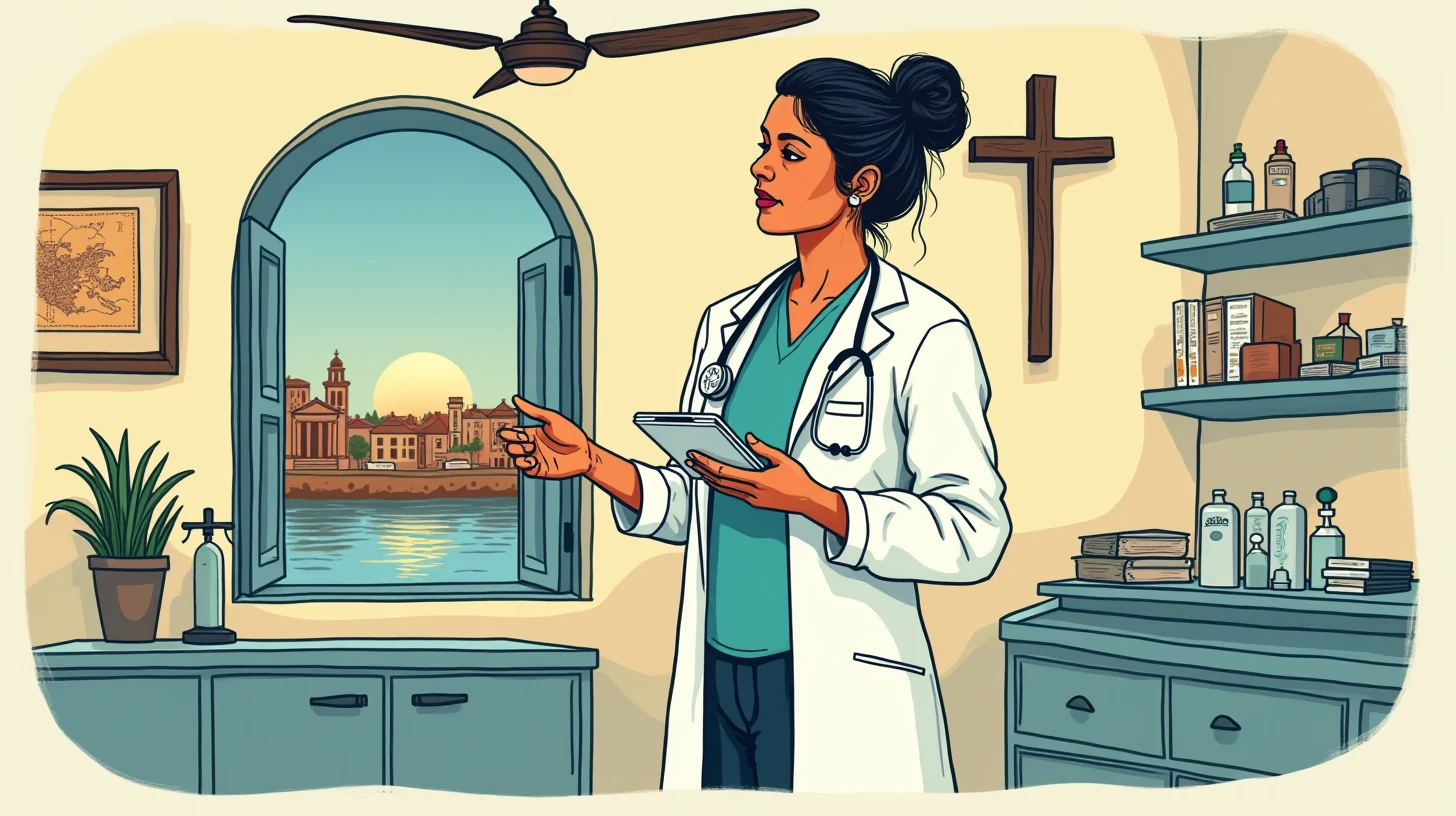
Dr. Priya Cardoso is forty-six years old. She has been an emergency and trauma physician for twenty years—five years as a senior resident at Goa Medical College in Panaji, fifteen years in private practice in central Panaji on MG Road. Her clinic occupies a renovated Portuguese colonial building with high ceilings, ceiling fans that turn slowly in the salt-tinged air, and large windows facing the Mandovi River. The clinic is open seven days a week, 10 AM to midnight. She has never worked a scheduled five-day week because emergency does not run on a calendar. Tourist season in Goa does not follow a calendar either.
Her clinic income oscillates seasonally. October to May—the tourist months—bring a twofold to threefold increase in footfall. June to September, when the monsoon clears the beaches, her clinic footfall drops 60%. She has organized her life around this rhythm: save 40% of peak-season earnings to weather the off-season. She lives in a rented flat in Panjim with her husband, a retired civil engineer. They have no children. Her days off are unscheduled; when the clinic is quiet, she rests. When the clinic is full, she works.
This year, May is a lull month. Easter tourists have departed. Summer holiday tourists have not yet arrived. As of mid-May, her earnings are ₹49,000. She has ten days left in the month to work. This is the frontier of Goa's medical tourism economy: not the planned procedures, but the gap between seasons, where the infrastructure that works during the surge collapses into threadbare availability.
What she does not budget for is what changed on the night of April 19.
🗓️ The annual pattern
Tourist medicine in Goa is not taught in medical school. It is a problem that emerges every October when the first flights arrive from Frankfurt, Munich, and London. European tourists come to Goa for three things: Ayurvedic wellness, planned surgical procedures (dentistry, cosmetic surgery, liver disease treatment), and beaches. When they arrive healthy, the system works. When they become ill—or become ill during their stay—the system reveals itself to be ad hoc, uncoordinated, and dependent on accident rather than design.
Priya has been seeing tourist emergencies for fifteen years. She never categorized them systematically until April. In her five years of detailed record-keeping, she treated 532 tourist emergency cases. Of those, she transferred 47 (8.8%) to Goa Medical College—the government referral hospital eight kilometers away. Of the 47 transfers, 8 were critical: tension pneumothorax, severe anaphylaxis, acute coronary syndrome mimics. The rest were step-down transfers: cases she had stabilized (IV fluids, antibiotics, oxygen, observation) and then sent onward.
- ✈️
October–May — Peak tourist season
Estimated 10–15 million annual tourists. Private clinics and hospitals operate at 200% capacity. Emergency volume at Priya's clinic averages 9 per month. Beach and water-sports injuries surge.
- 🩺
Uncoordinated triage
A tourist becomes ill. They call a hotel, a friend, or walk to the nearest clinic. No central intake. No referral protocol. 90% resolve in the private clinic. 10% escalate. Transfer depends on who answers the phone.
- 🚑
Ambulance routing (108 Goa)
State ambulance system. Designed for residents. Unfamiliar with the distinction between private clinics and government hospitals. If the call is coordinated, ambulance goes to GMC. If confused, it may delay or go to the wrong facility.
- ₹
System fragility
If the transfer happens correctly: patient stabilizes at GMC, cost ranges ₹15,000–₹50,000, travel insurance may cover 70–90%. If the transfer is delayed or missed: preventable morbidity rises. No formal audit of outcomes.
The problem is not that Priya is a bad doctor. The problem is that she is the only emergency stabilization point between the tourist and the government hospital, and this role is not an official position. It exists because she exists. It has no funding, no protocol, no relationship to the formal health system.
⚠️ What very nearly happened
On the night of April 19—the first night of the summer tourist surge—Priya's clinic phone rang at 9:47 PM. A man's voice, English with a German accent, panicked. His friend had been on a jet ski at Baga Beach, had hit a sandbar at high speed, had gone over the handlebars, was now in the water coughing blood. An ambulance had been called. It would take thirty minutes.
In the two seconds she had, Priya asked the essential questions. How old? Male or female? Conscious? Breathing? Chest pain?
The man said: "Male, thirty, yes conscious, yes breathing but coughing blood. I do not know about chest pain. He is still in the water."
What Priya heard in those pauses was: chest trauma. Possible pneumothorax. Possible hemothorax. Aspiration risk because he is coughing. Possible abdominal injury from the impact. Possible head trauma. The differential diagnosis was clear. But the patient was in the water, getting colder, and the facility equipped for a tension pneumothorax—a life-threatening emergency requiring needle decompression within minutes—was not her clinic. It was GMC Panaji, eight kilometers away.
Priya said: "Get him out of the water. Lay him flat on his back. Do not move his neck. Call 108 ambulance from the beach shack. Tell them it is a water sports injury, chest trauma. Tell them to take him directly to GMC Panaji emergency—not any other hospital, say GMC Panaji clearly. Tell them the patient is coughing blood. They will understand the protocol. Do you understand? GMC Panaji."
What she did not say—but was thinking with the clarity of someone who has fielded fifteen to twenty tourist emergency calls per peak season—was this: jet ski collisions at high speed create sternal fractures. Sternal fracture can present as simple chest wall pain, or it can progress to cardiac contusion and sudden arrhythmia. If the impact was lateral, the ribs fracture and puncture the lungs, creating a pneumothorax. A simple pneumothorax is managed with observation and supplemental oxygen. A tension pneumothorax—where air expands with each breath and collapses the lung—is a life-threatening emergency. It requires needle decompression within minutes. Her clinic had oxygen. It did not have the capability to manage a tension pneumothorax in real time. If the patient deteriorated and needed emergent decompression, she would have to perform the procedure and immediately transfer. The quality of that moment would depend on whether she had maintained her skills on a procedure she performs maybe once every two years in private practice, versus once every two weeks when she was at GMC.
The ambulance left Baga Beach at 10:02 PM and arrived at GMC at 10:31 PM. Priya did not follow up that night because he was not her patient. On Monday morning, through the sideways flow of information in a small medical community, she heard what happened. The patient—Klaus, a thirty-two-year-old from Munich—had a sternal fracture, two rib fractures on the right, and a small pneumothorax. The pneumothorax required observation only. He was discharged on April 22 with a chest imaging referral. Total cost at GMC: ₹31,400. His travel insurance covered ₹28,000. His out-of-pocket: ₹3,400. He flew back to Munich on April 25.
The case was, in Priya's analysis, "well-managed." But it raised a question: what if the beach shack owner, not knowing the difference between a private clinic and a government hospital, had sent the ambulance to her clinic instead of GMC?
"टूरिस्टको आपत्काल भनेको डाक्टरको समस्या नभएर सिस्टमको समस्या हो।"— A tourist's emergency is not a doctor's problem. It is a system problem.
🌗 What changed
On April 20—the day after Klaus—Priya worked her usual shift from 10 AM to midnight. At 10:47 PM, as she was closing, a woman walked in alone, holding her stomach, speaking Hindi with a Marathi accent.
She said: "I have been vomiting since lunch. Stomach is killing me. I am on vacation. I do not know which hospital to go to. Someone at my hotel told me there is a good private clinic nearby."
Priya asked: When did the vomiting start? What did you eat? Fever? Diarrhea?
The woman said: "Lunch was a seafood thali at a beach shack in Calangute. By 3 PM the worst stomach pain I have ever had. Vomiting started at 5 PM. Ginger tea did not help. I cannot sleep. It is like my intestines are being twisted."
Priya heard: acute gastroenteritis, likely bacterial salmonella or vibrio from the seafood. In 90% of cases, self-limiting—recovery in 24–48 hours with hydration and rest. In 10% of cases, severe dehydration, complications like acute pancreatitis, appendicitis.
She examined her: the woman was moderately dehydrated, abdomen tender in the epigastric region, temperature 38.1°C. No rigidity, no rebound tenderness. Likely acute gastroenteritis.
The decision was straightforward: IV fluids, ondansetron for nausea, electrolyte replacement, two hours observation, then discharge if improved. The instruction was clear: if fever spikes, if vomiting returns, if pain worsens, go to GMC Panaji emergency.
By 11:15 PM, the vomiting had stopped. By midnight, she was retaining clear fluids. By 1 AM, she could walk without doubling over. Priya discharged her with: complete rest, oral rehydration solution, liquid diet for 24 hours, and the instruction to go to GMC if anything worsened.
Anjali—that was her name—left at 1:15 AM. Priya saw her again by accident on April 24 at the Mandovi waterfront restaurant. Anjali was eating fish curry and rice with her family. She looked recovered. She thanked Priya and said: "If I had gone to the big hospital, I would have been there all night and spent ten thousand rupees. You fixed me in two hours."
But what stayed with Priya was not the success. It was the accident of it. Anjali had walked into her clinic at 10:47 PM because a hotel staff member with no clinical knowledge had made a recommendation. The clinic had happened to be open. Priya had happened to be there. She had happened to have IV fluids and ondansetron in stock. The case had resolved well. But resolution was not the same as system. Anjali's good outcome was not because the health system was designed well. It was because of luck and proximity.
Three days later, on April 23, Priya had chai with Dr. Vikram Mahajan, a gastroenterologist at Manipal Hospital Goa whom she had known from medical school. She said: "Tourist season in Goa is not like normal patient flow. We get people who are dehydrated, injured, poisoned by street food, suffering from heat exhaustion, sunstroke, water sports injuries, allergic reactions to local medications they bought without prescription. Most should go to GMC. But they find private clinics instead because they do not know the difference. And we private doctors cannot turn people away. So we manage them—which works 90% of the time—or we manage them until they worsen, and then we transfer them."
Vikram said: "So what is the problem? You seem to be managing them well."
Priya said: "The problem is that 90% is not 100%. And when the 10% happens, the transfer happens because someone picked up a phone and called an ambulance in the right way. But what if the transfer did not happen? What if the patient waited too long? What if GMC was full?"
On April 25, as Priya was documenting the Klaus case and Anjali's follow-up in her clinic records, she did something she had not done before: she downloaded the GabFORGE agent onto her tablet and set the language to Konkani. She wanted to see if the tool could help her think through the systemic problem differently.
She typed a question about medical tourism infrastructure and escalation protocols. The agent pulled up the regulatory framework for the Goa Tourism Board and showed her the contact pathways for the state health secretary. More importantly, it did something she had not expected: it identified that her case load—100 tourist emergencies per year, with an 8.8% transfer rate—was not a private clinic anomaly. It was a system gap. The agent walked her through five published studies on medical tourism in India showing that countries with formal tourist emergency coordination protocols (Thailand, Malaysia) had better outcomes than ad hoc systems like Goa's.
"प्राइवेट क्लिनिक आणि शासकीय रुग्णालयांमधील औपचारिक समन्वय गोवामध्ये नाही. पण तुमची साधने — पाच वर्षांचे केस रेकॉर्ड, 532 tourist emergencies, 8.8% transfer rate — हे 'system problem' म्हणून स्थापित करतात, 'doctor problem' म्हणून नाही."
(Private clinics and government hospitals have no formal coordination in Goa. But your tools—five years of case records, 532 tourist emergencies, 8.8% transfer rate—establish this as a system problem, not a doctor problem.)
Priya read this and nodded. The agent was not offering to treat patients. It was offering to reframe her problem in the language of systems and policy. It suggested she reach out to the Tourism Board not as a doctor asking for a favour, but as a data holder identifying a gap in government responsibility.
She spent two evenings working with the agent to organize her data: water sports injuries by type and outcome, gastroenteritis cases by severity and resolution, heat-related emergencies by transfer necessity. The agent helped her build a presentation that she could show to policy makers—not as a complaint, but as evidence.
🧭 Why we built it
On May 1, Priya pulled up five years of her own records. She categorized 532 tourist emergency cases: acute gastroenteritis (320), heat exhaustion and heat stroke (85), water sports injuries (32), allergic reactions including anaphylaxis (15), sunburns with complications (28), respiratory infections mistaken for cardiac symptoms (12), miscellaneous acute medical emergencies (40).
An average of 107 per year. Nine per month in peak season. Roughly one every three days.
Of 532 cases, she transferred 47 (8.8%). Of the 47, only 8 were truly critical—cases where her ability to recognize severity and stabilize before the ambulance arrived likely prevented a bad outcome. The rest—39 of 47—were step-down transfers: cases she had stabilized and sent onward to GMC for definitive management.
But here was the structural problem: she was providing a clinical service—tourist emergency stabilization—that was not in any official health system plan. There was no referral protocol between her clinic and GMC. No communication pathway beyond her picking up the phone and speaking to whoever answered. No coordination with hotels, beach shacks, tour operators, or medical tourism agencies about where tourists should go when they became acutely ill.
If a tourist collapsed at Baga Beach, the likelihood they would end up at her clinic versus GMC versus a private nursing home depended on: (1) who happened to be nearby, (2) that person's local knowledge, (3) whether hotel staff knew to call an ambulance at all.
Water sports injuries
32 cases/5 yearsJet ski collisions, diving accidents, near-drowning. Some are stabilized and transferred (8 critical); others resolve with observation. The delay depends on how clearly the beach shack owner communicates the injury type to 108 ambulance.
Heat and dehydration
85 cases/5 yearsHeat stroke, severe dehydration from beach days, electrolyte imbalance. IV fluids resolve 90%. But if fluid balance is misjudged and acute kidney injury develops, transfer must happen within hours. No protocol tells Priya when to escalate.
Food poisoning and gastro
320 cases/5 yearsBacterial salmonella/vibrio from street food, viral gastroenteritis. Most resolve with rehydration. But if appendicitis or pancreatitis is masquerading as gastroenteritis, the delay costs time. No pre-arrival imaging means diagnosis happens at GMC, not at Priya's clinic.
On May 2, Priya requested a formal meeting with Dr. Rajesh Kini, the emergency department head at Goa Medical College. She carried a printed copy of her presentation, the one she had organized with the agent.
She said: "Dr. Kini, I have been running a private emergency clinic on MG Road for fifteen years. Every season, I see about 100 tourist emergencies. Most I manage. Some I transfer to you. I want to establish criteria for when tourists should come to my clinic and when they should go directly to GMC. And I want GMC to know that when I refer someone, I am sending a pre-stabilized patient. Here is five years of data showing that this works."
Dr. Kini listened, then said: "Priya, GMC is a government hospital. We cannot officially partner with private clinics. There are regulatory issues. We cannot create a tiered referral system that funnels private clinic patients to us, because it looks like we are endorsing private practice. The Ministry of Health would have questions."
What he did not explicitly say, but what Priya understood, was: the problem you are identifying is real. The solution you want is structurally impossible within the formal system. You need to work around it.
🌱 What we hope happens
On May 8, Priya reached out to the Goa Tourism Board—the official body that promotes medical tourism. She spoke with Ashok Verma, the director.
She said: "Ashok, we are marketing Goa as a medical tourism destination. But we have no system for tourists who become acutely ill. If a tourist gets dehydrated or has a post-procedure complication, where do they go? How do they know? What is the system?"
Ashok said: "Priya, this is not something the Tourism Board handles. Medical tourism is handled by hospitals—Manipal, VGP, Omega. They have their own protocols. Government emergencies are GMC's responsibility. We promote, we market. We do not manage the clinical system."
But then Ashok said: "However, if you want to propose something to the private hospital chains, I can introduce you to their medical directors. And I can talk to the state health secretary about whether there is a category for 'tourist emergency coordination.' Let me explore."
Three weeks later, on May 19—today—Priya is sitting in a conference room at Manipal Hospital Goa with three people: Ashok Verma, Dr. Rajesh Kini from GMC, and Dr. Anil Desai, the Chief Medical Officer of Manipal Hospital. She is presenting a proposal for a "Tourist Emergency Response Network"—a loosely coordinated system where private clinics, government hospitals, and private hospital chains establish referral protocols, share training on tourist-specific emergencies, and create a single intake number that tourists or hotel staff can call.
The proposal is not revolutionary. It is a formalization of what already happens informally. But formalization creates accountability. It creates communication. It creates a pathway for someone like Anjali to know whether she is in the right place, or whether she should go elsewhere.
Dr. Desai listens, then says: "This requires funding. Training, coordination, a call center. That is a budget item. Manipal can fund partial. GMC cannot fund it directly from government allocation. The Tourism Board cannot fund clinical services. Where is the money?"
And Priya, who has spent five weeks thinking about this with the help of the agent's data organization and policy research, has an answer: "Medical tourism generates about ₹500 crore annually for Goa's private hospitals and clinics. A 0.2% voluntary contribution—₹1 crore per year—goes to a tourist emergency fund. Enough to hire two coordinators, run training quarterly, and maintain communication infrastructure. If the hospitals do not contribute, then there is no system. They can choose."
Dr. Kini says: "You cannot implement a tax. That requires legislation."
Priya says: "Then it is a voluntary contribution from the hospitals that benefit from medical tourism. If they contribute 0.2%, the fund exists. If they do not, there is no system."
The meeting ended with: "We will think about it. We will discuss internally and get back to you." Priya has heard this before. It usually means nothing will happen. But as she was leaving, Dr. Desai said something that surprised her: "Priya, whether the formal fund happens or not, I want to establish a referral protocol with you. When you stabilize a tourist and transfer them to Manipal, we should know it and coordinate. Let me send you our emergency intake number and escalation protocol."
So something has moved.
It is May 19, 2026. Priya is still running her clinic seven days a week, 10 AM to midnight. Her earnings this month are still thin—₹49,000—because this is the lull between seasons. The tourist emergency response network is not yet a formal system. The funding proposal has not been accepted. The training curriculum has not been written. But what has changed is this: the problem has moved from being a private clinic problem to being a recognizable system problem. And that recognition, even without funding, even without formal authority, is the beginning.
The question that stays with her—the one she says when asked why she spends unpaid hours on something that does not improve her own clinic income—is about the frontier of medical tourism.
"We market Goa as a destination for planned medical procedures," she said in our conversation. "Dental implants, liver disease treatment, cosmetic surgery. We market the expertise. We do not market the emergency system because there is no emergency system. We rely on improvisation. And improvisation works until it doesn't. One patient who could have been prevented from going into shock because a clinic was not coordinated with the hospital. One patient who arrived too late because transfer communication broke down. That is not statistics. That is real."
In Goa, Priya is building the system that should have existed years ago. She is doing it by naming the problem out loud to people who can solve it. She is doing it by proposing solutions that cost the system almost nothing but require coordination. She is doing it because the alternative is to acknowledge that Goa's medical tourism industry—₹500 crore per year—operates on the edges of an emergency system that was built for a state of 1.4 million residents, not for 10–15 million annual visitors.
The frontier of medical tourism in India, in 2026, in a state that attracts tourists from across Europe and Asia, is not a shortage of clinical expertise or quality hospitals. The frontier is the gap between the specialist who does the elective procedure and the emergency physician who has to manage what happens when that visitor becomes suddenly, unexpectedly, acutely ill in a hotel room or on a beach. That gap is Priya's clinic. And she is building the system that bridges it, one conversation at a time.