
The Patna PHC doctor and the pharmacy markup trap
Dr. Ravi Sharma is thirty-two years old. He completed his MBBS from Patna Medical College Hospital in 2014, worked in a government hospital in Biharsharif for two years, and in 2016 accepted a posting as the sole government doctor at the Primary Health Centre in Runni Saidpur block, Sitamarhi district—a rural block in north Bihar, two hundred kilometers from Patna, serving a population of sixty thousand across thirty-seven villages. His district has one of India's worst doctor densities: one qualified physician per ten thousand people. The nearest specialist—a cardiologist, a surgeon—is in Patna, a five-hour journey by road.
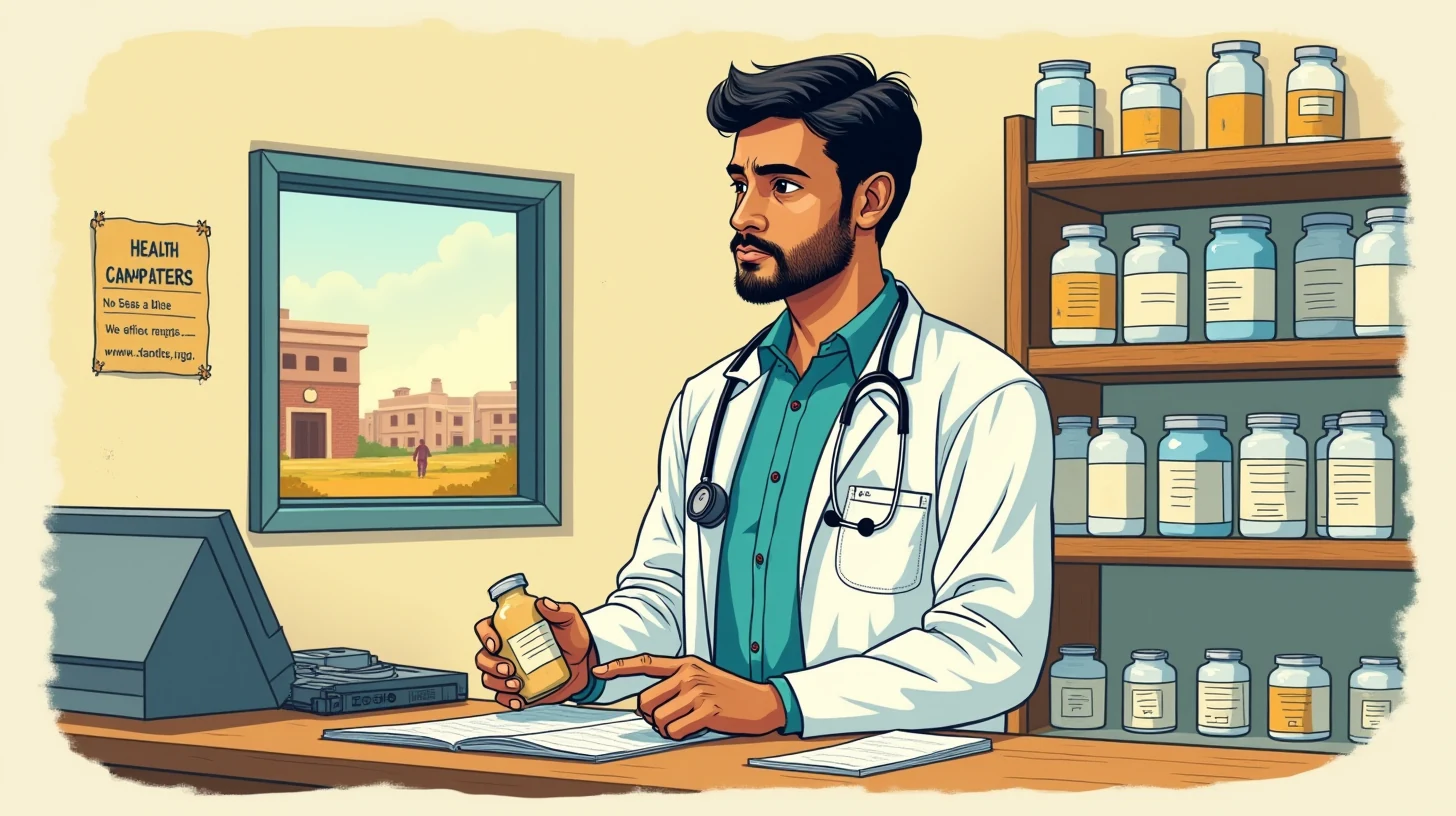
The posting came with a salary of ₹28,000 a month, a government house, and zero specialist support within a hundred kilometers. It also came with an unwritten understanding: the PHC doctor was expected to survive not on salary alone, but on the revenue generated by the clinic's attached dispensary. Ravi was told this plainly by the district medical officer on his first day. "The salary is for your basic needs. The pharmacy markup is how you feed your family."
In 2016, when Ravi arrived in Sitamarhi, he did not think about the dispensary. He thought about the medicine stockouts he had heard about in other PHCs, the patients who came to government facilities expecting free care and left disappointed when the drugs were unavailable, the quacks who filled the gap. He thought he would work hard, build patient trust, and make the clinic the hub of rural healthcare that the government had designed it to be.
Eight years later, he is still working hard. But the clinic's survival now depends on the one mechanism that is systematically destroying the trust he built. Every markup he adds to a patient's medicine is a payment for his daughter's school fees. Every rupee he foregoes is money he cannot send to his parents. Every conservative prescription is a threat to his family's survival.
🗓️ The annual ritual
In November 2022, the Supreme Court of India ruled that EPF members who had contributed to pension schemes on actual salaries above the statutory cap were entitled to higher pensions. The ruling was about employee benefits. But it triggered a broader conversation in medical circles about rural doctor compensation. How should a government doctor be paid fairly without depending on patient medicine consumption?
In Bihar, no such conversion happened. The rural doctor salary in 2023 remained ₹28,000 — unchanged since 2015. The cost of living in Sitamarhi had risen forty percent. Ravi's education loan repayment was ₹7,000 a month and would continue until 2028. His wife was pregnant with their second child. The pharmacy markup was the only mechanism between solvency and default.
Every year, in April, the district medical officer conducts a performance review. Ravi's clinical performance is always rated "excellent." His diagnostic accuracy is praised. His referral rates are appropriate — he sends complex cases to the Community Health Centre in time, before they deteriorate. Every year, the same comment appears on the form: "Doctor demonstrates appropriate clinical judgment and patient-centered care."
Every year, the doctor in the neighboring district — one who prescribes three antibiotics for a simple viral fever, who sees ninety patients a day instead of seventy, whose pharmacy revenue is double Ravi's — is also rated "excellent" by the same metric. The system has no measurement for whether the medicine is necessary. Only for whether the markup is collected.
- ₹
2016 — Salary frozen at ₹28,000
Ravi accepts the Sitamarhi posting with base salary of ₹28,000/month and the understanding that pharmacy markup would supplement survival. At the time, this was survivable.
- 📈
2016–2024 — Cost of living rises 40%
Rent, food, school fees in rural Bihar climb. NHM incentive of ₹8,000/month arrives irregularly, often three to six months late. By 2024, the base salary has fallen below subsistence needs.
- 💳
2016–2028 — Education loan ₹7,000/month
Ravi's MBBS loan repayment is fixed until 2028. He cannot transfer without triggering a ₹20 lakh rural bond penalty. The combination locks him into Sitamarhi and dependence on pharmacy revenue.
- 🏥
2024 — No restructuring. Markup system accelerates.
By 2024, the pharmacy markup has become not optional supplementation but essential survival. Ravi has two children, aging parents, and no income path other than medicine sales.
Ravi's financial situation is not unusual among rural doctors in Bihar. It is the baseline. The variation is only in whether a doctor has family wealth to fall back on, or whether they are anchored to the markup system by economics alone.
⚠️ What very nearly happened
In 2021, Ravi read an article in the Indian Journal of Medical Ethics about appropriate prescribing in low-resource settings. The article discussed the phenomenon of "prescribing for profit" — the practice of recommending unnecessary medicines because the markup revenue is essential to the clinic's survival. The article cited Bihar as a case study: rural PHCs with the highest unnecessary-antibiotic prescribing rates correlated with the lowest doctor salaries. One concluded: "The problem is not the doctor. The problem is the system that makes the doctor profitable when the patient is sicker."
Ravi read it at night, after his shift. His clinic had seen seventy-two patients that day. He had prescribed antibiotics to forty-three of them. At least thirty of those prescriptions, he knew, were not medically necessary. They were responsive antibiotics for viral fevers, combination antibiotic regimens for mild gastroenteritis, extended antibiotic courses for conditions that resolved with supportive care alone. Each prescription generated markup revenue. Each one was, by the logic of the system, correct.
He decided to run an experiment. For three months, starting in June 2021, he would prescribe only essential medicines. He would explain the markup costs to patients in advance. He would also reduce his pharmacy incentive claim — he would take his baseline salary and not claim the excess markup revenue beyond what was necessary to cover pharmacist salary and overhead.
He wanted to see if prescribing in good faith and foregoing profit would change how patients perceived his clinic.
The first month, the experiment felt good. A patient with mild gastroenteritis came to his clinic with watery stools and mild dehydration. Ravi gave her oral rehydration salts, dietary counseling, and a follow-up in three days. She recovered completely in two days. He explained to her family that antibiotics were not necessary for viral diarrhea — they would do more harm than good by killing helpful bacteria and promoting resistance. The family listened politely and left.
But within hours, the mother mentioned to her neighbor that Ravi had not prescribed "real medicine" — no antibiotic injection, no anti-spasmodic, no probiotic supplement. The neighbor, who had gone to a nearby RMP with a similar complaint and received a ₹300 antibiotic injection package, began to tell others that the government doctor "was not taking the case seriously."
By the second month, patient volume at the clinic had dropped by fifteen percent. Mothers bypassed Ravi's clinic and went straight to the RMP — Ramesh, who worked three blocks away and charged ₹50 per consultation and gave everyone an antibiotic. Or they traveled to the private doctor in town, Dr. Mishra, who had two years of training and no credentials but charged ₹300 per consultation and prescribed aggressively. Ravi's pharmacy revenue collapsed. He was seeing fifty-eight patients a day instead of seventy.
"રોગીઓ મને બોલે છે — તમે આપીયું ઓછું દવા, તો રોગ સાજો શોધે છે?"— Patients ask me: if you give less medicine, how will the illness know to heal?
Ravi continued the experiment because he believed in it. But the cash was disappearing. His wife, Priya, was preparing for their daughter's school admission. His mother in Patna was unwell and needed tests. By the end of July, he realized his out-of-pocket was ₹1.5 lakhs lower than the previous month.
By the end of August, his loan repayment was due. His daughter needed new shoes. Priya, with quiet firmness, asked when he was "going to stop this experiment because we cannot afford it."
He stopped. He went back to standard prescribing — the three-drug combinations for viral fevers, the extended antibiotic courses, the branded medicines at higher markups. The patient load recovered. Within three months, the pharmacy revenue was back to ₹2.5 lakhs to ₹3 lakhs per month. His out-of-pocket returned to normal.
His wife stopped asking. And Ravi stopped asking himself whether the medicines he prescribed were necessary.
What very nearly happened was the completion of a structural realization: that the good doctor and the surviving doctor are mutually exclusive in this system. That he had reached a point where continuing to be right about medicine meant failing to be responsible for his family. So he chose his family. The patients' interests lost in the calculus because the system made them losable.
🌗 What changed
In the spring of 2023, Ravi applied for a transfer to PMCH Patna. PMCH is Bihar's flagship medical college hospital — five thousand beds, multiple specialist departments, a salary-based compensation structure with no pharmacy markup. At PMCH, a doctor earns ₹45,000 to ₹65,000 depending on seniority and specialization. There is no "incentive" tied to patient medicine consumption.
The application went to the rural posting authority. The response came back three months later: transfer request rejected. The reason cited was the rural bond — the ₹20 lakh bond Ravi had implicitly signed when he accepted the Sitamarhi posting in 2016. The bond is, officially, a guideline. In practice, it is treated as contractual. To transfer, Ravi would need either to pay the full amount, or to serve the full ten-year rural posting obligation — which would take him to 2026.
(By 2026, many of his medical college cohort would have completed MD training. Several would be assistant professors already.)
Ravi withdrew the transfer request. He remains in Sitamarhi. He continues to prescribe.
But his strategy has shifted. In 2024, he hired a full-time pharmacist — a woman named Lakshmi, trained as a GNM, who has learned to dispense and counsel patients on medicines while Ravi focuses on diagnosis and referral. The arrangement reduces his pharmacy revenue slightly — Lakshmi's salary is ₹12,000 a month, which comes out of what would have been his markup share. But it creates a buffer between Ravi and the act of selling medicine.
More importantly, it freed him to begin a referral strategy that he had abandoned in 2021: referring stable cases upward to the Community Health Centre in Darbhanga, two hours away, where a doctor can manage cases without the same markup pressure. He also began to enroll patients in PM-JAY (Ayushman Bharat) more aggressively — the scheme that provides ₹5 lakhs per family per year for hospitalization. When a patient needed diagnostic imaging — an ultrasound for abdominal pain, an X-ray for suspected pneumonia — he began to refer them to a diagnostic center in town that worked on PM-JAY rather than dispensing antibiotics preemptively.
This strategy reduces his pharmacy revenue. In a good month, it is now ₹1.8 lakhs instead of ₹3 lakhs. But it changes the character of his work. He is the doctor who knows when a case is beyond his capability and acts on it. He is the referrer, the one who triages upward rather than treats downward. It is slower economics. It is better medicine.
"મારો વિચાર બદલાયો. હું દર્દી ને દવા વેચતો નથી — હું તેને સાચી જગ્યાએ મોકલું છું. જ્યાં તેને સાચો ડૉક્ટર મળશે, જ્યાં તેને ఆ દવા નહીં પણ તે રોગ બંધ થશે."
(My thinking changed. I am not selling medicine to the patient — I am sending them to the right place. Where they will see a doctor who cares about whether the medicine is right, not about how much money it generates.)
But his daughter still needs shoes. His loan is still due until 2028. His parents in Patna still need money for medical care. And he still wakes up knowing that his baseline survival, his non-referral days, depends on the pharmacy markup — the one mechanism that is slowly destroying rural healthcare in Bihar.
🧭 Why we built it
There are, conservatively, fifteen thousand government doctors serving rural Primary Health Centres across India. Of those, approximately eighty percent work in states where pharmacy markup is the primary income mechanism — where the base salary is insufficient and the dispensary is the revenue stream that determines whether the doctor can feed their family.
Most of them are in Ravi's situation. They are clinically excellent — diagnostic accuracy, appropriate referral practice, evidence-based medicine — but they are economically trapped. They need the markup to survive. They are aware that the markup system creates perverse incentives for them to prescribe more than is medically necessary. And they are aware that every rupee of unnecessary markup pricing is money a poor patient cannot afford to spend on other needs.
It is a system where everyone is trapped. The doctor is trapped by salary insufficiency and rural bond enforcement. The patient is trapped by poverty and lack of alternative care options — the RMP is accessible, the government doctor requires travel, the private doctor in town is expensive. The RMP is trapped because they have no training but the government has no capacity to enforce qualified practice, so they have become the primary care option. The government is trapped by budget constraints and population scale — Bihar cannot train and station enough doctors to achieve the doctor density of developed states.
The only people who are not trapped are the pharmaceutical manufacturers, who are guaranteed higher consumption regardless of whether it is medically necessary.
What it does
- 💰Maps the complete income breakdown for a rural PHC doctor — base salary, NHM incentive (and its payment delays), pharmacy markup structure, and realistic monthly cash flow — so the doctor knows the actual financial foundation they are working with.
- 🗺️Identifies which states have referral networks that insulate doctors from income loss when they refer cases upward — and which states have salary restructuring or alternative compensation models.
- 📊Surfaces doctor behavior data — prescribing patterns, referral rates, unnecessary-antibiotic prevalence — so the doctor can benchmark their own practice against similar doctors in their district.
What it does not do
- 🔒Never enters clinic financial records, bank accounts, or loan details — the doctor provides income information; the agent only analyzes the structure and identifies options.
- 💳Never suggests tax evasion, loan default, or escape from the rural bond — it presents the legal and financial reality of the bond, the transfer pathways that exist, and the cost of each option.
- ✅Never decides whether the doctor should stay in rural practice or transfer — it surfaces what is actually possible in their district and what other doctors have done.
Bihar's situation is particularly acute because the state has no structural fallback. Unlike states with community health insurance or stronger Ayushman Bharat presence, Bihar's rural patients are purely out-of-pocket. This means that patients are simultaneously unable to afford care from qualified doctors and unable to access free care at government hospitals without traveling hundreds of kilometers. The gap is filled by unqualified RMPs — estimated at thirty thousand in Sitamarhi district alone — and the RMPs drive down the perceived value of qualified medicine.
The solution is not to shame rural doctors for taking pharmacy revenue. They need the income to survive. The solution is to break the structural link between a doctor's income and a patient's medicine consumption. That requires state-level change:
- Raising rural doctor salaries to ₹50,000–60,000/month, so pharmacy revenue is optional rather than essential — and adjusting salaries annually for inflation and cost-of-living increases.
- Waiving or restructuring rural bond penalties, so that doctors can transfer to better-resourced postings without forfeiting ₹20 lakhs or committing to ten years of rural service.
- Strengthening rural referral pathways, so that doctors can refer upward to CHCs and district hospitals without losing income — the referral hospital captures the revenue, not the PHC.
- Implementing capitated payment models, where a doctor's income is tied to population health outcomes and preventive care, not medicine sales volume.
- Aggressive enforcement of RMP practice, so that qualified doctors are not competing with unqualified practitioners who have no prescription discipline and no accountability.
None of these are happening in Bihar at scale. Ravi's salary remains at ₹28,000. Rural bond enforcement remains strict. RMPs continue to practice openly with minimal oversight. And the pharmacy markup remains the only mechanism keeping rural doctors economically above water.
The structural realization is simple and devastating: a doctor in rural Bihar who prescribes conservatively will eventually default on their loans. A doctor who prescribes aggressively will survive, but their patients will become dependent on unnecessary medicines and will develop antibiotic resistance. The system has designed a choice where every option fails someone.
🌱 What we hope happens
Ravi sent us a message in early May 2026, after his referral strategy had been running for sixteen months. He said that patient volume was still lower than in his maximum-markup period — only fifty-five patients a day instead of seventy. But the character of his clinic had changed. He was no longer the doctor who prescribed aggressively to survive. He was the doctor who knew when a case was beyond rural capability and moved it upward.
More importantly, he had begun to be trusted differently. The mothers in his area had started to ask him questions — not demands for medicine, but questions about whether a fever required treatment, whether an antibiotic was necessary, whether their child could recover without medicine. Several of them had started to bypass the RMP in favor of his clinic, because the RMP would give an antibiotic injection, and Ravi would explain why the antibiotic was not necessary.
His pharmacy revenue, measured in monthly cash, was lower. But his sense of work had shifted. He was no longer a doctor trapped in a system designed to make him profit from necessity. He was a doctor practicing medicine.
The reality is that his family still needs the income. His loan still runs until 2028. His daughter still needs shoes. He has not solved the problem. He has only chosen a different way of being trapped — a way that allows him to see himself as a doctor rather than a salesman.
Which is what we hope this would be. Not a rescue. Not a state salary restructuring that happens tomorrow. Just a free tool on a tablet, in Sitamarhi or Champaran or any district in Bihar where a doctor is facing the same structure, that reads the financial reality clearly and says: you are not immoral for needing the pharmacy income. The system is immoral for requiring it.
If you are a rural doctor in Bihar or another state facing the same structure, the resource is free at gabforge.in. Tell us your district, your patient volume, your current income breakdown, and the terms of your rural bond. We have mapped the pharmacy markup systems across fifteen states. We know which states have referral networks that insulate doctors from income loss when they refer. We know which states have begun salary restructuring. We know the cost of the rural bond penalty and the pathways to waiver or deferment. And we will tell you — not what you should do morally, but what is actually happening in your district, what other doctors in your situation have done to shift the economic balance, and what is genuinely possible given the constraints you face.
You are not trapped alone. The system is trapped around you. And the gap between what is individually possible for a good doctor and what is systemically possible is where clear information lives.