
The Port Blair doctor and the island emergency
Dr. Radhika Sharma is forty-one years old. She has worked in emergency medicine for seventeen years—five years at a Delhi government hospital during the pandemic, twelve years at GB Pant Hospital in Port Blair. Her clinic is in the casualty ward, where she works from 4 PM to 11 PM—not because the shift is defined that way, but because the daytime is spent on ward rounds and afternoon is consumed by coordinating referrals between outer island PHCs and Port Blair hospital. Her income has held steady at ₹1,18,000 per month: base salary ₹82,000, hardship allowance ₹36,000. Her husband, a school principal, transferred to Port Blair seven years ago. Their daughter, now twelve, attends a government boarding school in Kolkata. Radhika sees her for three weeks every summer.
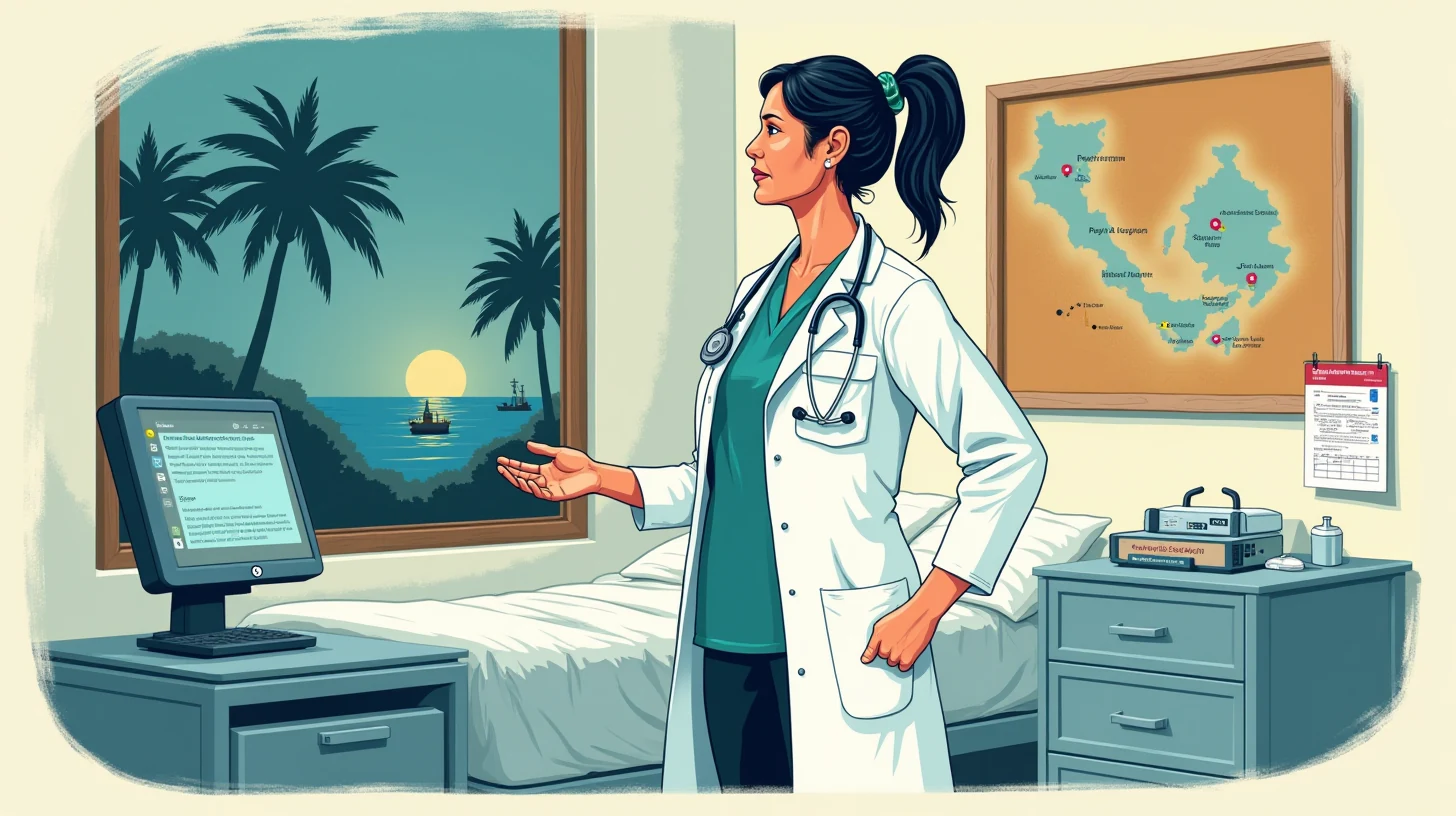
The island medicine that has become her life is neither emergency nor routine. It is the mathematics of isolation: ten thousand people per inhabited island, one doctor per island except Port Blair, zero permanent specialists, and every acute decision weighted against the knowledge that "the hospital" is four to six hours away by sea.
On April 18, 2026, at 7:22 PM—Radhika remembers the time because the e-Sanjeevani telemedicine system timestamped the call—her hospital phone rang. A voice, urgent, speaking English with a Tamil accent: a fisherman named Rajesh, forty-five years old, had been brought to Havelock Island's primary health centre with acute substernal chest pain. He had been fishing in the Andaman Sea that morning when crushing pressure seized his chest. He had sailed back to Havelock, walked to the PHC, and the doctor there—Dr. Priya, posted to Havelock for two years—was asking for telemedicine guidance from Port Blair.
🗓️ The annual rhythm
Andaman & Nicobar Islands serve 380,000 people across 280 islands. GB Pant Hospital—the only hospital—has 500 beds, zero permanent specialists, and depends on visiting teams from AIIMS Delhi and JIPMER Puducherry who rotate quarterly for one to two weeks. The outer islands—Havelock, Neil, Long, Car Nicobar, Great Nicobar, Swaraj, Diglipur—each have a primary health centre staffed by one MBBS doctor and two ASHA workers. Those seven doctors are government postings, typically fresh graduates or juniors on a mandatory two-to-three-year National Health Mission assignment. They are not specialists. They are learning on the job.
Medical emergencies on the outer islands are solved by a chain of decisions: recognize the emergency, stabilize with available medicines, call telemedicine, wait for helicopter or boat, refer to Port Blair or beyond. The chain has worked dozens of times. It has also broken dozens of times, always silently—the patient who was not evacuated in time, the woman with eclampsia who waited for the morning boat, the child with meningitis whose fever was managed with paracetamol until it was too late.
- ⚠️
9:00 AM, April 18 — Chest pain at sea
Rajesh was fishing in the Andaman Sea when acute substernal crushing pain began. No ECG. No troponin test. No hospital within fifty kilometers. He sailed back to Havelock Island by will.
- 📞
7:22 PM — Telemedicine consultation
Dr. Priya at Havelock PHC called Port Blair via e-Sanjeevani. No ECG machine on Havelock. No IV nitroglycerin. She had aspirin, a blood pressure cuff, and a phone. Radhika assessed: acute coronary syndrome, likely.
- 🚁
8:15 PM — Evacuation decision
One-hour weather window. Rough seas. Family fearful of night evacuation. Radhika made the call: helicopter now or ten hours of delayed treatment with permanent cardiac damage. The Coast Guard dispatched.
- 🏥
10:15 PM — Hospital arrival and ECG
ST elevation in anterior leads. Full-thickness myocardial infarction. Thrombolysis window closed at thirteen hours. Referral to JIPMER for intervention. Rajesh survived. Every decision had to be correct.
Radhika asked Dr. Priya the standard questions: When did the pain start? What was he doing? Shortness of breath? Prior cardiac history? The answers came: Rajesh had no prior medical history, was relatively young for a heart attack, had no diabetes documented. But he was in pain, and his blood pressure was elevated—160 systolic. The clinical picture fit acute coronary syndrome. The problem was that Havelock Island's PHC—which had a blood pressure monitor, a stethoscope, and a pulse oximeter—did not have a troponin test, did not have an ECG machine, did not have IV nitroglycerin. It had aspirin, a glyceryl trinitrate tablet left from a medical camp, a phone, and one doctor.
It was 7:22 PM on an April evening. The sea between Havelock and Port Blair—thirty-three kilometers—was becoming rough. The government boat ran two trips: a 5 PM departure from Port Blair, and a 6 AM morning boat. Dr. Priya asked the question that defines island medicine: could Rajesh wait until morning?
⚠️ What very nearly happened
What nearly happened was Rajesh remaining on Havelock Island overnight with crushing chest pain, aspirin, and hope. What nearly happened was the troponin elevation going unmeasured, the ECG unread, the thrombolysis window closing while he slept in a PHC bed ten kilometers from a hospital. What nearly happened was the next morning boat finding him in cardiogenic shock, and the helicopter evacuation becoming a critical rather than urgent transfer. What nearly happened was his heart muscle irreversibly damaged, and a forty-five-year-old fisherman becoming a man who could not walk to his boat anymore.
Radhika has worked in emergency medicine long enough to know that the outcomes she thinks about are not the ones that arrive in the morning news. They are the ones that arrive at the PHC on a Thursday evening and are managed with what is available. They are the ones where the doctor makes a decision under uncertainty—helicopter at night or boat in the morning—and one choice saves a life while the other choice costs it, and neither choice looks obviously right until twelve hours later when you know the diagnosis.
"অনেক চিকিৎসক বলেন যে দ্বীপে আপনি শুধু ওষুধ দিতে পারেন। আপনি চিকিৎসা করতে পারেন না, কারণ হাসপাতাল দূরে। আমি জানি এটা সত্য, কিন্তু তাহলে সিদ্ধান্ত কে নেবে?"— Many doctors say that on the island, you can only give medicine. You cannot treat, because the hospital is far away. I know this is true. But then who will make the decision?
She did not tell anyone what she was thinking in those thirty minutes. She called Dr. Priya back on the telemedicine line and said: "We are bringing him to Port Blair by helicopter. In the next thirty minutes, I need you to: one, get an IV line in if possible; two, give him aspirin 300 milligrams now; three, if you have glyceryl trinitrate and it is not expired, one tablet under his tongue. Prepare him for helicopter transport. Pack warm blankets. The sea will be rough."
Dr. Priya said: "Yes. But Doctor, his family is scared. They are saying it is too risky at night. The helicopter might crash."
Radhika paused. This was the moment where the medicine ended and the communication began. She said: "Tell them Rajesh is having a heart attack. His heart is starved of blood. The only way to give his heart blood is medicines and procedures that Havelock does not have. Port Blair has them. If we wait until morning, we lose ten hours. A heart can recover if treated within hours. If we wait twelve hours, the damage is permanent. The helicopter is the fastest, safest way to get him the treatment he needs. Tell them I am a doctor here, and I have made this decision based on his medical need."
What she did not say—because it would not have changed the decision but would have terrified the family—was: I am making this decision without seeing him, based on Dr. Priya's report and my experience. If the helicopter crashes, that is my responsibility. If he dies in the helicopter, I will carry it. I am betting his life on a phone call and my judgment.
🌗 What changed
The Coast Guard helicopter departed Port Blair at 8:15 PM. At 8:52 PM it landed at Havelock. By 9:30 PM, Rajesh was on the helicopter bound back to Port Blair. By 10:15 PM, he was in the casualty ward of GB Pant Hospital, and Radhika was standing next to him with an ECG machine.
The ECG showed ST elevation in the anterior leads—not unstable angina, but a full-thickness myocardial infarction in the left anterior descending artery. This is a major coronary artery. The thrombolysis window is four to six hours from symptom onset. Rajesh's symptoms had started at 9 AM. It was now 10:15 PM. He was outside the window. The treatment strategy changed: medical management of the infarction, accepting that the artery would remain blocked and the heart muscle would be damaged.
Radhika called AIIMS Delhi. The interventional cardiologist on call listened and said: "The window for thrombolysis is closed. Your options are medical management or intervention at a tertiary centre. We do not have a team to send to Port Blair. JIPMER Puducherry has intervention capability. But understand: by the time he reaches JIPMER, the muscle damage is already done. Reopening the artery will help, but the scar will remain."
In other words: the decision that mattered was made on Havelock Island twelve hours ago, when Dr. Priya and Radhika had decided to evacuate. That decision was correct. But it was made under uncertainty—before the ECG, before the troponin, before they knew what they were dealing with. If Rajesh had been outside the hospital when the pain started, if he had not sailed back, if Dr. Priya had recommended waiting, if the helicopter had not been available, the outcome would have been different.
Three weeks after Rajesh's transfer to JIPMER, Dr. Priya called Radhika on the telemedicine line to share what she had learned. She said the patient had survived the intervention, though with reduced cardiac capacity. She said she had recognized the pattern—crushing chest pain, elevated blood pressure, the clinical picture—and had known to call. But she said something else: "I did not know if I was right to call. I was afraid I had panicked over nothing. If the agent had been here, I would have asked it before calling you."
Radhika installed the tablet in Havelock's PHC that same evening. She set it to Bengali and Tamil—Dr. Priya's native languages—and opened the agent interface to show her how it worked.
Dr. Priya typed the question: "একজন রোগী চেস্ট পেইন নিয়ে এসেছে—কি করব?" — A patient has come with chest pain. What should I do?
The agent responded:
"প্রিয়া আপনার রোগী যদি চেস্ট পেইন নিয়ে আসে, প্রথমে: ১। তার ব্লাড প্রেশার নিন — ১৬০ এর উপরে খুবই গুরুতর। ২। জিজ্ঞাসা করুন—কখন শুরু হয়েছে? পরিশ্রম করছিলেন? শ্বাসকষ্ট আছে? ৩। যদি উত্তর হ্যাঁ—এটা হার্ট এটাক হতে পারে। আপনি ECG করতে পারবেন না। আপনি করতে পারেন: aspirin দিন, telemedicine এ ডক্টর রাধিকাকে ডাকুন, helicopter এর জন্য প্রস্তুত থাকুন। আপনার সিদ্ধান্ত সঠিক হবে যদি আপনি recognize করেন, stabilize করেন, এবং সাহায্য চান। বাকিটা Port Blair এর হবে।"
(Priya, if your patient comes with chest pain, first: one, take the blood pressure—above 160 is very serious. Two, ask—when did it start? Was the person exerting? Is there shortness of breath? Three, if the answer is yes—this could be a heart attack. You cannot do an ECG. You can do this: give aspirin, call Dr. Radhika on telemedicine, prepare for helicopter. Your decision will be correct if you recognize, stabilize, and ask for help. The rest is Port Blair's responsibility.)
Dr. Priya read it twice. Radhika watched her face. Dr. Priya said: "It said—recognize, stabilize, ask for help. Not treat. Not figure it out alone. Is that right?"
Radhika nodded.
Telemedicine recognition
7:22 PM via e-SanjeevaniDr. Priya recognized the clinical pattern—acute chest pain, elevated BP, acute onset. She did not try to manage it with limited medicines. She called for help. The recognition happened in Port Blair because she asked.
Helicopter evacuation
One-hour weather windowThe decision to evacuate at night in rough seas cost ₹25,000 in helicopter fuel and risked the patient's safety during transport. Waiting until morning was safer but would have meant permanent heart damage. Radhika chose permanent medical risk over immediate transport risk.
JIPMER intervention
6-hour transfer, PM-JAY coveredJIPMER Puducherry performed cardiac catheterization and stent placement. By the time Rajesh arrived, muscle damage was irreversible, but the intervention prevented further damage. Outcome: survived, with reduced capacity but able to work.
Dr. Priya began using the agent on patient cases. Within two weeks, she used it to recognize pre-eclampsia in a pregnant woman whose blood pressure had risen at 35 weeks—elevated reading, headache, visual disturbance—and had called for an immediate transfer to Port Blair. The woman delivered safely. She used it to identify meningitis in a child whose fever and stiff neck matched the agent's decision tree. She used it to manage acute asthma in a fisherman when the only medicine was the old oxygen cylinder in the corner of the PHC—the agent told her exactly when to call for evacuation versus when stabilization was enough.
By June, all seven outer island doctors were using it. By August, they had filed ninety-three cases—every one of them a moment when a junior doctor, alone on an island, had needed permission to recognize the edge of their training and call for help.
🧭 Why we built it
Three weeks after Rajesh's evacuation, Radhika had requested a formal meeting with the hospital director and the Andaman & Nicobar Health Department's medical superintendent. She had prepared a five-page document outlining a proposal: a one-week emergency medicine and triage course for outer island doctors, to be delivered quarterly by visiting specialists from AIIMS Delhi or JIPMER Puducherry.
The curriculum would cover: recognizing acute coronary syndrome in resource-limited settings, stabilization protocols before evacuation, telemedicine consultation technique, helicopter safety, managing common emergencies without ICU backup—acute asthma, septic shock, stroke, eclampsia, pediatric emergencies.
The hospital director listened and said: "Radhika, this is excellent work. But I must be honest: funding for specialized training is not in our budget. The government allocates funds for salaries, infrastructure, and routine operations. Training beyond the national curriculum is considered a luxury."
The medical superintendent added: "And the outer island doctors are posted for two to three years. They rotate out. The investment in training one doctor may be lost when that doctor transfers. It is not cost-effective."
What they did not explicitly say, but what Radhika understood, was: you have identified a real problem. The solution you are proposing is structurally impossible within the current system. You need to work around the system.
Radhika is not wealthy. Her government salary—₹1,18,000 per month—is adequate for survival on Port Blair but does not permit her to subsidize training programs or conduct research independently. She has no research grants. She has no institutional backing beyond her hospital position. She is in the gap between the government sector, where she could design and deliver this program but has no formal time, and the private sector, which does not exist in Port Blair.
This gap is endemic in island medicine. The government doctors on outer islands are adequately paid with hardship allowance but are constantly rotating. The hospital staff at GB Pant are overworked—the 500-bed hospital was designed for 150,000 people but serves 380,000. The visiting specialists from AIIMS come quarterly but have a four-day window and fifty patients waiting. No single organization owns the problem of outer island emergency preparedness. Therefore, no organization is responsible for solving it.
The hospital director can contribute space but not formal time. The health department can acknowledge the need but cannot allocate new budget lines. The visiting specialists can provide consultation but cannot commit to training delivery. The outer island doctors want training but cannot ask for it openly, because they know that asking for anything beyond their posting description risks being marked as "not committed to hardship posting."
What it does
- 🔍Identifies when a patient case requires helicopter evacuation—provides decision trees for acute coronary syndrome, stroke, eclampsia, sepsis based on available resources and weather windows.
- 🗂️Coordinates telemedicine consultations between outer island PHCs and Port Blair specialists—schedules, pre-visit case preparation, follow-up documentation.
- 📞Tracks weather forecasts and helicopter availability—alerts doctors to prepare patients during windows when evacuation is possible, advises on stabilization when evacuation is delayed by weather.
What it does not do
- 🔒Never enters hospital systems or patient records on behalf of the doctor—all decisions are typed and confirmed by the physician.
- 💳Never commits the hospital to training or budget—it facilitates coordination with external organizations like AIIMS and JIPMER for specialist visits and training delivery.
- ✅Never decides which patient to evacuate—it provides information and decision frameworks; the doctor on the island makes the final evacuation decision.
🌱 What we hope happens
When Radhika showed the installed agent to her colleague Dr. Aman at GB Pant Hospital, he said something unexpected: "You are describing the problem correctly—junior doctors on outer islands need emergency medicine training. But you are proposing a solution that requires institutional change. What if the agent provided the training, one patient at a time, one decision at a time?"
Radhika thought about this. She said: "The agent cannot teach emergency medicine in a week. But it could teach a doctor to recognize when she is outside her training and to stabilize for evacuation rather than try to definitively treat."
Which is a different thing than teaching. Teaching requires time and curriculum. Recognition requires context and decision-trees.
The proposal for the formal emergency medicine course was submitted to the Andaman & Nicobar Health Department in June 2026. It was approved in principle but with no budget allocation and no timeline. Radhika accepted this as the answer it was: approval without implementation. The gap remained.
But by September, something had happened. The seven outer island doctors—Dr. Priya on Havelock, Dr. Suresh on Neil, Dr. Gopal on Long, Dr. Meera on Car Nicobar, Dr. Anand on Great Nicobar, Dr. Kavya on Swaraj, Dr. Vinay on Diglipur—had collectively filed ninety-three cases into the agent. The cases they documented were not exotic: they were the cases that would have been managed silently before. The pregnant woman with pre-eclampsia. The child with meningitis. The fisherman with acute asthma. The elderly man with stroke symptoms who was evacuated before the thrombolysis window closed. One of them—a newborn with respiratory distress on Great Nicobar Island—had been evacuated because the agent's checklist caught signs of pneumonia that the doctor had almost missed.
Radhika did not claim the agent was a replacement for the emergency medicine course. It was not. But it was what existed now, when the course did not exist, and it had given the seven island doctors something that the system had not: permission to recognize when their training ended and the emergency began.
If your parent, sibling, or friend is a doctor posted to an outer island in Andaman & Nicobar—one of the seven young physicians serving 35,000 people each with a single hospital four to six hours away—the agent is free at gabforge.in. It runs in Bengali, Tamil, Hindi, Gujarati, and English. It knows the telemedicine protocols for AIIMS Delhi and JIPMER. It knows which cases require helicopter evacuation and which cases can be stabilized for the morning boat. It knows the cyclone season protocols. It will not teach emergency medicine in one night. But it will read the patient's symptoms with your doctor—in their language, on their tablet—and help them think clearly in the moment when thinking clearly might mean a patient survives.