
The Rishikesh doctor and the Char Dham surge
Dr. Arun Joshi is forty-eight years old. For twenty-two years he has been a general practitioner: twelve years at AIIMS Rishikesh as a senior resident, and now a decade in rotating government postings across Uttarakhand's hill districts. He has never had a steady clinic. His salary oscillates between ₹85,000 and ₹1,20,000 per month depending on his posting location. For six months each year—May through October—he earns an additional hardship allowance of ₹60,000 to ₹80,000 per month. This money is not discretionary income. It pays for his daughter's engineering college fees in Lucknow and for his mother's dialysis twice a week in Delhi.
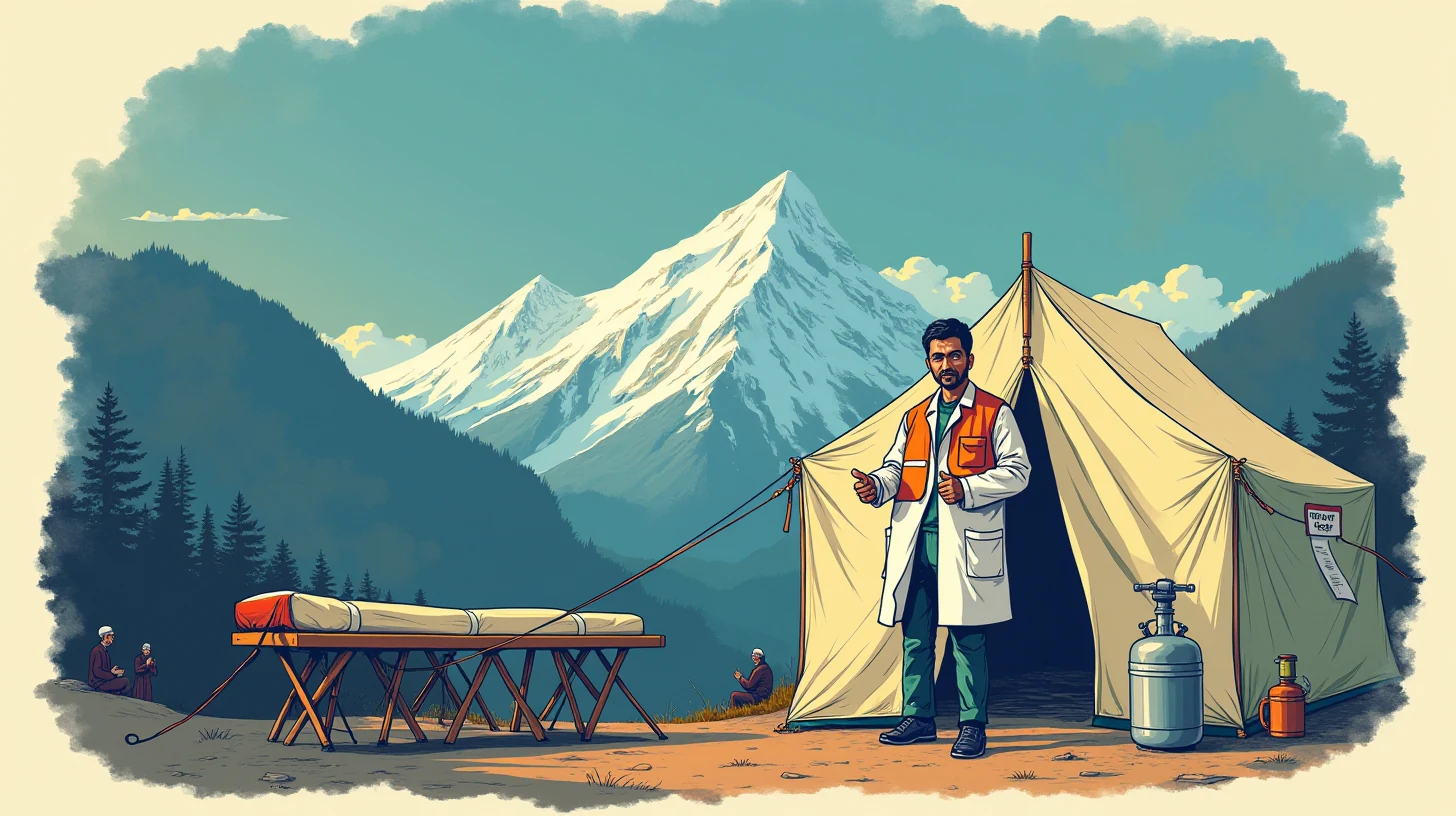
Every year, the calculation is the same: accept the Char Dham posting. Leave his wife and daughter in Dehradun. Move into a tent at 3,500 metres above sea level.
In 2024, he managed acute mountain sickness in sixty-three pilgrims. In 2025, he triage-referred one case of High Altitude Pulmonary Edema to the nearest hospital forty kilometres away—the patient died en route. By May 2026, he had been assigned to Chamoli district again, one of five government doctors rotating among seven medical camps along the Kedarnath and Gangotri pilgrimage routes. The season runs May through October. By mid-June, he would be stationed at Kedarnath Base Camp, managing between seventy and ninety patients per day, with seven litres of bottled oxygen allocated per camp per day.
He has never said no to the posting.
🗓️ The annual rhythm
Uttarakhand's Char Dham pilgrimage—Kedarnath, Badrinath, Gangotri, Yamunotri—attracts 1.2 million pilgrims each season. Most are elderly, many with uncontrolled hypertension and diabetes. At 3,500 metres, where oxygen is scarce and altitude sickness develops unpredictably, a single medical camp needs to manage acute mountain sickness, High Altitude Cerebral Edema, High Altitude Pulmonary Edema, myocardial infarction, and acute dehydration—often simultaneously, with minimal resources.
The Uttarakhand state government posts five doctors across these camps. AIIMS Rishikesh provides ten days of intensive training each May. The training covers altitude pathophysiology: how hemoglobin binds oxygen less efficiently at elevation, how arterial oxygen saturation drops, how the body's compensatory mechanisms work fine until 2,500 metres and then begin to fail. It covers case studies. It covers the numbers from 2013, when the Kedarnath disaster killed 969 people.
- 📋
May 2–4 — Assignment and briefing
Arun receives his posting assignment via the Uttarakhand NHM portal. Five doctors choose among three districts. Chamoli district, where Arun is assigned, handled 62,000 pilgrim visits in 2025.
- 🏥
May 4–14 — AIIMS intensive training
Ten-day program on altitude medicine, triage protocols, telemedicine setup, pharmacology at altitude, and psychological resilience. Dr. Vikram Singh walks through case studies: the 2023 Chamoli landslide, the 2024 cardiac-event triage at Kedarnath Temple.
- ⛺
June 15 – July 31 — Camp deployment
Arun is stationed at Kedarnath Base Camp at 3,500m. He rotates between five camps, managing seventy to ninety patients per day, with seven litres of oxygen allocated daily. Average five acute cases per 1,000 pilgrim visits requiring intervention beyond rest.
- ₹
Aug 1–Oct 31 — Rotation and recovery
Arun rotates out to a lower-altitude posting in Haridwar to recover from altitude sickness himself. He collates monthly statistics (847 patients assessed, 87 cases with significant intervention, twelve evacuations, three deaths) for the Uttarakhand NHM annual report.
What Arun knows, from twelve years at AIIMS and a decade in the field, is that the training exists. The knowledge exists. What does not exist is a matching of knowledge to patients at the moment they need it.
⚠️ What nearly went wrong
The assignment for the 2026 season came on May 2. Arun was offered Uttarkashi district (47,000 pilgrim visits in 2025), Chamoli district (62,000 visits), or Pithoragarh district (lower volume, but more isolated). He chose Chamoli. The hardship allowance was identical across all three—₹75,000 per month. The clinical load was not.
The briefing meeting at AIIMS Rishikesh on May 4 was run by Dr. Meera Sinha, the nodal officer for the Char Dham Medical Response Program. She laid out the numbers with the precision of someone who had managed too many spreadsheets and too few ICU beds. "We have five doctors, fourteen paramedics, twenty-five ASHA workers, and sixty oxygen cylinders across seven camps," she said. "Ninety percent of cases are manageable at camp level. Ten percent require referral. That ten percent breaks down as: five percent for hospital observation, three percent for ICU-level intervention, and two percent for evacuation beyond state capacity. Your job is to sort those percentages accurately."
Arun wanted to ask what happened if he sorted them wrong. He already knew the answer. The 2013 Kedarnath disaster had killed 969 people—some from the flash flood, others from acute altitude sickness, hypothermia, or lack of access to medical care in the chaos. The calculation was simple: five doctors might prevent a repeat. Zero would guarantee one.
The ten-day training included altitude pathophysiology, triage protocols, telemedicine, and case studies of real failures. Dr. Vikram Singh walked through the 2023 Chamoli landslide: a rock collapse damaging a hydroelectric project, forty workers buried, sixteen confirmed dead. One survivor had developed pulmonary edema during transport and died. Three survived because the nearest doctor recognized the pattern—crush injuries accelerate into respiratory failure at altitude. "The knowledge to save him existed," Dr. Singh said. "But the knowledge and the patient were not in the same place at the same time. That is disaster medicine."
"पहाड़ों में, ज्ञान काम करता है पर सामर्थ्य नहीं। दोनों चाहिए।"— In the mountains, knowledge works but capacity does not. Both are needed.
By May 14, Arun was certified in altitude medicine and disaster response. He knew his allocation of seven litres of bottled oxygen per day was not adequate for a camp that might see two HAPE cases. He also knew it was what the government had funded, and the rest would be problem-solving in real time.
🌗 What changed
The first patient on June 15 arrived at 7:15 AM. Hari Prasad, seventy-one, from Jaipur, dizzy and breathing rapidly. Oxygen saturation 82%. Arun sat him down, gave him oxygen at one litre per minute via nasal cannula, and asked questions: When did you arrive? From what altitude? Any chest pain? Any cough?
By 2 PM that day, Arun had seen forty-two patients. Every one was breathing harder than they should be. Most had headaches. One woman, Priya Sharma, sixty-two, had developed an alarming cough and was producing pink, frothy sputum. This was HAPE—High Altitude Pulmonary Edema. Her lungs were filling with fluid.
Arun gave her high-flow oxygen, sat her upright, and called for helicopter evacuation. The satellite phone took eight minutes to establish. By the time Dr. Patel from AIIMS Rishikesh's emergency department was on the line—a respiratory specialist—Priya Sharma's oxygen saturation had improved to 91%. The AIIMS physician called the IAF rescue center in Auli. ETA forty minutes if the weather held.
The weather held. Priya Sharma was airlifted. She spent three days in the respiratory ICU and was discharged on day four. She called the camp's satellite phone a week later, from Ahmedabad, to say thank you.
But the oxygen Arun had used to keep Priya alive until the helicopter arrived was four of his seven daily litres.
"सुनो — हमारे पास सात लीटर ऑक्सीजन है, सात दिन के लिए। अगर तीन HAPE cases आ गए तो?"
(Listen — we have seven litres of oxygen, for seven days. If three HAPE cases arrive?)
By July 2, Arun was running a different kind of triage. The seasonal statistics had arrived on the radio: 23,000 pilgrim visits to Kedarnath in June. Average of five acute cases per 1,000 visits requiring intervention. That meant 115 patients with genuine medical needs in his camp over the month.
Seven litres per day. Two hundred seventeen litres for the month. A single HAPE case used four to five litres to stabilize. A HACE case needed continuous oxygen until evacuation. An acute myocardial infarction needed two to three litres.
The math did not work.
🧭 Why this matters
What worked instead was a decision Arun had not articulated until Dr. Sinha visited the camp for a midseason review on July 5. "How are you rationing the oxygen?" she asked.
Arun hesitated. He could have said: I am following protocol. But protocol would have exhausted his supply by mid-June. Instead, he said: "I am using it for cases where the risk of death without it is high, and I am using it for cases where the helicopter evacuation time is long enough that stabilization is necessary."
"Which means?" Dr. Sinha asked.
"I am triaging for outcome," Arun said. "If a patient has HAPE and the helicopter can be here in an hour, I give them minimal oxygen—enough to improve saturation to survivable levels—and get them airborne. If a patient has AMS without edema and their oxygen saturation is stable at 82%, I am not giving them oxygen. I am giving them rest and descent instructions."
Dr. Sinha nodded. "That is correct practice. That is also unsustainable practice. If you get three HAPE cases in a week, you are out of oxygen."
"I know," Arun said.
"What happens then?"
"Then I manage them with the next best thing. Positioning. Continuous monitoring. Dexamethasone. And I call for helicopter evacuation for all three simultaneously."
"And if the helicopters cannot fly?"
Arun did not answer. They both knew what happened then. In 2013, hundreds had died when evacuation was impossible—not because the knowledge to treat them did not exist, but because the capacity to implement that knowledge did not exist at the moment it was needed.
What it does
- 🩺Recognizes altitude-related pathophysiology: HACE (cerebral edema), HAPE (pulmonary edema), AMS (acute mountain sickness)—each requiring different triage and escalation protocols.
- 📞Coordinates real-time telemedicine: guides trekking guides through descent protocols, calls AIIMS specialists for remote clinical decisions, arranges helicopter evacuations with weather coordination.
- ⚖️Makes resource-rationing decisions: allocates seven litres of oxygen daily across seventy to ninety patients, prioritizing cases where intervention changes outcome versus cases where descent or observation is sufficient.
What it does not do
- 🔒Never decides to evacuate without explicit clinical assessment—every case is triaged by vital signs, symptom progression, and evacuation time estimates.
- 💳Never withholds oxygen to patients in acute distress because of rationing—he monitors closely and escalates to simultaneous evacuations if capacity is exceeded.
- 🏥Never provides ICU-level care at camp; he identifies candidates for evacuation and prepares them for transport within the helicopter window available.
The frontier of Indian disaster medicine is not knowledge. AIIMS has that. The frontier is not technology—it exists. The frontier is the gap between what is possible and what is available at the moment a patient needs it. Arun exists in that gap. Every day, he sorts patients into categories: will survive with intervention available here, will need evacuation, might die regardless of what he does.
Most days, he sorts them correctly. Some days, he does not.
🌱 What we hope happens
On July 18, a pilgrim named Surendra Kumar, sixty-eight, from Lucknow, collapsed at the temple. His family brought him to the medical camp. Arun assessed him: no headache, no respiratory distress, but complaining of severe chest pain. An acute coronary syndrome. A heart attack.
Arun did not have an ECG machine. He did not have troponin testing. He gave him aspirin from his personal supply and called for helicopter evacuation. The response: all helicopters were grounded due to weather. High-altitude storm. Visibility too poor. ETA six to eight hours.
Arun gave him oxygen, started an IV, and monitored him continuously. Surendra's blood pressure was dropping. He was going into cardiogenic shock. Arun had no inotropes. No vasopressors. No medications to mechanically improve his cardiac output. He had oxygen and monitoring.
Six hours later, Surendra Kumar had another, larger myocardial infarction. Arun was there. He attempted CPR. He gave him oxygen. By the time the helicopter landed—eight hours and twenty minutes after the first collapse—Surendra Kumar had been in cardiac arrest for forty-five minutes. He was declared dead en route to Rishikesh.
The family asked Arun: could he have been saved if he was in a hospital?
Arun said: yes. If he had access to an ECG, to cardiac biomarkers, to percutaneous coronary intervention, to an ICU, he would likely have survived. At the temple, at 3,500 metres, with one doctor and limited medications, the outcome was determined not by Arun's knowledge or effort but by geography and altitude.
He filed the incident report. He said nothing else. He returned to the medical tent and saw the next patient.
It is late July 2026. Arun has been at Kedarnath Base Camp for six weeks. He will rotate out in the second week of August to recover from altitude sickness himself before returning to his permanent posting in Dehradun.
He is sitting in the medical tent on his one day off—a Tuesday afternoon when patient loads are historically low—and thinking about the calculation that has become his work.
He thinks: I have prevented catastrophe in some cases. Robert, an Australian climber with HACE, would have died without the descent protocol I relayed via radio. Priya Sharma, with HAPE, would have developed respiratory failure without the helicopter evacuation. In both cases, the outcome changed because of decisions made in real time based on available resources.
He thinks: I have also failed in some cases. Surendra Kumar needed cardiac intervention that did not exist. Another patient, a woman with severe altitude sickness and pulmonary edema, was evacuated but died at AIIMS Rishikesh from complications related to delay. The delay was not medical negligence. The delay was a weather system that grounded helicopters for eight hours.
He thinks: The frontier of Indian disaster medicine is not knowledge. AIIMS Rishikesh has that. The frontier is not technology—it exists. The frontier is the gap between what is possible and what is available at the moment a patient needs it. I exist in that gap. Every day, I sort patients into categories: will survive with intervention available here, will need evacuation, might die regardless of what I do.
Most days, I sort them correctly. Some days, I do not.
He opens his notebook and writes out the monthly statistics: 847 patients assessed, 87 cases with significant medical intervention, twelve evacuations, three deaths, zero cases of unmanageable complications.
He will present this to Dr. Sinha when he rotates out. The numbers will be aggregated with the other four doctors' numbers. The Uttarakhand NHM will include them in the annual Char Dham Medical Response Report. The data will show that government doctor postings at high-altitude pilgrimage sites reduce mortality by an estimated 15-20% compared to unmediated pilgrim populations.
What the numbers will not show is the cost: six weeks separated from his family, the ₹75,000 hardship allowance that does not fully cover his mother's dialysis during his absence, the altitude sickness he will recover from in Haridwar next month, and the knowledge that he has prevented some deaths but not all.
It is May 2026. The next Char Dham season is beginning. AIIMS Rishikesh is recruiting for the five doctor positions again. Arun has already submitted his name. The hardship allowance is essential. The work is necessary. The calculation—which patient will benefit most from the oxygen he has, which patient needs evacuation, which patient will not survive regardless—is the frontier of his medical practice.
He knows, rationally, that the solution is not better doctors or better training. The doctors are good. The training is rigorous. The solution is more resources. More oxygen. More hospitals. Helicopter stations at lower altitudes closer to pilgrimage routes. ICU-capable mobile clinics that can be deployed at 3,500 metres.
None of these exist because they cost money that the government has not allocated. Because the problem—pilgrim medical emergencies at high altitude during monsoon season—is episodic to the state health system and structural to the people who live and work in the mountains.
No one organization owns the problem. The Uttarakhand NHM owns the statistics. AIIMS Rishikesh owns the training. The helicopter services own the evacuation capacity. The trekking associations own the guide protocols. The pilgrims own the outcomes.
What Arun owns is the moment when a patient's life depends on a decision that he must make with incomplete information. Whether to evacuate. Whether to escalate oxygen. Whether to manage at the camp level or prepare for the worst.
"The frontier," he said in a quiet conversation after the season ended, "is not what you know. It is what you can do when what you know is not enough. That is every day at Kedarnath."
The agent on the tablet—the one his nephew might eventually place in front of him—would not replace his training or his judgment. It would not bring ICU beds to 3,500 metres or land helicopters in storms. What it could do is what all the good things do when they arrive quietly: it could ask him what the question was, and then answer it, in his own language, at the moment he needed to know the answer. Before the season, before the patients, before the numbers became a weight he carried alone.
For now, Arun has submitted his name for the 2027 season. The calculation will remain. The oxygen allocation will not change. The families will wait. The mountain will demand.
And on a Tuesday afternoon in a canvas tent at 3,500 metres, a doctor will sit with his notebook and count the lives he changed.