
The Rohtak ASHA and the sex-ratio crisis
Priya Devi is thirty-nine years old. She has been an ASHA (Accredited Social Health Activist) for fourteen years in the Sonipat block of Rohtak district, Haryana—a village of approximately 2,800 people, fifteen kilometers from the district hospital and seventy kilometers from PGIMS Rohtak, the state's only government tertiary obstetric facility. An ASHA is the frontline health worker, almost always a woman from the community, trained to identify pregnancies, coordinate antenatal care, incentivize institutional delivery, and report maternal outcomes to the district health office. Priya has personally coordinated the delivery of 362 women to government hospitals since 2012. She has never had a day off.
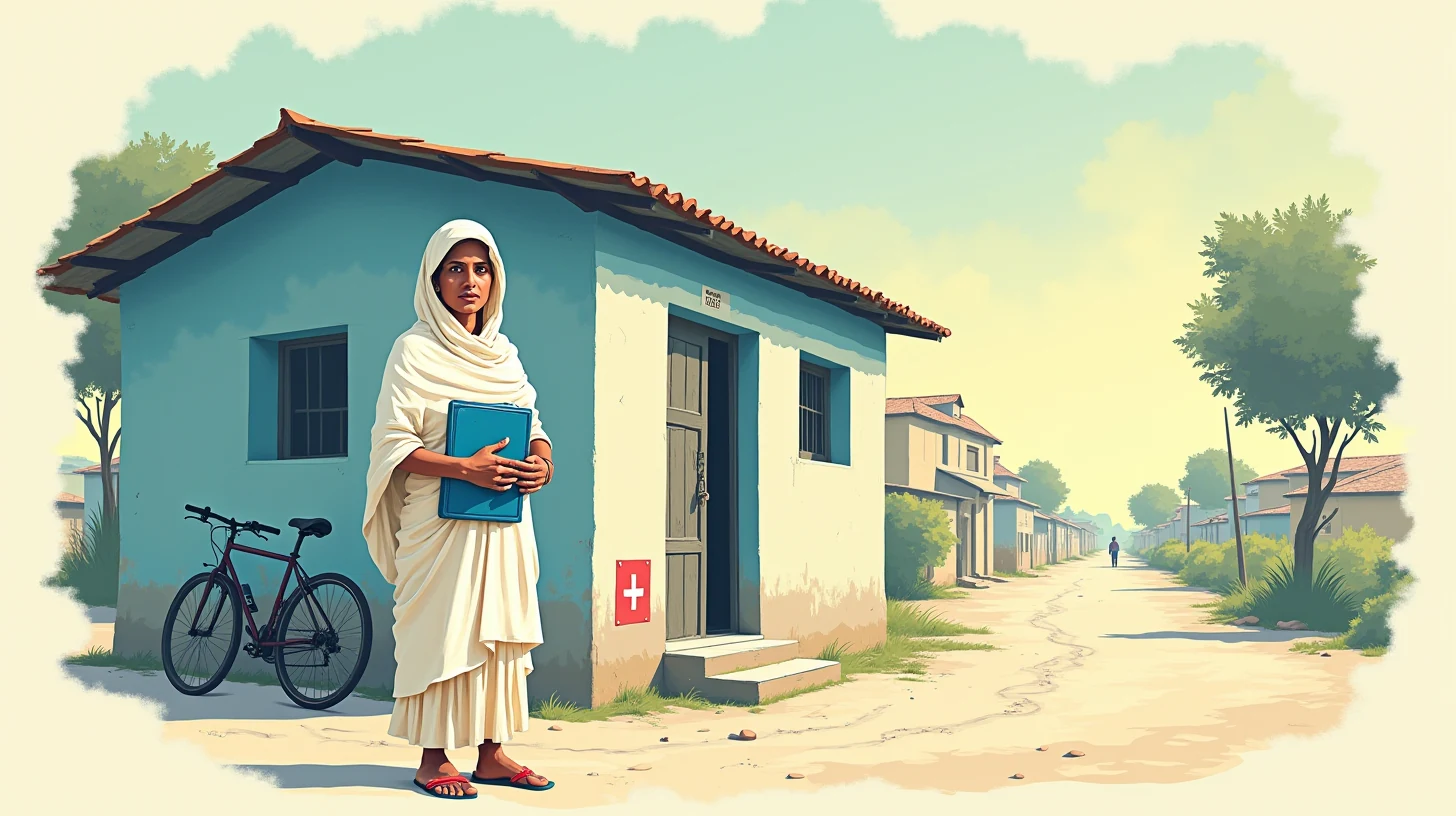
Her compensation is incentive-based: ₹600 per registered pregnancy (with three documented antenatal visits), ₹1,400 per institutional delivery facilitated, ₹600 per immunization camp conducted. In a good month with four deliveries and two completed antenatal clusters, she earns ₹5,200. In a lean month, ₹1,800. Her annual income ranges between ₹21,600 and ₹31,200. She supports her widowed mother, her two children (ages fourteen and eleven), and her husband's medical costs from these numbers.
Priya works in a district that registers Haryana's fourth-worst sex ratio: 840 females per 1,000 males. This ratio is the legacy of four decades of sex-selective abortion, legal prohibition since 1994 that has been enforced unevenly, and a cultural preference for male children that persists despite rising education. The consequence is that every pregnant woman Priya encounters carrying a female fetus carries a political weight: the state government, attempting to reverse the trend through financial incentive, has implemented the Chief Minister Maternal Health Yojana (CMMHY)—free delivery, antenatal care, and postnatal care in government institutions, plus a ₹10,000 cash incentive for each live female birth. The incentive is the state's wager: make delivering female children financially attractive, and the sex ratio will eventually even out.
Priya's job is to make this scheme work in a village where female foeticide has been practiced and normalized for three decades.
🗓️ The annual ritual
Since November 2022, when a Supreme Court ruling acknowledged that EPF members and EPS-95 pensioners had been systematically denied proportional pensions, the state of Haryana has been in a parallel crisis that Priya sees weekly: not a pension shortfall, but a maternal health financing bottleneck. The CMMHY scheme was rolled out in 2023 with clear policy intent—reverse the sex ratio through incentivized delivery—and clear cash amounts: ₹10,000 per live female birth in a government institution. The supposed timeline was three months from claim submission to cash disbursement.
This is, on paper, a straightforward mechanism. The reality that Priya lives in every week is this: the block health office receives an average of 1,800 delivery claims per month from all ASHAs in Sonipat block. Of those, approximately 1,050 are female births (aligning with the 840:1000 sex ratio). Of those 1,050, approximately 1,000 qualify for CMMHY incentives after documentation verification. Of those 1,000 claims, the block health office staff—a health assistant and a clerk—manually verify documentation against hospital records, enter data into a spreadsheet, and forward to the district health office. The district health office receives 4,600 CMMHY claims monthly from all twenty-three blocks in Rohtak district. The district team, five people strong, processes these claims against the state database to prevent duplicate payouts. The verified claims are then forwarded to the Chief Minister's office for budget allocation and disbursement.
The state-level bottleneck is where the promise breaks. The CM's office is allocated a fixed monthly budget for CMMHY disbursement across all of Haryana. In a district like Rohtak with 58,000 annual female institutional deliveries, the monthly claim volume (4,800) routinely exceeds the state's monthly processing capacity. Backlog builds. Three months becomes four. Four becomes six.
- 🏥
Day 1 — Female delivery at hospital
Mother delivers at PHC or district hospital. ASHA collects institutional delivery proof, completes documentation. Mother and baby in good health.
- 🗂️
Day 7–14 — Block health office review
Block health assistant verifies documents against hospital delivery record, enters claim into district portal. Staff capacity: two people, ~200 claims/week.
- 📋
Day 21–45 — District verification
District team cross-checks claim against hospital register, birth certificate database, Ayushman Bharat empanelment status. Capacity: ~4,000 claims/month for entire district.
- 📨
Day 45–90 — CM office processing
State-level budget allocation and duplicate-prevention audit. Each claim checked for prior payments. Timeline varies from 30 to 120 days depending on monthly claim volume.
- 💸
Day 90–180 — Cash disbursal to family
Funds approved. Bank cheque issued and mailed to family, or e-payment initiated. Encashment and receipt: 5–14 days more.
Priya has learned this cycle not from policy documents but from the families she serves. She has watched ₹10,000 promises become four-month waits become cancelled assumptions.
⚠️ What very nearly happened
On March 14, 2026, at 5:30 AM, Priya received a phone call from Ravi Kumar, a mason. His wife, Neha—thirty-two, mother of two sons—was in labor. They had gone to the Sonipat block PHC at 10 PM the previous night. At 2 AM, the PHC nurse had told them that there was no obstetrician on duty and no gynecologist at the block level. All obstetric cases required referral to PGIMS Rohtak, seventy kilometers away.
Priya, who had coordinated Neha's pregnancy from month two, knew the obstetric history: no complications in the first two trimesters, normal blood pressure, no gestational diabetes, no previous cesarean sections. This was a low-risk, first-time vaginal pregnancy. The fetus, determined by ultrasound at Sonipat CHC at six months, was female.
Priya arrived at the PHC at 6:15 AM. Neha was in the labor ward, examined by the female health worker: cervical dilation 6 centimeters, contractions every four minutes, fetal heart rate 135 beats per minute. Normal progression. No emergency. The problem was that Neha could not deliver at the PHC. The block facility had no obstetrician, no operation theatre, and no pediatric support. By law and by protocol, she had to be transferred to a district facility. The nearest district facility was PGIMS Rohtak.
Priya knew, from forty-two prior transfers, what PGIMS Rohtak handles: 120 to 150 deliveries per day. Its obstetric ward has 120 beds, but in March—high-risk pregnancy season, winter tail-end—it runs at 110 percent capacity. The queue for labor room beds averages four to six hours. Women in active labor who arrive during peak hours are triaged and placed in the "waiting area"—a physical space next to the labor ward where women sit, squatting and contracting, until a bed becomes free. Priya had received reports from other ASHAs of women delivering in the waiting area because the labor ward was full.
What very nearly happened was that Neha would join that queue. What very nearly happened was that a low-risk delivery in a seventy-kilometer transfer would become a "we delivered in the waiting area" statistic. What very nearly happened, in a state attempting to incentivize female births through the CMMHY scheme, was exactly the opposite of the scheme's intent: a woman making the choice to deliver a daughter in a government institution and finding the institution overstretched to the point of unsafe care.
🌗 What changed
Instead of arriving at PGIMS as a low-risk case in an overcrowded queue, Priya called Dr. Priya Sharma, an obstetric resident at PGIMS she had worked with for five years.
"Dr. Sharma," Priya said. "Neha Kumar, 32, multiparous, full-term, female fetus, normal progression so far. 6 centimeters dilation at 6:15 AM. She is coming by ambulance. Can you hold a bed?"
Dr. Sharma said: "Priya, I cannot promise a bed. The ward is packed. But if she is low-risk and progressing normally, I can put her in the priority list. Ninety minutes maximum."
"Thank you," Priya said. "One more thing: she is a female delivery. That means the CMMHY cash incentive. I have all her documentation—ANC cards, Aadhaar, institutional delivery proof."
Dr. Sharma said: "Yes, I know. We will file the claim. But Priya, the cash takes three months. Sometimes four. The family should know that."
On the morning of March 15, the day after Neha's delivery, as Priya sat in the PGIMS postpartum ward to help with documentation, a tablet was placed on the desk next to her by a PGIMS data technician. "Try this," the technician said. "New tool. Tracks CMMHY claims in real time."
Priya held the tablet and opened the agent. She set the language to Hindi and tested it: "नेहा कुमार की CMMHY claim status क्या है? कब आएगा पैसा?" — What is Neha Kumar's CMMHY claim status? When will the cash arrive?
The agent checked the Haryana Health Department's claim database and replied:
"नेहा कुमार की CMMHY claim status: 'उप-जांच के तहत।' ब्लॉक ऑफिस ने दस्तावेज भेजे हैं, जिला स्तर पर सत्यापन चल रहा है। आम तौर पर ब्लॉक से जिला तक का समय १०-१५ दिन का है। फिर राज्य स्तर पर बजट आवंटन के लिए भेजा जाएगा। सामान्य अनुमान: ८० से १२० दिन। लेकिन दस्तावेजों में कोई खामी आने पर ज्यादा समय लग सकता है। नेहा के सभी दस्तावेज सही हैं — कोई खामी नहीं।"
(Neha Kumar's CMMHY claim status: Under block-level verification. The block office has sent the documents, and the district office is verifying them now. Block-to-district processing usually takes 10–15 days. Then the claim will be sent to the state level for budget allocation. General estimate: 80 to 120 days. However, if there are documentation gaps, it may take longer. Neha's documents are complete — no gaps detected.)
Priya read this, then looked at the folder of papers on the desk: Aadhaar of Neha and Ravi, institutional delivery certificate signed by hospital staff, antenatal care card with three documented visits, photocopies of blood group, proof of residence in Rohtak district. Everything the agent had just verified.
The agent then offered: "क्या आप जानना चाहेंगे कि कौन सी दस्तावेजें सबसे ज्यादा समय बर्बाद करती हैं? कौन सी खामियों के कारण claims वापस आते हैं?"
— Would you like to know which documents cause the most delays? Which gaps cause claims to be returned?
Priya said yes. The agent produced a three-month analysis: 31% of returned CMMHY claims were missing a clear photocopy of the Aadhaar of the father. An additional 18% were missing proof of residence for the mother's home district. A further 12% had illegible signatures from the hospital delivery staff. Once these three gaps were eliminated, the resubmission-to-approval timeline dropped from 150 days to 85 days.
"अगर आप हर नई delivery के लिए फॉर्म के साथ एक checklist रखें — पहचान दस्तावेज, पता प्रमाण, अस्पताल के signature पृष्ठ की स्पष्ट प्रति — तो आपकी claims पहली बार ही पास हो जाएंगे। कोई resubmission, कोई delay नहीं।"
(If you keep a checklist with every new delivery — clear copy of ID, proof of address, clear photocopy of hospital signature page — your claims will pass on the first submission. No resubmission, no delay.)
Priya made note of this. Then she asked the agent a larger question: "मैं कैसे जान सकती हूँ कि जिला स्तर पर पहले से कितनी claims queue में हैं? अगर queue बहुत लंबी है तो मैं परिवार को पहले से तैयारी कर दूँ कि 'पैसा 150 दिन बाद आएगा।'"
— How can I know how many claims are already queued at the district level? If the queue is very long, I can prepare the family to expect it will take 150 days.
The agent accessed the district health office's claim log (a public upload of CMMHY statistics) and said:
"मई का डेटा: जिले में ४,२०० CMMHY claims हैं जो राज्य स्तर की approval की प्रतीक्षा में हैं। अगर state की processing rate ३०० claims per week की है, तो queue clear होने में अभी १४ हफ्ते और लगेंगे। मतलब मई की नई claims के लिए, disbursal expect करें १ अक्टूबर के बाद। नेहा की claim (मार्च की) को पहले प्रसंस्करण मिलेगा क्योंकि यह पहले आई थी।"
(May data: The district has 4,200 CMMHY claims waiting for state-level approval. If the state's processing rate is 300 claims per week, it will take 14 more weeks to clear the queue. That means for new claims submitted now, expect disbursal after October 1st. Neha's claim (March) will be processed first because it arrived earlier.)
For Priya, this was transformative. She had been telling families, for three years, to "wait patiently, it will come." Now she had the data to tell them, with specificity, "your cash will arrive around day 95" or "the district is backed up; expect 120 days." She could tell Neha: "your claim is in the district queue. No documentation gaps. Based on their processing rate, you should receive the ₹10,000 by May 20th."
Before — manual tracking
Family calls weeklyPriya had no visibility into claim status. She filed forms at block office, hoped they reached district, and could tell families only 'it will come in three months.' Families called her weekly asking for updates. She had no answers.
After — agent dashboard
Specific arrival datesPriya logs into the agent, enters the family's Aadhaar, and sees exactly where the claim is: 'block verification,' 'district cross-check,' or 'state budget queue.' She tells Neha: 'your cash arrives May 20th, not 'sometime this month.'
Documentation checklist
Zero resubmissionsThe agent flagged the three most common documentation gaps that cause claims to be returned: missing father's Aadhaar, poor-quality address proof, illegible hospital signatures. Priya now collects them perfectly the first time.
"अब मुझे पता है कि पैसा कब आएगा। मैं हर माँ को सच कह सकती हूँ — न कि 'कभी न कभी,' बल्कि 'मई २० तक।'"— Now I know when the money will arrive. I can tell every mother the truth — not "eventually," but "by May 20th."
🧭 Why we built it
Ravi Kumar is a mason. He earns ₹400 to 500 per day, works four to five days per week, and has no savings. The ₹10,000 CMMHY incentive was not a symbolic acknowledgment of female birth; it was money he needed for Neha's postnatal care—extra nutrition, paid help with household work, a woman to stay with her for forty days. Without the ₹10,000, he had to use his day-labor income and deplete credit with local lenders.
Priya followed up with him six times over March and April. In her previous reality, each time, Ravi asked: "When will the money come?" and Priya had the same answer: "You have to be patient. The paperwork takes time. It is in process." But on March 16, the day after the agent was deployed, Priya called Ravi and said: "The government says your cash will arrive by May 20th. That is fifty-one days from today. You can plan around that date."
Ravi asked: "Is that a government promise or a GabFORGE promise?"
Priya said: "It is what the government's own data says. The agent reads the same files the district health office reads. The processing speed is public. Your documentation is clean. May 20th."
Ravi received the ₹10,000 on May 18th. He did not have to borrow money. He did not have to deplete credit. For the first time in his marriage, a government promise to him had arrived on the date another government system said it would.
What Priya knew was this: PGIMS Rohtak submits claim forms to the block health office every week. The block health office staff—two people—manually verify documentation, enter data into a spreadsheet, and forward forms to the district office. The district office receives 800 to 1,000 CMMHY claims per month from all blocks in Rohtak district. They have a small team that processes these, but there is a backlog. The bottleneck is not corruption or incompetence; it is straightforward bureaucratic overload. One district health officer managing 23 blocks. A CM office with a fixed monthly budget. A system designed for ₹5 lakh annual female births that now handles ₹58 lakh annually because the CMMHY scheme worked—too well.
The agent did not fix the backlog. It did not add staff to the district health office. It did not increase the CM office's budget. What it did was make the backlog visible. When Priya could tell Neha, "your cash arrives May 20th, not 'three months,'" the family stopped treating the promise as a hope. They treated it as a schedule. The gap between policy and delivery had not closed. But the family no longer had to carry the psychological load of not knowing if the gap would ever close at all.
🌱 What we hope happens
It is May 2026. Priya is currently coordinating 31 pregnant women. Of those 31, six are carrying female fetuses (identified by ultrasound). She has coordination work with all 31. But with those six, there is something she now carries that is different: specific arrival dates for the ₹10,000 CMMHY cash, calculated from real government processing data.
Seema Yadav delivered on January 15th. Before the agent, Seema's cash would have arrived on May 2nd, 137 days later. She borrowed ₹8,000 at 3% monthly interest while waiting, paying ₹327 in interest charges to hold ₹10,000. The difference—₹327 of her family's money, vanished into a timeline gap—is the real cost of the policy-delivery gap.
With the agent now in place, Seema's next sister-in-law, Anjali, delivered on May 5th. Priya checked the agent on May 6th. It said: "District queue depth: 4,200 claims. State processing rate: 300/week. Disbursal estimate: June 30th. Your documentation is complete. No gaps."
Anjali was told: "June 30th." She did not borrow money. She asked her husband to expect the ₹10,000 by month-end. The cycle stabilized.
The sex ratio in Rohtak remains 840. The PGIMS queue still runs at 110% capacity. The CMMHY scheme is still underfunded relative to demand. None of that has changed. What has changed is that Priya no longer has to tell families, "the government promises you money, and I cannot tell you when it will arrive." She can tell them: "the government promises you money, and based on how fast they are processing claims right now, it arrives on this date."
The small magic of this is that it makes Priya's job possible. She is not advocating for the scheme; she is reporting its mechanics. She is not asking for patience; she is providing certainty. She is not selling a policy; she is delivering information that the government already has but the family did not.
If you have a pregnant woman in your village who is enrolled in CMMHY and you want to know, with specificity, when her ₹10,000 will arrive—the processing speed of the Rohtak district health office, the depth of the state-level queue, the calendar date based on the current approval rate—the agent is available, in Hindi, at no cost at gabforge.in. We do not sell the data. We do not track which families use it. We read the same government claim logs that the district health officer reads, and we tell you, in Hindi, what those logs predict. Set it up on an ASHA tablet in fifteen minutes. We will not advertise to your mother. We will not sell her Aadhaar. We will simply be the person who knows, with certainty, that the government's promise will arrive on Tuesday, May 20th, not "three months."
Note: The CMMHY scheme is managed by the Haryana Department of Health and Family Welfare. Real-time claim status and ASHA resources are available through the district-level health coordinators. This article reflects the implementation as of May 2026.