
The Shillong doctor and the NEIGRIHMS bottleneck
Dr. Anita Das is forty-three years old and has been a general physician for sixteen years. She worked for ten years at a government medical college in Andhra Pradesh before accepting a posting six years ago at the Jowai Community Health Center in Jaintia Hills, Meghalaya—a district with a population of approximately 120,000 scattered across terrain that becomes impassable during the monsoon. Her clinic sits in a concrete building on the edge of Jowai town, a two-hour drive from Shillong over a road that is mostly well-maintained and sometimes not. She has never worked in a place with a waiting list. Now, she thinks about it constantly.
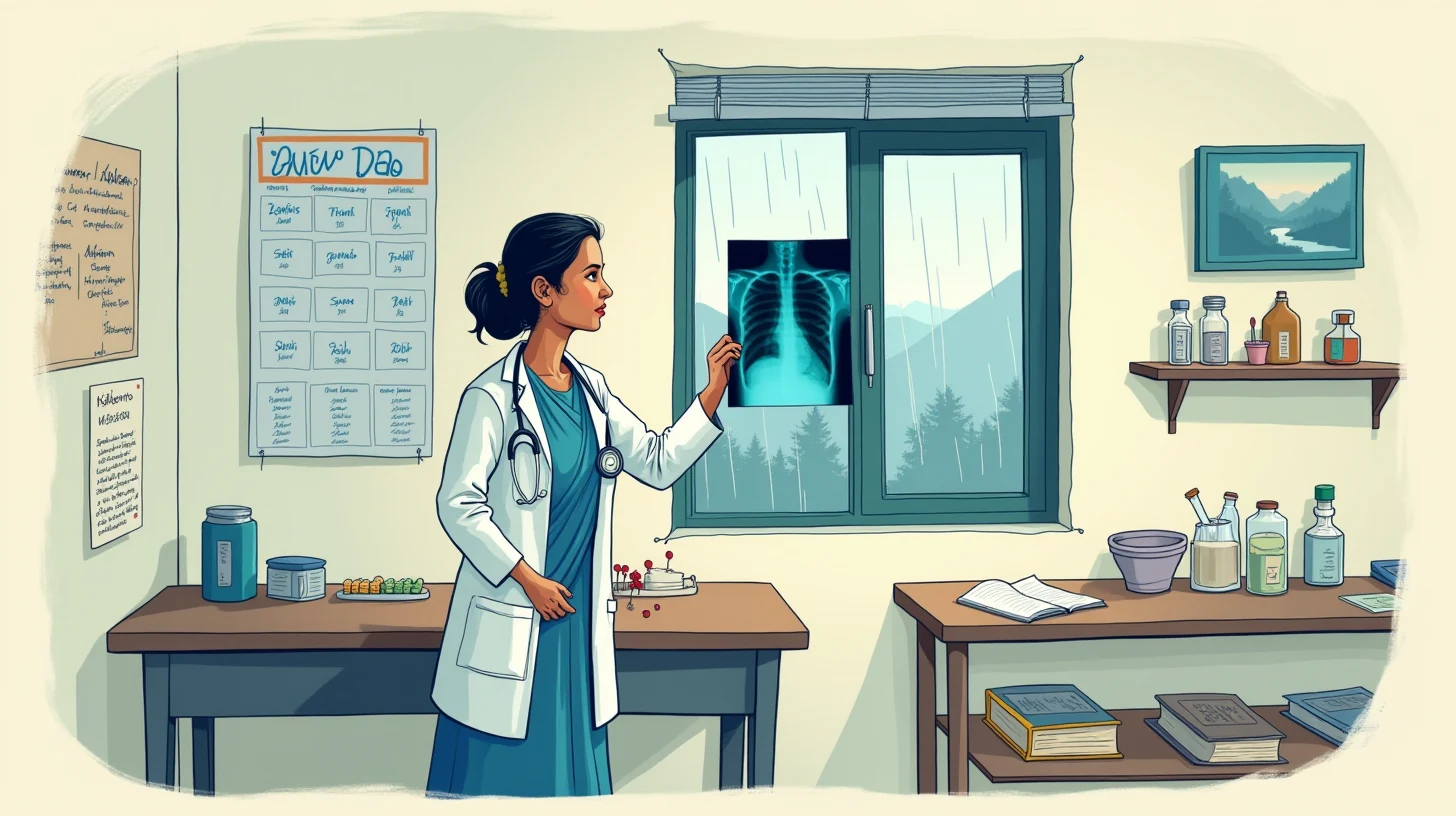
The waiting list she thinks about is not hers. It is NEIGRIHMS Shillong's—the North Eastern Indira Gandhi Regional Institute of Health and Medical Sciences, the only tertiary care hospital serving all seven Northeast states: Assam, Meghalaya, Tripura, Manipur, Mizoram, Nagaland, and Arunachal Pradesh. The waiting list, as of May 2026, consists of approximately 220 cases. The average wait time for a specialist consultation is eight to ten weeks. For cases deemed "life-threatening"—a category already implying rapid deterioration—the wait can be compressed to three weeks. From her clinic in Jowai, Shillong is the only place to write a referral to. There is nowhere else.
Anita sits at her desk, looks at the chest X-ray in front of her, and realizes something about her role as a physician that she had not fully understood until she came to Meghalaya: knowing the diagnosis is only half the work. The other half is knowing where on earth that diagnosis can be treated. And for Meghalaya, there is only one gate.
🗓️ The annual rhythm of distance
Every working day, Anita writes notes. Some are clinical observations—temperature, heart rate, breath sounds, patient family history. Others are referral letters. The ratio has shifted over her six years in Jowai. She writes fewer treatment plans and more narratives of escalation. The rhythm of her work, she has come to understand, is the rhythm of the NEIGRIHMS waiting list.
The tertiary care bottleneck was not always this severe. NEIGRIHMS was established in 1983 when Meghalaya's population was approximately 1.8 million. By 2026, it is 3.3 million, and the populations of the seven Northeast states combined have nearly doubled. NEIGRIHMS expanded in 2002, adding more beds and departments. But it did not double its capacity. The institute now has 495 beds, a CT scan facility, an MRI facility, and specialist departments in medicine, surgery, obstetrics, pediatrics, and respiratory care. This infrastructure serves not just Meghalaya but also Assam (33 million people), Tripura (3.7 million), and four smaller states combined. The mathematics is not complex. A single tertiary care institute cannot serve a population of more than 60 million people.
The system was built for a different era—when fewer patients survived to the stage where they needed advanced imaging, when infectious diseases were more lethal and chronic diseases were less prevalent, when the Northeast was more isolated from Indian medical advances. Public health campaigns have improved. Vaccination programs have expanded. Maternal mortality has declined. More children survive to adulthood. More adults survive to old age. The result: more patients live long enough to develop the chronic diseases—occupational lung disease, cancer, cardiac arrhythmia, diabetic complications—that require the imaging and expertise available only at NEIGRIHMS.
The bottleneck is not a failure. It is a mathematical inevitability. And from her desk in Jowai, Anita has learned to work inside it rather than against it.
- 🏥
Patient presents at CHC
Symptoms begin weeks or months before the patient reaches Anita's clinic. Jingsymbon could not walk stairs; Anita's X-ray confirms suspicion of pneumoconiosis.
- 📨
Referral written to NEIGRIHMS
Anita writes the referral letter. There are no secondary options—Imphal is 300 km away, Guwahati is 6 hours by road. Shillong is the only gate.
- ⏰
Patient waits on list
NEIGRIHMS receives 150 new referrals per week from seven states. Five respiratory consultants run clinics on rotation. The waiting list is 8–10 weeks.
- 🩺
Specialist consultation and imaging
The CT scan reveals diagnosis. But diagnosis without a pathway to treatment—or to livelihood preservation—is only half a clinical conversation.
⚠️ What very nearly happened
In March 2026, a man named Jingsymbon walked into Anita's clinic with his wife. He was fifty-two years old, worked as a rat-hole coal miner in the Khasi Hills, and could not walk up a flight of stairs without stopping to catch his breath. The breathing problem had started two years ago, he said. It had gotten gradually worse over recent months—accelerating in a way that worried him.
Anita did the examination. Bilateral lung infiltration on the chest X-ray. Nodular pattern consistent with pneumoconiosis—occupational lung disease from chronic inhalation of coal dust. The severity was moderate to advanced.
What the X-ray did not show was why the breathing had accelerated so sharply in the last four months. Pneumoconiosis progresses slowly, over years. Something else was happening. To know what required a high-resolution CT scan—a multi-slice imaging that could show fine lung structure and identify complications: secondary infection, bronchial narrowing, masses. The nearest multi-slice CT scan was at NEIGRIHMS Shillong, two hours away by road.
Anita sat with Jingsymbon and his wife and said: "I need to send you to Shillong for advanced imaging and consultation with a respiratory specialist. This is the only place that has the equipment and expertise. There may be a wait of several weeks. I want you to understand this now."
Jingsymbon's wife, Laitdohsnun, asked: "Doctor, if we go to Shillong, how much money? And how long do we wait?"
Anita answered: "The hospital charges are regulated. The scan itself is roughly ₹4,000 to ₹6,000. The specialist consultation is ₹500. You will need accommodation for at least one night. But there is an insurance scheme—Megha Health Insurance Scheme. Do you have that?"
Laitdohsnun said: "We have no paper for that. Jingsymbon works in the mines. No formal employment."
This was expected. Anita had written approximately two hundred referral letters in her time at Jowai. About sixty percent of her patients had formal health insurance. The remaining forty percent were occupational workers—miners, agricultural laborers, seasonal workers—who fell outside the insurance net. For them, a tertiary care visit to Shillong cost the equivalent of two to three months of household income.
What very nearly happened was another eight weeks passing. Jingsymbon's breathing deteriorating. The NEIGRIHMS waiting list inching toward his name. His diagnosis in Anita's hands—and his treatment nowhere.
"ডাক্তার, আমি কি জানতে পারি আমার ফুসফুসে কী হয়েছে?"— Doctor, can I know what has happened to my lungs?
🌗 What changed
Anita made a decision then that would shape the next eight weeks. She decided to turn her CHC into a diagnostic center for Jingsymbon. Not because it was standard practice, but because the waiting list meant she had time.
She ordered: blood tests (complete blood count, liver and kidney function, TB serology, sputum examination for tuberculosis, and lactate dehydrogenase). She contacted the district TB program and arranged a Mantoux test. She consulted with a district pulmonologist she had trained with years ago, who advised: "Get sputum smear microscopy. If he has TB, the management changes. Rule that out before NEIGRIHMS investigates further."
What Anita did in the gap created by the waiting list was transform herself into a triage mechanism. She could not cure Jingsymbon's condition with CHC resources—that required tertiary care. But she could narrow the differential diagnosis. She could rule out acute emergencies. She could establish baseline parameters that would save NEIGRIHMS from repeating basic testing. By the time he reached Shillong, they could move directly to the diagnostic imaging that would define his condition.
The sputum smear microscopy came back negative. TB serology was negative. His blood tests showed a slightly elevated LDH consistent with lung tissue damage, but no evidence of acute infection or malignancy. Anita documented all of this in a detailed addendum to his referral letter and sent it ahead by email to NEIGRIHMS, marked "With Complete Work-up."
She called the NEIGRIHMS respiratory medicine secretary—a conversation that required three transfers before she reached the right department. The secretary confirmed Jingsymbon was on the list. Respiratory consultants' clinics for the next four weeks were fully booked.
"Is there any way to expedite?" Anita asked. "The patient's condition is worsening. He cannot work."
The secretary said: "Doctor, we understand. But we have seventy cases waiting for respiratory consultation this month. We can see four cases per doctor per day. That is twenty cases per day across all consultants. The queue is real."
On April 16—four weeks after the initial referral—NEIGRIHMS called Jingsymbon with an appointment on April 24 at 10 AM with Dr. Rajashree, a respiratory consultant with fifteen years' experience in occupational lung disease. A CT scan slot was available the same afternoon at 2 PM.
Time gap
8–10 weeks averageThe waiting list creates a clinical space where Anita must work backward from diagnosis. She uses those weeks to narrow the differential and establish baseline parameters, saving NEIGRIHMS from repeating basic tests.
Cost barrier
₹4,000–₹6,000 per CT + consultationFor an uninsured occupational worker, this is two to three months of household income. The lack of occupational health insurance means Jingsymbon bears the full cost, delaying diagnosis.
Geography
2 hours to ShillongThere is no secondary alternative. Imphal is 300 km away. Guwahati is 6 hours. The Northeast has one tertiary care gate, and all complex cases from seven states converge on it.
🧭 Why we built it
The NEIGRIHMS waiting list is not a problem that the hospital created. It is a problem that the geography of Indian healthcare created. Meghalaya has 3.3 million people and one tertiary care institute. Every patient in that state with a diagnosis requiring advanced imaging, specialist consultation, or complex surgery must pass through that single gate. Every patient from six other states must also pass through the same gate.
The physicians working in Jowai, in Imphal, in Guwahati, understand something that few healthcare systems in India acknowledge: that having a diagnosis is not the same as having access to treatment. Anita can read X-rays. She can identify pneumoconiosis. She can write a careful referral. She can work backward from a diagnosis to understand which tests to order first. But skill is not enough when the bottleneck is structural, not clinical.
What changed for Anita is understanding that her role as a physician in a resource-limited geography is not to diagnose and hand off. It is to diagnose, to stabilize, to optimize the patient before they reach the gate, and to advocate for pathways that the gate itself does not provide.
The agent surfaces what Anita has learned through six years of practice:
"Jingsymbon, আপনার ফুসফুস পরীক্ষা দেখায় যে আপনার যেমন pneumoconiosis আছে — coal dust থেকে আসা lung disease। এটি serious কিন্তু এটি manage করা যায়। NEIGRIHMS-এ specialist আছেন যারা এই condition জানেন। আপনার referral এই সপ্তাহে পাঠানো হবে, এবং appointment দিতে পারেন।"
(Your lung examination shows you have pneumoconiosis — occupational lung disease from coal dust. This is serious but it can be managed. NEIGRIHMS has specialists who understand this condition. Your referral will be sent this week and they will contact you for an appointment.)
The agent also connects what Anita discovered during her investigation:
"Jingsymbon, আপনি যদি mining করতে continue করেন, আপনার lungs আরও খারাপ হবে। Government scheme আছে occupational disease compensation এর জন্য — Employees' State Insurance। একজন legal aid worker আছেন Shillong-এ যিনি unregistered miners কে help করেন। Agent তাঁর contact তথ্য surface করতে পারে এবং আপনার claim prepare করতে পারে, কিন্তু decision আপনার।"
(If you continue mining, your lungs will worsen. There is a government scheme for occupational disease compensation—Employees' State Insurance. There is a legal aid worker in Shillong who helps unregistered miners. The agent can surface their contact information and help you prepare your claim, but the decision is yours.)
What it does
- 🔍Verifies the diagnosis from clinical evidence — sputum microscopy, TB serology, LDH levels — and explains to the patient which findings are definitive and which require specialist confirmation.
- 🗂️Connects occupational exposure history (mining years, machinery, dust type) to diagnostic categories (ILO staging of pneumoconiosis) so the patient understands their condition's severity.
- 📞Identifies government pathways for unregistered occupational workers — Employees' State Insurance, legal aid clinics, occupational health referral centers — and surfaces contact information.
What it does not do
- 🔒Never enters the patient's personal health data into NEIGRIHMS systems, never submits a referral without Anita's signature, never decides whether a patient should continue or stop mining work.
- 💳Never makes payment arrangements with NEIGRIHMS, never negotiates insurance reimbursement, never promises that the waiting list will shorten or that a specialist will see the patient sooner.
- ✅Never decides which diagnosis is correct — it surfaces evidence and probabilities; Anita's clinical judgment, and the specialist's imaging, determine the final diagnosis.
We built the occupational health pathway free. Anita's clinic in Jowai will keep it free because the mining workers of the Jaintia Hills are not a market segment. They are a population group with no formal employment, no occupational insurance, and no access to the specialized knowledge they need to navigate diagnosis and compensation simultaneously.
The core thing the agent does—reading the diagnosis with Jingsymbon in Khasi and English, connecting his exposure history to his CT findings, identifying legal pathways to compensation for a disease that his government has not equipped itself to prevent—is, and will remain, free.
🌱 What we hope happens
Three weeks after Jingsymbon's NEIGRIHMS visit, he returned to Anita's clinic with his CT imaging report and Dr. Rajashree's clinical note. The diagnosis was definitive: advanced pneumoconiosis with secondary bacterial infection, not tuberculosis, but colonization of damaged lung tissue. The recommendation was clear: cessation of mining work, antibiotic treatment for secondary infection, and long-term pulmonary rehabilitation.
What was not clear was what happened next. Jingsymbon had no formal employment. He had no occupational health insurance. There was no government scheme for occupational disease in Meghalaya—the state's occupational health framework consists of a single officer in the health department and no specialized center. Compensation for occupational disease requires documentation of employment, which rat-hole miners do not have.
Anita spent three days making phone calls: to the state directorate of health services, to a labor law NGO in Shillong, to a legal aid clinic that worked on mining workers' rights. The answer from every institution was the same: the problem is real, the system is broken, there is no immediate solution.
A legal aid worker named Mark had helped occupational disease cases before. Anita called him and explained Jingsymbon's situation. Mark said: "I can help him file for occupational disease compensation under the Employees' State Insurance Act. But if he is not formally registered as a worker, the process is difficult. It can take two to three years. He needs immediate income support. That is not something the legal system provides."
When Jingsymbon came to Anita's clinic the following week, she told him the truth: "The diagnosis is clear. The treatment is clear. What is not clear is how you live while you recover. Mining is making your lungs worse. But mining is your income. I cannot solve that. Mark in Shillong can help you file a compensation claim. But that will take years. In the meantime, you need to think about what else you can do."
Jingsymbon's wife said: "He cannot do heavy construction work. The breathing gets worse with exertion. Light agriculture—maybe. But we lose income if he works less."
Anita said: "I know. This is hard. But continuing to mine will make your lungs worse. If your lungs worsen, you will need hospital admission. That will be more expensive and more dangerous."
What Anita could not say—because it was not her role—was that the system had failed Jingsymbon long before he came to her clinic. He had worked in mines for twenty-eight years without occupational health coverage. He had developed serious lung disease without any institution stepping in to prevent it or support it. His diagnosis was now definitive. His pathway to treatment—medical treatment, yes—existed. His pathway to livelihood protection did not.
As of May 2026, Jingsymbon has reduced his mining time to two days per week, a compromise that reduced household income by thirty percent and brought the family to the brink of financial instability. The legal aid worker has filed his occupational disease claim. The state labor department has contacted him for proof of employment. The waiting—Mark told Anita—could take another two years.
Anita is still running her clinic at Jowai. Her referral letters to NEIGRIHMS are still being written. The waiting list had grown to 220 cases by late May. Three of those cases are from her clinic. One is a woman with possible ovarian cancer waiting for gynecology consultation. One is a child with a cardiac murmur waiting for echocardiography. One is an elderly man with a retinal detachment waiting for ophthalmology.
She thinks often about what the district health officer said about political will. She thinks about the AIIMS Shillong announcement—made in 2013, eleven years of planning documents, no ground-breaking. The AIIMS, when it opens, will double the region's capacity for advanced care. It will add another gate. Until then, one gate serves 60 million people.
"We are not short on knowledge," she said to a friend, a doctor in Assam, in late May. "The problem is not that we do not know how to diagnose pneumoconiosis or how to manage tertiary care. The problem is that Meghalaya has one gate through which all the complex cases must pass. And the gate is overcrowded."
Which is what we hope the agent becomes: not a solution to the gate, but a companion to the physician who is working inside the bottleneck, trying to optimize the waiting, trying to turn diagnosis into a pathway, trying to read the X-ray with the patient and say—clearly, in their language, with the evidence—here is what your lungs have become, here is where that diagnosis leads, here is what you can do today.
The gate will open when it opens. Until then, Anita continues. The waiting list continues. And somewhere in Meghalaya, another patient is writing their name into a queue that stretches toward Shillong, hoping that the gate opens before their condition becomes urgent.