
The Shimla doctor and the high-altitude medicine window
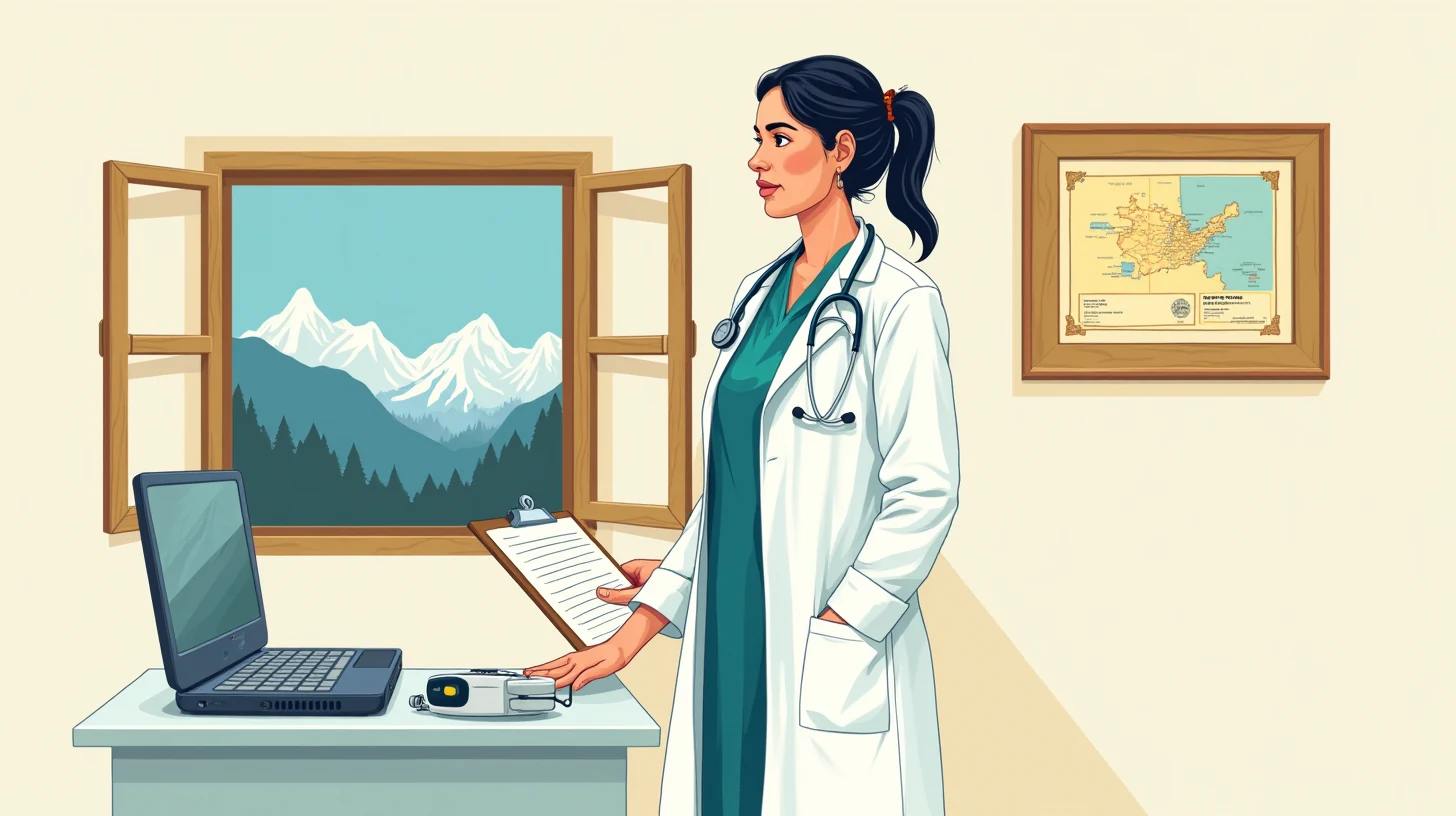
Dr. Meera Sharma is forty-two years old. She has been a general physician for seventeen years—eight years at Indira Gandhi Medical College in Shimla, nine years in private practice. Her clinic is on Mall Road in Shimla, in a narrow 1950s building with a window that faces directly toward Jakhoo Hill and, beyond it, the layered ridges of the Himalayas fading south toward Kinnaur. She works Tuesday to Saturday, 4 PM to 8 PM—not because she is part-time, but because mornings are spent on ward rounds at district hospitals and referral follow-ups from smaller towns. She has never worked a nine-to-five in her career. Mountain medicine does not work on a five-day week.
Her monthly income oscillates between ₹16,000 and ₹35,000. Winter months—October through March—see a 40 to 60 percent drop in clinic footfall. March, the month we need to understand, brought her ₹18,000. Summer brings a different problem: tourists and trekkers arriving with illnesses that do not exist in Shimla on their own, but live in the thin air above 2,500 meters. She has seen this before. She is about to see it more carefully than ever.
On March 15, 2026, at 5:47 PM—the time is on the referral slip—her clinic phone rang with a woman's voice speaking Himachali-inflected Hindi. A brother was trekking from Kinnaur, had stopped in Kufri village, two thousand meters above Shimla, had woken with a splitting headache, could not stand without vomiting. Acute mountain sickness. The problem was not the diagnosis. The problem was what it required her to understand in the next eight hours.
🗓️ The pattern nobody names
In Himachal Pradesh, high-altitude trekking is not recreation—it is infrastructure failure made visible. The state's twelve high-altitude districts—Kinnaur, Spiti, Lahaul, Pangi—are inaccessible five to six months per year. Roads close in October. They open in May. In that gap, a physician in Shimla, a doctor in Manali, an emergency clinic in Kaza—each operates alone, knowing that the nearest ICU is forty kilometers away at minimum, four to six hours by ambulance in good weather.
Meera knows the numbers because she has worked them. IGMC Shimla, her old institution, has a respiratory ICU. During winter, it runs at 105 percent capacity—patients in corridors, junior residents on night rotation with four-hour gaps between shifts. If a trekker needs mechanical ventilation and IGMC is full, the next step is AIIMS Bilaspur, ninety kilometers away, forty minutes by ambulance. If AIIMS is full, it is PGIMER Chandigarh, three hundred kilometers away, five to six hours. Each hospital has a waiting list. Each hour of delay increases mortality.
The private practitioners in mountain towns—there are roughly two thousand registered doctors in Himachal outside government institutions—are scattered across fourteen districts, working in clinics with blood pressure monitors and glucometers, not oxygen flow meters or ventilators. They know how to diagnose altitude sickness. They cannot treat what comes after. What they do instead is calculate: can this patient move? Do I have time? Is the hospital bed open? Can the roads stay open?
- 🏔️
The trekker at 2,500+ meters elevation
Symptom onset: headache, dizziness, nausea. No nearby physician. Descent or stay put — these are the only choices. Phone signal is intermittent.
- 📱
Private clinic in nearest town (Shimla, Manali)
Physician assesses by phone, orders descent and oxygen support if available. No ICU. Decision point: can the hospital one level up accept transfer?
- 🏥
District hospital (Shimla: 12 km, Manali: variable)
Eight ICU beds, usually full. If the patient arrives, waiting list determines admission. If no bed: escalate to IGMC or AIIMS. Mountain roads deteriorate in rain.
- 🚑
Tertiary referral (IGMC Shimla, AIIMS Bilaspur, PGIMER Chandigarh)
IGMC is 12 km away but overcrowded. AIIMS is 90 km, 40 minutes. PGIMER is 300 km, 5–6 hours. At this stage, outcome depends on the hour it happened, whether roads are open, whether any ICU has a free bed.
What is unusual is that no one acknowledges this openly. The state health system measures success by bed-occupancy rates, vaccination camps completed, outpatient visits recorded. A trekker in altitude sickness is a statistical anomaly, not a system problem. The private physicians treat it as episodic—one case this week, maybe two next month. The trekking guides learn through improvisation. No one organization owns the problem. Therefore, no one organization solves it.
⚠️ What very nearly happened
Rajesh was twenty-eight, worked in Delhi, had come for a seven-day trekking holiday. He had started the trek from Chail at 2,250 meters, climbed to Kufri the next day at 2,500 meters, felt fine until 7 AM on March 15. By noon, headache was severe. By 5 PM, he was vomiting and could not stand. His sister, with him on the trek, called Meera's clinic.
Meera asked the standard questions: When did symptoms start? Any respiratory distress? Is he responsive? His sister did not know most of the answers. Meera understood that "did not know" meant "no one in the family has seen altitude sickness before and cannot describe what they are seeing."
She said: "Put him on the phone." She ordered him to drink water—a full glass every twenty minutes. She told him to descend the mountain now, slowly, with rest breaks. "Do not let him sleep for the next four hours," she said. She asked his sister to mark their location on GPS and send it.
What Meera did not say to the woman—because the woman already had enough anxiety—was the calculation she had run in thirty seconds: we are assuming Rajesh can walk down. We are assuming the district hospital has ICU capacity. We are assuming it does not rain and close the mountain roads. We are assuming his condition does not deteriorate faster than we can move him downward. All of these assumptions, in mountain medicine, have a failure rate.
"पहाड़ में बीमारी और दूरी एक ही चीज़ हैं।"— In the mountains, illness and distance are the same thing.
Rajesh reached Shimla district hospital at 9:15 PM, three and a half hours after the phone call. His oxygen saturation at Shimla's 2,200-meter elevation was 91 percent—borderline. His respiratory rate was 24 per minute, elevated. His headache had not eased despite two doses of paracetamol and one dose of ibuprofen.
The casualty officer on duty was a junior MBBS resident named Dinesh, posted to Shimla two years ago, who had seen approximately three cases of altitude sickness in that time. Dinesh looked at Rajesh and then at Meera—the attending physician who had triaged him—with the expression of someone about to be told how to do his job. This was correct.
Meera ordered supplemental oxygen at two liters per minute via nasal cannula, IV access, blood work (CBC, metabolic panel, lactate), chest X-ray, and a head non-contrast CT scan. The CT was to rule out High Altitude Cerebral Edema, which shows as cerebral swelling on imaging. If the CT was clear and oxygen brought his saturation up, he could be managed on the ward. If not, the next call would be IGMC Shimla's respiratory ICU or further referral.
The CT at 11 PM was normal. Blood tests at midnight: no electrolyte imbalance, lactate slightly elevated at 2.8 mmol/L—consistent with mild hypoxia, not organ failure. By 1 AM, with supplemental oxygen, Rajesh's saturation was 96 percent. His headache had eased. His sister stopped looking terrified.
Meera went home at 1:30 AM and slept four hours.
🌗 What changed
She was back at 6:30 AM. Rajesh's overnight assessment was stable—he had slept, vitals held, oxygen saturation at 94 percent on 1.5 liters per minute. By 3 PM, they had weaned him to room air. His saturation without oxygen, at Shimla's elevation, was 93 percent—exactly where it should be for acclimatization.
Two nights. ₹18,400 total cost. His private insurance from Delhi covered ₹16,200 after deductibles. Out-of-pocket: ₹2,200.
The case was "straightforward" in Meera's words. No emergencies. No referral beyond district level. The problem was that "straightforward" had required four decisions made in real time by a physician who was not in the hospital—a physician working in a private clinic on a mountain with a phone and knowledge of what each hospital level could and could not do. If any assumption had failed—if Rajesh could not walk down, if the district hospital had no ICU bed open, if rain closed the mountain roads—the case becomes a referral cascade with a different ending.
On March 18, after Rajesh's discharge, Meera did something rare. She called Dr. Vishwanath Rao, head of medicine at IGMC Shimla and her old teacher from eighteen years prior.
"Sir," she said, "I want to propose a wilderness medicine program. There is no standardised training for trekking injuries in the high-altitude districts. Private clinics are inventing their own protocols. District hospitals are not equipped. What if IGMC ran a one-week certificate course, twice a year, for emergency room doctors, private clinic physicians, paramedics in mountain zones?"
Dr. Rao said: "Meera, this is a good idea. But it will not fit into IGMC's formal calendar. We have postgraduate programs. We have undergraduate teaching. A wilderness medicine course—it is not revenue-generating and not part of the curriculum. You would need funding, partner with an NGO, structure it outside the institution. The institution itself cannot do this."
What he did not explicitly say—but what Meera understood—was: the problem is real. The solution is structurally impossible within the current system.
Regulatory gap
No certification categoryThe Medical Council of India has no category for wilderness medicine certification. Formal medical curriculum does not include mountain emergency protocols. If the course is not officially recognized, participation is voluntary and unpaid.
Funding gap
₹10,000 maximum availableMeera's clinic income (₹16k–₹35k/month) cannot subsidise training programs. The Himalayan Health Initiative has one European grant. A single wilderness medicine course needs instructors, syllabus design, space, materials, certification framework—far beyond what any single private practitioner or small NGO can fund.
Ownership gap
No single accountable bodyThe private clinic doctors lack institutional backing. The government hospitals lack bandwidth. The NGO can fund design meetings but not delivery at scale. No organization owns both the problem and the resources to solve it systematically.
Meera is not a wealthy physician. Her clinic income does not permit her to subsidise training programs or conduct research on her own time. She has no grants. She has no institutional backing. She exists in the gap between the government sector, where she could develop a program but has no bandwidth, and the private sector, where she has bandwidth but lacks institutional legitimacy and funding.
By May, she had sketched out a proposal and reached out to Himalayan Health Initiative, a small NGO working in rural health. They had a grant from a European foundation—₹25,000 for that quarter. She asked if they could allocate ₹10,000 toward a wilderness medicine curriculum design.
The NGO director, Pratibha, who had worked in Himachal rural health for twelve years, said: "That is a tiny number. A wilderness medicine course needs syllabus design, instructor training, space, materials, certification. ₹10,000 does not cover it."
"No," Meera said. "But it covers a three-day design meeting. Five people—me, two IGMC consultants, a paramedic from Manali, a trekking guide who has seen emergencies. We design the curriculum. We figure out the rest after."
The meeting happened May 12 in a guesthouse in Narkanda at 2,700 meters elevation. Over three days, building from cases instead of textbooks, they assembled a curriculum: twenty-four hours, compressed into four six-hour modules. Recognition of altitude sickness in the field (AMS, HACE, HAPE). Emergency interventions with limited equipment—oxygen delivery, heat management for hypothermia, what to do if you do not have oxygen. Evacuation planning and communication—coordinating with helicopters, when to descend versus wait. Integration with hospital systems.
Meera sat in that room and realised something: the knowledge existed. The trekking guides knew it through experience. The paramedics knew it through improvisation. The hospital doctors knew it through training. What did not exist was a single place where it was written down, structured, taught in the same language to people working in different contexts. By June, she had installed the GabFORGE agent on her clinic tablet and opened a new folder: "Curriculum_Draft_2026."
On an evening in early June, she typed a question into the tablet in Hindi:
"हमारे पास 24-घंटे की wilderness medicine training curriculum है — दो weeks के लिए। क्या यह Himachal Pradesh Medical Council के साथ formally register कर सकते हैं? या कम से कम, क्या हमें eligibility criteria, documentation requirements, या कोई भी existing recognition pathway बता सकते हो?"
The agent pulled up the HP Medical Council portal structure, cross-referenced the educational accreditation framework, and surfaced three pathways:
"मीरा जी, इस curriculum के लिए तीन routes हैं। एक: Medical Council को खुद approach करो — वो 'Continuing Medical Education' credits देते हैं अगर curriculum एक registered institution या NGO से आए। दूसरा: IGMC को curriculum के साथ approach करो — अगर वो officially endorse करें, तो 'Faculty Development' के तहत certification दे सकते हैं। तीसरा: Himalayan Health Initiative के नाम पर register करो — NGO-run professional training के लिए council ने flexibility बढ़ाई है। सबसे strong path: IGMC endorsement + council recognition दोनों। पर पहले सिर्फ one small course run करके proof दे दो।"
(Meera, there are three routes for this curriculum. One: approach the Medical Council directly—they issue Continuing Medical Education credits if the curriculum comes from a registered institution or NGO. Two: approach IGMC with the curriculum—if they officially endorse it, they can issue certification under 'Faculty Development.' Three: register under Himalayan Health Initiative—the council has increased flexibility for NGO-run professional training. The strongest path: IGMC endorsement plus council recognition both. But first, run one small course and provide proof.)
Meera sat back in her clinic office and opened a document. The agent had compressed three months of potential conversation with bureaucratic windows into five minutes of clarity. She marked down the three pathways, added a timeline, and forwarded the agent's response to Pratibha at the NGO and to Dr. Rao at IGMC.
Dr. Rao read it and called her within an hour. "If the council has flexibility on NGO training," he said, "then we can formally sponsor the curriculum at IGMC without changing our calendar. We acknowledge it, provide space, credit your participants' hours as Faculty Development. The council recognizes that. That is enough."
The pilot course is scheduled for July 15–18. Eight participants: three private doctors from Manali and Shimla, two paramedics from district hospitals, two trekking guides from Kinnaur, one emergency clinic nurse. IGMC space. Himalayan Health Initiative funding. Council accreditation in discussion.
"आपकी curriculum में जो बदलाव हैं — altitude oxygen systems, helicopter evacuation timing, field triage protocols — ये सब council नहीं पूछेगा। Council सिर्फ पूछता है: क्या instructor qualified हैं? क्या documentation है? क्या participants को certificate मिलेगा? और अब, सब हाँ है।"
(The changes in your curriculum—altitude oxygen systems, helicopter evacuation timing, field triage protocols—the council will not ask about those. The council only asks: are the instructors qualified? Is the documentation complete? Will participants receive a certificate? And now, all are yes.)
🧭 Why this matters to Himachal Pradesh
As of late June 2026, the curriculum has not yet been taught, but the pathway is clear in a way it was not in May. Meera's work—which started as a lone physician sketching a proposal on a guesthouse table at 2,700 meters—has become a structured pilot with regulatory clarity, institutional backing, and a route to recognition.
What shifted was not the problem. Trekking injuries in high-altitude Himachal Pradesh still happen at the same rate. Wilderness medicine is still absent from India's formal curriculum. IGMC still has no dedicated bandwidth. But the question "Can this exist?" changed from a dead-end in Dr. Rao's office to a three-part pathway with specific institutions and council precedents.
Meera knows why this remains difficult. Wilderness medicine training is not standard in India's medical system. The regulatory categories do not yet exist. But when the frontier of Indian medicine is visible—when you are standing on a mountain at 2,500 meters with a patient whose oxygen saturation is dropping and you have four hours to a hospital—the gap between system and geography becomes impossible to ignore.
The private practitioners see it as episodic. The trekking guides manage it through improvisation. The hospitals manage it through overflow. No single organization owned the problem. Until someone drew a map, collected the knowledge, and showed that the knowledge, regulation, and institution could align if you asked the right questions in the right order.
🌱 What we hope happens
It is June 2026. Rajesh is back in Delhi, fully acclimatized to sea level, telling his colleagues that Himachal Pradesh is beautiful and dangerous. Meera is still running her clinic Tuesday to Saturday, 4 PM to 8 PM. This month her income is ₹32,000—better than March because summer tourists have arrived. Summer will only improve if trekking season extends and the patient load holds.
She is also spending five to seven hours per week on wilderness medicine curriculum work, unpaid, except now with a structural map that connects her work to institutions and regulatory pathways. She has calculated that if the July pilot course happens with eight participants and leads to regular annual offerings, it might prevent one Rajesh situation per year from becoming a mortality. One prevention, in a state where trekking injuries are seasonal and frequent, is not nothing.
The question that stays with her—the one she says when asked why she continues unpaid work that does not improve her clinic income—is about what a frontier actually is.
"हम knowledge की कमी में नहीं हैं। हम infrastructure की कमी में हैं — knowledge को consistently apply करने का। एक अच्छा डॉक्टर, एक अच्छा paramedic, एक अच्छा hospital, ये handle कर सकते हैं। लेकिन handle standardize नहीं है। Handle luck है। Standardize system है। और Himachal Pradesh में, trekking emergencies के लिए, अब मैं system build कर रही हूँ — और agent ने mujhe दिखाया कि कैसे।"
(We are not short on knowledge. We are short on the infrastructure to apply knowledge consistently. One good doctor, one good paramedic, one good hospital—they can handle emergencies. But handle is not standardize. Handle is luck. Standardize is system. And in Himachal Pradesh, for trekking emergencies, I am now building the system—and the agent showed me how.)
She is doing it with ₹10,000 from a small NGO, IGMC institutional space, and one clarity conversation with an agent that mapped three bureaucratic pathways she did not know existed. She is doing it alongside a clinic that some months brings in less than the cost of keeping the lights on. She is doing it because the alternative is to acknowledge that for a trekker in acute mountain sickness on a mountain five hours from the nearest ICU, the difference between recovery and mortality is not medicine—it is geography.
And geography, once you see it clearly, becomes a problem you cannot unsee.
If you are a physician in a high-altitude region, a paramedic building emergency protocols, a trekking guide who has seen emergencies unfold—or if you are a healthcare administrator building specialist pathways in remote areas—the product is free at gabforge.in. We have native Hindi, Marathi, Bengali, Tamil, Telugu, Kannada, and Punjabi, and the routing knows the Himachal Pradesh Medical Council portal structure, IGMC and AIIMS referral protocols, HPASHIRA incentive documentation, and the regulatory pathways for professional training certification. You can ask about curriculum accreditation, referral protocols, institutional partnerships, or simply the clinical decision you need to make on a mountain at night. We will not advertise to you. We will not sell your data. We will sit with you—like Meera does—and trace the line from the problem you see to the institution that can help solve it.