
The Silvassa factory doctor and the referral maze
Dr. Vikram Sharma is forty-three years old and has been an occupational health officer for twelve years. Six years in a government ESIC dispensary in Vadodara, Gujarat. Now six years as the Senior Medical Officer for ESIC Silvassa industrial estate. His official responsibilities are clear: manage the health of approximately 2,400 workers across seventeen factories in the Silvassa estate, coordinate occupational injury claims, conduct pre-employment medical screenings, and maintain ESIC dispensary compliance. His actual responsibilities are much larger. He is, in essence, the only medical gatekeeper between the industrial workers of India's smallest union territory and a healthcare system designed for states, not union territories.
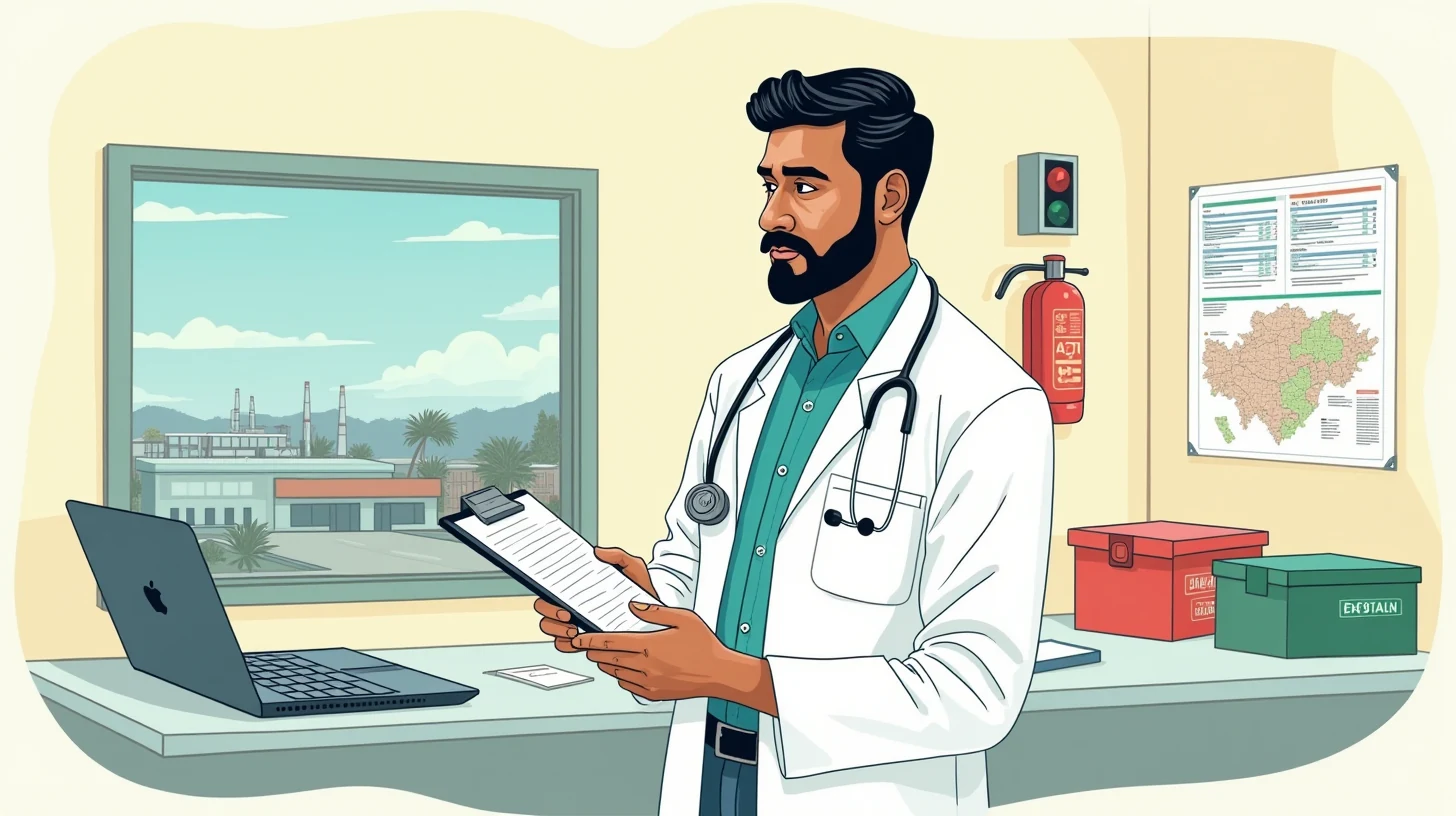
His office is in the ESIC dispensary, a concrete building with a red cross painted on the gate, located inside the industrial perimeter. The building contains an examination room, a small ward with four beds for short-term observation, a pharmacy, an X-ray unit from 2008, and a staff of four: himself, two nurses, and a pharmacy technician. It operates 7 AM to 6 PM, Monday to Friday, with emergency provisions only for life-threatening injuries. The nearest government hospital—Silvassa Civil Hospital—is twelve kilometers away and perpetually under-resourced. Anything requiring specialist care is referred outbound to Gujarat: ESIC Surat Regional Hospital, 150 kilometers away, for tertiary cases; Vapi private hospitals for urgent burns or trauma; and Ahmedabad for cases Surat cannot handle. His income is ₹1,52,000 per month, a stable government salary with job security and pension. It is also the lowest rung of the ESIC hierarchy. There is no promotion pathway without leaving Silvassa. He stays because the problem is interesting—and because he has calculated, with the precision of someone who runs a dispensary, that leaving would mean someone else runs it badly.
On April 18, 2026, at 11:47 AM, the factory siren at Unit 7 (Pinnacle Chemicals, a mid-size polymer manufacturer) sounded not the standard shift-change pattern, but the emergency sequence—three long bursts. The ESIC dispensary received the call two minutes later. A worker named Suresh, aged thirty-two, had been transferring concentrated sulfuric acid from a large storage tank to smaller containers when the transfer hose split. The acid—98% H₂SO₄—sprayed across his right arm, right shoulder, and partially across his neck and jaw. The factory's first-aid station applied water irrigation immediately. Then they called the ambulance.
Vikram did not need the full history to know three things: (1) this was a severe chemical burn, (2) Silvassa Civil Hospital had no burns unit, and (3) the decision tree for the next eight hours was about to become very complicated.
🗓️ The annual ritual
In the UT, occupational health follows a rhythm unchanged since ESIC opened the Silvassa dispensary in 2009. Factory injuries arrive at the dispensary gate. Vikram assesses them. Depending on severity, he either stabilizes and discharges, or stabilizes and refers. The referral options are not always clear. Neither are the hospitals' capacities. Neither is the insurance framework. What exists is what Vikram has built through trial and error over six years: a mental map of which hospital can do what, which contacts answer their phones on a Saturday, which private practitioners will take an ESIC patient without payment upfront. This map lives in his head.
Approximately fifteen to twenty occupational injuries arrive each month across seventeen factories. Of those, two to three each month require referral beyond Silvassa Civil Hospital—some burns, some crush injuries, some respiratory emergencies from chemical exposure, some acute illnesses triggered by workplace conditions. Heat stroke during summer. Acute kidney injury from dehydration. Poisonings from chemical handling. Each required a decision tree that Vikram had built through conversations with senior doctors at ESIC Surat and private practitioners in Vapi.
- 🛑
Factory injury — 7 AM to 6 PM
Worker is injured on-site, first-aid applied by factory staff, ESIC dispensary notified. Vikram begins assessment within ten minutes. If after hours, injury waits for morning or goes directly to Silvassa Civil Hospital.
- 🩺
ESIC dispensary assessment — 10–30 minutes
Airway, breathing, circulation checked. IV access, pain management, fluid resuscitation initiated using Parkland formula for burns. Tetanus and prophylactic antibiotics for open wounds. Transfer form begun.
- 📱
Referral decision — 30–45 minutes
Vikram calls ESIC Surat and Vapi simultaneously. Determines capacity, travel time, and cost-sharing arrangement. Family discusses options. Ambiguity here creates delays. A two-hour gap means infection risk increases exponentially.
- 🚑
Ambulance dispatch — 45–60 minutes
ESIC ambulance leaves with paramedics, oxygen, and Vikram's transfer documentation. Vapi: 40 km, 40 minutes. ESIC Surat: 150 km, four hours. Choice made, no turning back.
- 🏥
Specialist admission — 40 min to 4 hours after dispatch
Receiving hospital reviews transfer form, admits to burns or trauma unit, continues IV fluids and pain management. Delay here depends on whether the receiving doctor had to re-assess from scratch or could continue from Vikram's documentation.
The problem is not that Vikram does not know what to do. The problem is that what he knows is not written down anywhere. The decision trees are in his head. The contacts are in his phone. The protocols are custom, grown from experience, not systematized. If Vikram took a prolonged leave or were transferred to another ESIC station, the next occupational health officer at Silvassa would start from scratch.
⚠️ What very nearly happened
Suresh arrived at the ESIC dispensary at 12:08 PM. The burn was worse than the factory description suggested. Full thickness on the right arm from shoulder to wrist—the skin charred and leathery, with underlying tissue visibly damaged. Partial thickness—raw, weeping, painfully red—across the right shoulder and the right side of the jaw and neck. The worker was conscious, in severe pain, breathing rapid at 28 breaths per minute, indicating compensatory breathing from pain or early shock.
Vikram's immediate actions over twelve minutes were routine for a burns doctor: airway and breathing checked (mouth and throat clear, no soot or swelling, oxygen saturation at 96%), pain and fluid management via IV access (two large-bore lines), morphine (10 mg IV), and Ringer's lactate infusion calculated using the Parkland formula—4 mL × %TBSA × weight in kg. Vikram estimated the burn at 20% of total body surface area. Suresh weighed 70 kg. This required 5,600 mL of crystalloid over twenty-four hours, half in the first eight hours. Burn dressing applied with sterile saline-moistened gauze, covered with clean cotton sheet—no creams, no oils, nothing that would stick. Tetanus toxoid and prophylactic cefazolin IV. Documentation: burn diagram, TBSA calculation, time of exposure, chemical composition, exposure duration (ninety seconds), pre-treatment at scene (water irrigation, ten minutes), current vital signs.
By 12:25 PM, Suresh was stabilized. Pain controlled. Fluids running. Vital signs stable. The question Vikram now faced was no longer how to stabilize. It was where to send him.
"બર્ન કેસમાં દર એક કલાક મહત્ત્વ રાખે છે — પણ આ UT માં તમે દર્દીને ૧૫૦ કિલોમીટર ૨ કલાક માટે ભેજો છો — કે ૪૦ કિલોમીટર ૪૦ મિનિટ માટે, પણ પૈસા માટે."— In a burn case, every hour matters. But in this UT, you either send the patient 150 kilometers for two hours of doubt about whether the receiving hospital can handle it, or 40 kilometers in 40 minutes to a private hospital where the family pays out of pocket.
At 12:30 PM, Vikram made a call to the factory supervisor. "Suresh needs specialist burn care. We can hold him here for six hours while we stabilize fluids and monitor his airway. But this burn needs a burns unit. His ESIC card covers referral to ESIC Surat Regional Hospital, 150 kilometers away, four hours by ambulance. Or we can arrange transfer to Vapi Private Hospital, forty kilometers away, forty minutes. Vapi has a burns unit, but he will need insurance pre-clearance and the cost will come partly from his pocket unless ESIC covers it."
The supervisor asked: "What would you do if he were your brother?"
Vikram paused. "Honest answer? Vapi. It is faster. Burns units are time-sensitive. Every hour of delay increases infection risk and complications. But if he cannot afford it, we go to Surat and work with ESIC."
The family, when reached, made the decision in minutes. They would pay for Vapi. They knew, without needing explanation, that time was the variable.
🌗 What changed
Three days later, Vikram received a follow-up call from Suresh in Vapi. The airway had remained intact. Preliminary assessment suggested the burn would require skin grafting. Estimated cost for a three-week stay with grafting: ₹4 to 6 lakhs. ESIC would cover approximately 50%. The remaining cost would be out-of-pocket for the family. Suresh was recovering. The referral had worked. But Vikram sat with his wife, Anjali (also a doctor, part-time physician at Silvassa government primary health center), and said: "That case worked because I made the right calls. But it worked because of luck. If Vapi had been full, I would have sent him to Surat, and he would have lost two hours. If the ambulance had broken down, he would have deteriorated in transit. If the family could not afford the out-of-pocket costs, he would have gone to Surat, not because it was the right choice, but because it was the only choice."
Anjali, who had heard this reasoning before, said: "So what do you do about it?"
A week after Suresh's case, on April 25, Vikram sat in his dispensary office one evening and typed a message into the AI agent on his tablet, setting it to Gujarati. He needed to think through the referral problem systematically—what if he could document every decision tree, every contact, every criterion for transfer? He typed: "અમે ૧૭ ફેક્ટરીમાં ૨,૪૦૦ કર્મચારીઓને સેવા આપીએ છીએ, પણ દર બર્ન કેસે મને સ્વતંત્ર ટેલિફોન કૉલ કરવાનો પડે છે. ક્યાં હોસ્પિટલ જવું, કેટલો સમય લાગશે, એટલો બધું આપણા માથામાં છે."
"ડૉક્ટર શર્મા, તમે જે નેટવર્ક બનાવ્યો તે મહત્વપૂર્ણ છે. પણ તે આપણા માટે લૉક ઇન કર્યો નથી. ચાર પાર્ટ્સમાં સોચો: પહેલો, ఇंજુરી ટાઇપ મુજબ ઘર આધारિત રેફરલ પાથ (બર્ન = Vapi, ક્રશ = Surat, રેસ્પિરેટરી = Surat). બીજો, પ્રી-ક્લીયરેન્સ એગ્રીમેન્ટ — Vapi અને ESIC Surat સાથે કોર્ટરલી બેડ રિઝર્વેશન. ત્રીજો, સ્ટેન્ડર્ડ ટ્રાન્સફર ફોર્મ જે ૫ મિનિટમાં ભરાય. ચોથો, તમે તે કામ લેવાયો તોય, આગલો ડૉક્ટર તેને ચાલુ રાખી શકે."
(Dr. Sharma, the network you have built is important. But it is not locked in for us. Think in four parts: first, injury-type-based home referral pathways (burn equals Vapi, crush equals Surat, respiratory equals Surat). Second, pre-clearance agreements—quarterly bed reservations with Vapi and ESIC Surat. Third, a standard transfer form that takes five minutes to fill. Fourth, even if you step down, the next doctor can continue it.)
Vikram sat back. The agent had named the problem precisely as he had felt it. He requested a meeting with the ESIC Silvassa Regional Director.
Over the next month, a working group formed. It included Vikram, a senior consultant in occupational health at ESIC Surat Regional Hospital, a senior occupational health officer from Vapi's burns unit, the chief medical officer from Silvassa Civil Hospital, a representative from Daman's ESIC dispensary, and a paramedic from the Silvassa industrial ambulance service. Over two half-day meetings on Zoom, they mapped out the real issue: when an industrial injury occurred, the referral options were not clearly communicated. Families delayed decisions. Ambulances were not always available. Hospitals in Gujarat were not pre-informed and could not accept transfers immediately.
The solution was three-part: First, pre-identification of injury types and recommended destinations. Burns to Vapi or ESIC Surat. Crush injuries to ESIC Surat or Ahmedabad trauma centers. Respiratory emergencies to ESIC Surat. Second, pre-clearance: a quarterly agreement with Vapi and ESIC Surat to keep standing emergency beds available for UT referrals, with ESIC patients receiving priority admission. Third, documentation: a standardized transfer form capturing everything the receiving hospital needed—chemistry of exposure, time, interventions done, vital signs, fluid status—so the receiving physician could continue treatment without re-assessment delays.
Hospital capacity check
15–20 min per caseVikram called ESIC Surat and Vapi separately, waiting for answers about bed availability and reception readiness. Pre-clearance agreements eliminated the guesswork; standing beds mean immediate acceptance.
Family decision delay
Variable, up to 2 hoursFamilies asked multiple questions: Which is better, which is closer, who will pay. Clear referral pathways mean one conversation: this injury type goes to this hospital, here is the cost breakdown.
Transfer documentation
Haphazard notesVikram's transfer forms varied by case. The receiving doctor often re-assessed from scratch, losing time. A standardized form means Vapi's burns unit sees TBSA, fluids, interventions, without delay.
By the end of May 2026, Vikram had drafted a fifteen-page protocol document. It included decision trees for twelve common industrial injury types, contact numbers for four receiving hospitals, and a transfer form designed to be completed in under five minutes. As of May 26, the protocol has not been formally adopted. Ashok Kumar said he would submit it for approval at the next ESIC regional conference, but no date has been set. ESIC Surat verbally agreed to the pre-clearance model but wanted headquarters formalization first. Vapi said they would accept it but wanted a quarterly fee—approximately ₹5,000 per month—to reserve emergency bed capacity, a cost the ESIC budget did not anticipate.
🧭 Why we built it
Vikram understands the barriers. They are partly bureaucratic inertia, partly financial constraint, partly the reality that occupational health is not a revenue generator. It is a cost center. Protocols are not funded unless they reduce costs or liability. A protocol that makes referrals smoother and faster is good practice, but it is not a cost reduction—it is actually a cost increase, because faster referrals mean more transfers, which means more spending.
But underneath the bureaucratic barriers is something structural: occupational health in the UT is, fundamentally, an orphan. The factory system exists to serve industry, not medicine. The ESIC system exists to cover workers, but it is designed around state-level infrastructure. The UT is too small to have its own medical school, its own specialist centers, its own healthcare ecosystem. The entire edifice leans on goodwill—Vikram's goodwill with Surat, Surat's goodwill with referral centers, Vapi's goodwill with private insurance networks. When the system works, it works because a physician in Silvassa stayed late to make calls. When it fails, it fails because no one organization owns the problem.
The frontier of occupational health in the UT is not a lack of knowledge or medical skill. It is the gap between what one person can manage and what a system should provide. A doctor cannot scale himself. He can only write down what he knows and hope the next person reads it.
🌱 What we hope happens
It is May 2026. Suresh is recovering well in Vapi. The family estimates the total cost, after insurance, will be approximately ₹1.8 lakhs out-of-pocket. ESIC paid ₹3 lakhs. It is a good outcome for a severe burn. Suresh sent a message thanking Vikram for the fast referral decision. The dispatcher who drove the ambulance mentioned that the transfer form Vikram had prepared was the most complete he had ever seen—it meant the Vapi doctor did not waste time re-assessing things already documented.
Vikram is still running the ESIC dispensary, 7 AM to 6 PM, Monday to Friday. His income is still ₹1,52,000 per month. He is spending three to four hours per week on the referral protocol work—attending working group calls, refining decision trees, gathering feedback from practitioners. He is doing it with zero additional funding and zero additional time allocation. He is doing it because Suresh's case made clear to him that the gap between a worker being transported to Surat (four hours, delayed grafting, higher risk of infection) and a worker being transported to Vapi (forty minutes, timely intervention, better outcomes) is a gap that should not exist by chance. It should exist by design.
The question that stays with him—the one he voices when asked why he invests time in something that does not improve his own position or income—is about what industrial medicine really means in a UT without scale. "In Gujarat, an occupational health doctor is part of a system. There are medical schools producing occupational health specialists. ESIC centers in every district. Private hospitals expecting industrial referrals. The system is designed to handle thousands of injuries. But here, in the UT, there is one dispensary serving four thousand workers across three regions, with one senior doctor—me. That is not a system. That is a person."
The protocol he is building is an attempt to turn that person into a system. To write down, in clear language, what should happen when. To remove the dependency on individual judgment calls and replace it with decision trees that any occupational health doctor could follow. It is a frontier that most states have already crossed. In the UT, it is still being drawn, one referral at a time, with phone calls that a state-level occupational health network should be making instead.