
The Srinagar doctor and the winter road closure
Dr. Arif Qayoom is fifty-three years old. He has been a general physician for twenty-eight years—fourteen years as a junior doctor at SKIMS Srinagar, six years as a consultant in the same institution, and eight years in private referral practice in Jawahar Nagar, the central district of Srinagar. His clinic sits in a three-storey building with a corner window overlooking the Jhelum River and, beyond it, the northern slopes of the Pir Panjal range, where in November the snow begins to gather on the higher peaks. He sees patients by appointment, Monday to Saturday, 10 AM to 1 PM and 4 PM to 7 PM—but the afternoon slots often extend into evening because referral cases from smaller towns arrive without schedules, and because the road that connects them changes with the weather.
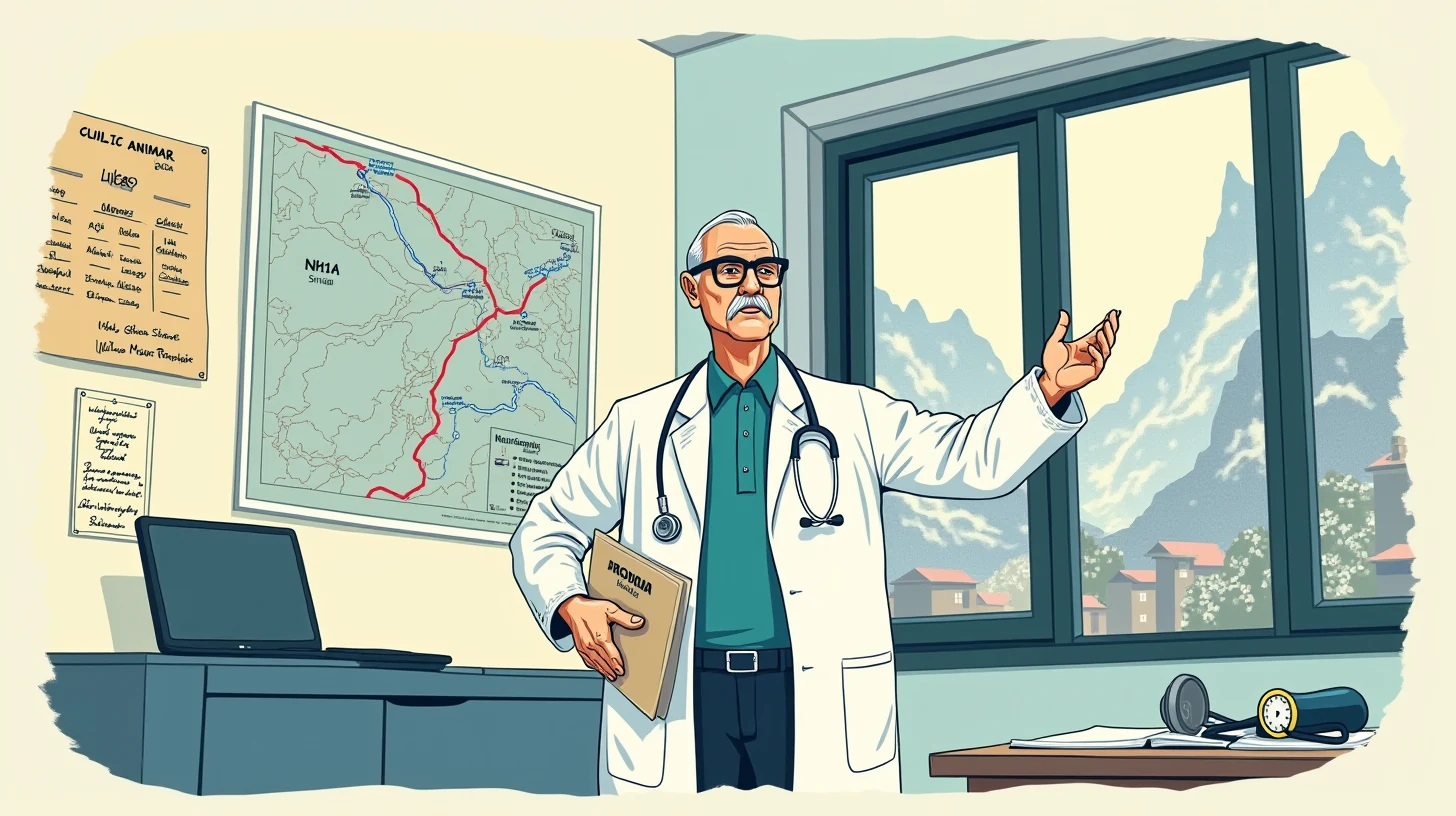
His income oscillates between ₹3 lakh and ₹6.5 lakh annually. Winter brings a different problem: not fewer patients, but a different calculation entirely. Winter in the Kashmir Valley brings the annual closure of NH1A—the only all-weather road connecting the valley to Jammu and the rest of India. Winter brings the question that Arif must answer every November: how many patients can I safely see in my clinic when the only hospital that can save them becomes unreachable?
🗓️ The annual ritual
NH1A runs 270 kilometres from Srinagar to Jammu, climbing over the Pir Panjal at Banihal Pass. Between December 15 and February 28, when heavy snow closes the upper passes, the road becomes impassable—sometimes for three days, sometimes for two weeks. When it closes, it closes completely. No commercial traffic moves. No ambulances cross. The only routes out are helicopter evacuation, which is weather-dependent, capacity-limited, and expensive, or the old cart track over the mountains, which in snow is not viable for a medical emergency.
SKIMS Srinagar—the tertiary care centre for the entire Kashmir Valley and parts of Ladakh—is 35 kilometres from Arif's clinic by road. In normal traffic, 45 minutes. In winter snow, 90 minutes. If the roads close, it becomes unreachable except by helicopter. AIIMS Jammu, the second tertiary centre, is 220 kilometres away—a four-hour drive in fair weather, eight to ten hours if the passes are snowed in, unreachable if NH1A closes. Private hospitals that could manage cardiology emergencies or acute surgery do not exist in the valley. The private imaging centres in Srinagar are diagnostic-only; they have no in-patient beds, no ICUs, no ventilators.
What this means, practically, is that from mid-December to late February, Arif's clinic becomes the de facto gateway to specialty care for the entire central valley. Patients with suspected heart attacks, with uncontrolled hypertension, with new-onset fever and a cardiac murmur, with abdominal pain and jaundice—they all arrive at his clinic because they trust him, because they cannot afford the private hospital in Jammu (which costs ₹3 lakh to ₹5 lakh per admission), and because they assume that he will know what to do if the roads close while they are in his care.
Every November, Arif opens a file on his desktop labeled "WINTER_PROTOCOL" and performs the calculation: how many referral cases can I safely take in December without risking a patient stranded between my clinic and the only hospital that can save them? The answer, for six years running, has been: fewer than I would see.
- ⚖️
November — Winter Protocol Planning
Arif and government doctors across the valley review weather forecasts and NH1A closure data from previous years. SKIMS administrators issue guidance on referral acceptance during winter months. Private practitioners must decide whether to scale back complex cases.
- 📨
November 1–December 10 — Safe Referral Window
Before the worst snow, acute cases can be safely referred to SKIMS. Cardiologists schedule elective procedures. Emergency admissions spike as doctors rush to admit cases while roads are still predictable.
- 🛑
December 10 — February 28 — Road Closure Risk
Patient referral patterns change. Complex cases that require rapid re-referral or multi-stage interventions cannot be safely sent. Arif turns away cases, reduces income, but avoids patients trapped between clinic and hospital.
- 💳
Mid-Closure — SKIMS 100%+ Capacity
Patients who were admitted before closure cannot be discharged. Stepdown wards fill. ICU beds are occupied by stable patients waiting for roads to reopen. New emergencies must wait.
- 🌱
Late February — Roads Reopen
NH1A clears. Patient discharges resume. Hospital census drops. Arif's income rebounds as deferred cases return. The frontier returns to normal—until November.
⚠️ What very nearly happened
In November 2025, Arif called Dr. Samir Khan, the director of SKIMS outpatient services. They had been medical students together. Arif said: "Samir, I need to reduce my December intake. I can take routine consults, but no complex cases—no acute coronary syndromes, no undiagnosed hypertension emergencies, no suspected cancers requiring cross-division coordination. Anything that needs a hospital bed if it goes wrong, I need to turn away or refer directly to you."
Samir said: "Arif, you understand this will affect your income?"
"Yes."
"You understand your patients will be disappointed? Some of them travel from Baramulla, from Kupwara. They have appointments with you that they cannot change."
"Yes. But I understand the roads better than they do. And I understand what happens when a patient needs an ICU bed and the helicopter cannot fly."
The calculation Arif made was familiar to him by now. In 2019, when the August reorganisation brought Jammu & Kashmir from state to union territory, administrative boundaries shifted, some government doctors were redeployed, positions froze, and the political uncertainty made it unclear whether the winter road closure protocols would remain in place. He had been making versions of this calculation ever since. It had become more specific with each passing year.
What nearly happened was this: a patient would arrive at his clinic in early December with a presentation that required SKIMS-level care—a heart attack, an acute stroke, an acute abdomen. He would refer them. The roads would close within 24 hours. The patient would be admitted but unable to leave. SKIMS would be over 100% capacity, holding stable patients in ICU beds because the hospital could not discharge them while the roads were closed. And Arif would be left wondering: did I send them, knowing the roads would close, because the alternative—not sending them—was worse?
"ہمارے پاس ڈاکٹر ہیں، ہمارے پاس ادویات ہیں — مگر ہمارے پاس سڑک نہیں ہے۔"— We have doctors, we have medicines—but we do not have the road.
🌗 What changed
On November 24, 2025, at 8:45 AM, Arif received a call from the district hospital in Baramulla, a town 50 kilometres north of Srinagar. A patient named Rashid, sixty-two years old, had woken with chest pain—heaviness across the chest, radiating to the left arm, ongoing for two hours. An ambulance had brought him to the district hospital casualty. The ECG showed ST-elevation in the anterior wall leads. STEMI. Acute myocardial infarction. The left anterior descending coronary artery was completely blocked. The treatment was angiography and immediate stent placement, available only at SKIMS.
The district hospital doctor asked: should we transport him now, or wait?
Arif did not hesitate. "Oxygen via mask. Aspirin 300 mg, clopidogrel 600 mg, atorvastatin 80 mg, sublingual nitroglycerin. Get IV access. Call SKIMS and tell them an anterior STEMI is coming, ETA 45 minutes."
What Arif did not say on the phone, but was thinking, was this: the date is November 24. Fresh snow is forecast for November 26 or 27. Rashid needs stent placement within two to three hours of symptom onset if mortality is to be minimized. If the roads close in the next 36 hours, he will be in an ICU bed at SKIMS, stable, waiting for discharge but unable to leave. But if he does not go now, and if he has another chest pain episode at home without intervention, the mortality risk is higher. The decision was: transport immediately.
Rashid reached SKIMS by 12:15 PM. The cardiology team was waiting. Urgent cardiac catheterization revealed a completely occluded left anterior descending artery. A drug-eluting stent was placed. By 1:30 PM, he was in the cardiology ICU, cardiac output improving with oxygen and intravenous heparin. By 8 AM on November 27—just hours before the roads closed—Rashid was discharged to the stepdown ward, stable, troponin elevated but trending down, on dual antiplatelet therapy.
The forecast for November 26 had been updated: fresh snow in the upper passes, NH1A closure predicted for November 27 midday, roads closed for 3–4 days, reopening November 30 or December 1.
What this meant for Rashid was clear: he would be in SKIMS when the roads closed. But he was no longer in the ICU. He was stable. The stent was patent. By the time the roads opened, he would be home.
"اس بار، سڑک بند ہونے سے پہلے خطرے سے نکل گیا۔ اگلی بار نہیں ہو سکتا۔"
(This time, he escaped the danger before the road closed. Next time it might not be so fortunate.)
Arif had handled one case and seen it resolve not by changing the system, but by timing—by the narrow window between admission and closure. But what stayed with him was the structural reality: he had managed Rashid's case individually. But an individual solution is not a system solution.
🧭 Why we built it
There are approximately 2,400 government doctors in Jammu & Kashmir—the majority posted to Jammu division and smaller towns. SKIMS Srinagar absorbs referrals from a 300+ kilometre radius. Specialist OPD waits at SKIMS are 3–6 months. The tertiary care system in the valley is stretched to 100%+ capacity year-round. The winter road closure makes it structurally worse.
Arif documented this five winters ago, when he was still working part-time at SKIMS. He found that during the two-week period each December when road closure frequency spiked from 10% to 40%, the SKIMS ICU census increased by an average of 22%—not because more critically ill patients arrived, but because stable patients who would normally have been discharged were held in hospital beds waiting for road stability. Beds filled. The waiting list for elective cases grew. Patients with routine complaints were pushed to the bottom of the OPD queue.
What he did not publish, because it would have been politically sensitive, was his conclusion: the road closure is not just a logistical problem. It is a structural problem in how specialty care is distributed across the union territory. SKIMS is at capacity. The winter road closure makes it worse. And the only way to manage it, for now, is to not send patients when you cannot guarantee them a route back home.
This affects not just cardiology. It affects all specialty care. A child with suspected meningitis cannot be safely sent to SKIMS in mid-January if the roads are forecast to close. A woman with complications from diabetes cannot be safely referred for an ICU-level intervention if the hospital might be cut off. The calculation compounds across every clinic, every specialty, every town connected to Srinagar by NH1A.
SKIMS Overcapacity
100%+ year-roundThe only tertiary care centre in the Kashmir Valley operates at constant overflow. Winter road closures prevent patient discharge, filling ICU beds with stable patients. No capacity for surge admissions.
Geographic Isolation
14 days/seasonNH1A closes an average of 14 days per winter. When it closes, the valley becomes geographically isolated. Helicopter evacuation is weather-dependent, capacity-limited, and expensive. No ambulance route exists.
Fragmented Referral System
No private coordinationGovernment doctors have cadre structures and administrative hierarchy. Private practitioners work independently. No mechanism exists for collective decision-making about winter referral protocols.
Arif spent three weeks in December trying to organize private practitioners. He called colleagues. He explained the problem. Of twenty he called, twelve agreed the problem was real. Of twelve, three said they would attend a meeting. Of three, one showed up. The meeting never happened.
The barrier to change is not the absence of knowledge. It is the absence of coordination. Every doctor in the valley knows the roads close. Every doctor knows SKIMS is over capacity. But no institution has stepped forward to pre-agree on protocols, to train people, to communicate, to plan. So every November, individual practitioners make individual calculations. Some turn away patients. Some send them anyway. Some reduce their intake. No system solution exists.
🌱 What we hope happens
It is February 2026. The roads are stable. The winter season is ending. Arif's clinic is back to normal intake. Rashid came in for his one-month post-STEMI follow-up in early February. His ejection fraction had improved to 42% on repeat echocardiography. He is on dual antiplatelet therapy, long-acting beta-blockers, and an ACE inhibitor. He returns to Baramulla with a cardiology appointment scheduled for four weeks hence.
The winter protocol proposal remains on Arif's desk, unsigned by SKIMS administration, unimplemented by the private sector, unchanged since December.
What stays with Arif, and what he will calculate every November when the first snow falls on the Pir Panjal, is a question about the definition of medical practice in a geographically constrained region.
"We are not short on treatment options," he said. "We know how to treat a heart attack. We know how to manage stroke. We know the protocols. What we are short on is the assumption that the patient will be able to reach treatment. The entire system of medical care in India is built on the assumption that if something bad happens, you can get to a hospital. But in the Kashmir Valley, from December to February, that assumption is false. The roads close. The assumption fails. And we do not have a backup system. What I did this winter was an individual solution—tell patients not to come unless they are truly emergencies, which reduces my income and makes some patients feel abandoned. But an individual solution is not a system solution. A system solution would require SKIMS and the private sector to pre-agree on protocols, to train people, to communicate, to plan. None of that happened. So next November, I will make the same calculation. I will reduce my intake. Some patients will be turned away. And we will hope that the roads do not close while they are in crisis."
He paused, then: "The frontier, in my understanding, is not the absence of knowledge or treatment options. The frontier is the gap between what you can do in a hospital in Srinagar and what you must do when your patient is in a clinic fifty kilometres away and the roads that connect them have become impassable. Until that gap is bridged—not by more doctors, but by protocols and coordination—we are managing a crisis, not practising medicine."
If you are a physician in Jammu & Kashmir, or a family member caring for someone in the valley, the product is free at gabforge.in. We have native Urdu, Kashmiri, Punjabi, Hindi, and English, and the routing knows SKIMS appointment procedures, the NHM emergency protocol contacts, the SEHAT health assurance scheme empanelment process, and the weather-forecast integration with road-closure likelihood. You can set it up on a tablet in twenty minutes. We will not advertise to your patients. We will not sell your data. We will help you read the winter forecast with the same care you would use to read a clinical presentation.