
The Agartala bamboo maker and the wrong trade code
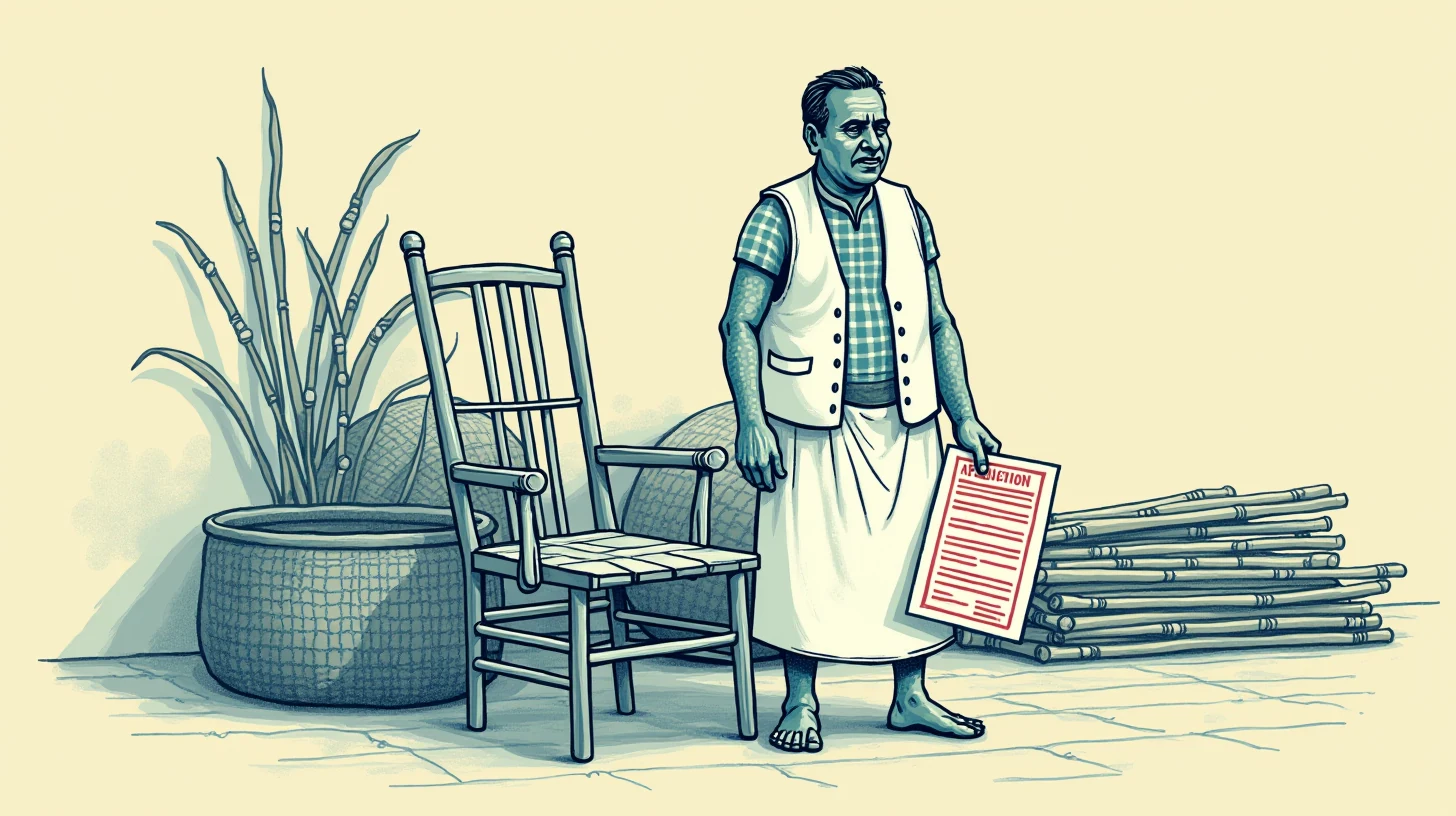
Bijoy Das stands in his workshop in Battala market, Agartala, with a bamboo chair half-finished in his hands. The chair is beautiful — slender poles lashed with jute, the seat woven in a diamond pattern that his father taught him to do fifty years ago, when Bijoy was twelve and his father was still alive. His father made baskets. Bijoy scaled up to furniture. The skills moved up with him, but the paperwork never followed.
The workshop is a long room on the second floor, reachable by a narrow staircase that creaks under weight. The walls are lined with finished pieces: chairs, stools, shelves, even a full bed frame made of bamboo poles and jute webbing. On the ground floor, in the shop, customers come in and place orders. Bijoy makes them in the workshop. His wife handles payments. They have been doing this for twenty-two years, ever since Bijoy took the leap from his father's basket-making and decided that furniture could work in Agartala.
In January 2024, the state government announced the PM Vishwakarma Yojana — a scheme to give small artisans ₹1 lakh in free toolkit and ₹3 lakh in collateral-free credit. Bijoy read about it in a WhatsApp message from his neighbour. He went to the DIC (District Industries Centre) office in Agartala to apply.
The form had a list of eighteen trades. Bijoy read through them: carpenter, mason, blacksmith, plumber, welder, electrician, basket weaver, leather worker, tailors, dyers, cobbler, and ten others. He saw "carpenter" and thought, "I work with wood. That's me." He filled in Trade 5 — Carpenter — and submitted the application.
Three weeks later, a letter arrived. It said: "Application rejected. Applicant does not qualify under Trade 5 (Carpenter). Bamboo workers must register under Trade 7 (Basket Weaver). Please reapply." The letter was polite. It was also final.
Bijoy read the letter twice. He didn't understand. He wasn't a basket weaver. He made furniture. What did the DIC mean?
🗓️ The trade code problem
India's PM Vishwakarma Yojana lists eighteen trades. Each trade has a specific definition, a toolkit value, and a credit limit. The scheme is designed to give small artisans the tools they need to start or scale. But the definitions matter. A carpenter uses wood and metal. A basket weaver uses cane, rattan, and bamboo. The distinction seems obvious — until you realize that bamboo furniture makers are closer to basket weavers than to carpenters, because the material is the same, the lashing techniques are the same, and the market is the same.
Bijoy had been making bamboo furniture for two decades. He had never been a "basket weaver" on paper. He had learned from his father, who made baskets. But Bijoy had grown beyond baskets into chairs, beds, shelves. In his mind, he was a furniture maker. On the PM Vishwakarma form, that most closely matched "carpenter." So he filled that in.
The DIC rejection letter was not a refusal of the scheme. It was a direction to the right category. The letter said: "Bamboo workers, including furniture makers, qualify under Trade 7 (Basket Weaver) because the primary material is bamboo and the techniques — lashing, binding, weaving — are traditional basket-making skills, even when applied to furniture." This made sense once it was explained. But no one had explained it.
The PM Vishwakarma portal does not explain this. The DIC office did not proactively tell applicants. The assumption was that Bijoy would read the rejection, understand the reason, and reapply under the correct trade. Some people do. Most do not.
⚠️ Three notices, one afternoon
Bijoy was still thinking about the rejection when his neighbour's daughter, Ritu, came home to visit from Bangalore. Ritu works at the DIC Agartala office — she's a data entry operator there, just twenty-four years old, processing MSME applications. She was having tea with her mother in the next house when her mother mentioned Bijoy's problem. Ritu went upstairs to the workshop.
Bijoy showed her the rejection letter. Ritu read it and nodded. "This happens every month," she said. "Bamboo workers come in, see 'carpenter' on the form, apply, and get rejected. Then half of them give up."
She asked Bijoy a few more questions. Did he have an Udyam certificate? Yes, from 2019. Did he have any government registrations for selling to government offices? No. Was he trying to bid on any state tenders? He said he had heard about a Tripura government office supplies tender, but he didn't know how to register.
Ritu said, "Let me help you." She took his phone and installed GabFORGE.
Over the next two hours, sitting in the workshop with Bijoy and his wife Saloni, Ritu explained what the agent could do. She asked it to look at three things: (1) why the DIC rejected him, (2) why his Udyam certificate was outdated, and (3) why he couldn't access the state B2G tender portal.
The agent worked through the logic. It found that:
First: The PM Vishwakarma portal's Trade 7 (Basket Weaver) explicitly includes "bamboo furniture makers" in the detailed eligibility criteria. Bijoy had misread the main list and applied under Trade 5. He needed to reapply under Trade 7.
Second: His Udyam certificate was registered in 2019 under the old UAM (Udyog Aadhar Memorandum) format. The North East MSME Finance scheme (NEMCF) and the state tender portal required a current Udyam certificate issued after 2020. The old UAM was no longer accepted. He needed to migrate to the new Udyam format.
Third: The Tripura Handicrafts Board ran a registration portal called ATITHI (Assisting Traditional & Indigenous THI artisans). This portal was the gate to the state B2G tender system. Without ATITHI registration, Bijoy was invisible to the government procurement system, even though his work qualified.
Three separate rejections, each with a different cause.
"আমি তো কার্পেন্টার নই, বাঁশের কাজ করি। কিন্তু ফর্মে বাঁশের কোনো অপশন দেখি না।"— I'm not a carpenter. I work with bamboo. But I don't see bamboo as an option on the form.
🌗 The category correction
The agent explained the three fixes in Bengali. This is what it told Bijoy:
"বিজয় ভাই, তিনটি সমস্যা আছে। প্রথমত, PM Vishwakarma এ আপনি Trade 5 এ apply করেছেন, কিন্তু বাঁশের কাজ Trade 7 এর অন্তর্ভুক্ত। দ্বিতীয়ত, আপনার Udyam সার্টিফিকেট ২০১৯ এর, এটা UAM ফরম্যাট। NEMCF স্কিম নতুন Udyam চায়, ২০২০ এর পরে। তৃতীয়ত, Tripura তে state tenders দেখতে হলে ATITHI registration দরকার। তিনটাই ঠিক করা যায়। Trade 7 এ reapply করুন, Udyam update করুন, ATITHI তে register করুন।"
(Bijoy, there are three problems. First, you applied under Trade 5 in PM Vishwakarma, but bamboo work is under Trade 7. Second, your Udyam certificate is from 2019 — that's the old UAM format. NEMCF requires the new Udyam, issued after 2020. Third, to access state tenders in Tripura, you need ATITHI registration. All three can be fixed. Reapply under Trade 7, update your Udyam, register with ATITHI.)
Ritu, who was sitting in the corner with her phone, said, "I can help with all three."
She called her colleague at the DIC and asked him to flag Bijoy's file for Trade 7 re-registration. The next day, Bijoy went to the DIC office with Ritu, filled in the correct form, and submitted it. The colleague said the re-registration would take two weeks. It took two weeks.
For the Udyam migration, Ritu sat with Bijoy at his home and did it online. She logged into the Udyam portal, uploaded the documents that were still valid (PAN, Aadhar, bank statement), and changed the certificate status from UAM to the new Udyam format. The system issued a new certificate number the same day. The old UAM was archived.
For ATITHI, Bijoy had to register on the Tripura Handicrafts Board portal. He provided photographs of his work, a brief description of his process, and his business registration. The board reviewed applications in batches. It took three weeks. In the third week, he received a confirmation: "ATITHI Registration Approved — Bamboo Furniture Maker, Agartala."
What it does
What it does not do
🧭 Why trade codes lock artisans out
The PM Vishwakarma scheme is built around eighteen trades that were considered the "core traditional artisan categories" when the scheme was designed. The list includes obvious ones: blacksmith, carpenter, mason. But it also includes narrower ones: basket weaver, dyer, leather worker, cobbler. Each trade has a specific toolkit value and credit limit. The scheme assumes that each artisan fits neatly into one category.
In reality, artisans move between categories. A basket weaver becomes a furniture maker. A cobbler starts making leather bags. A blacksmith learns welding. The material and technique evolve, but the person's primary identity on paper stays fixed. If an artisan applied under "basket weaver" ten years ago but now makes bamboo furniture, they are still, on paper, a basket weaver. If they try to apply for the scheme again, the system checks their registration history and rejects them as "already registered."
Bamboo work is a particular victim of this logic. Bamboo workers in India exist on a spectrum from pure basket weaving at one end to large-scale furniture manufacturing at the other. The PM Vishwakarma scheme puts them all under Trade 7 (Basket Weaver). An artisan like Bijoy — who has not made a basket in twenty years — still has to apply under a category that doesn't describe what he does. The category is correct, technically. But it feels wrong to him. So he guesses wrong. The system rejects him. And most artisans, at this point, give up.
The NE MSME Finance scheme and the ATITHI registration add two more layers of bureaucracy. Each requires a different credential. Each has a different validation system. A Tripura artisan like Bijoy has to navigate three separate portals, three separate forms, and three separate approval processes. The approval is not automatic. It is not based on a single unified identity. It is based on matching the paper category to the scheme's expectations.
This is where an agent that speaks Bengali and understands the artisan's situation becomes valuable. The agent can say, in the artisan's language, why the rejection happened. The agent can explain that the rejection is not about worthiness or capability — it's about matching the right category to the right scheme. The agent can guide the artisan through the three registrations without having to visit the office three times or fill out the forms three times from scratch.
🌱 The B2G order
Bijoy's Trade 7 certificate arrived in March. The ₹1 lakh toolkit subsidy was approved and transferred to his bank account in April. He used the money to buy better bamboo, a motorized lashing machine, and a new set of chisels and cutting tools. The workshop became cleaner, faster. He could take bigger orders.
In May, the Tripura State Office Supplies tender was published on the ATITHI portal. It called for bamboo furniture for three new government office buildings in Agartala. The contract value was ₹82,000. Bijoy submitted a bid, with photographs of his work and a quote.
Two weeks later, Bijoy's bid was accepted. He had won his first contract with the state government.
Ritu came to the workshop the day he found out. Bijoy showed her the letter. It said: "Tripura State Office Supplies — Bamboo Furniture Contract Awarded to Bijoy Das, Battala Market, Agartala — ₹82,000." Ritu took a photo of Bijoy standing next to a half-finished chair, holding the letter. She sent it to her office group with a caption: "This is what happens when someone explains the trade codes in Bengali instead of leaving them in English."
The contract arrived in June. Bijoy hired two workers to help him. His wife Saloni started scheduling deliveries. The workshop, which had been quiet before, became loud with the sound of lashing and cutting. The bamboo poles stacked on the shelves began to shrink as Bijoy built the furniture for the state offices.
This is what an artisan in Agartala needed: not a government office that was kinder, not a form that was simpler, not a scheme that was easier to understand. Bijoy needed someone to read the rejection letter and say, in Bengali, what it meant. He needed someone to say, "Your trade category is wrong, but it's an easy fix." He needed someone to point out that his Udyam certificate was outdated and show him how to update it in one afternoon. He needed someone to tell him that state tenders existed and that he had a path to access them.
The agent did all three. Ritu did the rest. Bijoy now has a government order and a clearer workshop. His father, who made baskets fifty years ago, never bid on a state tender. Bijoy, who scaled his father's skills into furniture, now supplies the state government. The trade code that rejected him the first time became the path that accepted him the second time.
The ₹82,000 order will be complete by August. Bijoy is already bidding on the next tender. The agent sends him a reminder once a month: new Tripura tenders, new NEMCF loan schemes, new PM Vishwakarma updates. The reminders arrive in Bengali. Bijoy reads them. The paperwork no longer feels like a barrier. It feels like a map.