
The Aizawl bamboo weaver and the trade code that blocked her grant
Lali Sailo walked to the District Industries Centre office in Aizawl on a Tuesday morning, carrying her brother's rejections in a brown envelope. The PM Vishwakarma application had come back stamped Not Eligible three days earlier. Tahir had been making bamboo furniture—chairs, tables, bed frames—in a workshop near their family home for three years. He had UAM registration from 2018, a workspace, tools, and steady orders from hotels and tourist lodges across Mizoram. Everything looked right on paper. Everything was wrong in taxonomy.
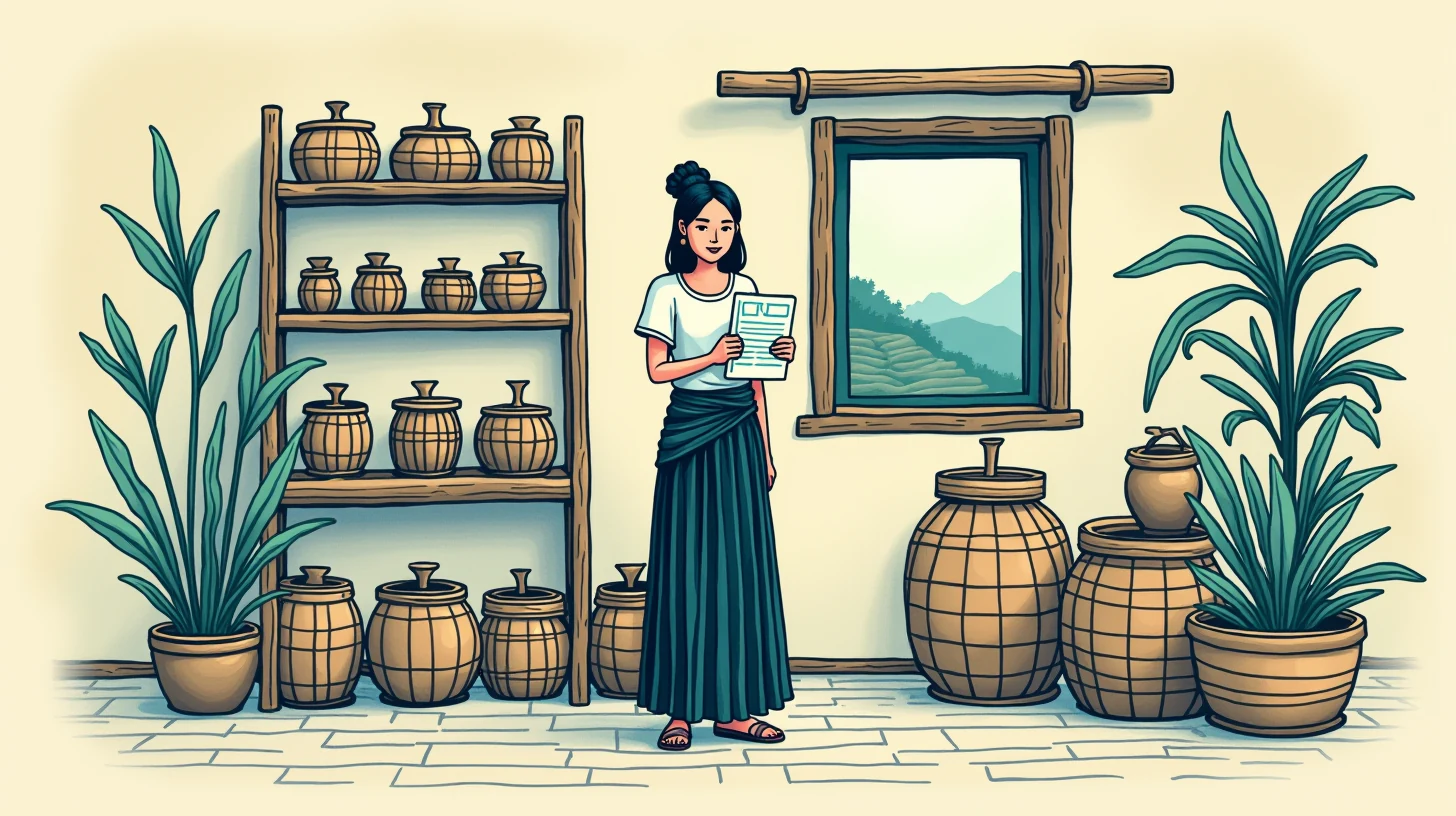
The woman at the PM Vishwakarma help desk glanced at the application and exhaled. "Trade 5 is Carpenter," she said. "Carpenter is wood only. Bamboo is Trade 7—Basket Weaver, Mat Weaver." Tahir had chosen Trade 5 because bamboo, to an outsider, looked like woodwork. Bend it, cut it, join it. But the government's 18-trade list, drafted without NE artisan input, drew a hard line: if the material wasn't timber, it wasn't carpentry.
Lali runs the retail side—the shop in Aizawl market where tourists and locals buy Puan textiles and her brother's baskets, mats, and small furniture. She also holds the Udyam registration, the paper that unlocks credit. That paper was four years too old to matter.
Three failures arrived in the same mailbox that month. PM Vishwakarma said Trade 5 doesn't cover bamboo. NEDFI, the development bank for the Northeast, looked at the 2018 UAM certificate and sent the loan back marked Current Udyam certificate required. And MHDC—Mizoram's Handicrafts Development Corporation—was a name Lali had never heard, hidden in a government registry she didn't know to check. Each barrier meant different paperwork, different deadlines, different offices in a city that already sprawls across steep hills. Then a tourism officer visiting the shop mentioned in passing that she'd seen a PM Vishwakarma success story from someone in Champhai.
🗓️ Why bamboo work is Basket Weaver, not Carpenter
PM Vishwakarma Yojana divides traditional trades into 18 categories. Trade 5 is Carpenter—primarily wood furniture and structural work. Trade 7 is Basket Weaver and Mat Weaver—which includes all woven and plaited materials: bamboo, cane, palm, reed, and straw. The distinction matters because each trade has its own skill standards, supply chains, and market characteristics. Bamboo work in the Northeast—where bamboo forests and regional craft traditions are foundational—falls entirely under Trade 7, even when the output looks identical to wooden furniture.
The District Industries Centre at Aizawl manages trade registration and can issue corrective certificates. When Tahir went back with fresh documents, the DIC officer explained that re-registration under Trade 7 was a simple update: no new Udyam audit, just a form change and a fee. The DIC then forwards the corrected application to the PM Vishwakarma portal. The toolkit subsidy—₹1 lakh for bamboo artisans under Trade 7—doesn't require existing capital or collateral. It's a direct credit to buy tools, materials, and workspace improvements.
Mizoram's Handicrafts Development Corporation (MHDC) is separate but complementary. MHDC registration opens access to government procurement tenders for tourism ministries, cultural departments, and hospitality chains. A single registration unlocks dozens of small orders that retail shops cannot reach. Lali had never heard of it because awareness campaigns don't always reach small operators in smaller cities.
:::infographic type: timeline Four steps that unlocked Tahir's grant
- PM Vishwakarma rejection — Trade 5 (Carpenter) application declined; bamboo furniture is Trade 7
- Tourism officer's remark — Casual mention of success story triggers search for correct pathway
- Trade 7 re-registration + Udyam migration — DIC Aizawl updates Trade 7; Lali migrates 2018 UAM to current Udyam in single session
- MHDC registration — Opens state government procurement; NEDFI loan approved within 48 hours of Udyam update :::
⚠️ Three rejections in one month
The first rejection came from PM Vishwakarma: Trade 5 doesn't include bamboo. That was a category error—fixable by choosing the right trade.
The second came from NEDFI. NEDFI specializes in craft loans for MSMEs in the Northeast. Their application form asked for "Current Udyam Certificate." Lali's 2018 UAM (Udyog Aadhaar Memorandum) certificate was decades of validity remaining, but NEDFI doesn't accept the old format anymore. UAM was phased out in favor of Udyam in 2020. Banks and credit institutions in Mizoram update their systems slowly; NEDFI had moved to Udyam-only verification. The upgrade was free and took one afternoon at the Udyam online portal, but nobody at NEDFI's helpline mentioned the path.
The third barrier was MHDC itself—invisible until it mattered. Lali had registered Tahir's furniture under MSMEs and paid the Udyam fee. MHDC was a separate entity, a state government corporation that she would need to contact directly. MHDC links artisans to government and corporate buyers. Without it, Tahir's work stayed in the tourist market and direct customer network. With it, MHDC publishes tender lists three times a year: hospitality chains buying bulk orders, heritage gift shops for airports, government office refurbishment projects. A single ₹40,000 order from an MHDC tender was bigger than Tahir's average monthly workshop sales.
The tourism officer's casual remark—"Someone in Champhai got their toolkit grant; I saw their workshop update on the DIC notification board"—triggered Lali to search. She found a GabFORGE community post from another bamboo artisan in Tripura who had the same rejection and re-registered under Trade 7. The post mentioned that DIC offices handle the correction quickly.
"Bamboo ame bambuak ti, mahse government trade code-ah chuan a inkhawl mawlh a. Trade 7 a chan chuan toolkit grant a lo awm theih a, mahse khawvelah nise eme tih khan ka han tum tum ang," a ti Lali.(Bamboo is bamboo, but the government trade code had to be right. Trade 7 is where the toolkit grant lives, but you only know if someone tells you.)
🌗 What the category change unlocked
Lali booked a session with a GabFORGE agent who specialized in NE MSME schemes. The agent is Mizo-speaking and helps artisans navigate the gap between local craft reality and central government categories. In Mizo, they discussed the problem:
Lali: "Tahir's bamboo furniture a dah mang lo MSME trade code leh a, rejection a lo tla. Mahse nuai a aw mahse eme tih khan a tul a, ani?"
(Tahir's bamboo furniture wasn't matching the MSME trade code, and rejection came. But something is fixable, right?)
Agent: "Aw, Trade 7 a kan phut ang. Basket Weaver ti. Bamboo an le cane, palm—sawi la in Mizoram artisan workshop-te lam chu Trade 7 a kan lo dah. PM Vishwakarma toolkit grant—₹1 lakh—a lo awm theih a."
(Yes, we put it in Trade 7. Basket Weaver. Bamboo and cane, palm—in Mizoram artisan workshops like yours it's Trade 7. PM Vishwakarma toolkit grant—₹1 lakh—can happen.)
Lali: "Mahse Udyam tul a. Ours 2018 ka la-register. NEDFI chu UAM lo accept lo."
(But Udyam is needed. We registered in 2018. NEDFI doesn't accept UAM.)
Agent: "Udyam portal-ah migration a los. One afternoon. After that NEDFI unblock thei a, amaherawhchu state procurement—MHDC—a lo awm a rin zawk leh."
(Udyam portal has the migration. One afternoon. After that NEDFI opens, plus there's state procurement—MHDC—which is bigger.)
The agent walked Lali through three steps:
Re-register Tahir under Trade 7 at DIC Aizawl — The DIC form change took 20 minutes. DIC forwarded to PM Vishwakarma portal immediately. Three weeks later, toolkit grant approval arrived.
Migrate UAM to Udyam online — Lali logged into the Udyam portal with her AADHAAR, migrated the 2018 UAM record to the new certificate format. No audit, no inspection, no fee. The system generated the new certificate within 48 hours. NEDFI's application, which had been pending, was resubmitted and approved within two business days.
Register with MHDC Mizoram — The agent provided the MHDC contact details and helped Lali prepare the product catalog. MHDC registration took one week. Within the first month, MHDC issued Tahir a tender for 50 bamboo chairs for a government office in Shillong. The order was ₹1.8 lakh—larger than his usual monthly revenue.
"PM Vishwakarma rejection a, Udyam rejection a lo tla chang e, mahse eme tih ka hrethiam lo a. Nuai a, ani? Trade code change, Udyam update, MHDC register—tin a aw. Mahni chiah lo change a, aber a inkhawl."
("PM Vishwakarma rejected me, Udyam rejected me, and I didn't understand why. But something was fixable, right? Trade code, Udyam, MHDC—it was all doable. Just three changes, and everything shifted.")
:::infographic type: boundary What an agent can explain vs. what DIC/NEDFI/MHDC do
Agent explains:
- Why bamboo is Trade 7, not Trade 5
- How to migrate UAM to Udyam
- Where MHDC fits in the value chain
- Which form to fill and in what order
DIC does:
- Updates trade registration; forwards to PM Vishwakarma
- Issues revised certificate for the scheme
NEDFI does:
- Approves loan after Udyam certificate is current
- Does not explain Udyam migration path
MHDC does:
- Registers artisans in state procurement system
- Issues tenders; handles bulk orders
- Does not actively recruit from small retailers :::
🧭 Why NE artisans lose grants to category confusion
The PM Vishwakarma scheme's 18 trades were designed with mainland India in mind. Most are straightforward: Carpenter, Plumber, Electrician, Tailor. But in the Northeast, where bamboo and cane are primary materials and cultural traditions predate modern trade classifications, the schema breaks down. A bamboo artisan making chairs and furniture can reasonably call themselves a carpenter. But the central government's scheme doesn't recognize bamboo work as carpentry—it routes it through Basket Weaver, which feels like a downgrade until you realize the toolkit grant is the same size and the trade code matters more than the name.
NEDFI's Udyam-only requirement also caught dozens of artisans off guard. The transition from UAM to Udyam happened nationally in 2020, but many small operators in Mizoram, Manipur, and Meghalaya renewed their UAM instead of migrating. They didn't know the difference mattered for new credit applications. NEDFI doesn't flag this on rejection; they simply send back the application and move on. The burden of knowing the pathway falls on the artisan.
MHDC exists but operates silently. It doesn't advertise to retail shops; it works through government procurement channels that small operators don't monitor. An artisan can have been registered with MSME for five years without knowing MHDC tenders exist. A single mention—from a tourism officer, from a peer, from an agent—can triple their market access.
The deeper issue is fragmentation: three separate registration systems (Udyam, PM Vishwakarma, MHDC), three different renewal cycles, three different portals. For mainland Indian artisans in larger cities with better internet and proximity to government offices, the friction is manageable. In Aizawl, where one person handles Udyam renewals for dozens of small shops, the friction compounds into silence and rejections that feel permanent.
🌱 Tahir's grant
The first toolkit payment arrived three weeks after Trade 7 registration. Tahir bought a precision band saw, a planer, curing racks, and high-grade adhesive—tools that let him work faster and finish tighter joinery. The ₹1 lakh came directly to his Udyam-linked bank account, no collateral needed. He hired a part-time assistant, moved into a larger workshop space near the vegetable market, and could now take bulk orders without subcontracting.
The MHDC procurement tender for the Shillong order came before the NEDFI loan approval, but having both pathways open meant Tahir could take the risk. The order was delivered in eight weeks. MHDC took a 15% commission, but ₹1.5 lakh net into the workshop still justified the work.
By November 2023, a year after the first rejection, Tahir had three standing orders: 12 chairs monthly for a Mizoram tourism lodge, quarterly MHDC tenders, and Lali's retail customers. Lali expanded the shop to include a small workshop display where tourists could watch bamboo furniture assembly happen. The wrong trade code had forced them to find the right one. The Udyam certificate, aging in a drawer, had led them to the current system. The MHDC name, unheard of weeks before, had become routine.
The rejections didn't feel like mistakes in the end. They felt like checkpoints that forced a clearer map.