
The Daman wholesaler and the state code that disappeared in a merger
The monsoon air in Nani Daman hangs heavy with salt and the smell of cardamom from the wholesale spice merchants three storefronts down. Prakash Patel, 52, stands behind the counter of his provisions shop—the same counter he's stood behind since 1998, the same counter his father bought when it was called a "general store" instead of a "wholesale distributor." His shop is one of thirty in this corner of Nani Daman, tucked between a textile merchant and a pharmaceutical stockist. The shelves behind him climb twelve feet: rice in gunny sacks, flour in cardboard boxes, cooking oil in steel cans, all of it moving through his hands and into the vans of small retailers from Navsari to Daman itself.
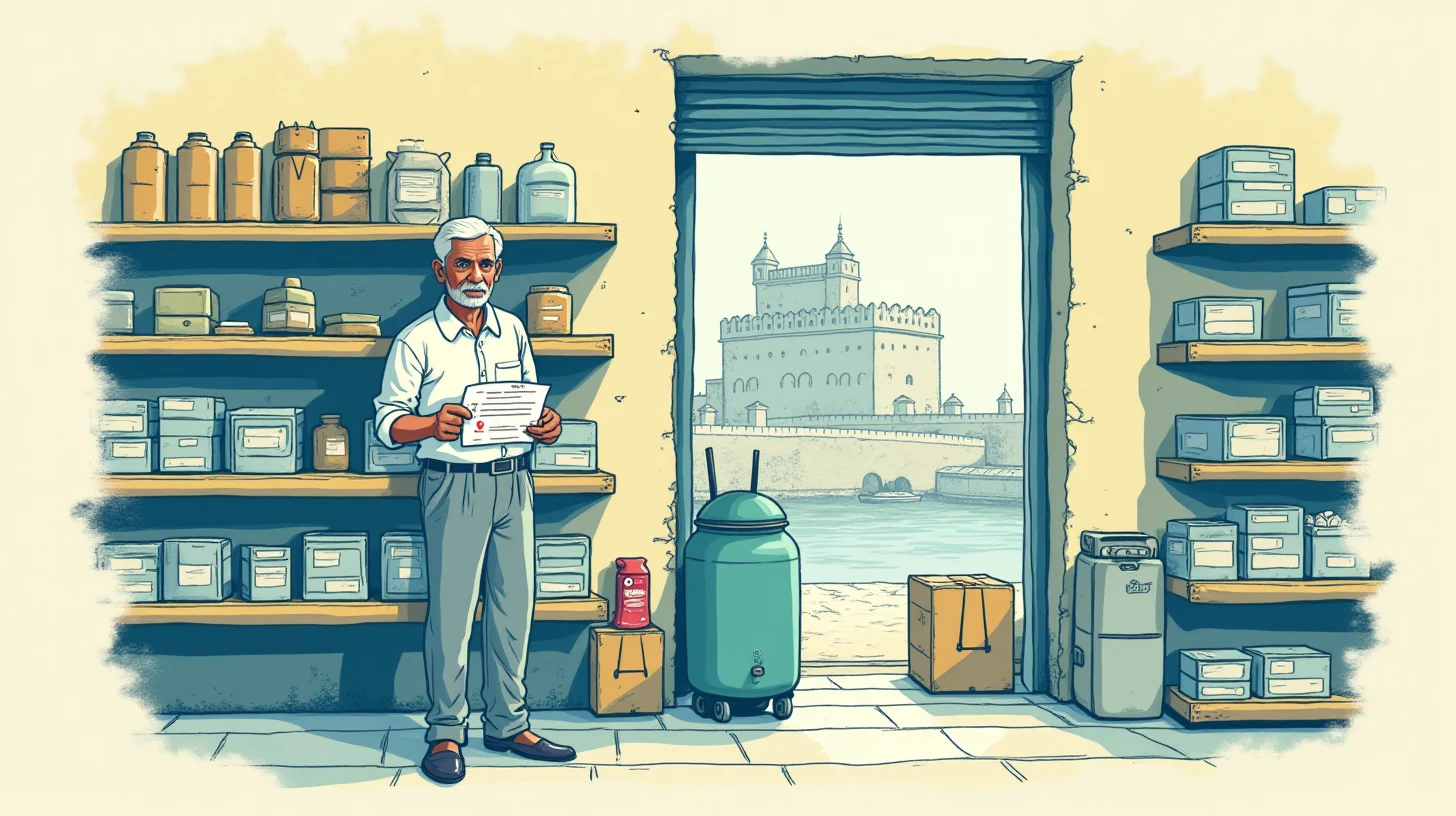
The shop has never been flashy. Prakash has never needed flash. His GSTIN—the 15-digit Goods and Services Tax Identification Number—has been the same since he first registered in 2012. It starts with 25, the state code for Daman & Diu. That number has been on every invoice, every e-way bill, every certificate on his office wall. For thirteen years, it meant something. It meant the GST department knew him. It meant Gujarat buyers trusted his paperwork. It meant the tax system knew where his shop was, and what rules applied.
Then, on October 26, 2020, the shop's GSTIN—the very foundation of his business paperwork—became half-invisible.
🗓️ How a UT merger broke a working GSTIN
The 2020 merger of Daman & Diu and Dadra & Nagar Haveli into a single Union Territory did something that looks simple on paper but broke the entire GST system for businesses like Prakash's. The new UT was called Dadra and Nagar Haveli and Daman and Diu (DNHDD). It was assigned a new GST state code: 26.
Daman & Diu, which had always been state code 25, ceased to exist as a separate jurisdiction. The territory, the law, the administration—all merged into DNHDD. But the businesses that had registered under state code 25 were not automatically migrated. No batch process ran. No administrator sent out letters. The Ministry of Finance issued circulars explaining the change, but there was no mechanism to regenerate GSTINs or automatically update the state code in existing registrations.
Prakash's GSTIN remained registered under state code 25. He was still operating in Nani Daman, still filing GST returns, still paying his dues. But on paper, his GSTIN belonged to a state that no longer existed.
E-way bills rejected
Chirag identifies the pattern
GSTIN core field amendment
FSSAI and licence migration
The first sign that something was wrong came quietly. A buyer in Baroda—a retailer who had been purchasing from Prakash for five years—tried to process an e-way bill for an order of two tons of rice. The portal returned an error: "State code 25 not recognized for the UT DNHDD." The buyer called Prakash. "Your invoice won't clear the highway checkpoint. There's something wrong with your GSTIN." Prakash checked. The GSTIN looked fine to him. He called the GST helpline. The agent on the phone said the same thing everyone would say for the next two years: "You need to update your registration."
No one said how.
⚠️ Three systems, one merger
The DNHDD merger didn't just affect GST. It fractured three separate compliance systems at once, and each required a different fix.
GST: Prakash's GSTIN state code was stuck in the past. Every e-way bill he generated carried state code 25. The GSTN system, updated to recognize only DNHDD (code 26), began rejecting anything that came through with the old code. Buyers in Gujarat and Maharashtra—the markets where he sent most of his wholesale orders—started asking for new invoices from vendors with "valid state codes." Prakash was suddenly unreliable on paper.
FSSAI: His FSSAI registration for food products carried the same legacy state code. The FSSAI portal, FOSCOS, was also updated post-merger. It no longer recognized "Daman & Diu" as a valid state. Renewals couldn't be processed. Buyers doing compliance checks saw a registration that looked outdated.
Shop and Establishment: His Shop and Establishment licence, issued under the old Daman & Diu law and registered with the local municipal office, still showed him as a "Daman & Diu" category business. The DNHDD administration had created a new unified licensing system, but old licences weren't automatically migrated. Technically, his business classification was from a state that no longer existed.
It was this last detail that Chirag noticed when he came home from Surat in May 2023. He was studying commerce, learning about GST and compliance in his classes. He walked into the shop and asked to see the invoices his father had been struggling with. He spread them out on the counter—three years of rejections, all starting in late 2020. He pulled out his phone and Googled "Daman Diu merger GST."
The notification from October 26, 2020, appeared immediately. The Union Territory of Dadra and Nagar Haveli and Daman and Diu: New State Code 26. All existing registrations would need to be amended. Chirag showed it to his father. "That's the date," he said. "That's when everything broke."
⚠️ Three systems, one merger
Prakash read the notification three times. He had been doing business under state code 25 for thirteen years. He had never been told to change anything. No letter from the GST officer. No notification in the newspaper. No call from the shop association. The system had simply decided, in October 2020, that he no longer existed—and then spent two and a half years rejecting his paperwork without telling him why.
"મને કહ્યું, 'તમારો કોડ બદલાયો છે.' પણ કોણ કહે? આંકણી-કર્મચારી? સરકાર? મે તો બસ ઈનવોઈસ લખતો હતો."(They told me, 'Your code has changed.' But who tells you? Some calculator-official? The government? I was just writing invoices.)
— Prakash Patel, wholesale shop owner
🌗 The state that changed its name
Chirag decided to trace the solution backwards. He called the DNHDD GST office and asked what his father needed to do. The officer told him: Core field modification. Form GST CMP-02. The GSTIN state code would need to be amended from 25 to 26. The application would take 15 working days.
Chirag: So we submit a form, and the state code changes?
GST Officer: Yes. But the address must match your current registration. And you'll need to show that the business is still located in the same place, in Nani Daman.
Chirag: And then the FSSAI registration?
GST Officer: That's a separate portal. FOSCOS. You'll need to submit there as well. But you'll need proof of the merger—the government notification or the official gazette.
Chirag: My father's Shop and Establishment licence still says "Daman & Diu."
GST Officer: The DNHDD administration has automated that migration. Once your GSTIN is amended, the licence should update within a week. But verify with the local municipal office in Nani Daman.
Chirag printed the notification from October 2020. He downloaded Form GST CMP-02. He printed the last three GST returns his father had filed—they were still processing, the system was still accepting returns, but the state code was wrong on paper. On the form, he wrote the reason for amendment: "UT merger, October 26, 2020. DNHDD state code 26 now applicable."
His father signed it. On June 15, 2023, Chirag submitted the form to the GST officer at Silvassa, the administrative capital of DNHDD.
"સરકાર બદલાય છે, કાયદો બદલાય છે, પણ ઇનવોઈસ તો સમાન રહે છે—જ્યાં સુધી કોઈ તમને કહે કે તે બદલ્યું છે."
(The government changes, the law changes, but the invoice stays the same—until someone tells you it's changed.)
Prakash waited. The GST officer reviewed the application. The registration was verified. On June 29, 2023—15 working days later—the amendment was approved. Prakash's GSTIN now carried state code 26. When he generated the next e-way bill, the system accepted it without error.
The FSSAI migration came next. Chirag logged into the FOSCOS portal under his father's account. He found the section for state code migration. He uploaded the government gazette notification showing the October 2020 merger. He submitted the form. Within 21 days, the FSSAI registration was updated. The state code in the certificate changed from 25 to 26.
The Shop and Establishment licence updated automatically. The DNHDD municipal office had already migrated all old Daman & Diu licences when they received the merger notification. By the time Prakash's GST amendment was approved, his licence was already correct—it had been waiting for his GSTIN to catch up.
What it does
What it does not do
🧭 Why UT mergers leave compliance gaps
The DNHDD merger wasn't an isolated incident. The creation of Ladakh as a separate Union Territory in 2019, and the reorganization of Jammu and Kashmir, created similar GST code changes. Kashmir (state code 01) became the Union Territory of Jammu and Kashmir (code 01, but with different administrative rules), while Ladakh became a separate UT (code 37). Businesses in both territories faced the same problem: registrations that no longer aligned with geography.
The issue is structural. When a UT merger happens, the Ministry of Finance issues notifications. The GSTN system is updated. But there is no mechanism to automatically update existing registrations. There is no batch process, no notification email, no administrative order that reaches down to the 15 million GST registrants. The burden falls entirely on the business owner to discover the change, file the amendment, and wait 15 working days for approval.
In Prakash's case, the delay cost him three years of rejected invoices, lost orders from Baroda, and the anxiety of operating a business on paperwork that the tax system had declared invalid. His buyers didn't understand why their invoices were being rejected. They assumed his registration was fraudulent or lapsed. Some moved to other suppliers.
🌱 Chirag's vacation discovery
By August 2023, Prakash's GSTIN was correct. His FSSAI registration was migrated. His Shop and Establishment licence matched the new UT code. The e-way bills that had been rejected for three years now processed cleanly.
He sent an e-way bill to the Baroda buyer—the same buyer who had stopped placing orders because of the state code issue. The buyer's system accepted it immediately. "Your GSTIN is valid again," the buyer said over the phone. "We can resume the order."
The first clean invoice under the new state code felt like clearing a debt he didn't know he owed. Prakash printed it and stuck it on the wall next to the other certificates, the ones that now all said the same thing: valid, current, in the state of Dadra and Nagar Haveli and Daman and Diu.
Chirag returned to Surat in August 2023, back to his commerce degree. But before he left, his father showed him something. A new order from the rice buyer in Baroda. Two tons, same as five years ago, same as the invoice that had been rejected in 2021. The paperwork went through without a hitch.
"The state changed its name," Chirag said, closing the order form. "But the business stayed the same."
Prakash smiled. The shelves were still stacked the same way. The salt air still hung the same over Nani Daman. The shop was still there, still moving rice and flour and oil into the vans of retailers. It had just taken a notification from 2020 and a commerce student home from Surat to explain why it had stopped being visible to the rest of the tax system.
Now it was visible again. The code had changed, and so had everything—just not in a way that showed on the shelves.