
The Lajpat Nagar repair shop and the ₹31,000 sitting in the wrong ledger
Lajpat Nagar market moves at the speed of screens and broken glass. On a Tuesday afternoon in March, Ramesh Sharma sat behind his counter at "Sharma Mobile Repairs," a 12×10 space wedged between a sari shop and a mithai store. His reading glasses sat crooked on his forehead. His hands, calloused from twelve years of micro-soldering and display replacements, were folded on the counter next to a Samsung A12 waiting for its charging port. Behind him: shelves of spare screens, batteries, charging cables in a dozen colours, and a small stack of cardboard boxes labelled "Extended Warranty Agreements." Outside, Diwali decorations from the previous month still hung between the storefronts.
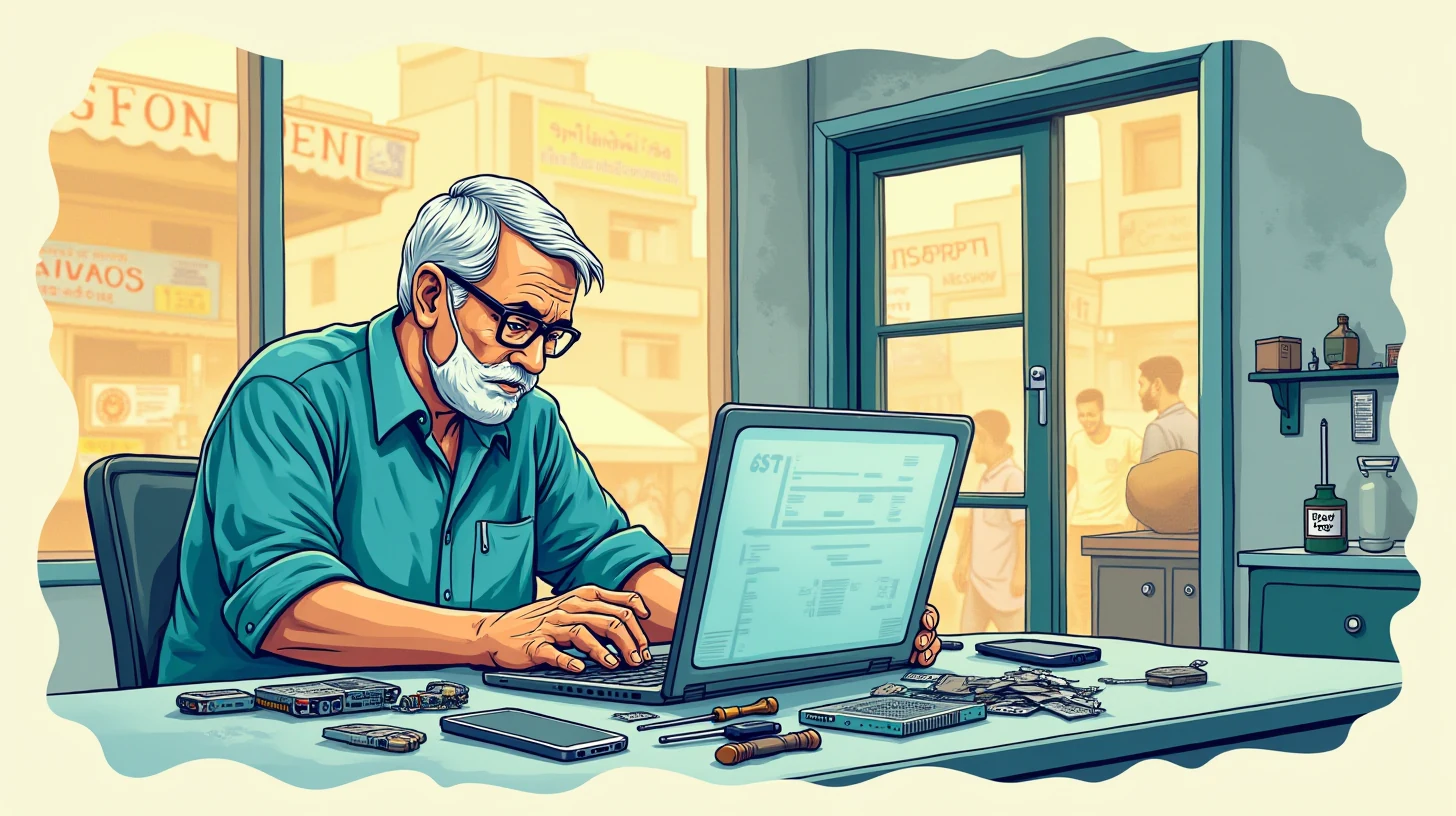
Ramesh had not slept properly since the MCD notice arrived three weeks earlier. The letter was polite, official, and catastrophic in the way only government notices can be: his trade licence from 2018 was categorized as "General Retail" — Category 5 under the old municipal bylaws. But the 2022 MCD Act revision had redefined shop classifications. Electronics repair required Category 21. He was operating under the wrong licence. Fine: ₹5,000. Timeline: 30 days to upgrade or face shop closure.
He had not told Meera, his wife, about the IRDAI referral letter that came a week later.
🗓️ The three-layer Delhi shop compliance
Delhi's municipal compliance reformed in 2022. The revision sounds bureaucratic — a refresh of trade categories, a harmonization with GST tiers — but for repair shops like Ramesh's, it created three invisible traps, each one requiring a different authority to fix.
Trap 1: The MCD Trade Category Collapse. The old "General Retail" licence covered almost everything: a vendor could repair, sell accessories, run a small service counter, all under Category 5. The 2022 MCD Act split this into specialist categories. Electronics repair — smartphones, tablets, components — became Category 21. The municipality didn't announce this loudly. Ramesh found out when the notice arrived. Thousands of Delhi repair shops were in the same situation. The upgrade path was clear but cost-bearing: submit Form TL-6 (Modification of Trade Licence), pay an inspection fee of ₹1,200, and wait 10 days. The fine for operating without the correct category was ₹5,000, compoundable to ₹2,500 on first-offence grounds.
Trap 2: The GST TCS Blind Spot. Ramesh had integrated Amazon and Flipkart in 2019, offering "approved repair partnerships." Customers could order spare parts and repairs through the marketplace. His quarterly e-commerce sales exceeded ₹2.5 lakh regularly. Marketplace regulations required TCS (Tax Collected at Source) at 1% of the transaction value. Amazon collected it. But where did it go? It landed in a section of the GST portal called the "Electronic Cash Ledger" — a holding zone for collected but unclaimed TCS credits. The system didn't automatically credit his account. He had to file a GST return claiming the credit manually. Ramesh filed quarterly returns, but he had never looked for the TCS line item. Over eight quarters, ₹31,200 had accumulated, invisible.
Trap 3: The Warranty Regulation Gray Zone. For the past two years, Ramesh had offered customers a "6-Month Extended Warranty" for ₹299. The product was simple: if a repaired phone failed again within six months due to the same defect, Ramesh would repair it free. He thought of it as a service guarantee. But the Insurance Regulatory and Development Authority (IRDAI) saw it differently. Extended warranty products — even informal ones — that promised to repair or replace goods fell under the definition of "insurance intermediary services." He should have registered as an intermediary. He should have disclosed the product's terms with a regulator. A customer complaint had flagged him to IRDAI. He received a referral notice asking him to clarify his status.
Three separate laws. Three separate authorities. One repair counter.
⚠️ The afternoon Vikram visited
Vikram Sharma, 26, worked at a fintech startup in Gurgaon. His job was to understand regulatory edges — how products intersected with banking law, GST, financial reporting. He visited Uncle Ramesh's shop every other month to pick up spare phone chargers.
On the afternoon of 22 March, he arrived to find Ramesh visibly tense, carefully replacing a fractured iPhone screen. Meera had called him: "Your uncle is stressed. Can you visit?"
Vikram sat on the low stool behind the counter and asked routine questions. How is the shop? How are sales? Ramesh sighed and pulled out the MCD notice. "Probably nothing. Government letter. They want money."
Vikram read it slowly. His first thought wasn't about the fine — it was about the category mismatch. If the MCD had updated its categories in 2022, the GST registration might have implications too. "Do you sell on Amazon or Flipkart?" he asked.
Ramesh nodded. "Since 2019. Small business. Nothing major."
"Show me your GST portal."
They walked to the cramped back office — a plastic desk piled with warranty forms, battery invoices, and a battered HP laptop. Vikram logged in using Ramesh's credentials and navigated to the "Ledgers" section. He clicked on "Electronic Cash Ledger."
His eyes widened. "Uncle. You have ₹31,200 sitting here. Look."
The Electronic Cash Ledger showed a running total: TCS deposits from Amazon and Flipkart, accumulated since Ramesh began selling on the platforms. The marketplace had collected 1% TCS on each transaction. The money was real — it was in the system. But Ramesh had never claimed it in a GST return. It had simply accrued.
"What is this?" Ramesh asked, bewildered.
"This is your tax credit. You already paid it. You just have to claim it against your GST liability. In your next quarterly filing, this ₹31,200 will reduce the amount you have to pay."
Ramesh stared at the screen. The fine from the MCD notice suddenly felt less catastrophic.
Then Vikram asked, "What about the IRDAI letter?"
Ramesh's face fell. He opened a drawer and pulled out the referral notice. Vikram read it, then turned to Ramesh. "The extended warranty. You're running it as a service guarantee, but the regulator sees it as insurance. We need to restructure it."
It was 2 PM. By 6 PM, Vikram had mapped a three-point recovery.
title: "बारह साल का दुकान, तीन घंटे में सब ठीक हो गया।" en: "Twelve years of the shop. Everything fixed in three hours." attribution: "Ramesh Sharma"
🌗 Three fixes, one afternoon
Fix 1: MCD Category 21 Upgrade
Vikram opened the MCD online portal. The process was straightforward but arcane — a reflection of how Delhi's municipal licensing had evolved.
"You file Form TL-6," Vikram explained, sitting beside Ramesh. "It's a 'Modification of Trade Licence' form. You declare the new activity — 'Electronics Repair' — under Category 21. The MCD schedules an inspection. They come, see that you're actually repairing phones, and approve it."
"How much does it cost?" Ramesh asked.
"₹1,200 inspection fee. The fine is ₹5,000, but it compounds to ₹2,500 if you apply within 30 days and it's your first violation. So your total is ₹1,200 + ₹2,500 = ₹3,700."
Ramesh nodded slowly. It was manageable.
They filled out Form TL-6 online. Vikram uploaded photos of the shop interior, the repair equipment, and a list of services offered. He submitted it that evening. The MCD system generated a reference number and scheduled an inspection for five days later.
"When the inspector comes," Vikram said, "just show her the repair counter, the tools, the spare parts. Answer honestly. It's a formality."
Fix 2: TCS Credit Claim
"Now the GST part," Vikram said, minimizing the MCD portal and opening the GST portal again.
"The Electronic Cash Ledger — you see this balance?" He pointed to the ₹31,200 figure. "This is TCS that Amazon and Flipkart collected from your customers. It's held in escrow by the GST system. You can use it to pay your GST liability."
"So it's free money?" Ramesh asked.
"No. It's your customers' money that the marketplace already withheld. The GST system says: we collected this at 1%, but you might have a legitimate business reason for input tax credit. Rather than refund it to your customers or let the government keep it, we'll give you a credit. But you have to claim it in your GST return."
Vikram showed Ramesh his last quarterly filing. "In your next QRMP filing, there's a section for 'ITC from Other Ledgers.' You claim the ₹31,200 here. It reduces your output liability. If your normal quarterly GST is ₹35,000, it becomes ₹3,800. That's ₹31,200 in cash you don't have to pay."
Ramesh felt the weight lift. He had been saving to pay the next GST installment. This credit would cover it entirely and leave room for the MCD upgrade fee.
Fix 3: Extended Warranty Restructure
"The IRDAI issue is trickier," Vikram said, opening a blank document on the laptop.
"The ₹299 extended warranty you sell — right now, it reads like insurance. You promise to repair free if the product fails. IRDAI says: that's a regulated financial product. You need to be registered as an insurance intermediary, disclose terms, hold reserves, all of that."
"But I'm not selling insurance," Ramesh protested. "I'm just promising to fix the phone again if my repair didn't hold."
"Exactly. So we reframe it. Instead of 'Extended Warranty Insurance,' call it a 'Service Contract.' The agreement says: 'You purchase a six-month service contract. If the repaired item fails due to the same defect, we will repair it once at no charge.' That's a service contract, not insurance. IRDAI doesn't regulate service contracts the same way."
Vikram drafted a one-page "Service Contract" agreement. It clearly stated:
- Term: 6 months from repair completion
- Coverage: One free repair for the same defect
- Exclusions: Water damage, physical damage from drops or accidents, non-defects
- Non-transferable, non-refundable after 7 days
"Print these. Keep them at the counter. When a customer buys the warranty, they sign and get a copy. You keep a copy. This shows the regulator that you were transparent about what you were selling. It's not insurance. It's a service contract with explicit terms."
Ramesh read the agreement. It was clear and fair. "And this stops the IRDAI?"
"It stops them from treating you as an unregistered insurance intermediary. Service contracts are a different animal. If they want to regulate service contracts later, they will, but you've documented everything. You're protected."
"बारह साल से मैं यही सोचता था कि सरकार को सिर्फ पैसा चाहिए। मुझे पता नहीं था कि ₹31,200 पहले से मेरे पास है।"
(For twelve years I thought the government just wanted money. I didn't know ₹31,200 was already mine.)
What it does
- 🔍Identifies the MCD Category 21 upgrade requirement and explains the Form TL-6 modification path
- 💰Locates the ₹31,200 TCS credit in the Electronic Cash Ledger and explains how to claim it against output liability
- 📋Explains the IRDAI service contract restructure: rename extended warranty as 'Service Contract' with explicit written terms
What it does not do
- 🔒Never accesses Ramesh's GST portal or MCD licence account on his behalf
- ✅Never confirms MCD inspection outcome or IRDAI compliance status — those depend on the inspector's visit and regulator's review
🧭 Why Delhi repair shops face layered compliance
Ramesh's situation is not unique. Delhi's repair and retail sector — estimated at over ₹50,000 crore annually — sits at the intersection of municipal, tax, and financial regulation. Each layer operates independently. Each layer has its own deadlines, forms, and fines.
The MCD 2022 Act reorganized trade categories without a parallel communication campaign. Shop owners discovered the change when notices arrived. Similarly, the GST implementation of the Electronic Cash Ledger in 2019 was introduced quietly. Most small sellers never learned to claim TCS credits. They assumed the marketplace was deducting their money.
The extended warranty gray zone reflects a broader regulatory gap: India's insurance law and goods-and-services law don't clearly demarcate when a promise to repair becomes a regulated financial product. Small retailers like Ramesh were left to guess. The IRDAI referral is one endpoint of this ambiguity.
The systemic failures are three:
Municipal communication failure. The MCD should have proactively notified all registered shops about category changes and provided a transition period. Instead, enforcement came first.
GST design blind spot. The Electronic Cash Ledger holds legitimate tax credits but requires manual claiming. There's no nudge, no auto-credit, no reminder. The system assumes all sellers are tax-savvy.
Regulatory scope creep. IRDAI's definition of "insurance intermediary" is broad enough to catch informal service guarantees. For small retailers, seeking explicit IRDAI registration feels excessive, so they operate in the shadows.
The result: shops like Ramesh's operate in technical violation of three laws, not out of malice, but out of structural ignorance.
🌱 Vikram's afternoon visit
The MCD inspection came on 27 March. The inspector spent twelve minutes in the shop, asked Ramesh three questions about his repair process, and nodded. "Category 21 upgrade approved," she said. The new licence arrived four days later. Ramesh framed it and hung it next to the old one.
The next quarterly GST filing came due on 20 April. Vikram sat with Ramesh at the laptop and walked him through the new ledgers. In the ITC section, he claimed the ₹31,200 TCS credit. The total quarterly liability dropped from ₹42,000 to ₹10,800. Ramesh paid online and printed the receipt.
On the counter, Ramesh printed 50 copies of the Service Contract and laminated them. He placed a stack at the checkout. The next customer who asked about the extended warranty received the new agreement. She read it, signed, kept a copy. "This is more professional," she said. Meera laughed from the shop doorway.
By late May, three things had quietly resolved:
The MCD Category 21 licence hung on the wall, compliance confirmed. The ₹31,200 TCS credit had been claimed and applied, reducing Ramesh's GST burden. The extended warranty had been reframed as a service contract, closing the IRDAI exposure.
Twelve years of reputation. Three layers of law. One afternoon with someone who asked the right questions.
On a Wednesday afternoon, Vikram visited again. Ramesh was at the counter, reading glasses on his forehead, soldering a broken charging port. The Lajpat Nagar market moved at the speed of broken screens and customer confusion, the same as always. But behind the counter, everything was aligned.