
imphal-handloom-shop-and-the-handloom-mark-registration
Bimola Devi arranges stacks of Moirang Phee — the signature indigo-bordered handwoven textile of Manipur — in her stall at Ima Keithel, the sprawling women's market in Imphal. For sixteen years, she and her extended family have woven the same patterns her mother learned from her grandmother: the geometric Meitei borders that take weeks to complete, each thread positioned by hand. Phanek, Innaphi, Moirang Phee — fabrics that carry the heritage of the Meitei community into the everyday lives of thousands of families.
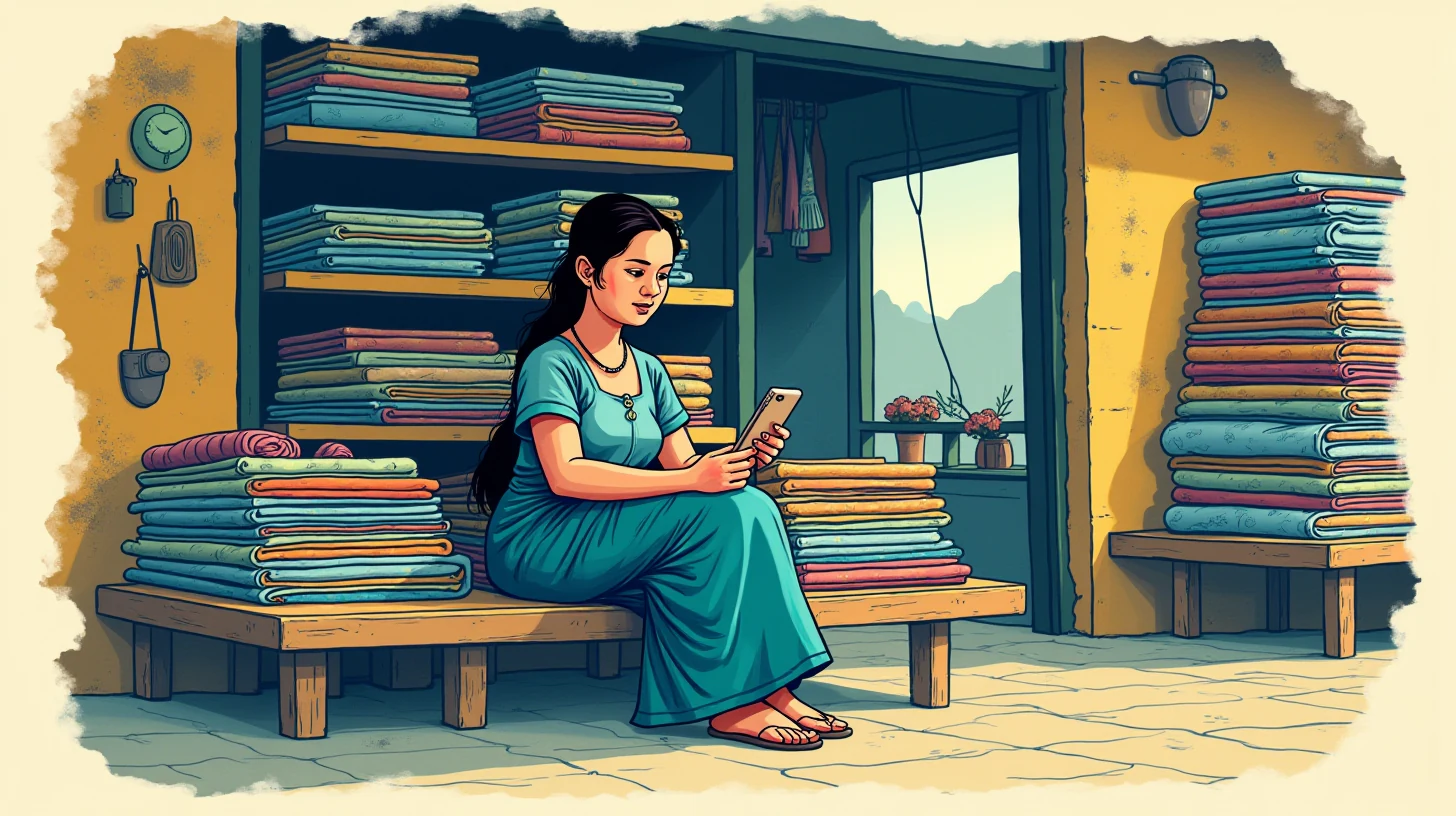
Three weeks ago, her phone buzzed with an opportunity.
A bulk buyer from Delhi had found her shop's social media page. He wanted fifty pieces of Moirang Phee for his high-end textile store. The order would have doubled her monthly revenue. But he sent one sentence that stopped everything: "Do you have Handloom Mark certification?"
Bimola had no answer. She asked her mother, her aunts who work the loom beside her — none of them had heard of the Handloom Mark either. The Delhi buyer, polite but firm, said he could only place the order once she had it.
That's when her cousin, who works in the Manipur government directorate, told her about GabFORGE. An agent, speaking Meitei, could explain what was blocking her path.
🗓️ Handloom Mark, Manipur's textile heritage, and Ima Keithel's place in India's textile map
Manipur's handloom sector is anchored in its women. The state produces some of India's finest handwoven textiles — Moirang Phee, the distinctive bordered cloth; Phanek, the tubular wraparound worn by Meitei women; intricate Innaphi shawls. The techniques are often passed down inside families, mother to daughter, across generations. Ima Keithel itself is a living archive: 2,000 women traders and weavers trading everything from groceries to fabrics, most of them managing their own inventory and supply chains.
The Handloom Mark is a recent entry into this world. Launched by India's Ministry of Textiles through the National Handloom Development Corporation (NHDC), it's a certification system designed to distinguish genuine handwoven textiles from machine-made or semi-handloom products. The mark carries a unique 12-digit code. It serves a specific purpose: in India's growing e-commerce and B2B textile market, buyers — especially from major cities — increasingly demand proof that a textile is truly handwoven.
For someone like Bimola, the mark represents a bridge to markets she couldn't reach before. But it also represents a bureaucratic process she doesn't yet understand.
⚠️ The Delhi order blocked, the Cooperative registration unclear, two separate requirements collide
Bimola's situation contains two separate but linked challenges, and she initially thought they were one.
The first: the Delhi buyer's requirement. He wasn't being difficult. High-end textile retailers across North India routinely ask for Handloom Mark certification. It's become an unspoken credential. Without it, a bulk order — no matter how authentic the weaving — simply will not move. The mark is proof to the consumer that they're buying hand-made goods.
The second: the Manipur Weavers Cooperative Society registration. A few months earlier, the Cooperative had contacted her, suggesting she join. The benefits sounded real — access to bulk yarn orders, collective marketing, credit schemes. But the registration process felt opaque. What did membership actually mean? Was it mandatory? How long would it take? Would there be fees?
These two requirements — the mark, the Cooperative — seemed like separate doors in separate buildings.
Actually, they're the same door, opened in two steps.
🌗 The agent explains the two-step path, speaking Meitei
Bimola sat down with the GabFORGE agent on a Tuesday afternoon, her phone propped on her stall counter while customers browsed around her. The agent, speaking Meitei, explained it simply:
Step one: Register with the Manipur Weavers Cooperative Society.
This isn't optional if she wants the Handloom Mark. The Cooperative is a prerequisite. When she registers, her family's weaving unit — currently unrecognized by any government system — gets formal status. The Cooperative's job is to vouch for her: that she is indeed a weaver, that the textiles are indeed handwoven, that she meets the standards.
The registration also opens a door to credit. Manipur's MSME department, through the Cooperative, offers MUDRA loans specifically designed for weaver collectives. Rates are subsidized. The maximum is usually 10 lakhs, and the tenure can extend to five years. Bimola's mother had mentioned, years ago, that they needed money to upgrade their loom equipment — this was the scheme for exactly that.
Step two: Apply for Handloom Mark through NHDC.
Once the Cooperative registration is in place, Bimola can apply at handloommark.gov.in. The application asks for basic details about her weaving unit, the types of textiles, production capacity. NHDC reviews the application and, if everything is in order, issues the Handloom Mark. The mark is a certificate with a unique code. She prints it on a label or a small card and attaches it to her products.
The agent also explained the distinction that had confused Bimola: the difference between a weaver and a trader.
A weaver is someone who operates the loom. A trader is someone who buys woven goods and sells them on. Bimola is both — she weaves with her family and sells her own pieces. The Handloom Mark registration recognizes her as a weaver first. There's a separate trader registration if she decides to buy from other weavers and resell, but for now, she doesn't need that.
The agent also mentioned the Handloom Mark is not the same as a Geographical Indication (GI) tag — another certification that some Manipuri textiles carry. The GI tag says: this textile comes from this region, made using these specific techniques. The Handloom Mark says: this specific piece was handwoven, by hand, not by machine. Both have value, but they protect different things.
🧭 Manipur's handloom sector and the certification gap blocking national market access
The Manipur handloom sector has a structural problem: authenticity, unproven at scale.
Individual weavers like Bimola are known in their communities. Customers who visit Ima Keithel can see the looms, watch the work, meet the weaver. Trust is built in that face-to-face transaction.
But the moment a buyer from Delhi asks for fifty pieces, the nature of the transaction changes. The buyer can't visit the loom. He can't watch the work. He's placing an order from a phone. From his position, how does he know the fabric is truly handwoven and not a factory product sold under a handloom label? Dishonest sellers do exactly that — they buy cheap machine-made fabric and pass it off as handwoven to get premium prices.
The Handloom Mark solves this problem. It creates a paper trail. NHDC verifies the weaver's credentials, the production capacity, the use of hand looms. The mark becomes proof.
For Manipur's weavers, this is a gap that's been widening. National markets are opening — e-commerce platforms, high-end retailers, B2B buyers — but they won't buy without certification. State-level sales stay local. National sales stay locked unless weavers can prove their work.
Bimola's situation is typical. She has the skill, the heritage, the product. What she lacked was the credential to cross a state line.
🌱 Cooperative registered, Handloom Mark filed, the Delhi order waiting to move
After the GabFORGE consultation, Bimola filed her application with the Manipur Weavers Cooperative Society. It took three weeks — one week to gather the documents (a simple form, her Aadhaar, a photograph of her weaving unit), a week for the Cooperative to process, and a week of follow-up calls to confirm. On the 23rd day, she received a letter: weaving unit registration number 2847-MW-IMP. She framed it.
With that certificate in hand, she filled out the Handloom Mark application on handloommark.gov.in. The form asked for the registration number from the Cooperative, details about her textiles, her production capacity (she and her family weave approximately 40 pieces a month), and photographs of the loom and the product. She uploaded everything.
The NHDC portal said: your application is under review. The estimated timeline was 45 to 60 days.
On day 47, the Handloom Mark was issued. A certificate with her name, her registration number, and a unique 12-digit code: HM-2026-1204847. The code now appears on a small woven label that she stitches into every piece.
She took a photograph of the certificate and sent it to the Delhi buyer.
Two days later, she had her answer: the order was confirmed. Fifty Moirang Phee pieces, delivery in two months, payment on delivery. Her total revenue for the next quarter just shifted.
When the agent asked if she'd faced any difficulties, Bimola said the hardest part was simply not knowing where to start. Once she understood that the Cooperative registration came first, and the Handloom Mark came second, and that both were necessary because one proved she was a weaver and the other proved her weaving was real, the path became clear.
She also mentioned that her aunt — an older weaver in the same unit — was now considering membership in a MUDRA lending circle through the Cooperative. If they could access 5 lakhs in subsidized credit, they could buy two more looms. That would let them take on the larger orders that come seasonally during the festival months.
The Delhi order was the beginning, not the end.
What it does
What it does not do
"মৈরাং ফী বোৱা হৈছিল মোর মাক-খুড়িমাক্না — মাত্র কাগজ নাছিল। সেই কাগজখনকে Handloom Mark বোলে।"— The Moirang Phee was woven by my mother and aunt — there was just no certificate. That certificate is called the Handloom Mark.
"বিমোলা দেবী, Handloom Mark পাবলৈ হ'লে আগতে Manipur Weavers Cooperative Society-ত register করিব লাগিব। সেই পিচত NHDC-ৰ handloommark.gov.in-ত application দিব পাৰিবা। Delhi buyer-য়ে এই mark বিচৰাটো স্বাভাৱিক — ই প্ৰমাণ কৰে যে কপোৰ হাতেৰে বোৱা। Cooperative-ত register হ'লে MUDRA ঋণো পাব পাৰিবা।"
(Bimola Devi, to get the Handloom Mark you first need to register with the Manipur Weavers Cooperative Society. After that you can apply at NHDC's handloommark.gov.in. It's normal for the Delhi buyer to ask for this mark — it proves the fabric is handwoven. After registering with the Cooperative, you can also access MUDRA credit.)