
The Itanagar tribal merchant and the APEDA registration his Delhi buyer needed
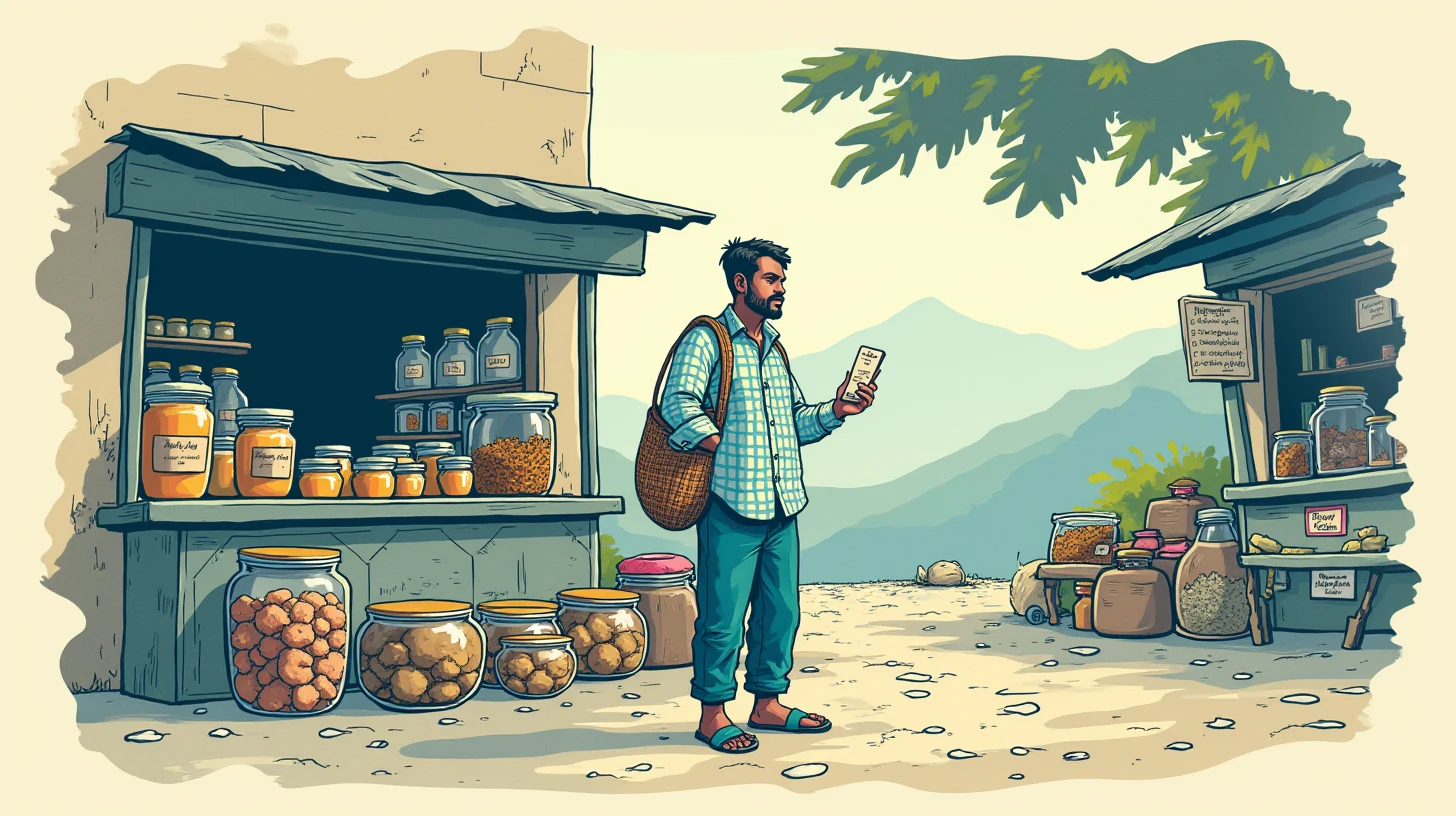
Tage Ete was standing behind the honey jars in his Naharlagun market stall when his phone buzzed on a Tuesday morning in March. The message was in Hindi, from a buyer in Delhi he'd connected with through a food trader forum: "Bhaiya, aapka honey kaisa hai? Bulk mein lena hai — lekin APEDA registration aur FSSAI certificate chahiye. Kya aapke paas hai?"
(Brother, how is your honey? I want to buy in bulk — but I need APEDA registration and FSSAI certificate. Do you have those?)
Tage read it twice. He knew his honey. He'd been selling local wildflower honey, dried mushrooms, tribal spices, and packaged Arunachal organic products from his shop for fourteen years. His wife Bini helped him source from tribal producers in the villages around Itanagar. But APEDA? FSSAI? The words meant nothing to him. He showed the message to Bini, who shrugged. They had no idea what their Delhi buyer was asking for.
That Wednesday, he did what most small merchants do — he searched Google on his phone. The results were overwhelming: official portals in English, acronyms stacked like stone, registration forms that asked for things he'd never heard of. APEDA meant exporter codes. FSSAI meant food safety licences. Both portals assumed he already knew the difference, and neither explained how they connected. And somewhere in between, there was a third problem waiting: he'd been planning to apply for an MSME loan through NEDFI (North East Development Finance Corporation) to expand the shop, but his Scheduled Tribe certificate — which he had — was issued in Arunachal Pradesh format, and the NEDFI portal wasn't recognizing it.
Three walls. Each one appeared only when you ran into the last one.
🗓️ What APEDA and FSSAI mean in the context of NE tribal organic products
Let's start with what Tage didn't know, because it's the same gap that stops a thousand small merchants in the Northeast from scaling online.
APEDA — the Agricultural and Processed Food Products Export Development Authority — is a government body that registers exporters and producers who want to sell agricultural products above a certain threshold, especially for bulk or B2B orders. If you're selling ₹500 worth of honey to a neighbour, APEDA doesn't care. If you're selling ₹50,000 worth of honey to a Delhi food company, APEDA wants to know who you are, where your product comes from, and whether you've registered with them. An APEDA exporter code is proof that you're a legitimate source.
FSSAI — the Food Safety and Standards Authority of India — is about food safety. Every food business needs a licence. For Tage's packaged honey, he needed a state-level FSSAI licence (not just the basic registration). But there's a wrinkle specific to organic products: if you want to write the word "organic" on a honey label, FSSAI wants to know that the claim is backed by either a full organic certification, or at least qualified language like "naturally harvested, no synthetic inputs added." You can't just write "organic" and hope.
For a tribal producer in Arunachal Pradesh selling products with authentic tribal origins, both registrations should theoretically be straightforward. APEDA often has expedited pathways for tribal producers. FSSAI recognises organic produce from tribal-majority regions. But the portals themselves are designed as if you already know this. They're in English. They ask for business registration numbers that a shop owner in Naharlagun may not have. They don't explain which comes first — APEDA or FSSAI, or whether you need both.
And then there's the loan.
⚠️ Three compliance walls appearing one after another; NEDFI loan format issue
Tage's son, Rohan, was in his second year at a college in Guwahati, studying commerce. When he came home for spring break in April, his father showed him the Delhi buyer's WhatsApp message. Rohan was sympathetic but not immediately useful — he knew what APEDA and FSSAI were in theory, but he'd never filed either. So he did what his generation does: he opened his laptop and started looking for a tool to help.
That's when Rohan found GabFORGE.
Rohan had been using GabFORGE for his college project research — it was faster than scrolling through PDFs. He'd never thought of it as a tool for his father's problems. But on a whim, he clicked the agent button and asked a question in Hindi: "Mera baap Arunachal Pradesh mein general store chalata hai. Uska honey Delhi ko bechna hai. APEDA aur FSSAI kya hote hain? Kaise register karte hain?"
(My father runs a general store in Arunachal Pradesh. He wants to sell his honey to Delhi. What are APEDA and FSSAI? How do you register?)
The agent came back with an explanation in Hindi — not perfect, but clear. It laid out the APEDA registration process: go to apeda.gov.in, create an account, fill in your producer details, upload proof of identity and address, wait 15–20 working days for verification. It explained FSSAI the same way: foscos.fssai.gov.in, state licence application, specific requirements for organic honey labelling. And it flagged the detail that would matter most to Tage: "'Organic' likha ho label par, toh ya FSSAI organic certification chahiye, ya qualified language: 'naturally harvested, no synthetic additives.'" (If you write 'organic' on the label, you need either FSSAI organic certification or qualified language like 'naturally harvested, no synthetic additives.')
Rohan printed it out and brought it to his father. Tage read it slowly, running his finger under the Hindi words. This made sense in a way that the English portals hadn't.
But there was still the NEDFI problem. Tage had a Scheduled Tribe certificate from the Arunachal Pradesh government — a document he'd received years ago for various schemes. When he tried to upload it to the NEDFI portal for an MSME loan to expand the shop, the system rejected it. The portal wanted a certificate in a specific format, issued after a certain date, with fields it didn't recognize in Tage's government-issued paper. The agent, when Rohan asked it again, had honest bad news: "NEDFI ka ST certificate format issue ek common problem hai. Arunachal Pradesh se aapka cert ho sakta hai rejected ho. Alternative: Arunachal Pradesh MSME portal par directly apply karo — wo aapke local ST cert ko recognize karega."
(The NEDFI ST certificate format issue is a common problem. Your cert from Arunachal Pradesh might get rejected. Alternative: apply directly to the Arunachal Pradesh MSME portal — they'll recognize your local ST cert.)
So the NEDFI loan was shelved for now, but APEDA and FSSAI had a path.
🌗 Son visits from Guwahati, installs GabFORGE, agent explains in Hindi the path
The conversation with the agent happened in fragments — Rohan asking questions when his father had them, taking screenshots, explaining what the agent had said. Over the course of two weeks, using GabFORGE in Hindi, they built a checklist:
For APEDA:
- Create account at apeda.gov.in with email and PAN (Permanent Account Number — Tage's brother-in-law had helped him get one years ago for a trade licence)
- Upload proof of business existence (shop registration or even a shop lease agreement)
- Upload bank statement showing business transactions
- Upload identity proof and address proof
- Submit. Wait 15–20 working days for their verification team to check.
For FSSAI:
- Register at foscos.fssai.gov.in for a state-level food business licence
- Provide shop address and business details
- For honey labelling: since Tage didn't have a full FSSAI organic certification, the agent clarified that he could use the qualified claim "naturally harvested, no synthetic additives added" instead of just "organic"
- This qualified claim doesn't require separate certification — just honest labelling
For the shop:
- Keep records of honey sourcing (which village producers it came from, basic notes on collection dates)
- This helps with both APEDA verification and future FSSAI inspections
By the time Rohan left for Guwahati, Tage had taken three afternoons to gather his documents. He'd extracted his PAN from an old insurance policy. He'd asked his landlord for a letter confirming he'd leased the shop. He'd taken bank statements to a cyber cafe and photocopied them. His hands were callused from forty-four years of working with goods, not papers, but the papers were coming together.
🧭 NE tribal producers and the compliance gap — organic honey worth ₹800/kg trapped behind paperwork
Tage's situation isn't unique to him. Across the Northeast — Arunachal Pradesh, Meghalaya, Manipur, Mizoram, Nagaland — there are hundreds of tribal producers making genuinely exceptional honey, mushrooms, spices, and preserved foods. Some of it is sold locally for ₹600–₹800 per kilogram. In Delhi or Bangalore, that same honey would retail for ₹1200–₹1500 per kg. The buyer is waiting. The product is ready. What's missing is the paperwork that connects them.
The problem isn't that APEDA and FSSAI are unreasonable. Both agencies have good reasons for their requirements — they want to know where food is coming from, and they want to ensure it's safe. The problem is that tribal producers are expected to navigate two separate government portals, in English, without any explanation of which comes first or why. APEDA doesn't mention FSSAI in its requirements. FSSAI doesn't mention APEDA. A producer like Tage ends up searching the internet, finding conflicting information, and either giving up or filing incomplete applications that get rejected.
There's also an assumption built into both portals: that producers already have certain documents. A business registration. A PAN (which requires formal business status). A bank account in business name (not just personal). These are things that a formal shopkeeper might have, but a tribal producer selling community products might not have formalized that way. The portals don't say, "Here's how to get a PAN if you don't have one" or "A shop lease letter counts as proof of business." They assume you already know.
For the NEDFI loan, there's an additional layer: regional governments issue Scheduled Tribe certificates in different formats. The NEDFI portal was designed assuming all ST certificates would be nationally standardized — they're not. Arunachal Pradesh issues them in one format, Meghalaya in another. A tribal merchant from Arunachal applying for an NEDFI loan with a state-issued cert hits a dead end until someone tells them to apply to the Arunachal Pradesh MSME portal instead, which recognizes local documentation.
What it does
What it does not do
🌱 FSSAI licence obtained, APEDA filed, what the Delhi order could mean
Two and a half months after that March WhatsApp message, Tage had both pieces of paper.
The FSSAI state licence came through first — Arunachal Pradesh processes these in about 30 days if your application is complete. Once he had it, Tage reprinted his honey labels with the new licence number and the qualified claim: "Naturally harvested, no synthetic additives." It's not the word "organic," but it's honest, and it complies.
The APEDA registration took longer — verification includes actual inspection, or at least correspondence with local authorities to confirm that Tage Ete is a real person selling real honey. But by mid-May, the exporter code came through. A registration number. Proof that he existed in a government database now, as an agricultural exporter.
He sent both documents to the Delhi buyer. He'd been nervous about the scan quality — his cyber cafe operator had helped him email them as PDFs. But the buyer came back the next day: "Bilkul sahi hai. First order 50 kg ready karo. Ise packaged karo, 1 kg cartons mein. Payment 7 days ka terms de denge."
(Perfect. Get 50 kg ready. Package it in 1 kg cartons. I'll give you 7-day payment terms.)
Fifty kilograms. At ₹800 per kilogram (the wholesale price, still respectable), that's ₹40,000. Just this order. From one buyer.
Tage and Bini spent that week sourcing honey from three tribal beekeepers they'd worked with for years. They repackaged it into branded 1 kg cartons, each one labeled with the FSSAI number and the "naturally harvested" claim. They kept the sourcing records — which villages, which beekeepers, which dates — because the agent had warned them that APEDA inspectors can ask for traceability.
The courier picked up the first order on a Friday afternoon.
It arrived in Delhi on Monday. By Tuesday, payment had cleared to Tage's account.
"दिल्ली वाले को शहद चाहिए था, हमारे पास था। बस कागज़ नहीं था जो उन्हें चाहिए था।"— The Delhi buyer wanted honey, we had it. We just didn't have the paper they needed.
Tage has already received a second order request — 75 kg this time, plus 25 kg of dried mushrooms. The mushrooms will need their own FSSAI compliance check, but Tage knows now that he'll need to check with the FSSAI state office to confirm whether mushrooms sold dried and packaged are classified as processed food (more requirements) or preserved produce (fewer). He's learned to ask those questions before filing.
The NEDFI loan application is still on hold, waiting for the Arunachal Pradesh MSME portal to recognize his ST certificate, but he doesn't need it as urgently now. The Delhi buyer has opened a door. If the orders keep coming, a bank loan might follow naturally — a bank will want to lend to someone with documented buyers and revenue.
Rohan is already thinking ahead. From Guwahati, he's been researching whether there's an FSSAI organic certification process that wouldn't be too expensive for his father's honey — if they got certified organic, the margins could push to ₹1000+ per kg. That's a longer process, but it's no longer a mystery.
The thing about APEDA and FSSAI is that they exist for good reasons. Bulk food sales across state lines need traceability. Organic claims need backing. Exports especially need verification. A Delhi buyer ordering 50 kg of honey is right to ask for documentation.
The problem is that the documentation systems — the portals, the processes, the formats — were built without remembering that there are merchants like Tage. People who speak Hindi better than English. People who run successful shops without formal business registrations. People in regions where government ID systems work differently. People where a Scheduled Tribe certificate matters, but not in the format some distant portal expects.
"Tage bhai, Delhi buyer ko do cheez chahiye: APEDA ka registration number aur FSSAI certificate. APEDA ke liye apeda.gov.in par register karo — exporter code milega. FSSAI ke liye foscos.fssai.gov.in par state licence apply karo. Honey ke liye ek aur baat: 'organic' likhna ho toh ya FSSAI organic certification chahiye, ya label par likho 'naturally harvested, no synthetic inputs' — yeh allowed hai bina full organic cert ke."
(Tage, the Delhi buyer needs two things: APEDA registration number and FSSAI certificate. For APEDA, register at apeda.gov.in — you'll get an exporter code. For FSSAI, apply for a state licence at foscos.fssai.gov.in. One more thing for honey: to write 'organic' you need either FSSAI organic certification, or write 'naturally harvested, no synthetic inputs' on the label — that's allowed without a full organic cert.)
The Delhi order isn't life-changing money, but it's the difference between a shop that sells locally and a shop that's connected to national supply chains. APEDA and FSSAI were the connectors. They just needed to be explained.
Tage's shop in Naharlagun is still the same — the same jars of honey, the same bundles of dried mushrooms, the same check shirts on the hooks by the door. But now it has an exporter code. Bini has learned to keep sourcing records. Rohan is researching organic certification. The door to Delhi hasn't closed.
And the next merchant in Itanagar who gets that same WhatsApp from a bulk buyer will know to ask: "Does anyone have GabFORGE?" They probably already do.