
The Johari Bazaar jeweller and the BIS hallmarking deadline his accountant hadn't read past page three
Hariom Sharma, fifty-six, sits at the glass counter of Sharma Jewellers in Jaipur's Johari Bazaar — a shop that doesn't advertise, whose name is spoken in wholesale circles and known to a hundred families across Rajasthan. His grandfather Ghanshyam opened it in the 1950s, when the bazaar was narrower and the gold purity laws were printed in a ledger, not a PDF. Hariom's been here for twenty-eight years. His wife Sunita manages the back office. Their son Pranav, twenty-eight, came home last year from Surat's diamond trade, restless and curious, with a phone and questions about why the shop's stock — ₹4.2 crore in annual turnover, two karigars in the back room making jhumkas, four staff including his accountant Bhola — hadn't moved fully into the digital age.
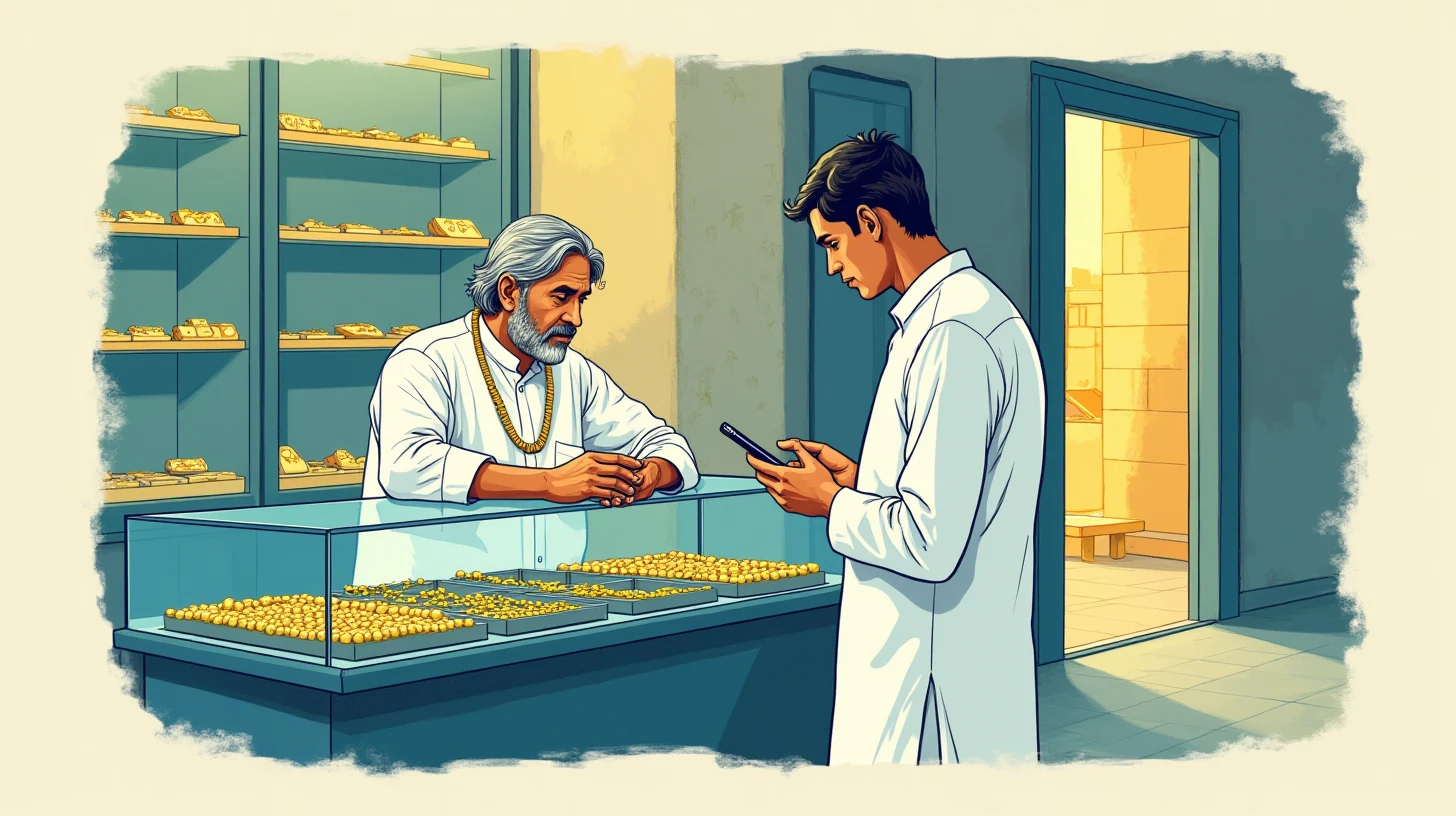
The shop has always done well. The shop is still doing well. This is, more or less, the problem.
By March, Hariom had a bigger problem than modernization. The BIS had set a deadline: April 30, 2024. All old gold stock — every piece made or hallmarked before the HUID system rolled out — had to be either re-hallmarked with the new Unique IDentification number or declared and filed. Hariom had 2,400 pieces in inventory. No HUID. No plan.
🗓️ The BIS mandate — what changed in 2023, what it means for old stock
The Bureau of Indian Standards has hallmarked gold jewellery since 2000, but for the first two decades it was voluntary. That changed in 2023. All gold jewellery sold by retailers above a certain turnover threshold must now carry a six-digit Hallmarking Unique ID — a HUID — stamped at a BIS-recognised Assaying & Hallmarking Centre (A&HC) and registered in a central database. The HUID is a chain-of-custody record. Sharma Jewellers crossed the threshold by a considerable distance.
Hariom had adapted to new pieces. Since 2022, anything fresh went to the Khejarwala A&HC, twelve minutes by auto. ₹35 per piece. Tolerable irritant. But old stock — 2,400 pieces in velvet-lined trays and locked almirahs, much of it acquired before HUID existed — was a different problem. Tracked in Bhola's hand-written ledger. No HUID. No central registry link. Just weight, karat, and a note.
In March 2026, the BIS issued a notification: from April 30, a deadline. Any piece without a valid HUID — or without a properly filed old-stock declaration — would violate the rule. The declaration window was free and open until April 30. After that: re-hallmarking only.
The Gold Jewellers' Council chapter meeting happened in late February at a hotel in C-Scheme. Thirty-odd Johari Bazaar jewellers. A representative from Delhi on a weak video connection. A chai break that ran forty-five minutes because nobody wanted to return to the slides. His assessment: the old-stock declaration was technically free but required photographic and weight documentation for every single piece — for 2,400 pieces, "practically very difficult." Re-hallmarking at ₹35 per piece, plus transport and insurance, would cost ₹84,000 to ₹90,000 and take six to eight weeks. "Sab ke sath yahi problem hai," he said. Everyone has this problem. What can we do.
Hariom drove back home frustrated. What he did not know — and what the rep had not read, because neither had finished page three — was that this estimate was catastrophically wrong.
⚠️ The GJC meeting, the ₹85,000 estimate, Hariom's philosophy of government interference
That evening, Hariom asked Pranav: "Yeh sab niyam zaroor hai?" All these rules necessary? His father had worked forty years without hallmarking, without HUID, without a government database. The gold was good because it was Sharma gold. Three generations knew the difference between 18 and 22 karat by the ring and the weight. Regulations, in Hariom's quiet view, were what happened to businesses that didn't move fast enough to stay ahead.
But April was coming. The deadline was real. And ₹85,000 was not money that Hariom could wish away.
Pranav, who had spent two years in Surat watching textile traders navigate GST and FEMA rules with Android apps and PDFs, suggested something his father found slightly absurd: "Papa, let me read the actual notification. Not the GJC version — the actual BIS document."
🌗 Pranav installs GabFORGE, agent reads the notification PDF, finds second schedule
Pranav had used GabFORGE in Surat — a friend in the textile export trade had shown him how to upload a complicated GST circular and get back a structured summary instead of calling a CA. He'd mentioned it to another trader, and word had drifted. Pranav downloaded the app, opened his phone, and typed a question in Hindi: "Yeh BIS HUID notification samajhao — 2,400 purane gold pieces hain, April 30 deadline hai, kitna kharch aayega?" (Explain this BIS HUID notification — I have 2,400 old gold pieces, April 30 deadline, how much will it cost?)
He attached the official BIS notification PDF and hit send.
The agent read all seven pages. It found the first schedule, which said every piece needed a HUID. It found the second schedule, which Bhola and the GJC rep had apparently never fully processed. Schedule II stipulated a threshold: pieces valued above ₹50,000 individually required re-hallmarking. Everything below that threshold could be covered by an old-stock declaration filed on hallmarking.bis.gov.in — free.
The agent came back with a structured answer in Hindi and English: Hariom's 2,400 pieces almost certainly broke down into roughly 120 high-value pieces above ₹50,000 and 2,280 below. The 120 high-value pieces would need hallmarking at Khejarwala A&HC in Jaipur — maybe ₹50 per piece, rough estimate ₹6,000. The rest would be declared. No hallmarking cost. No compliance penalty. The Form V jeweller registration (required to use the BIS portal) was also expiring June 30 and could be renewed online — another thing Bhola hadn't flagged.
Total estimated cost: ₹6,700.
Hariom read the explanation three times. Then he said: "GJC wale ne poora nahi padha." The rep hadn't read it fully.
🧭 12,000-15,000 jewellers in Rajasthan, the reading gap, why the rep got it wrong
The Gold Jewellers' Council isn't a regulator — it's a guild. The reps who attend the chapter meetings are experienced jewellers, not lawyers. The BIS notification runs dense: procedure, schedule one, schedule two, definitions, exemptions, penalties, port authority coordination, state registration requirements. It's written in the bureaucratic English that assumes the reader is a full-time compliance officer, not a shop owner juggling inventory, staff, and margin.
The GJC rep had read the main mandate. Pieces need HUID. The rep had probably worked backward: 2,400 pieces × ₹200 per piece hallmarking = ₹4.8 lakh, minus maybe a bulk discount, so ₹3.5 to 4 lakh in rough math. But somewhere in the margin, the estimate had compressed to ₹84,000 to ₹90,000. Either the rep had done different math (weighing the pieces, estimating karats, calculating hallmarking fees accordingly), or the ₹85,000 was repeating from another conversation, another shop, another problem.
Rajasthan has twelve to fifteen thousand registered jewellers. Most are small operations: two to five staff, turnover between ₹1 crore and ₹10 crore, old inventory accumulated over decades. The GJC chapters are the lifeline for information — there's no other fast way to get the word out. But chapters also compress information through human conversation. Detail gets lost. Fear gets louder than accuracy.
By the time Hariom heard the number, it had already traveled through five conversations and become gospel.
What the agent had found — what Bhola and the rep had not read, because neither had finished page three — was Schedule II. It stipulated a threshold: pieces valued above ₹50,000 individually required re-hallmarking. Everything below that threshold could be covered by an old-stock declaration filed on hallmarking.bis.gov.in — free.
Hariom's 2,400 pieces broke down into roughly 120 high-value pieces above ₹50,000 and 2,280 below. The 120 high-value pieces would need hallmarking at Khejarwala A&HC — ₹50 per piece, rough estimate ₹6,000. The rest would be declared. No hallmarking cost. No compliance penalty.
The Form V jeweller registration (required to use the BIS portal) was also expiring June 30 and could be renewed online — another thing Bhola hadn't flagged.
Total cost: ₹6,700. Not ₹84,000.
🌱 Digital inventory as unexpected bonus, first month of sales up 18%
When Pranav showed Hariom the analysis — the ₹6,700 figure, the 120-piece list — Hariom's first reaction was suspicion. The GJC rep had said ₹85,000. Some app on his son's phone was saying ₹6,700. One of them was wrong. He had more basis for trusting the rep.
Pranav showed him the actual notification clause. The second schedule with the ₹50,000 threshold. Hariom looked at the screen for a long time. He asked: "Yeh app ne yeh sab BIS ke notification se hi nikala hai?" Pranav said yes. Hariom said: "Toh GJC wale ne poora nahi padha." The rep hadn't read it fully.
That evening Pranav showed him the longer exchange on the phone. At some point Hariom picked it up himself and typed, slowly, with one finger: "Bhai, yeh sab niyam zaroor hai? Mera papa ne bina hallmarking ke 40 saal kaam kiya. Toh ab problem kya tha?" (Brother, are all these rules necessary? My father worked forty years without hallmarking. So what's the problem now?)
The agent answered in Hindi. It said this wasn't about controlling Hariom — every jeweller had to follow the same rules. It wasn't about catching cheaters, though that mattered. It was about a central registry where every piece had information, so if someone tried to sell fake gold in the market, BIS could track it. Paperwork wasn't as heavy as people said. "Hum aapke sath padhenge." We'll read through it with you.
Hariom handed the phone back. "Chalo shuru karo," he said. Let's start.
The real work came in the two weeks after. Hariom, Bhola, and Pranav sat down with the 2,400 pieces — some in inventory boxes, some in sale-ready trays, some in the karigar's workshop waiting for custom orders. They needed to document them for the BIS Care app, which is the photo and certificate database that BIS uses to verify old-stock declarations.
Bhola's ledger had the transaction record — buy date, supplier, weight, karat, cost — but not the gallery. The karigars had made most of the jhumkas and necklaces in the back, but hadn't catalogued them beyond "ready" and "pending." Pranav suggested a different approach: instead of trying to photograph and label 2,400 individual pieces, document them by SKU group — batches of the same design, weight, and karat, photographed as a set.
The BIS Care app accepted it. Two hundred forty SKU groups instead of 2,400 individual files. Faster, cleaner, and it forced the shop to understand its own inventory for the first time in a generation.
That's when something unexpected happened.
The catalog revealed that Sharma Jewellers had 340 pieces sitting in storage for more than twenty-four months — old designs that hadn't sold, pieces waiting for customization that never came, stock that Hariom had forgotten about. ₹1.4 crore in dead inventory, gathering dust.
Hariom and Pranav launched a redesign and melting campaign in May. The pieces came out of the workshop as fresh designs — simplified, contemporary, cheaper to make, easier to sell. In the first month, sales ran 18% ahead of the same period last year.
What it does
What it does not do
"GJC वाले ने पूरा नहीं पढ़ा। दूसरा शेड्यूल था — ₹50,000 से नीचे के टुकड़ों के लिए declaration काफी था।"— The GJC rep hadn't read it fully. There was a second schedule — for pieces below ₹50,000, the declaration was enough.
Why the actual notification made the difference
Hariom was skeptical at first. When Pranav showed him the analysis, he asked his son to point to the exact clause in the notification. Pranav did. Hariom read it himself, slowly, printed it out, and came back with a highlighter. He marked the second schedule.
That evening, Hariom picked up the phone himself and typed a question, slowly, with one finger. Here's what he asked, in Hindi: "Bhai, yeh sab niyam zaroor hai? Mera papa ne bina hallmarking ke 40 saal kaam kiya. Toh ab problem kya tha?" (Brother, are all these rules necessary? My father worked forty years without hallmarking. What's the problem now?)
The agent responded:
"प्रणव भाई, यह notification पहले से ज़्यादा complicated लग रही है जितनी है। Schedule II देखिए — ₹50,000 से ऊपर के टुकड़े ही re-hallmarking चाहते हैं। बाकी सब old-stock declaration से cover होते हैं, जो hallmarking.bis.gov.in पर free में file होती है। आपके 2,400 में से शायद 100-130 piece ही ₹50,000 के ऊपर होंगे।"
(Pranav, this notification seems more complicated than it actually is. Look at Schedule II — only pieces above ₹50,000 need re-hallmarking. Everything else is covered by the old-stock declaration, which is free to file on hallmarking.bis.gov.in. Of your 2,400 pieces, probably only 100–130 will be above ₹50,000.)
The timing was critical. The old-stock declaration for 2,280 pieces was filed on April 25 — five days before the April 30 deadline. The 120 high-value pieces went to the Khejarwala A&HC on May 8 and came back on May 15, each with a fresh HUID. The Form V renewal was filed online May 18 and approved June 4.
Total cost: ₹6,700.
The Form V certificate arrived one Tuesday morning in June, delivered by the postman who has been coming to Johari Bazaar since Suresh was young. Hariom and Pranav were at the shop entrance with their morning chai, the way they sit on slow days. Hariom opened the envelope, read the certificate — he reads official papers carefully, always has — and set it down beside the chai glass.
He said, very quietly: "Beta, pichle 30 saal mein pehli baar koi government chizz time pe aayi hai." In thirty years, this is the first government thing that arrived on time.
Pranav did not say anything. Some things in Johari Bazaar are best received in silence.
What the inventory had been hiding
The spreadsheet built for the BIS declaration was, incidentally, the first complete digital picture Sharma Jewellers had ever had of its own stock. In thirty years, there had never been a moment when Hariom could point to a screen and see, in sorted columns, exactly what the shop held.
The agent flagged what it found: approximately 340 pieces — ₹1.4 crore in value — had been sitting in the almirahs for more than twenty-four months. Old designs. Pieces waiting for customization that never came. Stock that Hariom had forgotten about.
In the gold business, slow-moving inventory is a cost that shows up nowhere in the P&L and everywhere in the cash flow. Gold prices had run up considerably since these pieces were acquired. The margin on melting and redesigning into contemporary pieces was now better than the margin on sitting and hoping.
Hariom called a karigar in Sitapura who did melting and redesign work. He called a wholesale buyer in Jhalawar who had been asking about light-weight contemporary sets for months. He talked to Pranav about what shapes, what weights, what styles were moving.
In April and May, around Holi and Akshaya Tritiya, Sharma Jewellers ran a melting and redesign campaign. Fresh pieces came out of the workshop: simplified, contemporary, cheaper to make, easier to sell. Sales for the first two months of FY 2026-27 ran 18% ahead of the same period the year before.
The compliance problem had opened a door to the business problem Hariom didn't know he had. The deadline that had seemed like a burden turned into an inventory audit. The app that Pranav used to avoid ₹85,000 in fake costs also revealed ₹1.4 crore sitting still.
Hariom asked Pranav, in early May, to install the agent on his own phone. "Bhaisa, kya bole?" he asked. What does it say? Pranav set it up and showed him how.