
kohima-naga-heritage-shop-and-the-tribal-craft-permit
Dzüvilo Sumi's shop in Kohima's busy market district is a quiet archive of Naga identity. Wooden warrior spears lean against whitewashed walls. Glass cases hold beaded necklaces—each bead sewn by hand, each pattern a family technique passed down through generations. Bolts of handwoven Naga shawls, dyed with natural indigo and madder, are stacked by color. For forty-five years, Dzüvilo has run this shop. He learned the craft from his father, learned the business from customers—tourists, outsiders, city-bound young Nagas looking for a thread of home. For eight years, he'd been selling.
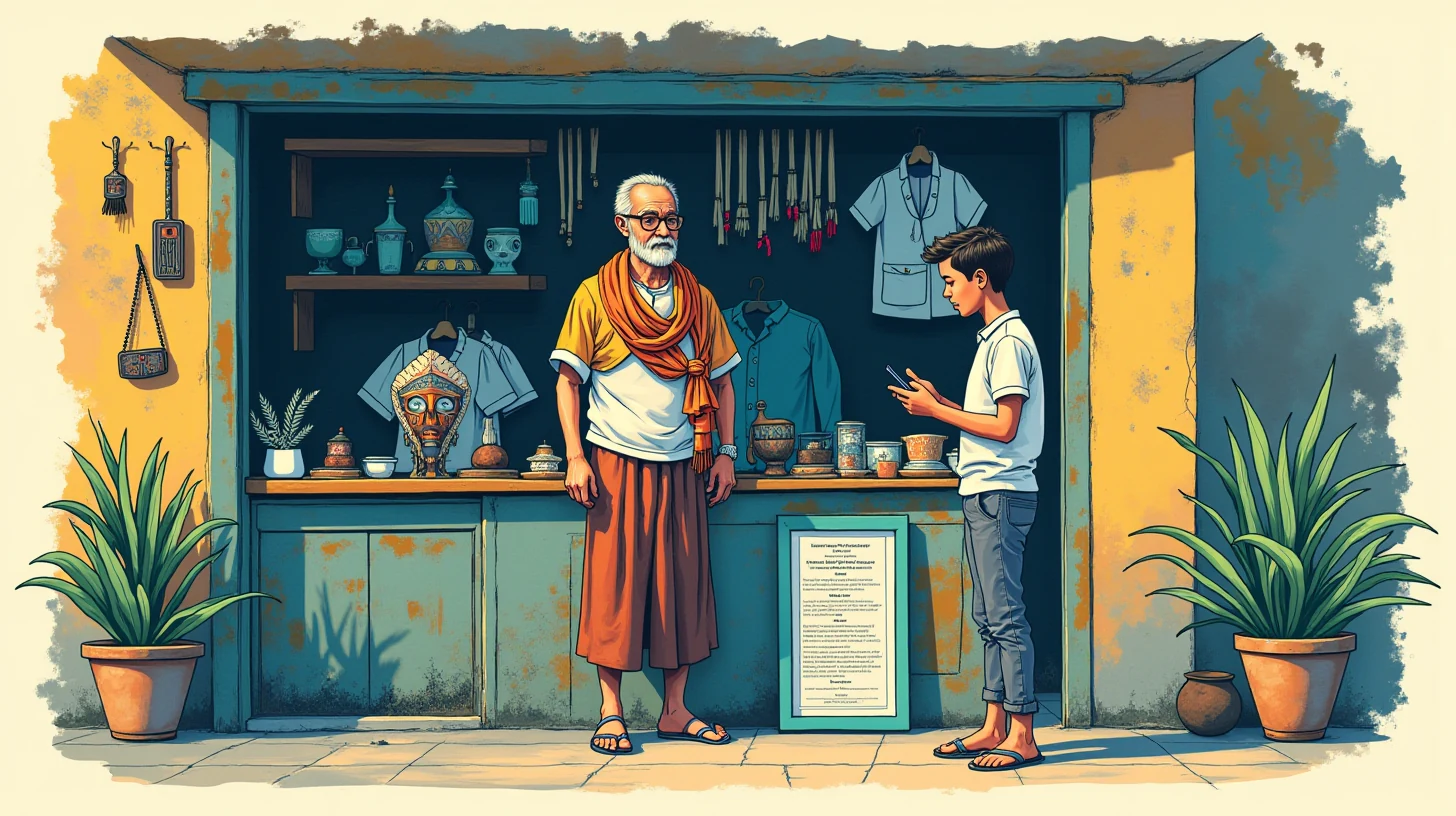
Then came the letter from the Nagaland tourism department.
🗓️ Nagaland tribal craft regulation, NHHDC, Naga heritage economy
Nagaland's tribal heritage sits at the center of a careful regulatory space. The state recognizes that Naga artifacts—textiles, beadwork, war ornaments, ceremonial masks—are not just commercial goods. They are cultural property, each one a claim to Naga identity and historical continuity. When those artifacts move across tribal boundaries, especially into commercial sale to non-tribal buyers, the state has frameworks in place.
The Nagaland Handloom and Handicrafts Development Corporation (NHHDC) is the state's official custodian of this boundary. It registers artisans, certifies authenticity, tracks sales of tribal craft to non-tribal buyers, and ensures that commercial exchange doesn't corrupt cultural heritage. For a tribal artisan like Dzüvilo—a Sumi Naga, heritage-trained, rooted in the community—NHHDC registration is both a formality and a privilege: it protects him legally and signals to buyers that his work is legitimate, authenticated, genuinely rooted.
What Dzüvilo didn't know was that selling Naga artifacts commercially, especially at scale or to outside markets, required that registration. He'd grown up in the craft. He'd never thought of it as requiring permission from the state. The shop had existed, the customers had come, the sales had happened. No one had asked for papers.
Now someone had.
⚠️ Tourism official notice, Flipkart requirement, two compliance gaps discovered at once
The tourism department official's letter was polite but firm. Dzüvilo was selling traditional Naga tribal artifacts—beadwork, shawls, spears—to non-tribal buyers without registration with the NHHDC. The practice wasn't illegal; the regulation was designed to protect artisans and ensure authenticity. But to continue selling, he needed to register.
For a shopkeeper running on narrow margins, whose entire inventory was built on word-of-mouth and walk-in customers, any new requirement felt like a sudden weight. The letter didn't explain what registration meant, how long it took, whether it cost money, whether he'd be turned down. It was just: register, or stop.
A week later came a second problem.
Dzüvilo's son, Rohit, worked in Kohima as an IT coordinator. He'd been encouraging his father to expand beyond the shop—to list inventory on Flipkart, reach customers across India, not just in Nagaland. A heritage Naga textile had real buyers: expat Nagas in Bangalore, collectors in Delhi, designers in Mumbai. The marketplace was there. All Dzüvilo had to do was sign up.
Flipkart's seller registration form had a field: "State-Issued Seller Certificate." Dzüvilo didn't know what it was. The form didn't explain it. He filled in his basic information, submitted, and got a rejection email: Certificate required to proceed.
So now there were two silences: the tourism department's requirement, unexplained. Flipkart's requirement, unexplained. And Dzüvilo, who'd never needed government papers to sell his grandfather's craft, was suddenly facing two different bureaucracies at once.
🌗 Son shows GabFORGE; agent explains both in Nagamese/Hindi
Rohit had downloaded the GabFORGE app on his phone—he'd heard about it from colleagues, the AI agent that explained government schemes in plain language, in your language. He showed his father the interface, selected Nagamese as the language, and typed in two simple questions: "What is NHHDC registration?" "What does Flipkart mean by seller certificate?"
The agent, trained to recognize the patterns of small traders and artisans, understood the situation immediately. It asked a few clarifying questions—how many years the shop had been running, whether the inventory was tribal-made, whether Dzüvilo had any existing tax registration. Then it explained, clearly and in Nagamese, backed by Hindi for moments when Rohit needed to clarify:
"Atü tünge wotso mo—NHHDC registration aköbü, GST tü. Akü tüge register akö tü nei tüge tu."
Two things were missing—NHHDC registration, and GST.
The agent then walked through each one. NHHDC registration, it explained, is free for tribal artisans. It's designed specifically for people like Dzüvilo—heritage crafts people who are part of the tribal community and making authentic work. The registration is a one-time process at the Nagaland Handloom and Handicrafts Development Corporation office in Kohima. You bring proof of tribal identity, documents showing the craft or inventory, and they issue a registration certificate. No fees for tribal artisans. The certificate protects you legally—it means you have permission to sell tribal artifacts commercially. It also helps buyers trust that the work is authentic.
On Flipkart's "state-issued seller certificate": the agent explained that what Flipkart actually wants is GST registration. When an online marketplace asks for that, they're asking to confirm that the seller is registered with India's tax system. For small sellers below ₹20 lakh annual turnover, GST registration is technically voluntary. But if you want to sell on Flipkart, Flipkart requires it. It's not hard—you apply online at gst.gov.in, provide basic business and bank details, and you get a GST number in 3-5 days. No cost.
So the picture became clear: NHHDC registration for Kohima, GST registration online. Two separate systems, two different purposes, but both necessary if Dzüvilo wanted to keep his shop legal and expand to online sales.
"NHHDC registration apfü tü tribal artisan tsürü — GST tü marketplace selling. Akü kelie apfü tü awoba, ketsie tü awoba."
(NHHDC registration protects you as a tribal artisan — GST is for marketplace selling. Both separate, both necessary.)
🧭 Naga craft sellers and the gap between traditional trade and marketplace compliance
Dzüvilo's situation is not unique. Across Nagaland—and across India—there's a gap between the world of traditional crafts and the world of digital commerce. A weaver, a bead-worker, a mask carver can operate for decades within the community, selling to neighbors, to pilgrims, to tourists who find their way to the shop. The craft speaks for itself. The work has legitimacy because it comes from the hands of someone known, someone rooted.
But when that same artisan tries to reach a national marketplace—Flipkart, Amazon, Etsy—suddenly there are new requirements. Not just logistics, but identity verification, tax registration, seller certificates. The platforms aren't designed for craft; they're designed for commerce. And commerce, in India, moves through specific legal channels: GST for tax purposes, MSME registration for small business benefits, sometimes state-specific certifications for heritage or tribal products.
For tribal artisans, there's an additional layer: protection. Nagaland's NHHDC exists partly to ensure that tribal heritage isn't commodified in ways that exploit artisans or misrepresent the culture. A Naga shawl sold online as "genuine tribal weave" is making a claim—not just about the product, but about its origins, its meaning, its connection to Naga people. The NHHDC registration is a way of saying: this claim is real, this artisan is authenticated, this product has integrity.
The challenge is that most artisans don't know these systems exist. They don't know that selling "tribal" goods commercially triggers different regulations than selling regular goods. They don't know that marketplaces ask for GST in the form of a "seller certificate." And they don't always know how to navigate the bureaucracy—who to contact, what forms to fill, where to go.
The GabFORGE agent, by explaining both the NHHDC registration and the GST requirement in the same conversation, in plain language, in Dzüvilo's own language, solved a problem that might otherwise have blocked him for months.
What it does
What it does not do
🌱 NHHDC registered, GST obtained, online selling possible
Within thirty days, Dzüvilo had moved. He and Rohit made a trip to the Nagaland Handloom and Handicrafts Development Corporation office in Kohima. They brought his tribal identity card, a few photographs of the shop and the inventory, and a letter from the tourism department (which, oddly, had helped clarify what was needed). The NHHDC official recognized him—Dzüvilo's work had a small reputation among heritage buyers. The registration was processed in a single visit. Free of charge. A certificate issued on the spot, with a registration number. The official also mentioned the PM Vishwakarma scheme—a central government initiative for artisans that offers subsidized loans and market linkage support. Dzüvilo's weaving would qualify under the Weaver category. Another opportunity, unexpected.
For the GST, Rohit handled the online application. The form was straightforward: shop name, address, annual turnover estimate (Dzüvilo guessed conservatively at ₹15 lakh), bank details, PAN number. Submitted online at gst.gov.in. Four days later, a GST registration number arrived via email. No verification office visit was needed. The number was immediately usable.
With the NHHDC certificate and the GST number in hand, Dzüvilo applied to Flipkart again. The seller registration form now had both pieces of information. The application was approved within a week.
The first product Dzüvilo listed was a handwoven Sumi Naga shawl—traditional indigo dye, the pattern a traditional geometric design his mother had taught him. He listed it at ₹2,500, with detailed photographs and a description that mentioned both the NHHDC registration number and the heritage of the work. Within two weeks, it had sold to a buyer in Bangalore. Then another sold to Delhi. By the end of the month, he'd made four sales online—more than his typical monthly online revenue zero.
More importantly, he'd solved the regulatory problem that had appeared so suddenly. The tourism department's letter was now answered by the NHHDC certificate. Flipkart's requirement was now met with the GST number. The two compliance gaps that had seemed incomprehensible a month earlier now made sense, and they were closed.
"Atü tünge wotso mo — NHHDC registration aköbü, GST tü. Akü tüge register akö tü nei tüge tu."— Two things were missing — NHHDC registration, and GST. I hadn't known I needed to register for either.
Dzüvilo still runs his shop in Kohima's market district. The spears still lean against the walls, the shawls still fill the shelves. But now, a few of those shawls find their way to buyers across India. His son checks the Flipkart order notifications. The NHHDC certificate hangs on the wall, framed—a sign that his work is officially recognized, that his craft matters not just to his family or his community, but to the state itself.
And when a young person from Kohima walks into the shop now, interested in learning the craft or starting their own heritage business, Dzüvilo can tell them the story. He can explain the NHHDC registration, the GST process, the PM Vishwakarma opportunity. He can tell them what a GabFORGE agent told him: that the bureaucracy, properly understood, is designed to protect them, not block them. And if they're confused, they can ask the agent themselves, in Nagamese or Hindi, and get a clear answer in return.
The craft continues. The heritage continues. And the commerce, at last, has permission to continue with it.
Resources for Naga heritage craft sellers:
- Nagaland Handloom & Handicrafts Development Corporation (NHHDC): Registration for tribal artisans selling Naga artifacts commercially. Free for tribal artisans. Contact: Kohima district office, Nagaland.
- GST Registration (gst.gov.in): Voluntary registration for sellers below ₹20 lakh annual turnover who want to sell on national marketplaces like Flipkart. 3-5 day turnaround. No cost.
- PM Vishwakarma Scheme: Central government support for artisans, including subsidized loans and market linkage. Weavers and craft artisans are eligible. Check pmvishwakarma.gov.in.
- Flipkart Seller Registration: Requires GST number for marketplace access. Apply after obtaining GST registration.