
The Gariahat saree seller and the ₹3 lakh GST notice she didn't owe
The evening before Durga Puja, Mitali Ghosh was standing in her saree shop in Gariahat market, Kolkata, arranging rolls of silk tissue. Fifty-two, half-reading glasses on a chain, she moved between the mahogany shelves like she had for thirty years. Her mother had opened the shop in 1994. Now Mitali ran it with her husband's help and a part-time assistant. The shop smelled of cardboard, cedar, and the faint spice of customers who'd just come from lunch.
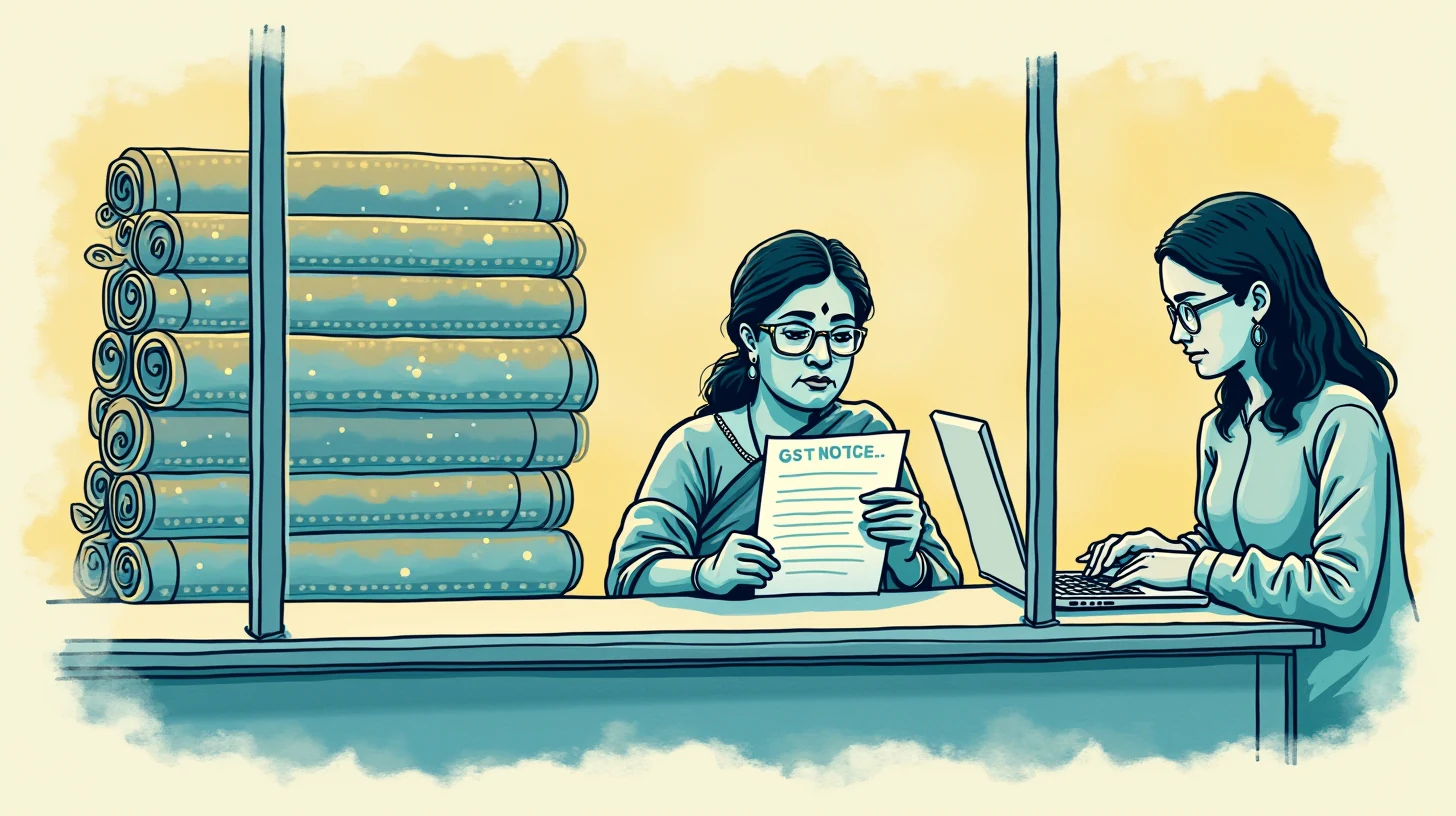
She'd been in the shop since 6 AM that morning, unpacking a shipment of Baluchari sarees from a supplier in Suri, when her CA had called. "Mitali, a notice came. ASMT-10. ₹3,12,000 demand. Your GST returns have a mismatch." Mitali had hung up feeling dizzy. She didn't know what ASMT-10 was. She paid her taxes. Her husband told her not to worry — the CA would handle it. But something in the CA's voice had sounded worried too.
By the next afternoon, Suparna — her niece, a final-year CA student visiting for Durga Puja — was sitting at the shop's small desk in the back room, reading the notice on her laptop. The festival chatter outside (shoppers buying bindi and mehndi, kids holding their parents' hands) seemed very far away. Suparna's face was serious. "Aunty, this notice says you have an ₹8,40,000 mismatch between GSTR-1 and GSTR-3B. But the demand is ₹3,12,000. That doesn't match the math."
Mitali had made tea. It was still steaming, untouched.
🗓️ The GSTR-1 and GSTR-3B mismatch
GST returns in India work like a three-part conversation with the tax office. GSTR-1 is the outward supply return — everything you sold, to whom, and how much tax you collected from them. GSTR-3B is the monthly return where you calculate: tax you collected (GSTR-1) minus tax you paid on purchases (GSTR-2A) equals tax you owe. The GST system matches these two returns automatically. If they don't align, the tax office issues an ASMT-10 scrutiny notice.
Mitali's problem was specific and common. She had started taking advance receipts from customers around June 2023. Wedding season. Customers would order custom sarees, pay 50% upfront, and collect the saree after the designer finished it. Mitali's CA, trying to be careful, had put these advance receipts into GSTR-3B under "advances received" — which is the right place for cash-in-hand. But she had not separately recorded these advances in GSTR-1, because there was no supply yet. They were deposits, not sales.
By February 2024, when the annual GSTR-9 return was being filed late (August instead of December — another problem), the CA realized the mismatch. Advances of ₹8,40,000 had been claimed as input credit in GSTR-3B but never matched to actual supplies in GSTR-1. From the tax office's perspective, it looked like Mitali had claimed credit on phantom sales.
They issued ASMT-10 and demanded ₹3,12,000.
What they didn't know — because Mitali's explanation hadn't been filed properly — was that these advances had slowly been converted to actual sales. The wedding sarees had been delivered, the final payments had been received, and they appeared in GSTR-1 across June, July, and August 2023. The "mismatch" wasn't evasion. It was a timing and classification issue. The actual tax shortfall was much smaller.
:::infographic type: timeline
- ASMT-10 scrutiny notice received (Feb 2024): ₹3,12,000 demand
- Suparna identifies DRC-03 voluntary payment path (Oct 2025): response window still open
- DRC-03 filed with explanation & ₹62,400 payment (Oct 2025): actual tax gap + interest
- MUDRA loan unblocked, Shop Act renewed (Nov 2025): Mitali's credit score recovered :::
⚠️ Three problems, one afternoon
Suparna kept reading, scrolling through email chains with the CA. She found three separate crises, all touching each other like a chain of dominoes.
The first was the ASMT-10 notice itself. The 30-day response window had been issued in February 2024. It was now October 2025. The window was technically still open — a quirk of how GST notices are reissued — but it was narrowing. Suparna sent an email to the CA asking for the exact date the notice was issued. The CA didn't reply for three hours.
The second was Mitali's MUDRA loan application. She had applied for a Pradhan Mantri MUDRA Yojana Tarun loan for ₹5 lakhs in May 2024 to stock up for Puja season. The bank had approved it in principle but then flagged her CIBIL score. There was a default notation from August 2023 — when the annual GSTR-9 return had been filed late, it had triggered a penalty and a brief payment delay that the bank's credit bureau picked up. The loan was frozen, waiting for the ASMT-10 notice to be resolved. If she paid the demand, her credit would recover. But if the demand was incorrect, she'd be paying for a mistake that wasn't hers.
The third was the West Bengal Shop and Establishment Act licence. In 2019, when Mitali had digitized her inventory (bought a till system, started keeping digital records), she'd assumed her Shop Act licence would automatically renew. West Bengal had a digital portal for many things. She thought this was one of them. It wasn't. She hadn't renewed the licence in six years. The renewal was supposed to happen every two years. A Labour Inspectorate visit in August 2025 had noticed, issued a ₹2,400 fine, and put the renewal on notice. It was pending. Every day the shop technically operated in violation.
Suparna closed the laptop. "Aunty, we have maybe three weeks before the ASMT-10 response window closes. We also need to clear the Shop Act renewal and the MUDRA block. They're all connected. The ASMT-10 demand is wrong — but we need to file the right response."
⚠️ The notice on the counter
Mitali kept the notice on the shop counter for two days, not wanting to look at it but unable to throw it away. Customers would see it and ask, "Kono somosya?" (Any problem?). She would smile and say, "No, no, just new rules." But her hands would shake a little when she handled the sarees, and she'd recount the inventory twice.
On the third day, a customer came in — a regular, Mrs. Banerjee, who'd been buying from Mitali for fifteen years. She noticed Mitali's expression and asked directly. Mitali told her the whole story: the ₹3,12,000 demand, the advance receipts, the mismatch she didn't understand, the CA who seemed confused too.
Mrs. Banerjee listened, then said something Mitali would remember: "Your mother's shop survived the Emergency. It survived two currency changes. It survived the hand-loom tax. A notice is just a notice. Get your niece to fix it."
"তিন লক্ষ টাকার নোটিস দেখে আমি সারা দিন খাবার খেতে পারিনি। ছয় বছর ধরে সবকিছু করছি নিয়মের মধ্যে থেকে — বিল কাটছি, ট্যাক্স দিচ্ছি, তারপরেও এই কথা। কিন্তু সুপর্ণা যখন বল্লো যে আসল টাকা মাত্র বাষট্টি হাজার, তখন আর কোনো অন্ধকার ছিল না।""I couldn't eat all day when I saw the ₹3 lakh notice. For six years I've done everything by the rules — cutting bills, paying taxes, and still this. But when Suparna told me the actual amount was just ₹62,400, there was no more darkness."
— Mitali Ghosh
🌗 What the agent explained
Suparna called the GabFORGE agent on a Tuesday afternoon. The shop was quiet. She sat in the back room with her aunt, put the phone on speaker, and pulled up the notice and the GST returns.
The agent spoke in Bengali first, then English, explaining the DRC-03 process.
এজেন্ট: "মিতালি আন্টি, এটি হলো DRC-03 ভলান্টারি ডিসক্লোজার প্রক্রিয়া। যখন আপনি নিজে থেকেই একটা ভুল ধরতে পারেন এবং স্বেচ্ছায় সংশোধন করতে পারেন, তখন সরকার আপনাকে পেনাল্টির অর্ধেক দেয়। আপনার ক্ষেত্রে আসল ট্যাক্স গ্যাপ হলো ₹62,400। পেনাল্টি হবে ₹31,200। মিলিয়ে সুদ দিয়ে ক্লোজ হবে।"
Agent (English): "Mitali aunty, this is the DRC-03 voluntary disclosure process. When you catch and correct an error yourself, the government gives you half the penalty. In your case, the actual tax gap is ₹62,400. The penalty is ₹31,200. With interest, you close the file."
Mitali asked how the tax gap was calculated. Suparna pulled up the numbers.
The advance receipts of ₹8,40,000 (June–August 2023) had been delivered as actual sarees by September 2023. The GST rate on sarees was 5%. So the tax that should have been collected and paid was ₹8,40,000 × 5% = ₹42,000. But the advances hadn't triggered GST when received (because no supply happened yet). When the sarees were delivered, Mitali had correctly charged GST. So the tax she actually paid was correct. The mismatch was purely a timing issue in how she reported advances.
The actual shortfall was the difference: she had claimed input credit on purchase taxes for materials (thread, dyes, finishing) that went into those sarees, but she had initially under-reported the output tax in GSTR-1 because the advance and the final delivery weren't aligned in the same month. Once you account for the input credits she'd already paid and the output GST from the deliveries, the actual tax underpaid was ₹62,400.
এজেন্ট: "DRC-03 মানে আপনি একটা চিঠি লিখবেন, বলবেন যে আপনি ভুল করেছিলেন, এই হলো সঠিক সংখ্যা, এবং আপনি ₹62,400 এখনই পেমেন্ট করছেন। কোনো প্রমাণ লাগবে না। তিন সপ্তাহে তারা বলবে 'ঠিক আছে, কেস বন্ধ'।"
Agent (English): "DRC-03 means you write a letter, say you made an error, here are the correct numbers, and you're paying ₹62,400 now. No proof required. In three weeks they'll say 'OK, case closed.'"
Mitali's face changed. "But I don't have ₹62,400 lying around. I have the MUDRA loan frozen. I've got inventory to stock."
Suparna had already thought of this. "You take a short-term loan from the bank against your future MUDRA approval. Once ASMT-10 is resolved, the bank unfreezes the MUDRA. Then you pay back the short-term loan with the MUDRA disbursement. The timing works if we file DRC-03 this week."
"আমাদের সমস্যা নয় যে নিয়ম জটিল, সমস্যা যে আমরা কেউ নিয়মের ভাষা বুঝি না। যখন সুপর্ণা বুঝিয়ে দেয়, তখন মনে হয়, এটার চেয়ে সহজ কিছু আছে কি?"
"Our problem isn't that the rules are complex. It's that none of us speak the language of rules. When Suparna explains it, it feels like there's nothing simpler."
What it does
- 🔍Identifies that the ₹8,40,000 GSTR mismatch was due to advance receipt timing — not evasion or fraud
- 📋Explains the DRC-03 voluntary payment path and why it reduces a ₹3.12L demand to ₹62,400 + interest
- 💡Maps the MUDRA CIBIL flag to the late GSTR-9 filing and explains the bridge loan sequence
What it does not do
- 🔒Never files DRC-03 on Mitali's behalf or accesses her GST portal
- ✅Never confirms the ASMT-10 will be withdrawn — that is the GST officer's decision after reviewing the payment
🧭 Why GSTR mismatches trigger scrutiny
The Goods and Services Tax is structured on a dual-return system in India. Every invoice creates a trail: the seller reports it in GSTR-1, the buyer claims credit in GSTR-2A (which is auto-populated from sellers' GSTR-1 filings), and the seller reconciles in GSTR-3B. When GSTR-1 and GSTR-3B don't match, the system flags it as ASMT-10.
This is especially common in businesses with advance payments: wedding planners, construction companies, saree and textile sellers. The GST rules say that advances don't trigger tax until the supply is complete. But many small business owners — and even some CAs — treat advances as immediate sales or as input credit opportunities. The mismatch isn't always fraud. Often it's confusion about timing.
Gariahat market in Kolkata is one of the oldest textile hubs in India. It's been a saree bazaar since the 1920s. Hundreds of shops operate in a narrow lane, most of them second or third-generation family businesses like Mitali's. When ASMT-10 notices started being issued at scale in 2024, dozens of Gariahat shop owners received them. Most didn't have nieces who were CA students. Most didn't understand that DRC-03 was an option.
The GST office had no malice. They were following the rules. But the rules operated on a language that small shop owners didn't speak.
🌱 Suparna's Puja gift
Three weeks later, Mitali received a letter from the GST office. The ASMT-10 notice had been withdrawn. The demand for ₹3,12,000 no longer existed. She had paid ₹62,400 through the DRC-03 process, and the case was closed.
On the same day, the bank unfroze her MUDRA loan. The short-term bridge loan was repaid from the MUDRA disbursement, and Mitali had ₹4,62,000 in her account to restock for Durga Puja.
The West Bengal Labour Inspectorate waived the ₹2,400 fine on appeal — Suparna had filed the Shop Act renewal application within thirty days of the violation notice — and the licence was active again.
Mitali closed the shop early on Shashthi, the first day of the festival. She went to Kalihat Temple with her husband and Suparna. When they returned, she found that Mrs. Banerjee had bought four sarees for her granddaughter's wedding — the largest single order of the season.
"Thank your niece for me," Mrs. Banerjee said. "Not just for fixing the notice. For reminding you that the shop is worth saving."
Mitali kept the GST office letter in a folder marked "Resolved" and moved the shop counter's notice board to display festival offers instead.