
The Leh trek shop owner and the trade licence that no longer existed
The trekking season in Leh doesn't announce itself. One week the bazaar is sleeping in May cold, the next week it's flooded with expedition teams and solo wanderers checking gear lists. Stanzin Dorje had been timing this rhythm for seven years. His shop, Khardung Trek Supplies, sat fifty metres from the main bazar, where the smell of dried apricots mixed with fresh leather from the rope aisle. He knew when to stock rope by watching the weather apps of German trekking groups. He knew when the expedition companies would send scouts by listening to tea-shop gossip.
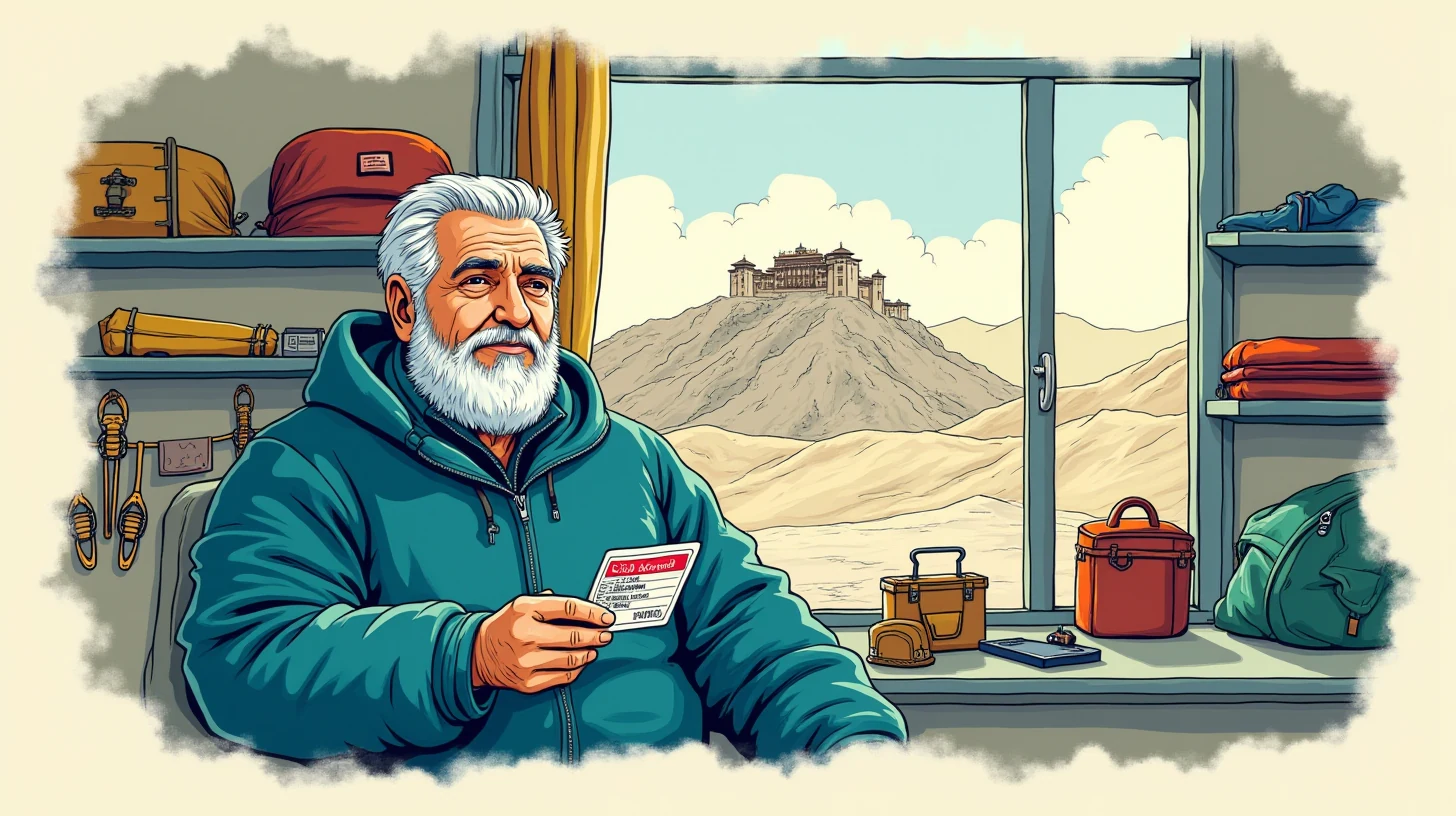
This May, when Sonam arrived—his younger cousin, back from a tourism management course in Chandigarh—Stanzin was waiting. Not for help with the spring rush. Stanzin was waiting for an answer that Sonam's two years of lectures might have given her: What do I do about the licence? Not the old licence. The one that no longer existed.
Stanzin held the laminated card from 2015, issued under the Jammu and Kashmir Shop Act, still valid on paper until last month. But the paper itself had become a ghost. In October 2019, when the Indian government bifurcated the state, Ladakh became a Union Territory without a legislature. The Jammu and Kashmir government in Srinagar no longer administered Leh. The J&K Shop Act stopped being administered here. Nothing replaced it. For six years, Stanzin had been operating in a zone between two bureaucracies, technically unlicensed, practically untouched. Until the spring a trekker from Hamburg complained that a tent he rented had a torn seam, and the damage claim reached Stanzin's desk along with a simple question: Where is your Adventure Equipment Rental Permit from the UT Tourism Department?
Stanzin had no permit. He had a 2015 photograph, a growing pile of dried apricots he couldn't legally call food products, and a cousin on the sofa with a laptop who suddenly looked very useful.
🗓️ When Ladakh became a UT without legislature
On August 5, 2019, India's Parliament passed the Jammu and Kashmir Reorganisation Act. The old state dissolved. Jammu and Kashmir became a Union Territory (with its own legislature, sitting in Srinagar). Ladakh became a Union Territory (without a legislature, administered directly by a lieutenant governor and a centrally appointed bureaucracy in Leh). The distinction matters more than it sounds.
When a state becomes a UT, its laws don't vanish instantly. Courts often continue applying old statutes until new ones are written. But the administration of those laws shifts. The J&K government stopped administering Ladakh. The UT administration, new and skeletal, hadn't yet written laws for Ladakh businesses. Stanzin's 2015 J&K Shop Act licence was still valid in theory. But the authority that issued it no longer governed him. The authority that now governed him had issued no replacement.
This legal gap—between the death of the old framework and the birth of the new—is where small business owners like Stanzin were left sitting. It's different from other UT transitions. Delhi, Puducherry, and Chandigarh all became UTs decades ago, with old legislatures or councils already in place. But Ladakh had no pre-existing body to smooth the transition. The nearest equivalent was the Leh Autonomous Hill Development Council (LAHDC), created in 1995 to manage Leh district matters—but it had never been the primary trade licence authority. That was always the state.
By 2025, the UT administration had still not enacted a central Shop Act for Ladakh. Instead, the LAHDC began issuing Trade Registration Certificates (TRCs)—a holding framework, accepted by banks and suppliers as equivalent to a shop licence, but not identical in law. It was interim. It was pragmatic. It was what Sonam found when she began digging.
⚠️ Three things the UT transition didn't clarify
The Hamburg trekker's complaint exposed three separate compliance gaps that the UT transition had left unmapped.
First: The trade licence grey zone. Stanzin was not unique. Hundreds of small businesses in Leh had been operating under J&K licences that no longer had a jurisdiction. The LAHDC TRC was a workaround, not a legal replacement. The UT administration had not published clear guidance. Was a J&K licence still valid? Could a business operate without renewing? What happened if you applied for a TRC but the LAHDC took months? Stanzin had simply assumed he could keep operating. Most shop owners did the same.
Second: FSSAI registration limbo. Stanzin sold dried apricots to trekkers—a small side business, but a food product. His FSSAI Food Business Operator registration had been issued under the J&K Directorate. When Ladakh became a UT, the FSSAI created a separate FBO registration body in Leh. Old J&K registrations were not automatically migrated. Many owners didn't know they needed to apply again. Stanzin had been selling apricots under a J&K registration that the UT FSSAI had no record of.
Third: Adventure equipment permit blindness. This was the one that mattered most for Stanzin. The Ladakh UT Tourism Department, set up in 2020, had quietly classified equipment rentals—tents, crampons, harnesses, ropes—as "Adventure Equipment," which required a special permit. This permit didn't exist under the J&K Shop Act. It was a new Ladakh UT requirement. Stanzin had rented thousands of rupees worth of gear without knowing this permit existed.
When the Hamburg trekker's claim came in, his insurance company asked for the Adventure Equipment Rental Permit. Stanzin realized he had never seen the form.
"Before that," Stanzin told Sonam, "I thought I was following the rules. I had a licence from the government. I was paying tax. I thought I was legal." What he had not understood was that the government that issued his licence no longer existed.
text_original: "सरकार बदलती है, लेकिन दुकान नहीं। Ladakh का कानून बदल गया, पर किसी ने हमें नहीं बताया।" text_english: "The government changes, but the shop doesn't. Ladakh's law changed, but no one told us." author: Stanzin Dorje, trekking shop owner, Leh
🌗 The Hill Council path
Sonam had brought a notebook. She sat with Stanzin one afternoon in June, with chai growing cold, and mapped out what the UT transition had actually created.
Sonam's notes, translated from Hindi:
"So you have three systems now, not one," she began. "The first is the Hill Council TRC. The LAHDC has been issuing these since 2021, slowly at first. They cover all retail and small business—shops, restaurants, rental places, everything. It's not the old Shop Act, but the courts are treating it as equivalent. And here's the thing—the government says it's temporary. It's only valid until a central Shop Act is made for Ladakh UT. But that could be years. So you apply for the TRC now, and you're legal now."
"What do I need?" asked Stanzin.
"You'll need: your proof of address from the shop, your Aadhar, your PAN, a passport photo, proof of rent or ownership. You go to the LAHDC office on Changspa Road—they have a counter. You fill out a form. You pay ₹500. They might ask about your water supply and electricity bill. Takes about two weeks. You get a certificate. It's valid for five years."
"And then?"
"And then you're a registered business in Ladakh UT. Banks will accept it. You can pay taxes against it. You can insure the shop. It's the linchpin."
Sonam turned the page.
"The second system is FSSAI migration. Because you sell food—the apricots—you need a Food Business Operator registration with the UT FSSAI, not the J&K one. The process is similar. You apply to the FSSAI office in Leh. You tell them your J&K registration number. They cross-check, they deregister the old one in the system, and they issue a new UT FBO certificate. This takes about three weeks. Fee is about ₹2,000 for a micro business. After that, your apricots are legal."
"And the third?"
"The third is the one that caught you," Sonam said. "Adventure Equipment Rental Permit. This comes from the Tourism Department of the UT Administration. It's new. It didn't exist under J&K. But Ladakh wants to track adventure rentals—who's renting, what condition are the tents in, accident liability, that kind of thing. You apply for this permit. You declare what equipment you have. You pay an annual fee. They issue a permit. You're good for a year."
"तीन दफ्तर, तीन दस्तावेज़, एक ही हफ़्ते में।"
(Three offices, three documents, one week of work)
🧭 Ladakh's compliance transition
What Sonam had identified was a pattern unique to UTs without legislatures. Ordinarily, when a state bifurcates or a region becomes a UT, the old legislative body hands off to a new one. But Ladakh had no legislature. So every law-making function had to be invented from scratch or absorbed by an interim body. The LAHDC, designed as a local council, had suddenly become the de facto trade authority. The Tourism Department, created in 2020, had to write its own rules.
The result: no single source of truth. Stanzin couldn't have found all three requirements by looking at one website or calling one office. He had to know that the LAHDC existed. He had to know that FSSAI had a UT registration process. He had to know that tourism equipment was classified separately. None of these were obvious. All three were legal.
This is how other UT-without-legislature businesses navigate it: they ask. They network. They talk to cousins who went to business school. They post in WhatsApp groups. They hire a CA or a consultant. They don't find the answers in official channels because the official channels haven't learned to speak to each other yet.
Stanzin's luck was Sonam. Her luck was a tourism course that had covered regulatory frameworks, even if the textbook version was simpler than the Ladakh reality.
What it does
What it does not do
🌱 Sonam's summer mapping
By August 2025, Stanzin had filed all three applications. The TRC came back in twelve days. The FSSAI migration took three weeks (the UT office was understaffed, but Sonam's call to the district inspector helped). The Tourism permit took twenty-one days. By September, his shop had three new certificates laminated and hanging beside the old 2015 ghost.
The Hamburg trekker case had been closed. The insurance company, seeing the Tourism permit, had approved the claim without further question. The tent was replaced. A small loss, but a lesson.
That October, when the trekking season opened again, Stanzin had something he hadn't had before: legal clarity. Not because the law had suddenly become simple. But because he had mapped it.
Sonam stayed through the autumn. She helped him reorder the FSSAI-compliant apricot packaging—the labels now had to declare allergens and shelf life, which meant buying new stock stickers. She helped him call the Tourism Department to ask about annual renewal. She helped him understand that his TRC would need renewing in 2030, but the FSSAI in 2030 if he didn't apply before the expiry.
By the time she went back to Chandigarh in November, the shop was operating in three systems instead of one. Not because the systems had been unified. But because Stanzin had finally learned that they existed.
This is how small business owners survive UT transitions: not through clear guidance, but through the network of people who ask the right questions. Sonam had the curiosity to look. Stanzin had the willingness to act. And the LAHDC, the FSSAI, and the Tourism Department had, despite their newness, left the doors open.