
The Patna hardware dealer and the e-way bill he thought wasn't needed
Vikash Kumar stood in the paint section of his hardware and paint shop on Boring Road, Patna, arranging tin cans of putty when his delivery driver's phone call came through. His hands were still dusty from the morning shift when he answered—the driver's voice tight, apologetic.
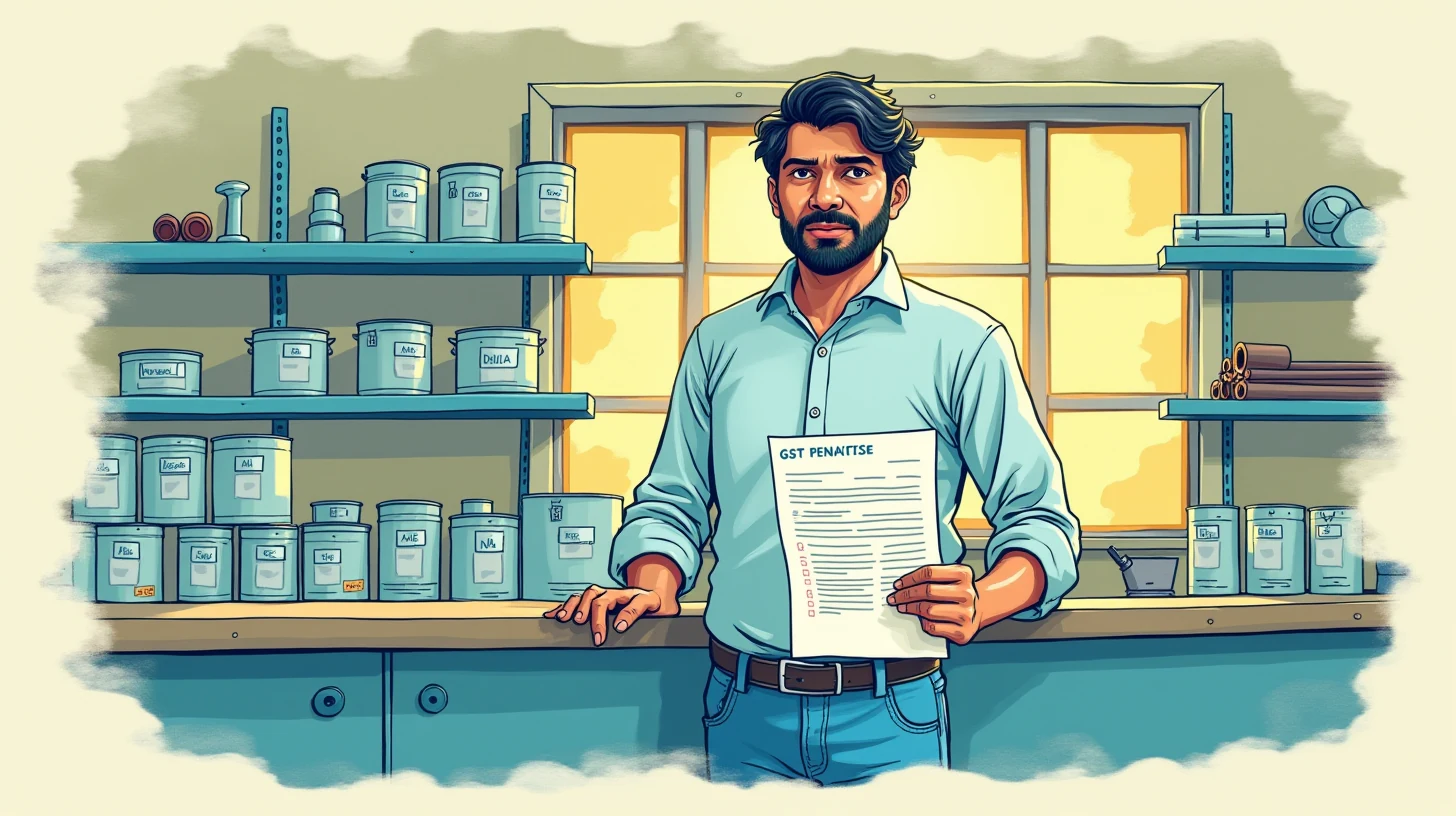
Boring Road, Three o'Clock
The van had been stopped on the ring road. A GST inspector was there.
Vikash had been running this shop for eight years. He supplies construction sites, contractors, painters across Patna district—anyone building, renovating, or painting buys from him. His wife Savita manages the accounts in the back room. His two children go to school not far from the shop. Life was steady, predictable, until the driver's next words: "Sir, they're saying no e-way bill. The goods are detained."
Vikash felt his stomach drop. He had sent ₹95,000 worth of paint and hardware—interior paints, exterior primers, plumbing fittings, electrical conduits, copper pipes—to a contractor's site that afternoon. He had done this dozens of times. The goods were valued at nearly a lakh but not quite. He thought the e-way bill requirement kicked in at ₹1 lakh. That's what he'd been told. That's what he'd been working with for years.
He was wrong. By ₹45,000.
🗓️ E-Way Bill System — What It Is, Who Needs It, The ₹50,000 Threshold Most Traders Don't Know
The e-way bill—electronic way bill—is a GST requirement, not optional advice. It's a digital record that tracks the movement of goods worth more than ₹50,000 from one place to another. The threshold applies to goods moving within the same state or between states. It applies to inter-city movement within Patna district. It applies to a hardware dealer sending supplies to a contractor site fifteen kilometers away.
Most traders like Vikash don't know the ₹50,000 threshold. They think it's ₹1 lakh. Or ₹2 lakhs. Or they've never questioned it.
The e-way bill must be generated before the goods leave the seller's premises. It takes two minutes. Log into ewaybillgst.gov.in with your GSTIN, fill in consignment details—buyer name, GSTIN, item description, HSN code, quantity, value—and a 12-digit e-way bill number is issued instantly. The buyer and transporter get SMS notifications. If a GST inspector stops the vehicle and asks for the e-way bill, you show the number, and the vehicle moves.
If you don't have it, goods are detained. Your delivery date slips. The contractor is upset. Worse: the GST department issues a penalty notice.
The penalty for transporting goods worth more than ₹50,000 without an e-way bill is 100% of the tax amount plus detention fees. Vikash's consignment was valued at ₹95,000. At 18% GST (the standard rate for hardware, paints, and fittings), that's ₹17,100 in tax. The penalty: ₹17,100. Add detention and processing: roughly ₹18,000 total.
Eight years of running a smooth shop. One delivery without a two-minute digital step. Three hours on the ring road. ₹18,000 paid.
⚠️ Inspector On Ring Road, Goods Detained, GST Penalty Notice, Three Hours
The detention was swift. The GST inspector checked the invoice, cross-referenced the GSTR-1 (Vikash's outgoing supply register), and found no corresponding e-way bill. The goods—paint cans, pipes, fittings—were sealed in the van. The driver was told to wait.
Vikash left the shop and drove to the ring road, his mind spinning through scenarios. Would the goods spoil? Would the contractor demand compensation? Would the inspector let him go with a warning?
No warning. The inspector was courteous but firm: e-way bill is mandatory above ₹50,000. Vikash had violated GST Rule 138. The penalty notice was printed on the spot.
The afternoon stretched into evening. Vikash's brother-in-law, who works in a CA's office, advised him to pay the penalty immediately—the sooner paid, the sooner the goods release. There was no appeal process for an inspector's on-field notice. Vikash transferred ₹18,000 to the GST payment portal that evening. By night, the goods were released.
The contractor got his delivery, a day late.
The real cost wasn't just ₹18,000. It was the realization that what he thought was sound business practice was actually noncompliance. It was the knowledge that he'd been doing this wrong for years—every consignment above ₹50,000 had been transported without an e-way bill. If the GST department had stopped other deliveries, he would have faced more penalties. If they audited his records, they might find dozens of violations in previous years.
That night, Vikash sat in the back room where Savita kept the accounts. She asked what happened. He told her the story. She said, "चिंता मत करो। अब पता चल गया। आगे ठीक कर देंगे।" Don't worry. Now you know. We'll fix it going forward.
🌗 Brother Visits, Installs GabFORGE, Agent Explains E-Way Bill Rules And BIIP 2021 In Hindi
Two days later, Vikash's younger brother Rohit visited for a family dinner. Rohit is a civil engineer working on construction projects across Patna—he uses project management apps on his phone, keeps digital records, coordinates with vendors through WhatsApp and email. He is the kind of person who is comfortable with apps.
Over dinner, Vikash mentioned the penalty in passing—a casual complaint about the ring road inspector, the ₹18,000 that could have been avoided if someone had told him the real threshold.
Rohit listened, then said, "भाई, एक चीज़ try करते हो। मेरे phone पर एक app है—GabFORGE। It has an AI agent that explains these things in Hindi. Let me install it on your phone, and ask it about the e-way bill rule."
Vikash was skeptical of apps. His phone was basic, used for WhatsApp and calls mostly. But Rohit had already pulled out his phone, found GabFORGE in the app store, and was gesturing for Vikash's device.
Twenty minutes later, GabFORGE was on Vikash's phone. Rohit showed him how to open the agent chat, and Vikash—hesitantly—asked in Hindi:
"ई-वे बिल का नियम क्या है? मेरे ₹95,000 का माल रोका गया क्योंकि मेरे पास ई-वे बिल नहीं था। क्या सीमा सच में ₹50,000 है?"
(What is the e-way bill rule? My ₹95,000 goods were stopped because I didn't have an e-way bill. Is the threshold really ₹50,000?)
The agent responded, clearly and in Hindi:
"विकाश भाई, E-Way Bill की सीमा ₹50,000 है — ₹1 लाख नहीं। ₹50,000 से ज़्यादा का माल एक जगह से दूसरी जगह भेजते हो, चाहे शहर के अंदर हो, e-way bill बनानी ज़रूरी है। ewaybillgst.gov.in पर जाओ, GSTIN से login करो, consignment की details भरो — 2 मिनट में बन जाती है। जो penalty हुई उसका reply GSTR-1 amendment में दो, CA को बताओ।"
(Vikash, the e-way bill threshold is ₹50,000 — not ₹1 lakh. When goods worth more than ₹50,000 move from one place to another, even within the city, an e-way bill is mandatory. Go to ewaybillgst.gov.in, login with GSTIN, fill consignment details — it takes 2 minutes. For the penalty, respond via GSTR-1 amendment, tell your CA.)
The agent then explained the penalty structure—100% of tax amount—and what GSTR-1 is (the outgoing supplies register Vikash files monthly with the GST department). It made sense, suddenly. The penalty wasn't arbitrary; it was a compliance cost tied to his tax liability.
Then Rohit asked, "भाई, क्या तुम्हें BIIP 2021 का बारे में पता है? मेरे CA कह रहे थे कि तुम eligible हो सकते हो।"
(Brother, do you know about BIIP 2021? Your CA mentioned you might be eligible.)
Vikash didn't. He asked the agent.
The response was patient and detailed. BIIP 2021 is the Bihar Industrial Investment Promotion Policy 2021, a state scheme designed to attract and support MSMEs (Micro, Small, Medium Enterprises) in Bihar. MSME eligibility is based on investment and turnover thresholds—if Vikash's hardware shop qualified as a Small Enterprise (investment below ₹10 crore, turnover below ₹50 crore), he could apply for reimbursement subsidies.
The reimbursement covers things like capital investment in equipment, infrastructure improvements, and sometimes working capital assistance. The application process goes through the Bihar Industrial Development Authority (BIADA). Vikash would need to gather documents—proof of business registration, MSME certificate, investment receipts, bank statements—and submit them through the BIADA portal.
"तुम्हारा दुकान ₹50,000 का monthly turnover करता है क्या?" the agent asked. (Does your shop have a monthly turnover of ₹50,000?)
Vikash did the mental math. ₹95,000 for one delivery, several deliveries a week, weekends too. Yes, easily ₹50,000 a week at least. Monthly, several lakhs.
"तो तुम definitely MSME हो। BIIP application शुरू करो। अगला छह महीने में subsidy मिल सकता है।"
(Then you're definitely an MSME. Start the BIIP application. You could receive subsidy in the next six months.)
Rohit looked at Vikash and grinned. "देख, यही तो है। सब कुछ samjha दिया, हिंदी में, दो मिनट में।"
(See, that's the point. Everything explained, in Hindi, in two minutes.)
🧭 Thousands Of Bihar Traders Operating With Wrong Threshold — The ₹1 Lakh Misconception
Vikash is not alone. Across Bihar—across India—hundreds of thousands of small traders operate with the wrong e-way bill threshold in their heads. It's ₹1 lakh, they think. Or ₹75,000. Or they've never questioned it because they've never been stopped.
The misconception spreads through word-of-mouth, through neighbors and competitors and chai-shop conversations. A trader in a nearby shop says, "Mera delivery roka gaya नहीं क्योंकि ₹1 lakh से नीचे था।" (My delivery wasn't stopped because it was below ₹1 lakh.) Someone else nods and thinks, "ठीक है, ₹1 lakh तक अपने ई-वे बिल नहीं बनाना।" (Okay, I don't need an e-way bill up to ₹1 lakh.)
The rule itself is not obscure—it's published on the GST portal, in official notifications, in CA WhatsApp groups. But for a hardware dealer in Patna who left school at sixteen and learned business through experience, the GST portal is intimidating. Official notifications are jargon. The rule lives in a world of "probably," "heard from someone," "seems reasonable."
Then an inspector stops your van, and the rule becomes very real.
What it does
What it does not do
"गलती ₹1 लाख वाली जानकारी थी। ₹50,000 से ऊपर का माल जाता है, ई-वे बिल चाहिए — यह किसी ने नहीं बताया।"— The mistake was wrong information — ₹1 lakh. Above ₹50,000 goods move, e-way bill is needed — nobody told me that.
🌱 Penalty Paid, E-Way Bill Habit Formed, BIIP Application Started
Three days after Rohit's visit, Vikash and Savita sat down with their CA, Ravi Mishra, who works out of a small office near Khokhan Market. Vikash showed Ravi the penalty notice, the GST portal screenshot, and the GSTR-1 amendment he needed to file.
Ravi confirmed what the agent had said: the e-way bill threshold is definitively ₹50,000. The penalty was compliant with GST law. Paying it was the right move. Going forward, every delivery above ₹50,000 must have an e-way bill generated before the goods leave the premises.
Ravi also mentioned BIIP 2021. He had brought it up before—he knew Vikash qualified—but Vikash had never acted on it. Now Ravi sensed interest. He said, "तुम्हारा business MSME है। BIIP के लिए documents तैयार कर दूँ? Capital subsidy मिल सकता है अगले साल।"
(Your business is an MSME. Should I prepare the BIIP documents? You could get capital subsidy next year.)
Vikash asked, "कितना मिल सकता है?"
(How much could I get?)
Ravi smiled. "Depends। अगर तुम equipment upgrade करो या shop का infrastructure improve करो—नई electricity connection, बेहतर shelving, air circulation—तो ₹2 to ₹5 lakh तक subsidy मिल सकता है। BIIP reimburses your investment 25-50% तक।"
(Depends. If you upgrade equipment or improve shop infrastructure—new electrical connection, better shelving, air circulation—you could get subsidy of ₹2 to ₹5 lakhs. BIIP reimburses up to 25-50% of your investment.)
Vikash had been thinking about improving the shop anyway. The paint section needed better ventilation. The storage area was cramped. A small HVAC unit and some reorganization could make the place safer and more professional. Now there was a subsidy backing the idea.
By the next week, Vikash had:
Generated e-way bills for all deliveries above ₹50,000. He logged into ewaybillgst.gov.in each morning, filled in consignment details for the day's outgoing supplies, and printed or screenshotted the e-way bill number. Two minutes per delivery. His driver now carried copies. No more detentions.
Amended his GSTR-1 to reflect the penalty and GST liability correctly. Ravi handled the technical filing, but Vikash understood what was being filed and why.
Started the BIIP 2021 application. Ravi gathered documents—MSME certificate, shop registration, business bank statements, invoices for past infrastructure expenses. They planned a small capital improvement project: new electrical panel, ceiling fans, and improved shelving. The cost would be around ₹2.5 lakhs. If BIIP approved, Vikash would receive a 40% reimbursement—₹1 lakh back.
Four weeks into the new routine, Vikash was standing in the shop again, arranging paint cans. A regular customer, a contractor from Kankarbagh, came in and asked for supplies—₹65,000 worth of materials for a villa project.
Vikash asked for the delivery address and generated the e-way bill on the spot, in front of the contractor. The contractor was curious: "क्या यह नया है?"
(Is this new?)
Vikash told him the story—the ring road, the detention, the penalty. The contractor nodded sympathetically but said something that made Vikash realize how many more traders might be in his old situation:
"मेरे दूसरे supplier का यह rule का पता नहीं है। मैं भी सोचता था ₹1 लाख था।"
(My other supplier doesn't know this rule. I also thought it was ₹1 lakh.)
Vikash realized then that the ₹50,000 threshold wasn't just his blind spot. It was an industry-wide blind spot, shared by hundreds of hardware dealers, paint merchants, plumbing contractors, and suppliers across Bihar who were one GST inspection away from the same penalty.
The agent had explained it in two minutes, in Hindi, without jargon. That mattered. That made it stick.
The Lesson
The e-way bill penalty cost Vikash ₹18,000 and three hours on a highway. The threshold is ₹50,000, not ₹1 lakh. Every delivery above that needs a two-minute digital step before the goods leave the shop.
The BIIP 2021 application is still in progress, but it's moving forward. If approved, it will reimburse 40% of his shop improvement costs—a real subsidy for an MSME that was operating without even knowing the scheme existed.
But the bigger lesson is this: the rules are published, but they don't reach traders like Vikash unless someone explains them clearly, in a language that makes sense, at a moment when the question is real.
Rohit's app did that. A small agent, trained to explain GST rules and state schemes in Hindi, to traders in Patna, in a way that makes compliance feel like clarity rather than bureaucracy.
Vikash still stands in his shop on Boring Road, arranging paint cans. But now, when a delivery goes out for more than ₹50,000, he generates an e-way bill. When a contractor asks about subsidies or state schemes, he has answers. And when another hardware dealer asks him about the ring road or e-way bills, he tells them the truth: ₹50,000 is the threshold. Generate the bill before the goods move. It takes two minutes.
It's not a lesson he wanted to learn that way. But it's a lesson that stuck.