
The Port Blair shell seller and the Wildlife Act he didn't know applied
The Aberdeen Bazaar in Port Blair hums with the particular energy of a tourist town at the edge of the sea. Cruise ships dock twice a week, and by mid-morning, the narrow lanes are lined with cameras, sunburned shoulders, and the murmur of Malayalam, Hindi, and English mixed into the island's own acoustic texture. Samuel Roy's shop sits near the corner—a small storefront with a hand-painted sign, glass cases running the length of the window, and a door that opens directly onto the pavement where cycle-rickshaws clink past in an irregular rhythm.
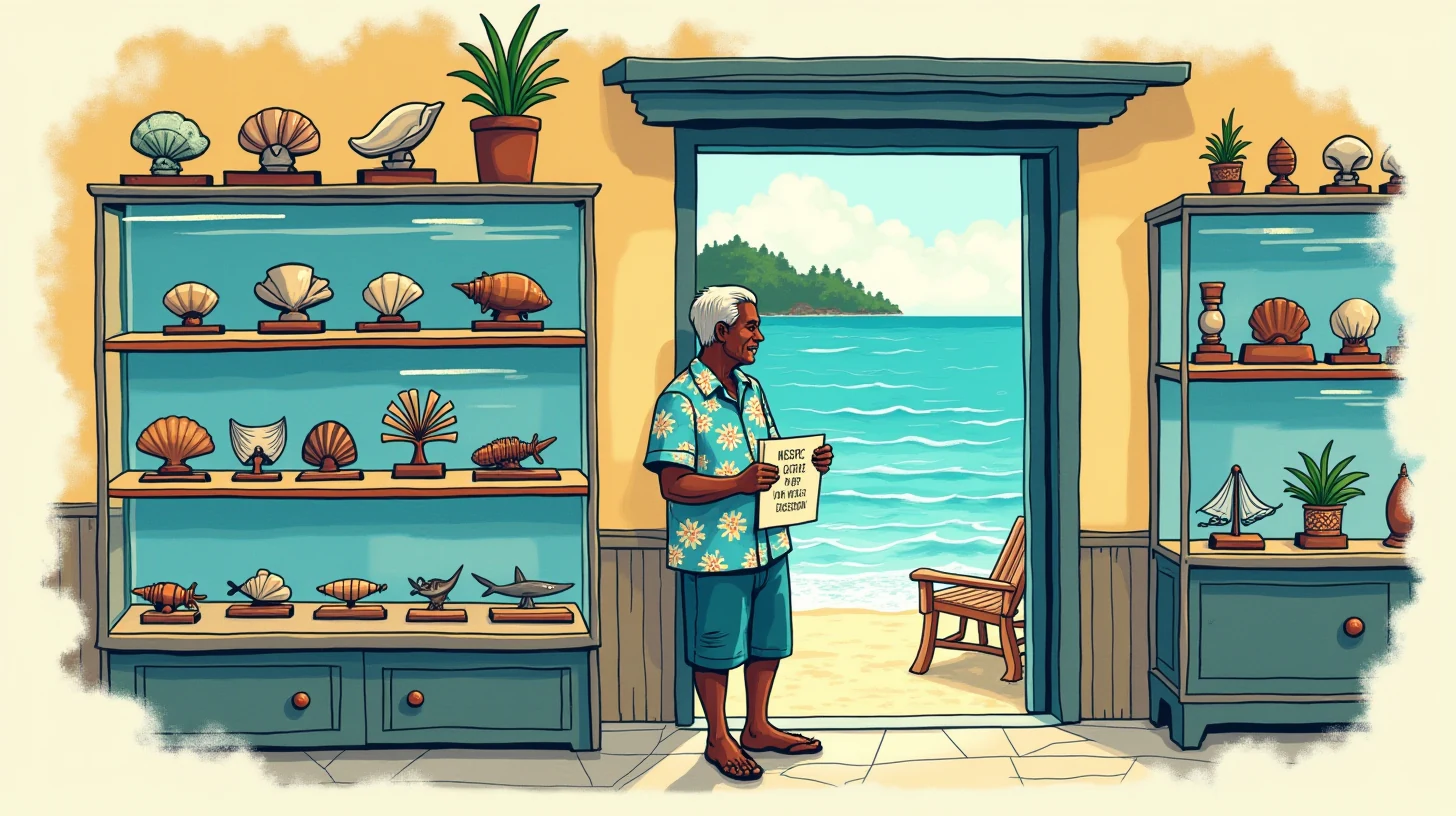
Samuel has run the shop for twenty-eight years. Before him, his father ran it for thirty-three. The inventory had barely changed: polished conch shells arranged in neat pyramids, cowrie shells strung on twine, sea urchin spines glued into geometric patterns, coral models in faded paint. A third-generation Islander, Samuel didn't think of these items as risky. This was the Andaman he knew—the sea was here, the shells came from the fisher community he'd bought from his whole life, and tourists bought what they recognized as "authentic." A conch shell on your mantle meant you had been to the Islands.
On a Tuesday in February, a man in a Forest Department uniform walked in without browsing and handed Samuel an official notice. Three hundred and forty conch shells. Section 49 of the Wildlife Protection Act, 1972. A fine of ₹25,000. Samuel's daughter Priya, who was home from her tourism management course in Mumbai, watched her father's face shift from confusion to something like shame—not because he'd done anything he believed was wrong, but because he suddenly understood that what he'd been doing all his life was now officially criminal.
🗓️ The Wildlife Protection Act and shells
The Wildlife Protection Act, 1972, is India's oldest conservation statute. It divides protected animals into four schedules based on the level of threat and the strictness of protection required. Schedule I contains the most protected species—tigers, elephants, rhinos, Indian bison. But Schedule II and III include creatures most people have never heard of, including many marine animals and their byproducts.
What matters for a souvenir seller: most sea shells—conch, cowrie, nautilus, sea urchin—fall under Schedule II or III. You cannot buy them, sell them, or possess them without a permit from the Forest Department. The aquaculture exemption exists, in principle, but it's narrow. You must source from a licensed aquaculture facility with proper documentation. These are rare in Andaman, and the paperwork is complex.
The Andaman and Nicobar Administration operates under the Wildlife (Protection) Act with unusual stringency. The Islands' ecosystem is fragile. Enforcement happens through the Forest Department, and they inspect tourist shops regularly. The penalties are structured to deter: first offense can run to ₹25,000 plus confiscation of stock. A second offense lands you in jail.
Most shop owners in Port Blair don't know this. They inherit inventory from parents. They buy from local fishers. They see no difference between a conch shell and a wooden replica. The law sees a difference—a sharp, expensive, potentially criminal one.
⚠️ Three problems on a Tuesday
The first problem was obvious: the 340 conch shells. These had come from Zahir, a fisher from Haddo who Samuel had bought from for fifteen years. Zahir collected them in shallow nets, cleaned them, and sold them by weight. Samuel had paid ₹4 per shell. He'd done the same math his father had done. The notice made it clear this was no longer an option.
The second problem emerged when Priya started asking questions. Samuel also sold coconut cookies, coconut candy, and coconut-based sweets packaged in plastic and labeled with his shop name. He'd been selling these for eight years—they came from a home-kitchen operation run by a woman from Port Blair, and tourists loved them. Priya asked if he had FSSAI registration for food items. Samuel looked blank. He'd never heard of it. Priya checked the FSSAI website and found that any food sold in A&N—even secondary items in a tourist shop—requires state-level registration. His coconut products had been sold without any license for eight years.
The third problem was bureaucratic but real: his Trade Licence from the Port Blair Municipal Authority listed him under "Marine Products – General." The Forest Department was now interpreting this category as implying that he needed a WPA permit to operate at all. Whether this interpretation would stick was unclear, but it hung over the entire conversation.
"मैंने तो बस यही सीखा था कि अपनी दुकान चलाओ, सीपियाँ बेचो, पर्यटकों को खुश करो। कानून कहाँ था?""I only learned what my father taught me: run your shop, sell shells, make the tourists happy. Where was the law?"
— Samuel Roy, Port Blair
🌗 The legal line in the display case
Priya sat down with her father, a cup of chai between them, and walked him through what she'd found.
Priya: "बाबा, देखो—यह सूची देखो। शंख, सीपी, समुद्री शूल—यह सब प्रतिबंधित हैं। वाइल्डलाइफ प्रोटेक्शन एक्ट के तहत।"
"Dad, look—see this list. Conch, cowrie, sea urchin—all prohibited. Under the Wildlife Protection Act."
Samuel: "तो फिर मैं क्या बेच सकता हूँ?"
"So what can I sell?"
Priya: "यह देख—लकड़ी की नक़ल। तराशी हुई लकड़ी से बना समुद्री जानवर। यह कानूनी है क्योंकि यह असली नहीं है। और यह—नारियल के छिलके से बना, रंग किया हुआ। भी कानूनी है।"
"Look—wooden replicas. Carved from wood to look like sea animals. These are legal because they're not real. And this—made from coconut shell, painted. Also legal."
Samuel: "और नारियल की मिठाई?"
"And the coconut sweets?"
Priya: "उन्हें FSSAI के साथ रजिस्टर करना होगा। अगर हम यह करते हैं, तो कानूनी हैं। अभी नहीं हैं।"
"They need to be registered with FSSAI. If we do that, they're legal. Right now, they're not."
The line Samuel had to draw was this: anything that came from the ocean with its original natural form was prohibited. Anything carved, painted, or transformed was legal. A conch shell was wildlife. A wooden replica of a conch shell was a craft.
What it does
What it does not do
"सीपी असली है तो सजा है। सीपी नकली है तो व्यापार है।"
(A real shell means punishment. A fake shell means business.)
🧭 Why coastal tourist shops face WPA exposure
Port Blair is not alone in this pattern. Every coastal tourist town in India has shops like Samuel's—sellers who inherited a model from an older generation, who bought from local fishers without asking about regulations, who thought "authentic" and "legal" were the same thing. The Andaman and Nicobar Islands enforcement is stricter than most, but the underlying law applies everywhere: Goa, Kerala, Tamil Nadu, Odisha.
The demand for real shells is real. Tourists want to feel they've brought back something genuinely local, something that came from the sea they saw. A wooden replica sits in a shop by the thousand. A conch shell feels like proof.
But enforcement has shifted. The Forest Department, under pressure to show results on environmental targets, has begun visiting tourist shops. The penalty structure creates incentive: confiscate the goods, fine the seller, show a statistics report to the ministry. For shop owners, the surprise is total.
What's emerging instead is a replica economy. Sculptors in Port Blair, Kochi, and Pondicherry are developing expertise in wooden marine models, resin replicas, and painted coconut crafts. The market for these is growing. And unlike selling wild-harvested shells, selling replicas is legal, defensible, and sustainable.
🌱 Priya's research
Samuel disposed of the 340 conch shells. He didn't sell them, didn't donate them, didn't try to move them to another state. He filled two burlap sacks, took them to the Forest Department office, and got a receipt. The fine was reduced to ₹8,000 after he filed a compounding application—an acknowledgment that he'd violated the Act but would comply going forward.
He replaced the conch shells with carved wooden replicas sourced from a sculptor in Port Blair named Thomas, who'd spent three years learning to replicate marine anatomy in teak and rosewood. The replicas sold—not immediately, but steadily. Tourists still wanted something that looked like the sea. The models were beautiful enough, detailed enough, and they didn't come with a fine.
The coconut products were easier. Priya filled out the FSSAI registration form herself, uploaded photographs of the packaging, and submitted it to the foscos portal. Approval came in twenty-one days. Samuel printed new labels with the FSSAI registration number and didn't lose a single product from his shelves.
Six months later, the Aberdeen Bazaar shop looked different. The glass cases still caught the light. The inventory still smelled of salt and varnish. But now, when a customer asked for something authentic, Samuel could say it was: authentic in craft, authentic in design, and authentic in compliance. He was no longer betting against a notice from the Forest Department. His daughter's tourism education had become his daughter's protection.
The Islands' ecosystem, fragile as it is, keeps its shells. Samuel keeps his shop. The line between them—drawn in law, enforced in statute, but made real by a daughter with a laptop and a father willing to change—holds.