
The Puducherry gift shop and the Chennai supplier who charged the wrong GST
The white walls of White Town catch the afternoon sun in long, clean rectangles. Marie Therese Pillai stands in the doorway of her shop—Chambre de Curiosités—watching a customer turn a handmade ceramic bowl over in her hands. The space behind her is deliberately sparse: terracotta on one wall, French-aesthetic stationery in wire holders, Auroville pottery on floating shelves. The building itself is pre-independence Pondicherry—high ceilings, tall shuttered windows, a courtyard entrance that still smells of jasmine and colonial salt.
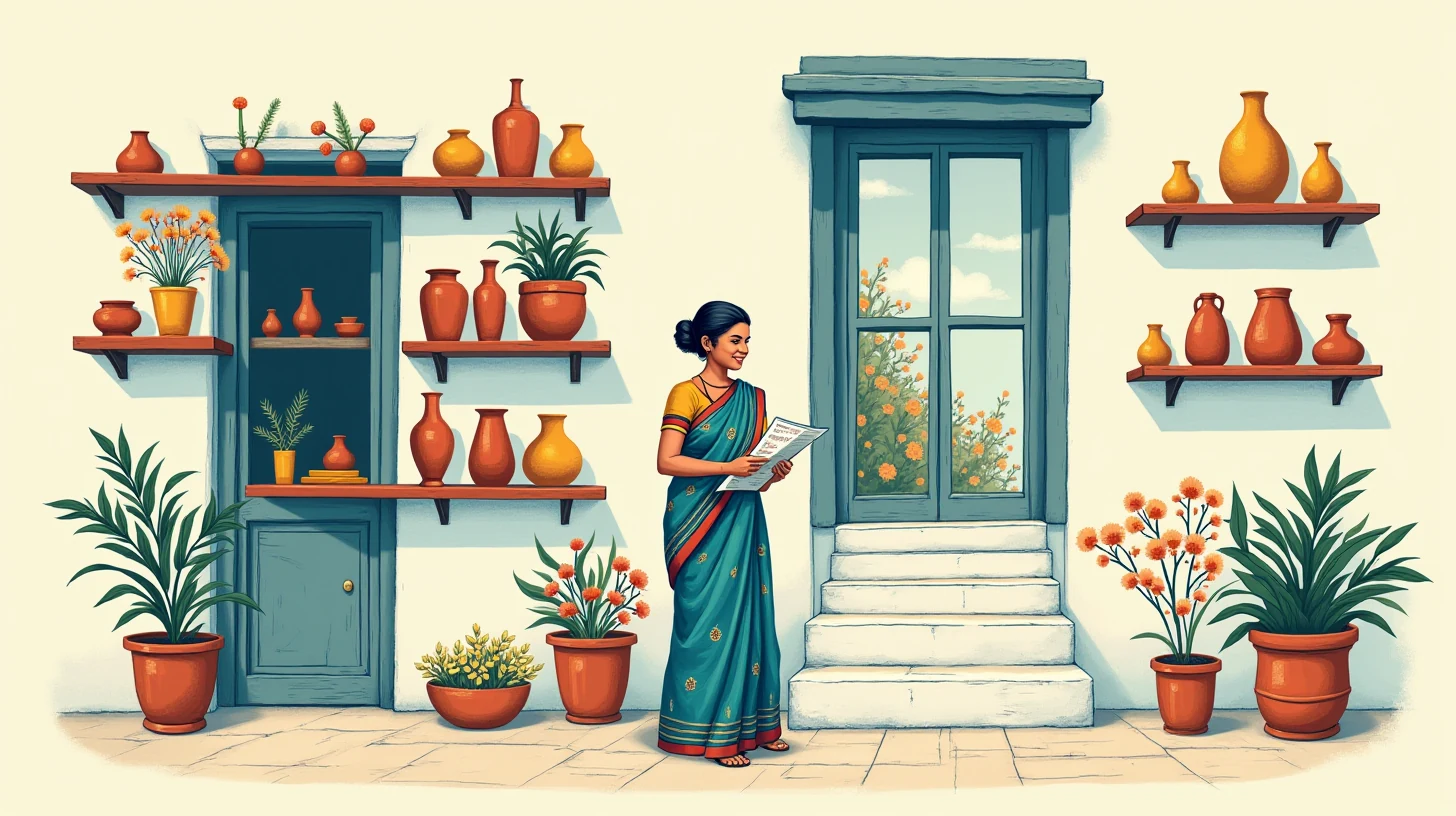
Marie is fifty-three. She's run this shop for eight years, sourcing from a network that spans Chennai suppliers, local potters, and the artisans of Auroville, thirty kilometers south. The shop turns small but steady profit. The problem—or rather, the three problems—hadn't surfaced until her son Thomas came home from Chennai for a long weekend in March.
Thomas is an architect. He notices buildings the way other people notice weather. He walked into the shop, hugged his mother, and within ten minutes was standing in front of the new display shelf she'd installed last year, tilting his head. Not at the shelf itself, but at the heritage notification placard on the outer wall. Then he was asking about her GST filings. Then he was asking her to pull her invoices from the Tamil Nadu stationery supplier.
By evening, mother and son had uncovered three separate compliance gaps that had been sitting, quietly accumulating, beneath the aesthetics of the gift shop.
🗓️ The TN-Puducherry GST boundary
Puducherry is administratively a Union Territory, but it's geographically a set of enclaves scattered through Tamil Nadu. For GST purposes, it has its own state code: 34. Tamil Nadu is state code 33.
When a supplier in Chennai sells to a buyer in Puducherry, the supply is technically interstate. Interstate supplies in GST are taxed at 5% IGST (Integrated GST)—a single tax that replaces the combined CGST (Central GST) and SGST (State GST). The buyer can claim the full 5% IGST as input tax credit.
But here's where habit breaks the rule. Many Chennai suppliers, especially smaller ones who've been trading for decades, treat Puducherry as "basically Tamil Nadu" and invoice using CGST (2.5%) + SGST (2.5%) instead. It's intra-state treatment. It's wrong—but it's fast, and it feels familiar.
Marie's stationery supplier had done exactly this. For two years, they'd invoiced every shipment with Tamil Nadu's CGST+SGST split. Marie, trusting the invoices, had claimed the input credit accordingly in her GSTR-2 filings. Her auditor never flagged it. The GST officer's system accepts what you file. No one shouts.
Until the GSTR-2B—the auto-populated list of inbound tax credits from GST officers' GSTR-1 filings across India—rolled in with a mismatch. The supplier's invoices (CGST+SGST) didn't match the GST officer's records (IGST), because the supplier themselves, filing their own GSTR-1, had split it into state and central. The mismatch was ₹44,000 in input tax credit hanging in the void.
There's another complexity: Auroville. The pottery and craft pieces Marie buys from Auroville artisans come from people who aren't individually GST-registered. Auroville has a special legal status under the Auroville Foundation Act, and the artisans operate under a collective exemption. When Marie sells these pieces in her shop, she has to charge GST—but she can't claim input credit because the artisans don't issue GST invoices. It's a leak in her supply chain.
:::infographic type: timeline
- Step 1: Marie claims input credit on CGST+SGST invoices from Chennai supplier (2024–2025)
- Step 2: Thomas reviews invoices, notices Puducherry state code 34 but GST type is CGST+SGST (Tamil Nadu treatment, should be IGST)
- Step 3: GST mismatch appears in GSTR-2B; supplier issues corrected invoice with IGST; ₹44,000 credit reconciled
- Step 4: Auroville supply restructured as "procurement from unregistered supplier"; Heritage Zone minor works application filed retroactively :::
⚠️ Three problems in a colonial building
The first problem was the ITC mismatch. Marie and Thomas calculated the impact: if the GST officer had assessed the discrepancy, the input credit would have been reversed, creating a tax liability she hadn't budgeted for. The ₹44,000 was money that had already been claimed and spent in reconciliation entries.
The second problem was Auroville. Marie wasn't losing money on the pottery—the artisans charged reasonable wholesale rates—but she was operating in a gray zone. She was paying tax on goods that had no corresponding input credit, which meant her effective tax rate on Auroville products was closer to 10% retail. She could reformulate her procurement side to track Auroville purchases as "unregistered supplier" purchases, which would maintain the GST charge to retail customers but document the input-credit gap. It was honest bookkeeping, but it required a pivot.
The third problem was the shelf.
The new display shelf was a modest thing—three tiers, white-painted wood, mounted against the interior wall near the southern window. It wasn't load-bearing. It wasn't structural. But it was visible from the street when the shutters were open, and White Town is a heritage zone. Puducherry Heritage Zone regulations require approval from the Heritage Zone committee for any interior modifications that might alter the outward appearance of a protected building. A shelf visible through a window—especially in a property listed for architectural merit—technically falls under the scope.
Marie hadn't known. She'd contracted a local carpenter, paid ₹8,000, and installed it in an afternoon.
Thomas pulled out his phone and photographed the placard. Then he photographed the shelf through the window from the street. By the time Marie brought tea, he'd found the Puducherry Heritage Zone notification online.
🌗 The boundary between two adjacent states
The conversation happened in Tamil, French, and English in rotation—the three languages of Puducherry's commercial life.
Marie (in Tamil): "Why would they care about a shelf? It's inside the shop."
Thomas (in English): "Heritage zones exist because the building itself is protected. Any change to how it looks from the public street—that's their jurisdiction. It's not about what's inside; it's about the boundary between private space and the heritage they're protecting."
Marie (in French): "Et le GST? How do I fix the invoice problem?"
Thomas (in English, translating): "Two parts. First, call your Chennai supplier today. Tell them Puducherry is GST state code 34, not 33. Tell them you need a corrected invoice with IGST instead of CGST+SGST. They'll issue a debit note and a replacement invoice. You submit the replacement to the GST officer in your next GSTR-2B cycle. The ITC mismatch resolves because now your filing matches what the supplier reported in their GSTR-1."
He paused, sipping the tea.
Thomas (continuing): "The Heritage Zone issue needs a minor works application. You'll need an architect's certificate—which is lucky, because I can help with that. The shelf is a reversible modification, so it's a regularisation application, not a retroactive permission. The committee usually approves these in thirty days. There's a fee—around ₹1,500."
Marie (in French): "Et Auroville?"
Thomas (in English): "That one's actually straightforward. You're already charging GST to customers. You just need to be clear in your books that you're not claiming input credit on the Auroville purchases because the suppliers aren't registered. It's transparent and defensible."
"ஒரு பக்கம் தமிழ்நாடு, மற்றொரு பக்கம் புதுச்சேரி—ஆனால் வரி ஒன்றுதான் என்று நினைத்தேன்."
(On one side is Tamil Nadu, on the other Puducherry—but I thought the taxes would be the same.)
— Marie Therese Pillai
"ஒரு பக்கம் தமிழ்நாடு, மறுபக்கம் புதுச்சேரி — இரண்டும் வேற வேற, ஆனா ஜிஎஸ்டி அதை புரிஞ்சுக்கலை."— On one side Tamil Nadu, on the other Puducherry — they are separate, but GST hadn't understood that.
:::infographic type: boundary When you're in Puducherry (State Code 34):
- ✓ Supplies from Tamil Nadu suppliers are interstate → charge IGST
- ✓ Auroville artisans (unregistered) → charge GST on retail, no input credit
- ✓ Any visible building modification in heritage zones → requires approval before work
When you're buying in Tamil Nadu (State Code 33):
- ✗ Don't treat Puducherry buyers as Tamil Nadu buyers (common mistake)
- ✗ Don't assume unregistered suppliers can issue GST invoices
- ✗ Don't ignore heritage zone boundaries when supplying to White Town properties :::
🧭 Why Puducherry creates GST confusion
Puducherry's problem is geography. The UT is a non-contiguous set of enclaves—the main town, Karaikal to the south, Yanam on the Andhra coast, and Mahe tucked into Kerala. None of them are islands; all of them are surrounded by or adjacent to Tamil Nadu, Andhra Pradesh, or Kerala. For a trader, this creates constant boundary friction.
A Chennai supplier might do a hundred deliveries to Tamil Nadu per week, and one delivery to Puducherry. The one Puducherry shipment is an outlier in their workflow. If their software is automated, it might default to Tamil Nadu rules. If it's manual, the person filing might not even register that the destination postcode maps to Puducherry state code 34. This isn't malice—it's entropy. Default rules default.
Auroville compounds the problem. The artisan collective has legal exemption from GST registration, which is correct—but it means any buyer purchasing from Auroville is buying from an unregistered supplier. This creates a category of goods in Puducherry that enters the chain without GST documentation. If you're a registered buyer (like Marie), you have to absorb the tax. If you don't understand why Auroville purchases don't generate input credit, it looks like you're being cheated.
Heritage Zones are enforced unevenly. Puducherry has tourism value and colonial architecture—the regulations exist—but inspections typically happen only when work is visible or a neighbor complains. A shelf installed quietly, with steady customers, might never trigger a visit. But it creates latent compliance risk. The moment a property inspector arrives for another reason, or a building permit application requires a heritage certificate, the unapproved shelf becomes a liability.
🌱 Thomas's weekend audit
By the time Thomas left on Monday, three things had moved.
Marie called her Chennai supplier first thing Friday. They were surprised but compliant—one email later, they understood the distinction between state codes 33 and 34, and they issued a corrected invoice with IGST. Marie filed the corrected invoice in her GSTR-2 for the next month's return. The ₹44,000 mismatch didn't go away immediately, but it entered the regular reconciliation cycle where the tax officer could see that both the supplier and the buyer were now reporting the same tax type. By the June GSTR-2B, the discrepancy had cleared.
Thomas drafted a minor works retrospective application for the Heritage Zone committee, including an architect's certification that the shelf was a reversible interior modification with no structural impact. He submitted it on Saturday. The committee approved it in twenty-four days with a ₹1,500 regularisation fee—less than the cost of removing and reinstalling the shelf.
The Auroville puzzle took longer to restructure. Marie had to reorganize her procurement records to clearly separate registered-supplier purchases (where she claimed IGST input credit) from Auroville purchases (where she charged GST to customers but didn't claim input credit). It wasn't a compliance breach—it was better bookkeeping. When the GST officer eventually audited her, the records would be transparent: "Unregistered supplier, per Auroville Foundation Act exemption, GST charged to customer, input credit not claimed." That's defensible.
On the drive back to Chennai, Thomas told Marie that her shop wasn't uncommon. Puducherry had dozens of small businesses caught in the same gaps—boundary confusion, heritage complexity, Auroville supply chains. The difference was that Marie had a son who'd spent enough time in architecture to read a regulation placard and connect it to a shelf. Most shop owners didn't get that signal until an inspector arrived.
The gift shop stands where it did, white walls holding the afternoon light, ceramics on display, French stationery in wire holders. The shelf is still there. But now it's approved, the invoices are correct, and the GST officer's system matches reality.